Published: 16 March 2026. The English Chronicle Desk. The English Chronicle Online.
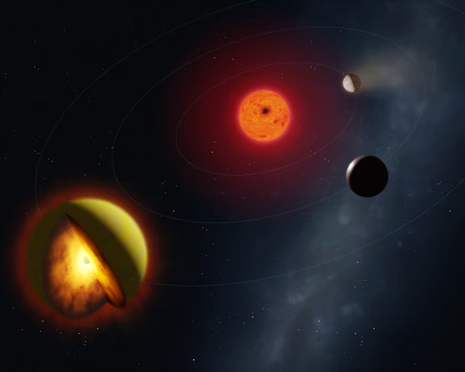
The vast expanse of our universe continues to challenge every traditional understanding of planetary formation and cosmic structure. Deep within the constellations of the southern sky, astronomers have recently uncovered a world that defies conventional scientific labels. This distant world, known as L98-59d, has provided the first tangible evidence for a liquid planet category. Rather than a solid rocky surface or a deep water ocean, this planet exists in a state of perpetual flux. It represents a breakthrough in our understanding of how planets evolve under extreme gravitational and thermal conditions. Scientists now believe that L98-59d is not merely a volcanic wasteland but a fully integrated molten sphere.
The initial discovery of this celestial body suggested a far more familiar environment to the research teams involved. Early observations led many to believe that the planet might harbour a deep and massive liquid water ocean. Such a feature would have placed it high on the list of potential candidates for extraterrestrial life. However, the latest data sets have painted a much more volatile and fascinating picture of the distant world. The planet is roughly one point six times the size of our own Earth. It orbits a small red dwarf star located approximately thirty-five light years away from our solar system. This proximity allows for detailed study that remains impossible for many other far-flung star systems today.

Dr Harrison Nicholls is an astrophysicist at the University of Oxford who has closely studied the new data. He describes the planet as being in a constant mushy and molten state across its entire surface. The consistency of the planetary material is frequently compared to thick molasses moving slowly under intense heat. This state is not limited to the surface crust but likely extends deep into the interior. Research suggests that even the core of this massive world remains in a liquid form. Such a discovery shifts the focus of planetary science toward a new classification of liquid planet types. This means the transition from crust to core is a gradient of heat rather than solid layers.
The environmental conditions on L98-59d are nothing short of hellish by any human or biological standard. Surface temperatures on the planet are estimated to reach a staggering nineteen hundred degrees Celsius at any time. These temperatures are high enough to melt almost any rock or mineral known to exist on Earth. Because of this heat, the entire globe is covered by a shifting and churning magma ocean. Large waves of molten rock are thought to roll across this sea with immense destructive power. These waves are caused by the tidal forces exerted by neighbouring planets in the same system. The gravitational tug of war keeps the interior of the planet constantly agitated and incredibly hot.
A human observer would find the atmosphere of this liquid planet to be equally hostile and strange. There is a pervasive and overwhelming stench of rotten eggs that hangs over the entire landscape. This smell is the result of an atmosphere that is incredibly rich in hydrogen sulphide gas. Such a chemical composition is a direct byproduct of the constant volcanic activity on the surface. While some might hope for life, Dr Nicholls remains very sceptical about any biological potential here. He notes that while aliens living in lava would be amazing, it is highly unlikely. Instead, scientists are choosing to marvel at the sheer alien nature of the environment itself.
For many years, our ability to study planets outside our solar system was limited by technological constraints. We could only make crude estimates based on the silhouettes of planets passing in front of stars. These methods gave us a rough idea of size and density but little else. The deployment of the James Webb Space Telescope has changed the landscape of astronomy forever. This powerful instrument can measure starlight as it filters through a distant planet’s thin atmosphere. By doing so, it provides a chemical readout of the gases that are present there. This allows scientists to determine the composition of a world without ever having to visit it.
In the case of L98-59d, these observations revealed a sulphur-rich atmosphere that puzzled the initial research teams. This chemical signature did not match the profile of a rocky world or a water world. For a planet to keep a sulphur atmosphere for five billion years, something must replenish it. Neither a solid crust nor a cold ocean could sustain such a volatile chemical balance over time. The only logical explanation was a constant source of outgassing from a deep, molten interior source. This led to the creation of advanced computer simulations to model the history of the world. These models confirmed that a liquid planet model was the only one that fit the data.
The simulation results suggest that the magma ocean on L98-59d extends thousands of kilometres deep into the planet. This vast reservoir of molten material acts as a storage system for various atmospheric gases. The magma protects these gases from physical processes that would usually strip them away into space. This efficient storage explains why the sulphur levels remain so high after billions of years of existence. It also suggests that this liquid planet might be far more common than we once believed. If other stars have similar tidal heating, many “rocky” planets might actually be molten spheres.

This realization has significant implications for our search for habitable worlds and the famous “Goldilocks zone.” Some planets that sit at the right distance from their star might still be completely uninhabitable. If tidal forces are strong enough, they can turn a temperate world into a molten furnace. This discovery serves as a reminder to be cautious when we label a new world as Earth-like. The diversity of worlds beyond our solar system is much wider than our previous models suggested. We are now entering an era where we must look for specific geological stability in our targets. A liquid planet can look very similar to a rocky one from a great distance.
Dr Jo Barstow, a planetary scientist at the Open University, has also been involved in these groundbreaking observations. She noted that the team had previously compared the planet to Jupiter’s moon, known as Io. Io is the most volcanically active body in our own solar system due to extreme tidal heating. However, the latest findings suggest that L98-59d is an even more extreme version of that environment. It is not just a world with many volcanoes but a world that is a single volcano. This makes it a primary example of how gravity can shape the physical state of matter.
The full details of this research have been published in the prestigious journal Nature Astronomy this month. The scientific community is now looking for other candidates that might fit into this new liquid category. By identifying the specific traits of a liquid planet, we can better filter our search for true alien life. Every new world we find provides a piece of the puzzle regarding our own place in space. While L98-59d may be a place of fire and stench, it is a beautiful example of cosmic variety. The search for knowledge continues as we look deeper into the dark reaches of our galaxy.
Related News:
 Virgin Trains Moves Closer to Challenging Eurostar Monopoly
 UK Bans Fake Numbers: Scammers Lose Their Trick
 Vibe coding’ named Collins dictionary’s word of the year
 Experts Urge Legal Right to Timely Cancer Care
 Patients to Test Health at Home to Ease NHS Winter Pressure
 One of world’s last dinosaurs on sale for £3m
 North Sea oil workers must lose weight or face job loss
 No link found between paracetamol in pregnancy and autism
 Britain deploys RAF specialists to assist Belgium with drone threats
 Government urges schools to ban phones to curb classroom disruption
 NHS frontline staff forced to cover gaps as managers remain scarce
 Stop using ChatGPT to write speeches, AI minister tells MPs
 Northern Lights may illuminate UK skies this week
 New laws to bolster UK’s defences against cyber attacks on NHS, transport and energy
 Hitler’s DNA Confirms He Truly Had Only One Testicle
 Working-Class Men with Prostate Cancer Left Behind by NHS
 Higgs Donates Nobel Medal to His Beloved University
 New AI tool could cut wasted efforts in organ transplants
 How Cultures Interpreted the Aurora Through History
 From War to Wales: Teen Innovator Eyes Net Zero Future
 From Baby Teeth to Bioengineering: The Future of Self-Healing Teeth
 Sundar Pichai Cautions on AI Hype and Market Risks
 Google Chief Urges Caution: Don’t Trust AI Blindly
 US Judge Says Meta Did Not Hold Illegal Social Media Monopoly
 Poll Reveals China Leads World in Trusting AI Technology
 Healthy Habits in Your 30s That Boost Life in Your 70s
 Raccoons Could Become America’s Next Pet
 Australia to Ban Social Media for Kids Under-16 Starting December
 Coffins Now Too Large to Cremate Amid Rising Obesity Crisis
 UK Taskforce Unveils Plan to Streamline Nuclear Reactor Rules
 NHS paediatric leave parents waiting months for answers
 Ofcom urges platforms to limit abuse and curb online ‘pile-ons’
 AI Actress Creator Says Tilly Norwood Won’t Replace Actors
 YouTube Warns Kids Will Be Less Safe Under Australia Ban
 Starmer’s communications chief to outline media strategy overhaul
 UK Car Sales Pass 2 Million as Chinese Brands Surge
 AI Grok Sparks Child Safety Alarm in the UK
 Indonesia blocks Grok chatbot over sexual content risk
 Google Removes Some AI Health Summaries Over Safety Concerns
 Nasa ISS Medical Evacuation: Crew-11 To Return Early
 US Clears Nvidia AI Chip Sales to China in Policy Shift
 Amazon Milton Keynes closure sparks concern for UK warehouse workforce
 BP’s Influence Sparks Controversy in UK STEM Education
 AI will transform human jobs, enhancing skills, says minister
 Astronomers Prepare for First-Ever Movie of a Black Hole
 MPs warn AI financial risks threaten UK stability
 MPs warn AI financial risks threaten UK stability
 EU launches Grok AI probe into X over explicit images
 ABC Facebook Page Briefly Hacked, Adult Photos Posted
 Pornhub blocks new UK users over age checks dispute
 Amazon mistakenly signals new global layoffs to employees
 Genes May Hold the Secret to Long Life, Scientists Find
 AI breast screening cuts later cancer diagnoses by 12%, study finds
 UK Launches First Rapid-Charging Battery Train This Weekend
 AI News “Nutrition” Labels Proposed for Transparency
 UK New Car Discounts Near £6,000 as Prices Are Slashed
 Most Statin Side-Effects Are Not Caused by Drugs, Study Confirms
 Childnet Censorship Row Over Teen Safety Speeches
 BT Names New Openreach Chief Amid Major Fibre Expansion
 AI fears hit UK wealth and comparison sites
 Tech Trends Set to Transform Life in 2026
 Starmer Targets AI Chatbots Over Child Safety Concerns
 UK Anti-Slavery Watchdog Urges Adult Sites Overhaul
 Toxic e-waste found in dolphins raises urgent health concerns
 How Ancient Scottish Rocks Challenge ‘Snowball Earth’ Theory
 Ayahuasca Psychedelic DMT Shows Potential as Depression Therapy
 Stewart Brand on Musk, Bezos and a Life of Long Thinking
 Facial Recognition Error Leads to Wrongful Arrest in Milton Keynes
 Social Media Trial: Woman Says Addiction Began at Six
 UK Social Media Ban for Under-16s Gains Momentum
 Met police to trial handheld facial recognition checks in London
 UK Teen Social Media Ban Trials Begin
 Zorevunersen Breakthrough for Dravet Syndrome
 Revealed: UK AI Push Faces Phantom Investment Claims
 Taking Multivitamins Daily Could Slightly Slow Ageing, Study Finds
 Ministers Urged to Act Faster on Deepfakes Threat
 MPs Reject Ban on Social Media for Under-16s
 Tesla Enters British Energy Market Following Ofgem Approval
 Social Media Giant Trial Reaches Final Jury Decision
 Cern Prepares First-Ever Antimatter Transport Test