Published: 09 April 2026. The English Chronicle Desk. The English Chronicle Online.
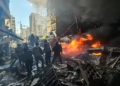
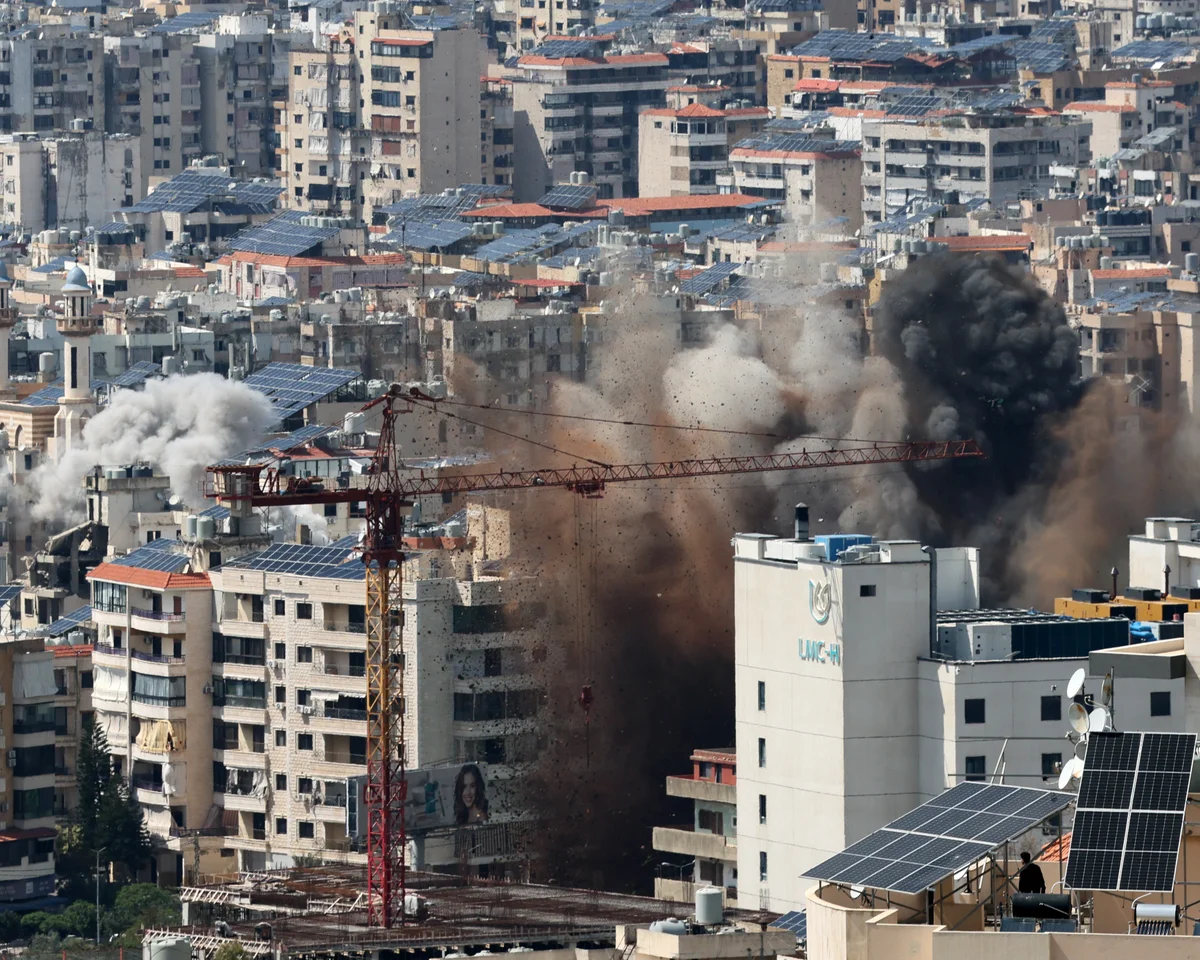
The fragile ceasefire recently established across the Middle East now faces an immediate threat of collapse. This diplomatic arrangement was meant to halt weeks of intense and devastating regional military conflict. However, the truce appears to be unraveling just hours after its official and public commencement. Divergent interpretations of the agreement have led to renewed violence and significant strategic blockades today. Israel has significantly intensified its bombing campaign across various regions within the sovereign borders of Lebanon. Meanwhile, Iran has reacted by halting the passage of vital international oil tankers through the area. This move follows an alleged breach of the ceasefire terms by the Israeli military forces today. The conflict had previously seen a brief moment of hope for a lasting regional peace. Iran and Pakistan both acted as primary brokers for this urgent and last-minute peace deal. Both nations asserted that the ceasefire terms explicitly included a cessation of hostilities in Lebanon.
Israeli Prime Minister Benjamin Netanyahu has openly disagreed with this specific interpretation of the deal. He insists that Lebanon remains a separate front from the primary conflict with the Iranian state. Consequently, Israeli forces unleashed their heaviest aerial attack of the entire war on Wednesday afternoon. These strikes targeted more than one hundred sites and resulted in at least two hundred deaths. Donald Trump initially remained silent regarding the sudden and violent escalation of the military campaign. He later stated that Lebanon was merely a separate skirmish and not part of negotiations. This stance has created deep confusion regarding the actual scope of the current international peace agreement. United Nations rights chief Volker Turk condemned the scale of these attacks as truly horrific today. He stated that such carnage within hours of a ceasefire agreement defies all rational belief. This violence places enormous pressure on a fragile peace desperately needed by the civilian population. Turk emphasized that the international community must act to prevent a total return to open war.

The political leadership in Tehran has responded with a series of very sharply worded public statements. Iran’s parliament speaker Mohammad Bagher Ghalibaf accused both Israel and the United States of clear violations. He specifically decried the aggressive bombing of Lebanon as a breach of the provisional ceasefire terms. Ghalibaf also criticized a US demand regarding Iran’s sovereign right to enrich its own uranium supply. He suggested that continuing bilateral negotiations under such aggressive conditions was becoming entirely unreasonable and futile. While the statement did not officially reject the ceasefire, it highlighted the immense and growing strain. These tensions emerged less than twenty-four hours after the official announcement of the peace agreement terms. The Fars news agency reported that oil tankers are once again being stopped by Iranian forces. This blockade in the Strait of Hormuz is a direct response to the Israeli military actions. Iran was expected to reopen this vital maritime passage during the two-week duration of the truce.
Global markets had reacted positively to the news of a potential end to the regional war. Oil prices had dropped sharply below one hundred dollars per barrel following the initial peace announcement. This shift prompted a significant surge in stock markets across New York, London, and Tokyo today. However, the news of renewed blockades has brought no immediate relief to the global shipping industry. Hundreds of laden tankers remain trapped in the Gulf while awaiting clearance from their marine insurers. These vessels also reported continued and deliberate interference with their critical satellite navigation and tracking systems. The White House has called the reports of the strait’s closure false and entirely misleading today. Trump stated he expects the waterway to reopen immediately, quickly, and safely for all global commerce. The United States continues to signal hope for the ceasefire despite the clear signs of unraveling. Vice President JD Vance attributed the differing views on Lebanon to a legitimate and simple misunderstanding.
Vance claimed the Iranians mistakenly believed the ceasefire terms covered their allies within the Lebanese borders. He clarified that the United States never made such a promise during the intense negotiation process. Israel had offered to check their actions slightly to assist the progress of the American negotiations. However, the Israeli government refused to include Lebanon in any formal and binding ceasefire document today. Within Israel, opposition politicians have launched a series of fierce criticisms against the current Prime Minister. Yair Lapid accused Netanyahu of failing to deliver the conclusive victory he had previously promised them. Lapid described the current situation as a diplomatic disaster that has eroded trust with the US. Netanyahu responded by stating that military objectives still remain and will be achieved by any means. He suggested that fighting would resume if a favorable and final agreement is not soon reached. This rhetoric has further heightened fears that the regional war is far from a conclusion.
Marine traffic has continued at a mere trickle through the vital and strategic Strait of Hormuz. Only five vessels were confirmed to have successfully crossed the waterway during the day on Wednesday. Four of these ships were Iranian and were traveling into the Gulf from the eastern side. The fifth vessel was a Greek-owned tanker attempting to navigate the increasingly dangerous and contested waters. Experts at AXSMarine suggested it is unlikely that shipping will resume at a normal pace soon. They noted that Iran still requires all passage to be approved by its own armed forces. This condition means the strait is not functioning as an open and free international waterway today. Furthermore, the United Arab Emirates claimed to have intercepted dozens of incoming missiles and drones today. These weapons were apparently fired by Iranian forces despite the official announcement of the peace deal. Iran also reportedly attacked a Saudi oil pipeline located near the coast of the Red Sea.
The Islamic Revolutionary Guard Corps claimed they struck several high-value targets across the broader Middle Eastern region. They alleged these targets included oil facilities owned by American companies in the port of Yanbu. These claims suggest that the conflict is expanding geographically even as diplomats discuss a potential truce. Donald Trump has provided a different version of the agreement in various social media posts today. His initial statements referred to an Iranian proposal as a workable basis for further peace talks. This caused significant surprise in Washington as the proposal differs widely from core American foreign objectives. The Iranian plan includes the right to enrich uranium and the full lifting of sanctions. It also demands the payment of war reparations and joint control over the Strait of Hormuz. White House Press Secretary Karoline Leavitt later clarified that this plan was considered fundamentally unserious. She stated that President Trump would never accept an Iranian wishlist as a final peace deal.
By Wednesday morning, Trump implied the ceasefire was based on a different fifteen-point American peace proposal. He insisted there would be no enrichment of uranium allowed under any future diplomatic agreement. The President also claimed the US would work to unearth Iran’s stockpile of enriched uranium. He referred to this material as nuclear dust and claimed it was enough for many warheads. A US negotiating team led by Vance and Jared Kushner will travel to Pakistan this weekend. They are scheduled to begin formal talks with an Iranian delegation starting on Saturday morning. These meetings are seen as a final attempt to stabilize the region before total war resumes. Iran has published two different versions of its own interpretation of the initial peace agreement. The Farsi version included a right to enrich uranium while the English version omitted this point. This discrepancy has led to further accusations of bad faith from both sides of the conflict.

The Iranian Foreign Minister confirmed that the strait would technically reopen during the two-week ceasefire period. However, he maintained that all shipping must still coordinate directly with the Iranian military for passage. Iran began charging tankers a two-million-dollar toll after the initial attacks occurred in late February. Tehran intends to keep this toll in place and share the revenue with the neighboring nation. Pakistan is still expecting to host talks on Friday to turn the truce into peace. However, the White House has not yet confirmed their attendance at this specific high-level regional meeting. The gaps between the two sides appear to be as broad and deep as ever. These divisions are wider than they were during the previous failed negotiations held in Geneva recently. At the Pentagon, the US Defense Secretary suggested that military force remains a very viable option. Pete Hegseth stated that US forces would take out the uranium stockpile if necessary today.
Any mission to destroy the buried uranium would be exceptionally long, complicated, and very risky. Trump previously opted not to pursue such a mission during the five weeks of active conflict. He had claimed he could monitor the situation remotely using advanced satellite technology and intelligence tools. General Dan Caine stated that the joint force remains ready if called upon for combat. He described the current ceasefire as merely a temporary pause in a much larger military campaign. Caine noted that the US air campaign has already achieved many of its primary military objectives. Over thirteen thousand targets were struck, destroying most of the Iranian navy and their naval mines. Hegseth claimed the US and Israel had finished destroying the Iranian industrial base during the night. He listed several high-ranking Iranian leaders who were reportedly killed or wounded during the recent fighting. These claims are intended to project a sense of total military dominance over the Iranian state.
The government in Tehran has portrayed the truce in equally triumphalist terms to its own domestic population. Senior advisers claimed that America was forced to accept a ceasefire due to Iranian military strength. They suggested that Iran will now play a central role as the axis of power. This conflicting rhetoric makes a long-term diplomatic solution seem increasingly difficult for the international community. Trump has also expressed anger toward Western allies who refused to support his war efforts recently. He is reportedly considering the possibility of the United States leaving the Nato alliance very soon. The President is scheduled to discuss this potential withdrawal with the Nato Secretary General today. Mark Rutte told reporters that some nations were tested and failed during this intense global crisis. However, he noted that many European nations provided vital logistical support and basing during the war. The world now watches as the Middle East teeters between a fragile peace and escalation.
Related News:
 Ukraine war briefing: Zelenskyy offers help to Saudi Crown prince on combatting Iranian drones
 Ukraine Sends Drone Experts to Defend US Bases in Jordan
 Saudi Arabia Urging US to Keep Up Iran Attacks
 Diplomacy on the Brink: Pakistan’s Risky Peace Mission
 Trump Slams Europe as Transatlantic Tensions Boil Over
 High-Value Target: Iranian Strike Destroys US Radar Plane
 UN Warns Israeli Death Penalty Bill Could Be a War Crime
 Pakistan and China Propose Five-Part Peace Plan
 Trump Issues Stark Warning After Strike On Iran’s Largest Bridge
 Hope and Fear as Iranians Flee Across the Turkish Border
 The Price of Hubris: Trump, Netanyahu, and the ‘Easy’ War
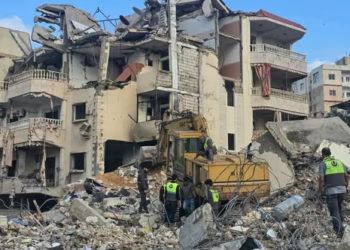 Israel Defies Ceasefire as Lebanon Operations Persist
 Capitol Attack Anniversary Sparks Deep Political Divide
 Saudi Officials Report Zubaidi Flee Before Yemen Peace Talks
 UK Targets in New York Bomb Threat Hoax: Man Jailed
 Gambia Supreme Court Hears Case to Overturn FGM Ban
 Trump targets Iran trade with 25% tariff warning
 Rudd successor: Defence chief and former ministers considered
 US Senate rejects resolution limiting Trump military powers
 Venezuela regime claims release of political prisoners signals new era
 Gulf states warn Trump Iran strikes risk wider Middle East war
 Machado Trump medal gesture reshapes Venezuela power struggle
 Greenland defence seen as shared Nato duty amid troop arrivals
 Geopolitical football: Iran, Trump and the World Cup clash
 Canada-China trade gains momentum in new strategic partnership
 Trump Receives Machado’s Nobel Medal in White House Meeting
 Syria President Declares Victory as Ceasefire Reached with SDF
 US Considers Asylum for British Jews Amid Rising Antisemitism
 Trump slams UK ‘stupidity’ over Chagos Islands, eyes Greenland takeover
 Trump Tightens Grip on EU and UK Energy Supply
 Shinzo Abe’s killer receives life sentence in Japan
 China General Under Investigation Amid Leadership Purge
 Philippines ferry disaster leaves 15 dead, dozens missing
 Cambridge Faces Scrutiny Over Arms Investment Transparency
 Epstein UAE Emails Shake British Royal Andrew’s Legacy
 Christchurch gunman seeks to vacate guilty plea
 Liberal Fallout: Taylor Challenge Casts Shadow Over Sussan Ley’s Leadership
 Infantino Faces Russia Threat and Trump Concerns at Uefa Congress
 Concerns rise for Canberra boy amid Iran detention fears
 Iran Says ‘Guiding Principles’ Agreed With US at Nuclear Talks
 Caribbean Leaders Urge Dialogue Amid US Oil Embargo on Cuba
 Months of Planning Behind US‑Israeli Mission to Target Iran’s Supreme Leader
 US Iran Operation: Sixth Service Member Killed
 Hezbollah Anger Erupts as War Returns to Beirut
 Middle East attacks intensify as Trump rejects Iran talks
 Iran-Iraq border airstrikes spark new tensions
 Thousands Protest Iran Strikes Outside US Embassy London
 US Bombers Arrive at RAF Base Amid Rising Iran Tensions
 UK Prepares Aircraft Carrier for Middle East Crisis
 New Zealand Covid Response Praised Despite Lingering Scars
 Abramovich Chelsea Sale Cash Faces Jersey Probe
 Yvette Cooper: UK Must Follow Principles, Not US Pressure
 Trump Iran War Stance Hardens as Conflict Widens
 US Strike on IRIS Dena Strains Strategic Indian Security Ties
 Kabul hospital strike sparks deadly blame row
 Slovenia Election: A Nation at a Crossroads
 Ghalibaf Iran: Survivor Emerges in Shifting Power Game
 Jury Rules Meta and YouTube Liable for Addictive Design
 Gulf Distrust Grows Over Rumoured US-Iran Peace Talks
 WHO Warns of Health Crisis Unfolding in Middle East
 Trump Softens Cuba Oil Stance as Russian Tanker Nears
 The Woman Guarding Earth From the Threat of Asteroids
 Trump Threatens Iran With Total Infrastructure Destruction
 IMF Predicts Global Economic Crisis Due to Gulf Unrest
 California Defies Trump With Strict New AI Standards
 Germany Grapples With AI Abuse Following TV Star Scandal
 Exiled Tycoon Warns of New Russian Attacks on UK Soil
 Labor Under Fire Over Stalled University Fee Reform
 LA 2028: Millions of Affordable Olympic Tickets Announced
 Inside the Deceptive Machine: A Former Producer Speaks Out
 Italy Faces Third Successive World Cup Absence After Loss
 Starmer Urges Ambitious EU Ties Amid Middle East Conflict
 Spain Faces Backlash Over Xenophobic Chants in Egypt Draw
 A Global Voice For Justice: Stephen Lewis Dies At Age 88
 Tragic End to Outback Search as Floods Claim a Life
 Ben Roberts-Smith Arrested Over Alleged War Crimes
 Reform UK Pledges To Halt Visas Over Reparations Demands
 US and Iran Agree to Two-Week Provisional Ceasefire
 Starmer visits Gulf as US and Iran agree ceasefire
 Gaza Child Arrives in UK for Life-Changing Care