Published: 19 April 2026. The English Chronicle Desk. The English Chronicle Online
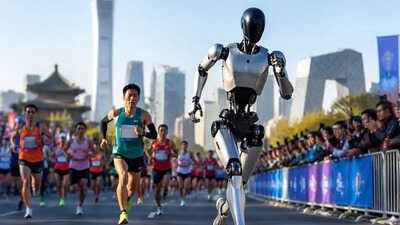
In a striking display of technological progress, humanoid robots have taken centre stage at the Beijing Half Marathon, where more than 100 machines competed alongside human runners in a parallel race that highlighted China’s rapidly advancing robotics industry.
The event, held on Sunday in the Chinese capital, showcased a dramatic leap in performance compared to the previous year’s edition, when many robots struggled to even start the race and most failed to complete the course. This time, however, the field of humanoid runners demonstrated significantly improved stability, coordination, and endurance, marking what experts describe as a turning point in embodied artificial intelligence.
The winning robot, developed by smartphone giant Honor, completed the half-marathon in 50 minutes and 26 seconds. Although this time was still significantly slower than elite human runners, it was faster than several professional human competitors in the parallel race and dramatically ahead of competing machines. Organisers noted that the robot’s performance, despite a minor stumble near the finish line, represented a major technical milestone in locomotion control and real-world endurance.

By contrast, the human men’s winner of the conventional half-marathon finished in just over one hour, while global elite long-distance runners remain far ahead of robotic counterparts in efficiency and endurance over extended distances. The comparison with world-class athletes, including Ugandan distance runner Jacob Kiplimo, underscored both the ambition and current limitations of humanoid robotics in endurance sports.
The Beijing event featured more than 100 humanoid robots, a significant increase from approximately 20 participants in the previous edition. Organisers implemented dual-track systems, allowing robots and humans to run side-by-side without interference. This separation was designed to prevent collisions and ensure safety, as earlier prototypes had shown instability in crowded environments.
Unlike last year, when several robots fell at the starting line or were unable to maintain balance over short distances, this year’s competitors demonstrated smoother gait cycles, improved battery management, and better terrain adaptation. Engineers credited advancements in sensor fusion, joint actuation systems, and AI-driven motion planning as key contributors to the progress.
One of the most closely watched machines was a humanoid unit developed by Unitree Robotics, which narrowly missed the top position but still completed the course with consistent pacing. Several models incorporated real-time adjustment systems that allowed them to respond to minor changes in surface friction and elevation, an important step toward real-world deployment beyond controlled environments.
Despite the technological achievements, the race also exposed ongoing challenges. The winning robot, although fast, required assistance after colliding with a barrier just metres before the finish line. Engineers quickly intervened to stabilise the machine, highlighting that while speed and endurance have improved, spatial awareness and last-stage control still require refinement.
The event is part of a broader national strategy in China to position itself as a global leader in advanced robotics and artificial intelligence. Government-backed initiatives have accelerated research funding, industrial subsidies, and public-private partnerships aimed at strengthening domestic innovation ecosystems. The humanoid robotics sector, in particular, has been identified as a priority industry with potential applications ranging from manufacturing and logistics to healthcare and defence.
China’s ambitions in this field have been visible beyond scientific laboratories. Earlier this year, the widely viewed CCTV Spring Festival Gala featured a high-profile performance by humanoid robots, including choreographed martial arts routines. Developed by Unitree and other firms, the robots performed synchronized movements using props such as swords and poles, demonstrating improved balance and dexterity in dynamic, human-like environments.
Experts observing the Beijing half-marathon say the progress reflects a shift from laboratory prototypes to real-world testing platforms. Unlike controlled factory conditions, endurance events require continuous adaptation, energy efficiency, and mechanical resilience over long periods. These conditions provide valuable data for developers working to refine next-generation humanoid systems.
However, researchers caution that despite rapid improvements, humanoid robots remain far from matching human athletic capability. Human runners benefit from highly efficient biomechanics, adaptive thermoregulation, and cognitive pacing strategies that robots cannot yet replicate. Even the most advanced machines in the race required frequent calibration and pre-programmed pacing adjustments.
Still, the symbolic significance of robots running a half-marathon alongside humans was not lost on observers. It demonstrated not only technological ambition but also the shifting relationship between humans and machines in public spaces. Where robots were once confined to factory floors, they are increasingly being tested in dynamic, unpredictable environments that mirror real-world conditions.
Industry analysts suggest that the implications of such developments extend far beyond sport. Humanoid robots capable of sustained movement and environmental awareness could eventually be deployed in disaster response, construction, elderly care, and hazardous industrial work. The ability to navigate long distances autonomously is seen as a foundational requirement for many of these applications.

Despite the optimism, questions remain about safety, regulation, and ethical deployment. As robots become more capable of interacting in shared human environments, policymakers will need to address issues related to accountability, reliability, and operational boundaries.
For now, the Beijing half-marathon stands as a vivid illustration of how quickly the field is evolving. What was once experimental spectacle has become a serious demonstration of engineering progress, with machines now capable of completing endurance events at speeds that would have seemed impossible only a few years ago.
As spectators watched humanoid runners cross the finish line—some steady, others requiring assistance—the message was clear: robotics is no longer just about imitation of human movement, but about redefining what machines can physically achieve in the real world.
Related News:
 The Influencer World Cup: Fifa’s TikTok Bet on a New Fan Era
 Brady Tkachuk Denies AI Video Claims After Olympic Gold
 Artemis II Returns After Historic Moon Flyby
 Gene Therapy Wins Major Prize for Restoring Vision
 Reform UK funding: mystery billionaire revealed
 Disneyland Adds Facial Recognition at Entrances
 Meta Faces EU Action Over Child Safety Breach
 Inside the World of AI Jailbreakers
 Disney+ Wins Champions League Rights in Key Markets
 North Korean Women’s Football Club to Visit Seoul in Rare Cross-Border Trip
 Canadian Fiddler Sues Google Over AI Defamation Claim
 Doomsday Clock Nears Midnight Amid Global Crises
 China mine blast death toll rises to 90
 UK firms accused of ‘AI washing’ boom
 Study Launches Into Brain Injury Risks in Women’s Rugby
 British Paralympian to Become First Disabled Astronaut in Orbit
 Unlocking the Genome: The Quest to Sequence Tardigrades
 Meta Drops AI Image Tool After Privacy Backlash
 BBC Shifts to Atlanta for England World Cup Semi-Final
 Gen Z turns to BirdTok for a gentler digital escape
 Virgin Trains Moves Closer to Challenging Eurostar Monopoly
 UK Bans Fake Numbers: Scammers Lose Their Trick
 Vibe coding’ named Collins dictionary’s word of the year
 Patients to Test Health at Home to Ease NHS Winter Pressure
 Britain deploys RAF specialists to assist Belgium with drone threats
 Northern Lights may illuminate UK skies this week
 UK and Ireland Announce Venues for Euro 2028 Tournament
 Saka Solidifies Role as Tuchel’s Key England Lieutenant
 Sundar Pichai Cautions on AI Hype and Market Risks
 Tiny Curacao Makes History as Smallest Nation to Reach World Cup
 Australia Face Big Changes as Cummins and Lyon Ruled Out of Ashes
 Aston Villa Remain Arsenal’s Key Obstacle in Title Pursuit
 Google Removes Some AI Health Summaries Over Safety Concerns
 EU launches Grok AI probe into X over explicit images
 ABC Facebook Page Briefly Hacked, Adult Photos Posted
 Chelsea warn fans of danger in Naples after hospital incidents
 Liverpool Chase Champions Glory With Stunning Qarabag Victory
 Meta trial over child exploitation claims begins
 Ben Stokes injury joke after brutal ball strike
 Wrestler at 60: A Powerful New Start in the Ring
 BT Names New Openreach Chief Amid Major Fibre Expansion
 Tech Trends Set to Transform Life in 2026
 BBC World Cup Presenting Duties Shared Among Trio
 Craig Tiley Leaves Australian Open Legacy
 Ocean Warming Drives Massive Marine Life Loss, Study Warns
 Stewart Brand on Musk, Bezos and a Life of Long Thinking
 English Cricket Faces Moral Crisis Over Indian Investment
 Hudson-Odoi Sends Nottingham Forest Into Europa Last 16
 World Cup Drinks Breaks Could Bring ITV Ad Debate
 Spurs Coach Defends Early Kinsky Substitution at Atlético
 The Kill Line: A Shifting Vision of the American Dream
 ‘Drinking from a Fetid Pond’: Superbug Genes in Lough Neagh
 Teenage Titan: Sooryavanshi Smashes IPL Records
 Sam Konstas Dropped as Australia Unveils New Contract List
 The Wildest Plastico: Leverkusen and Wolfsburg Thriller
 UK Banks to Deploy Controversial Mythos AI Tool Next Week
 UK Faces Growing Threat of Scale Hacktivist Attacks
 Ashley Cole: Finding His Voice and Vision in Italy
 WHO approves first malaria drug for babies
 FIFA Confirms Global Ban for Benfica Star Prestianni
 US Awaits Iran Reply on New Ceasefire Proposal
 Court Upholds Landmark Win for Transgender Rights
 Bracing for the Cherries: Guardiola Likens Vital Bournemouth Trip to the Dentist
 The Battle for Wembley Sparking Unprecedented Legal Warfare
 Discontent grows around Putin amid war strain
 Is Ollie Robinson the Chaos English Cricket Needs Today?
 Saka Playing Through Pain As England World Cup Campaign Looms
 Stolen Mobiles Could Soon Become Useless Bricks
 UK Ministers Lobby Trump Over Under-16s Social Media Ban
 Women’s T20 World Cup Breaks Records But Gaps Remain
 Martinelli Strikes Late as Brazil Edge Past Brave Japan
 France Dominate Sweden as Deschamps’ New Era Takes Shape
 US Advance Past Bosnia in World Cup Thriller
 Sydney Records Hottest June Since 1859 as Expert Warns New High a ‘Signature’ of Global Warming
 Trump’s Red-Card Intervention Hurts the US World Cup
 USA World Cup Heartbreak: Belgium Ends Their Dream
 Telstra Software Fault Triggers Massive Nationwide Outage
 Mbappé Brilliance Leads France Into Semi-Finals
 Spain’s Superstar Fan: Keyne Yamal Steals the Spotlight
 Houthis Strike Saudi Arabia as Middle East Tensions Rise