Published: 18 September ‘2025. The English Chronicle Desk
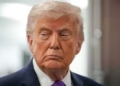
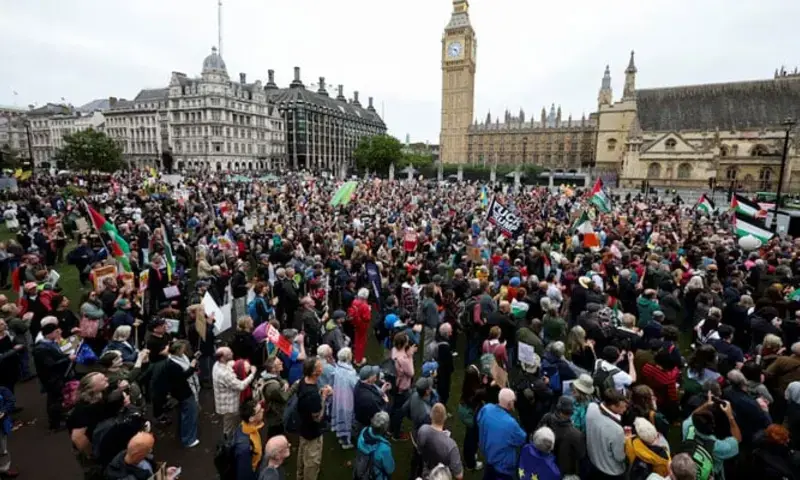
Thousands of demonstrators convened in central London on Wednesday to protest the arrival of US President Donald Trump for his second state visit to the United Kingdom. The rally, organized by the Stop Trump Coalition—a coalition of more than 50 unions, charities, and campaign groups—began in Portland Place and proceeded through Whitehall before concluding in Parliament Square. Organizers and participants voiced a wide array of grievances, including opposition to Trump’s policies on climate change, human rights, and international diplomacy.
The protest attracted significant attention, with the Metropolitan Police estimating attendance at approximately 5,000 people. In total, over 1,600 officers were deployed to monitor the demonstrations, including 500 personnel drawn from other forces. The police emphasized that they had been in close communication with the organizers to ensure that the protest remained peaceful and that disruption to the local community was minimized. Deputy Assistant Commissioner Louise Puddefoot noted that it would be “another busy day” for officers, following closely on the heels of other recent demonstrations such as the Unite the Kingdom protest.

Participants carried banners bearing slogans such as “No to Racism,” “No to Trump,” and “Stop Arming Israel.” Others brought replicas of the 20-foot Trump Baby blimp, which had become a symbol of public dissent during the president’s first state visit in 2019. The symbolic blimps floated above the crowd, drawing attention and media coverage while evoking the tone of earlier protests.
A spokesperson for the Stop Trump Coalition stated: “A government that will bow down to Trump and to racism is one that will open the door to fascism.” Organizers clarified that while Trump was not visiting Parliament, the demonstration aimed to oppose “the politics of Trumpism” and to advocate for “an alternative, democratic vision of the world based on peace, social justice, and international cooperation.” The coalition comprises a diverse group of campaigners, ranging from climate activists and anti-racism advocates to pro-Palestine organizations, reflecting widespread opposition to the president’s policies across different social and political spheres.
As crowds gathered near BBC Broadcasting House, attendees spoke candidly about their reasons for protesting. Many expressed strong personal opposition to Trump’s policies and rhetoric, describing him as “despicable” and asserting that his visit should not go unchallenged. Reverend Poppy Hughes, when asked about the role of religious figures in political protests, remarked: “Jesus preached peace and compassion, and that’s why I’m here. Standing for justice is not separate from faith.”
Political commentator Zoe Gardner, one of the rally’s organizers, stated: “Trump represents everything that we hate. We want our government to show some backbone, to reflect the widespread disgust at his politics and demonstrate that the UK is not complacent in the face of authoritarian tendencies abroad.”
Climate activism was also a significant focus at the protest. Auriel Dowty Glanville, a campaigner from Wimbledon, criticized Trump’s environmental record, describing him as a “climate denier” whose policies posed “the biggest threat facing us on Earth.” She labeled the invitation for a second state visit “appalling,” contending that it was primarily motivated by trade negotiations rather than diplomatic goodwill.
Several demonstrators employed humor and theatricality to make their point. Sarah Montgomery and Claudio Solano, from North London, donned white face masks with the phrase “Trump stinks,” which they had first worn during the president’s previous visit. “He still stinks,” said Montgomery, adding that everything Trump represented was antithetical to her values. Solano, a Brazilian national, criticized both Trump and his support for former Brazilian president Jair Bolsonaro, describing the political alignment as “disgusting” and questioning why the UK government appeared “so cowardly” in extending the state visit invitation.
As the march progressed, demonstrators paused outside Downing Street, which was under heightened security provided by officers from Wales and Northern Ireland. Signs bearing slogans such as “Duck Off Donald” and “Feed Him to the Corgis” were prominently displayed, reflecting a blend of satire and political critique.
The procession culminated at Parliament Square, where several speakers addressed the crowd. Performances and speeches were part of the program, including a set by singer-songwriter Billy Bragg. Political figures joining the stage included former Labour leader Jeremy Corbyn, current Labour MP Zarah Sultana, comedian Nish Kumar, and Green Party leader Zack Polanski. The speakers highlighted various grievances with Trump’s domestic and international policies, linking his state visit to broader concerns about democracy, climate change, and social justice.
Simultaneously, a smaller contingent of protesters gathered in Windsor, where President Trump was scheduled to spend the day with members of the Royal Family ahead of a formal state banquet. Amy Tisi, attending the Windsor demonstration, described it as “important to make a stand,” emphasizing continuity with protests staged during the president’s first visit. Tisi questioned whether the scale of the trip was intended to “fuel his ego,” reflecting a sentiment shared by several attendees.
Tensions were briefly heightened earlier in the day when a van adorned with photographs of Trump and the late convicted financier Jeffrey Epstein was driven through Berkshire. Thames Valley Police confirmed that the vehicle left the area after officers spoke with the driver, and no arrests or seizures occurred. Jeremy Corbyn referred to this incident during his speech in London, describing it as “sinister” that authorities had intervened to prevent public expression of opinion. “They take away the right to protest because they don’t want us to protest,” he said, underscoring concerns about the restriction of civic dissent.

The state visit itself has been contentious from the outset. Four men were arrested after images of Trump and Epstein were projected onto Windsor Castle on Tuesday evening as the president arrived in the UK, reflecting both the intensity of opposition and the high-security measures surrounding the visit. The protests in London and Windsor demonstrated the broad coalition of activists, political figures, and concerned citizens united in opposition to what they perceive as a problematic and provocative visit.
Despite the scale of opposition, the demonstrations remained largely peaceful. Organizers and authorities worked together to maintain order, and the protest highlighted a persistent public discourse around the appropriateness of Trump’s engagement with the UK government. For many participants, the rally was an opportunity to voice concerns about global political trends, climate inaction, and human rights, while advocating for a society that prioritizes justice, equality, and accountability over personal or political expediency.
The events of 18 September represent a continuation of a tradition of civic protest in the UK, showcasing the capacity of citizens and organized coalitions to publicly challenge political leaders and influence the discourse surrounding international relations. As Trump’s second state visit proceeds, both supporters and opponents continue to navigate a highly polarized environment, reflecting broader tensions in contemporary global politics.
Related News:
 UK Must Act with Courage and Clarity on Israel-Palestine Conflict, Says Foreign Affairs Committee Report
 Starmer and Trump to Meet in Scotland Amid Growing Gaza Ceasefire Pressure
 Minister Dismisses Legal Concerns Over UK’s Pledge to Recognise Palestinian State
 MPs Call on UK Government to Delay Biometric Visa Checks for Gaza Students Amid Humanitarian Crisis
 Radioactive Leak at UK’s Nuclear Warhead Base Sparks Outcry Over Safety and Secrecy
 ‘I’m collateral damage’: ex-minister Tulip Siddiq on her Bangladesh corruption trial
 Mutual Inconvenience: Why Alaska Was Chosen for the Trump-Putin Summit on Ukraine
 “I Don’t Expect to Live a Normal Life”: How a Leeds Teenager Became the Target of a Chinese Bounty
 Ministers Accused of Defamation Over Palestine Action Ban and Mass Arrests
 UK Defence Secretary Says Allied Troops ‘Ready to Act from Day One’ if Ukraine Ceasefire Agreed
 Is the UK Ready to Put Boots on the Ground in Ukraine? Assessing Military Capacity and Challenges
 Protests Expected as Israeli Arms Firms Join Global Defence Trade Fair in London
 UK Home Office to Launch French Beach Signage to Warn Asylum Seekers of Risks
 Charlie Kirk Killing Used to Mobilise UK’s Largest Far-Right Rally in Decades
 UK Immigration Figures: Separating Facts from Perceptions
 Far-Right Rally in London Draws Record Crowds Amid Clashes with Police
 UK and Ireland Set to Unveil New Proposals to Address Northern Ireland’s Troubles Legacy
 Trump Urges UK to “Call Out the Military” to Secure Borders Amid State Visit
Tulip Siddiq Raises Concerns Over Alleged ‘Fake’ Documents in Bangladesh Corruption Trial
Trump Urges UK to “Call Out the Military” to Secure Borders Amid State Visit
Tulip Siddiq Raises Concerns Over Alleged ‘Fake’ Documents in Bangladesh Corruption Trial
 UK Recognises State of Palestine in Push to Preserve Hope for Peace
 UK’s Recognition of Palestine: Symbolic Step or Real Change?
Trump’s UN Speech Criticises London and UK Policies, Draws Far-Right Attention
UK’s Recognition of Palestine: Symbolic Step or Real Change?
Trump’s UN Speech Criticises London and UK Policies, Draws Far-Right Attention
 UK Fighter Jet Purchase Could Breach Nuclear Treaty, Warns CND
 A Third of EU Citizens in UK Report Discrimination by Public Bodies Post-Brexit
 Jailed Georgian Opposition Leaders Warn UK of Iranian Links to Ruling Party
 Russia repeatedly targets UK military satellites, warns Space Command chief
 Pro-Palestine March to Proceed in London Despite Calls to Cancel After Manchester Attack
 UK Universities Warn Students Ahead of 7 October Pro-Palestine Protests
Starmer Considers Stricter Measures on Pro-Palestinian Protest Chants
UK Universities Warn Students Ahead of 7 October Pro-Palestine Protests
Starmer Considers Stricter Measures on Pro-Palestinian Protest Chants
 Public Trust in SNP Hits Historic Low Amid NHS Concerns
 Tony Blair Met Jeffrey Epstein at Downing Street in 2002
 China’s Mega Embassy in London Faces Further Delay
 Johnson Suggests Mandelson Linked to China Spy Controversy
 Minister Blames Deputy for Collapse of China Spy Case
 Shabana Mahmood Warns Border Failings Are Eroding Trust in States
 Witness statements reveal the CPS China spy row collapse in the UK
 Large scale Chinese spying in UK sparks political storm
 Nigel Farage Calls Vladimir Putin ‘A Very Bad Dude’
 Rachel Reeves signals welfare reform ahead of key budget
 Prince Andrew met alleged Chinese spies during Pitch@Palace China trips
 Kosovo agrees to host Britain’s refused asylum seekers
 Plaid Cymru Triumphs in Caerphilly, Ending Labour Century-Long Hold
 Rachel Reeves to lead UK trade push in Saudi Arabia amid rights debate
 British Woman in Iran ‘Losing Hope’ Amid Ongoing Detention
 Johnson Approved China’s London ‘Super-Embassy’ in 2018
 BBC Journalist Held and Interrogated in Vietnam
 Zohran Mamdani becomes New York City’s first Muslim mayor
Zohran Mamdani names all-female transition team for NYC mayoralty
Zohran Mamdani becomes New York City’s first Muslim mayor
Zohran Mamdani names all-female transition team for NYC mayoralty
 Second world war veterans honoured as King leads Remembrance Sunday
 BBC director-general and news chief resign amid bias row
 New review urges UK to repatriate Shamima Begum, others from Syria
 Rama Rebukes Mahmood for Targeting Albanian Families
 Russian Vessel Used Lasers on RAF Pilots, UK Claims
 Ireland Boosts Ukraine Aid as Zelensky Visits Dublin
 Terence Stamp, ’60s British Film Legend and Star of Superman, Dies at 87
 Hong Kong Summons UK and Australian Envoys Following Asylum Grants to Democracy Activists
 Police Scotland Spends £500,000 Compensating Officers Over Trump Visit
 Urgent Action Needed on Windrush Compensation as Survivors Speak of “Waiting to Die”
 Tanni Grey-Thompson Faces Abuse Over Opposition to Assisted Dying Bill
 TfL Invites RMT to Resume Talks as London Tube Strikes End
 Zarah Sultana Seeks Legal Action After Bitter Clash with Jeremy Corbyn Over Party Membership Funds
 Top Andy Burnham Ally Launches Fierce Critique of Starmer Ahead of Labour Conference
 Mahmood Pledges Reform of Modern Slavery Laws After Court Blocks Deportation Appeal
 Ed Miliband Urges Labour to Confront Billionaire-Backed Opposition to Net Zero Goals
 Digital ID Plans Ignite Debate Over £600m Treasury Tax Boost and Privacy Concerns
 Yvette Cooper Backs Digital ID Plan for UK Teens
 Ministry of Justice fails to file £11bn in spending receipts
 Reform UK candidate fined £19,000 after using AI-generated cases to challenge election
 William Steps Up Over Prince Andrew Palace Response
 Ireland Votes as Two Women Compete for Presidency
 Experts Warn Russia’s Burevestnik Missile Could Destabilise Arms Control
 Green Party Surges Past Labour in Latest UK Poll
 Zarah Sultana Launches Party to Change Politics
 Just Stop Oil Protesters Convicted Amid Climate Defence Row
 Starmer Faces Growing Dissent as Labour MPs Weigh Leadership Challenge
 Peers Flood Assisted Dying Bill with 942 Amendments
 Trump Deploys DHS to Charlotte in Major Arrest Operation
 Pentagon Officials in Ukraine to Discuss War End
 Venezuela Threatens Nobel Winner Machado with Fugitive Status
 Most Tories Expect to Support a Farage-Led Government