Published: 12 November 2025. The English Chronicle Desk. The English Chronicle Online
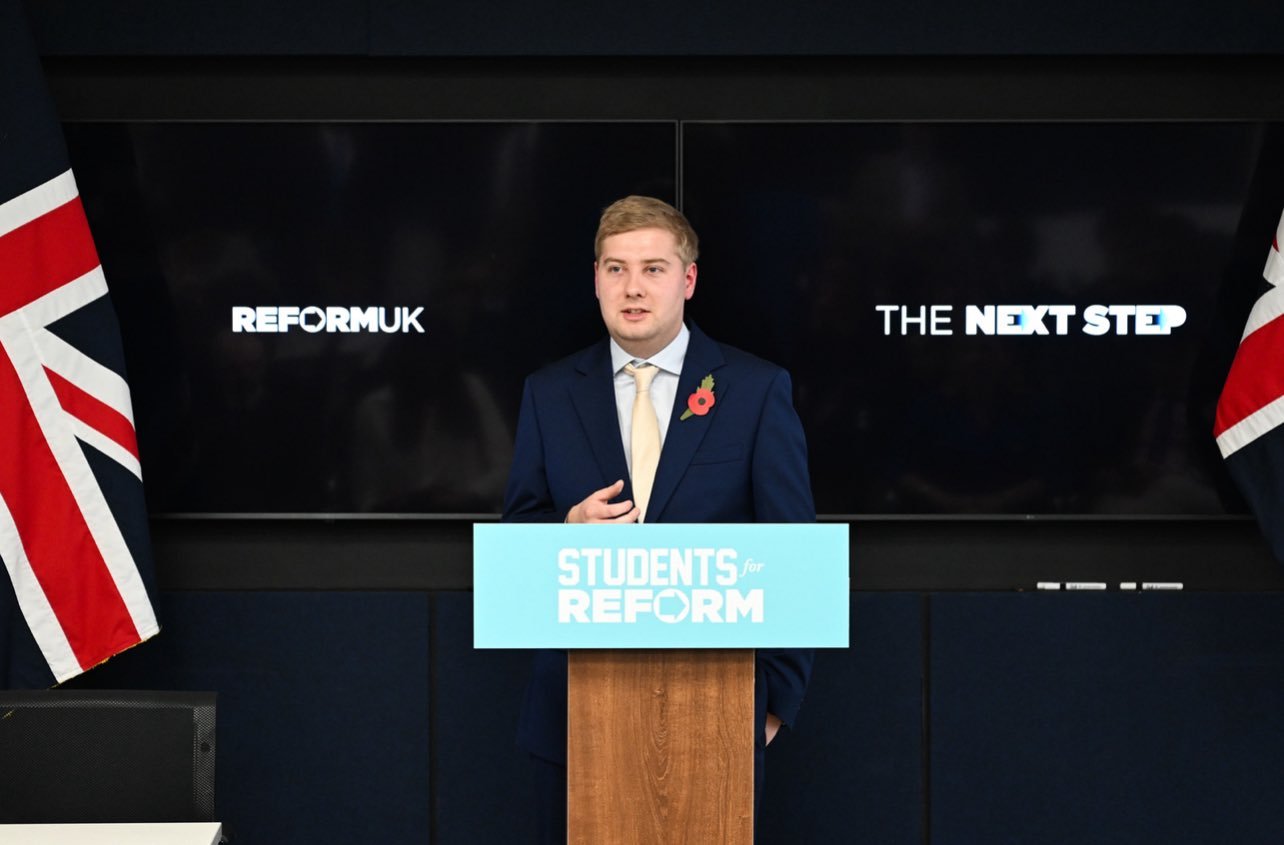
Nigel Farage’s selection for the presidency of a newly launched Reform UK youth wing has come under scrutiny after past social media posts revealed his critical comments about the King, describing him as “anti-British.” Jack Eccles, 21, was recently announced as the head of the Students for Reform group, a campus-focused initiative aimed at promoting the party’s political agenda and countering what it calls “woke Leftist ideologies” in universities.
Eccles, a former Conservative supporter, shifted allegiances to Reform UK when Farage returned to the political scene last year. Since then, he has played a key role in founding Lancaster University’s Reform society and has sought to expand the party’s influence among students. His appointment to lead the national youth wing was framed as part of an effort to galvanise young supporters and capitalise on growing enthusiasm for the party, particularly among young men.

However, questions over Eccles’s suitability for the role emerged after past posts on X, formerly known as Twitter, surfaced. In one now-deleted post from June 14, Eccles responded to a message from Sir Keir Starmer congratulating recipients of the King’s Birthday Honours. Eccles commented: “The King is anti-British and prioritises non-British cultures.”
Two other posts on his profile, still visible at the time of reporting, continued this theme. In another, Eccles claimed the King “champions anti-British values” in the lead-up to Trooping the Colour. In a separate message, he contrasted the King with the late Queen, suggesting that “the king does not put this country first like the queen did.” These remarks have provoked concern among political commentators and members of the public who question whether Eccles’s views are compatible with his new leadership role within a youth-focused organisation of a national political party.
The Students for Reform group is part of a broader strategy by Farage to cultivate grassroots support among young people, particularly in universities, where political allegiances are often in flux. Farage has long sought to position Reform UK as a populist alternative to both the Conservative and Labour parties, emphasising issues such as national identity, immigration, and opposition to what the party perceives as excessive political correctness on campus. The youth wing is expected to play a central role in mobilising student support ahead of future elections and in promoting the party’s policy agenda through events, debates, and social media campaigns.
Critics argue that Eccles’s past statements could undermine the credibility of the youth wing and the party more broadly. Political analyst Dr. Fiona Carter noted: “Universities are spaces that thrive on diversity of thought, but leaders of student political groups are expected to exercise a degree of responsibility and respect for national institutions. Publicly disparaging the monarch in such stark terms raises questions about judgment and leadership suitability.”
Supporters of Reform UK, however, have dismissed the controversy as a minor issue blown out of proportion by opponents. They argue that Eccles’s criticisms reflect a legitimate political perspective rather than a personal attack on the monarchy. A spokesperson for the party said: “Jack Eccles has demonstrated leadership and organisational skills at Lancaster University and is committed to engaging students in political debate. His views on the monarchy are a matter of personal opinion and do not detract from his ability to lead the Students for Reform group.”
The debate around Eccles’s appointment highlights broader tensions within UK politics regarding national identity, youth engagement, and the role of the monarchy in contemporary society. While Reform UK has grown in prominence in recent months, particularly among younger voters disillusioned with mainstream parties, the party faces ongoing scrutiny over its messaging and the political views espoused by its members.
Universities across the country have increasingly become battlegrounds for political ideas, with student groups often taking visible stances on issues ranging from climate change to free speech. In this context, the leadership and tone set by student political organisations are closely observed by both the media and the wider public. Eccles’s past statements about the King may intensify this scrutiny and generate debate about the values and priorities of Reform UK as it seeks to expand its influence among young voters.
Despite the controversy, Reform UK appears committed to moving forward with Eccles at the helm of its youth wing. Party insiders suggest that the appointment was based on Eccles’s experience in student politics and his ability to energise a base of supporters at Lancaster University and beyond. The party maintains that the youth wing will operate independently in its efforts to recruit and mobilise students, while also aligning with the broader Reform UK agenda in national campaigns.

The situation also underscores the enduring sensitivity of commentary on the monarchy within UK political discourse. Public figures, even student leaders, are often judged for statements about the Royal Family, and Eccles’s comments have reignited debates over freedom of expression, political affiliation, and respect for national symbols. As Students for Reform begins its activities, the group will likely face both support from loyal followers and criticism from detractors concerned about the tone and implications of its leadership.
As universities prepare for the new academic term, the presence of an active, politically engaged youth group under the leadership of someone with outspoken views on the monarchy is likely to generate further media coverage and public discussion. Whether Eccles’s appointment strengthens Reform UK’s influence among young voters or provokes controversy that hampers the party’s ambitions remains to be seen, but it is clear that the choice has drawn national attention to the party’s strategies and values in engaging the next generation of voters.
Related News:
 Prince Andrew Under Pressure as MPs Question Royal Lodge Rent Arrangements
 Second world war veterans honoured as King leads Remembrance Sunday
Palace to reinstate hyphen in Andrew’s surname
Second world war veterans honoured as King leads Remembrance Sunday
Palace to reinstate hyphen in Andrew’s surname
 William Steps Up Over Prince Andrew Palace Response
Prince Andrew Hosted Epstein Days Before Arrest
William Steps Up Over Prince Andrew Palace Response
Prince Andrew Hosted Epstein Days Before Arrest
 British Woman in Iran ‘Losing Hope’ Amid Ongoing Detention
 BBC Journalist Held and Interrogated in Vietnam
 Boris Johnson: Tories Risk Election Loss if They ‘Bash the Green Agenda’
 Kate Winslet to Narrate Film Highlighting King’s Environmental Mission
 Green Party Surges Past Labour in Latest UK Poll
 Celebrities and Charities Demand UK Government Act on Child Poverty
 Sultana says new party is aiming to ‘run government’
 Trump’s UK Ambassador Urges North Sea Drilling to Strengthen US Ties
 FBI Director Kash Patel Defends Girlfriend Amid Government Jet Claims
 Trump Speaks on Prince Andrew’s Royal Scandal Fallout
 Phillipson urges careful review of gender recognition guidance
 French Taxi Driver Cleared in David Lammy Theft Case After Fare Dispute
 Rachel Reeves Set to Break Labour Pledge and Raise Income Tax
 Prince William Plants Trees with Brazil’s Nature Heroes
 Who is Rama Duwaji? What Zohran Mamdani’s wife has said about Gaza and ICE as he’s elected NYC mayor
 Oprah enjoys Meghan’s jam on English muffins
 MPs Press Rachel Reeves to Hike Gambling Taxes
 Met Police Culture Makes Racial Harm ‘Inevitable’
 Nicola Sturgeon Urges SNP to Oppose New Oil Fields
 Eleven Arrested After Pro-Palestine Protest at Villa Match
Boris Johnson accused of undermining BBC leadership
Eleven Arrested After Pro-Palestine Protest at Villa Match
Boris Johnson accused of undermining BBC leadership
 Remaining rebel Labour MPs have whip restored
 Cuts to home insulation funding threaten UK climate goals
 King Charles to Lead Nation in Remembrance Sunday Service
 Tim Davie resigns as BBC director general amid bias claims
 ‘Reckless’ cuts to victims’ services will cost more than they save
 BBC director-general and news chief resign amid bias row
 Millionaires group urge Reeves to introduce wealth tax to ‘lift kids out of poverty’
 Starmer Faces Growing Dissent as Labour MPs Weigh Leadership Challenge
 BBC Faces Backlash as Reform UK Withdraws from Film
 The Debate Over Princess Beatrice and Eugenie’s Royal Status Intensifies
 Tim Davie Defends BBC Amid Bias Scandal Storm
 Reeves rejects £1bn plea for NHS redundancy payouts
Donald Trump threatens BBC over edited speech
Reeves rejects £1bn plea for NHS redundancy payouts
Donald Trump threatens BBC over edited speech
 British state supplied victims to ‘worst sex offender in history’
 Politics latest: Starmer ‘will fight any leadership coup’ as Streeting denies attempt to oust Labour PM
 Thai King Embarks on Historic China Visit After 50 Years
 Peers Flood Assisted Dying Bill with 942 Amendments
 England’s Special Needs Support Faces Breaking Point
 MoD warned over Excel risks before Afghan data breach
 Princess Anne Takes the Controls in Airbus Flight Simulator
 UK Unveils Fast-Track Deportation and Asylum Overhaul
 UK Asylum Overhaul Sparks Debate Over Human Rights and Deportations
 UK Asylum Reforms: Temporary Refugee Status and Faster Deportations
 UK Candidate Moved to Safe House After Election Threats
 Mahmood Defends Tough Overhaul of UK Asylum System
 Scottish Ministers Express Alarm Over UK Asylum Reforms
 UK Warns China After MI5 Issues Espionage Alert
 Westminster Advances Legacy Bill Amid Criticism
 Minister Defends Tough New Asylum Reform Plan
 UK Net Migration Falls Sharply After ONS Revisions
 UK Vulnerable to Attack, Defence Committee Finds
 Labour Faces Historic Decline in Wales
 Rama Rebukes Mahmood for Targeting Albanian Families
 Russian Vessel Used Lasers on RAF Pilots, UK Claims
 PM Shares Emotional Letter to Son on Men’s Struggles
 MP Offers Seat to Help Burnham Challenge Starmer
 PM Highlights UK Business at G20 in South Africa
 Boris Johnson Oversaw Toxic No 10 Culture, Covid Inquiry Finds
 Kate Forbes: Motherhood Harder Than Politics
 Welsh Government Christmas 2020 Lockdown Criticised
Reeves to Crack Down on Benefit Fraud While Lifting Two-Child Limit
Welsh Government Christmas 2020 Lockdown Criticised
Reeves to Crack Down on Benefit Fraud While Lifting Two-Child Limit
 BBC to Expand Standards Panel and Create Deputy Director Role
 Most Tories Expect to Support a Farage-Led Government
 Catherine urges end to stigma around addiction
 Labour MP claims devolution bill is ‘blatant discrimination’ against Cornwall
 English Mayors Set to Introduce Tourist Taxes
 Ex-Classmate Accuses Farage of Dishonesty on Racism Claims
 Millions Face Higher Taxes Under Reeves New Budget
 Peers Get Extra Time to Debate Assisted Dying Bill
 Planned Palestinian Flag Raising at Belfast City Hall Faces Delay Amid Legal Concerns
 Ex-Brexit MEP Rejects Claim of Pro-Russia Payments
 Government righting decades-old injustice for miners
 UK refugee resettlement under UN schemes drops sharply in one year
 UK delays ruling on China embassy plan until January