Published: 04 March 2026. The English Chronicle Desk. The English Chronicle Online.
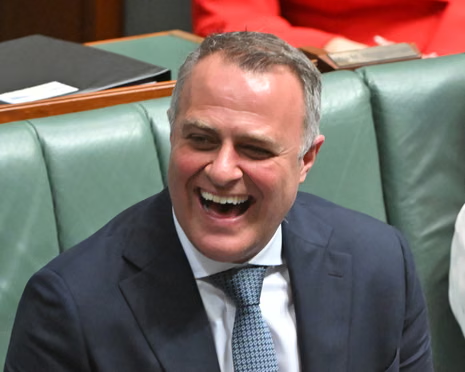
The landscape of Australian political finance has shifted today as Tim Wilson announced he has finally closed his controversial investment position. This decision marks the conclusion of a saga involving a leveraged financial product that aimed to profit from a falling share market. While the move was initially framed as a protective measure during the early days of the pandemic, it quickly became a point of intense political friction. Wilson confirmed to parliament on Wednesday that he has sold his stake in the Betashares Australian Equities Strong Bear Complex. This specific financial vehicle is designed to gain value when the ASX 200 index experiences a decline in performance. Because it uses gearing to magnify results, the risks involved are significantly higher than traditional stock holdings.
The shadow treasurer noted that his exit from the share market bet resulted in what he described as a modest profit. However, he was quick to temper this claim by suggesting that inflation had largely eroded the real value of those gains. In a move aimed at highlighting his personal values, Wilson stated that the proceeds would be donated to the International Railroad for Queer Refugees. This advocacy group provides essential support to LGBT individuals fleeing persecution under restrictive regimes like the one currently in power in Iran. This philanthropic gesture adds a layer of social conscience to a financial story that has dominated recent headlines. Despite the donation, the timing and nature of the initial investment remain subjects of significant curiosity among financial analysts.

Public interest in the financial dealings of the Liberal MP intensified after Guardian Australia first highlighted the investment last year. Observers noted that it is relatively unusual for a high-ranking politician to hold products that benefit from economic downturns. Typically, members of parliament are expected to maintain investments that align with the general growth and health of the national economy. Holding a short position can create a perceived conflict of interest, especially for someone serving as the shadow treasurer. Critics argue that profiting from market slumps sits uncomfortably with the responsibilities of economic leadership and public policy. Wilson has consistently defended the move as a rational response to the unprecedented uncertainty of the global health crisis.
Financial experts in Sydney previously characterized the investment as an uncommon choice for a retail investor or a public servant. One adviser described the product as a “terrible” bet given the robust recovery the Australian markets experienced following the 2020 crash. The Bear Fund is strictly intended as a short-term hedging tool rather than a long-term holding. Because the product is rebalanced daily, its value tends to decay over time if the market remains stable or rises. Data suggests that between the initial purchase in early 2020 and the most recent disclosures, the fund lost a massive portion of its value. This discrepancy between market data and Wilson’s claim of a modest profit has raised questions among seasoned market watchers.
The mechanics of the share market often involve complex strategies that are difficult for the general public to track easily. Wilson explained that he originally entered the position to guard against a “black swan” event triggered by the global pandemic. In financial terminology, a black swan refers to an unpredictable occurrence that carries a catastrophic impact on global systems. While the market did indeed suffer a sharp sell-off in early 2020, it rebounded with surprising speed and resilience. Subsequent disclosures indicated that Wilson maintained his short position long after the initial shock had passed through the system. This decision meant his portfolio was positioned against the very recovery that the Australian government was working hard to facilitate.
The Labor government has been vocal in its criticism of the Liberal MP over these specific investment choices. Government frontbenchers argued that the shadow treasurer should have a more optimistic outlook on the nation’s primary economic indicators. They suggested that maintaining a bet against the share market demonstrated a lack of confidence in Australian businesses and workers. Wilson countered these narratives by focusing on the rights of individuals to manage their private finances as they see fit. He emphasized that all his disclosures were made in accordance with the strict transparency requirements of the parliament. The updated register of interests will soon reflect the final sale and the subsequent donation of the remaining funds.
Throughout the controversy, Wilson’s office has remained relatively private regarding the exact size of the initial investment. While the percentage losses of the fund were publicly verifiable, the total dollar amount remained a matter of private record. Without knowing the exact entry and exit prices, it is difficult for external observers to verify the “modest profit” claim. The shadow treasurer’s assertion that inflation outstripped his gains suggests that the net real return was likely negligible at best. For many, the story serves as a cautionary tale about the complexities of using leveraged inverse products in a volatile environment. These instruments are powerful but can be devastatingly inefficient if held for several years instead of several days.
The transition from holding a bear market product to making a high-profile charitable donation appears to be a strategic pivot. By supporting the International Railroad for Queer Refugees, Wilson is reinforcing his long-standing reputation as an advocate for global human rights. The organization plays a vital role in transporting vulnerable individuals to safety, often under high-risk circumstances. This alignment with a cause close to his heart may help shift the public conversation away from his portfolio. It highlights the intersection of private wealth and public advocacy that often defines the careers of modern political figures. Nevertheless, the shadow treasurer will likely face continued scrutiny over his economic judgment as the next election cycle approaches.
The broader implications of this event touch on the ethics of parliamentary investments in specialized financial derivatives. As the share market continues to fluctuate, the rules governing what politicians can and cannot hold may come under review. There is a growing sentiment that investments should be limited to broad-based index funds to avoid any appearance of betting against the country. Transparency is the current standard, but some advocates are calling for even stricter divestment protocols for those in economic portfolios. For now, Wilson has cleared his ledger of the Bear Fund, ending a chapter that provided significant ammunition for his political opponents. The focus now returns to his performance in parliament and his critique of the current government’s fiscal policies.

As the English Chronicle continues to monitor these developments, the focus remains on how financial transparency shapes voter trust. The Australian public tends to favor leaders whose personal fortunes are tied to the collective success of the nation. When a leader appears to hedge against that success, it creates a disconnect that is difficult to bridge with simple explanations. Wilson’s sale of the investment is a clear attempt to close that gap and refocus on his duties as a senior member of the opposition. Whether the “modest profit” he mentioned will be enough to satisfy his critics remains to be seen in the coming weeks. For the time being, the share market remains a volatile arena where politics and profit frequently collide in unpredictable ways.
Ultimately, the story of Tim Wilson and his bear fund investment illustrates the high stakes of modern political life. Every financial decision made by a representative is subject to intense public and media examination. In an era of instant information, a “terrible” investment can quickly become a significant political liability. By exiting the position and donating the proceeds, Wilson is attempting to turn a negative narrative into a positive social outcome. As he moves forward in his role as shadow treasurer, his future investment choices will undoubtedly be watched with even greater interest. The lesson for all public officials is clear: in the world of finance, perception is often just as important as the bottom line.
Related News:
 UK Experts Raise Alarm Over Machinery Export to Armenian Firm
 Caffè Nero Warns Coffee Prices May Rise Again
 Wealthy Britons Flee Gulf War but Avoid UK Taxes
 UK Wage Growth Slows as Jobs Market Holds Firm
 Oil and Gas Prices Surge Amid Iran-Israel Attacks on Gasfields
 Student Loan Interest May Rise Despite 6% Cap
 Middle East Conflict Risks UK Food Supply Chains This Summer
 Carmakers Face £3bn Gap in UK Loan Payout Scandal
 BP Profits Surge Amidst Middle East Conflict Crisis
 BBC News Faces Deep Cuts in 2,000 Job Plan
 New UK advice scheme to boost savings and investing
 City & Guilds Faces Governance Crisis Over Sale
 Reeves Fights to Keep Treasury Role Amid Labour Turmoil
 UK Urged to Build EU Rejoin Consensus, Says Miliband
 UK rejects EV charging VAT cut amid Treasury clash
 Steel Tensions Rise Between United Kingdom and European Union
 EU Slashes Steel Quotas But Grants UK Favourable Rates
 EasyJet Takeover Sparks Fears Over Passengers’ Future
 How to Exit Your Broadband Contract Without Paying Exit Fees
 Chancellor Rachel Reeves Pushes for Sweeping Changes to Environmental Protections to Accelerate Development
 Inflation Latest: Cost of Living Expected to Rise Again in Key Figures Released Today
 Retail Sales See Uptick Amid Errors and Delays as ONS Faces Scrutiny
Shein UK Faces Allegations of Shifting Majority of Profits to Singapore to Reduce UK Tax
Retail Sales See Uptick Amid Errors and Delays as ONS Faces Scrutiny
Shein UK Faces Allegations of Shifting Majority of Profits to Singapore to Reduce UK Tax
 Jaguar Land Rover Extends Production Halt Following Cyber-Attack
 Great Britain’s Energy Operator Commits to Strengthening Grid to Prevent Blackouts
 UK Government Backs Return of International Rail Travel to Kent Stations
 Wetherspoon vows to keep prices low amid soaring energy and tax costs
 UK House Price Growth Slows as Buyers Exercise Caution Ahead of Autumn Budget
 Kemi Badenoch Unveils ‘Golden Rule’ to Halve Spending Cuts for Deficit Reduction at Tory Conference
 New V-Level qualification to transform post-16 education
 Real living wage set to rise nearly 7% for UK workers in 2026
 Reeves Faces Setback as Labour May Miss Homes Target
 Trump’s UK Ambassador Urges North Sea Drilling to Strengthen US Ties
 M&S Profits More Than Halve After Cyber-Attack
 Millionaires group urge Reeves to introduce wealth tax to ‘lift kids out of poverty’
 Starmer Says Labour’s Economic Plan Needs Years to Deliver
 Virgin Media Fined £23.8m Over Telecare Safety Failures
 Historic £100-Weekly Pension Boost Brings Relief for UK Mineworkers
 Starmer Faces Parliamentary Battles Over UK-EU ‘Reset’ Plan
 British skier killed in La Plagne avalanche tragedy
 ScottishPower Tops List of Worst UK Energy Suppliers
 City & Guilds pay surge sparks backlash amid £22m cuts
 AI job losses UK: Britain faces sharper employment shock
 India-EU Free Trade Deal Marks Historic Economic Shift
 UK Unemployment Rate Climbs to 5.2% Peak
 UK shelves £110m border project amid trade strain
 Switching Energy Deal Can Save £200 as Price Cap Falls
 Rachel Reeves Faces Middle East Conflict Test
 Grocery Inflation Rises Amid War Fears
 UK suspends study visas for four nations to curb asylum
 Jordanian Arrested in Philippines Over Bondi Beach Terror Links
 BrewDog sold Highland estate for knockdown price after abandoning reforestation plans
 Ukraine war briefing: Zelenskyy offers help to Saudi Crown prince on combatting Iranian drones
 Yorkshire Water Funding Sparks Debate Amid Fines and Pay Row
 Abramovich Chelsea Sale Cash Faces Jersey Probe
 Starmer Praised for Stance on Trump and Iran Conflict
 UK Energy Reform Could Cut Bills by £200
 Trump Slams Europe as Transatlantic Tensions Boil Over
 Hospitality Sector Teeters on Brink as Costs Surge
 Trump Facing Backlash Over Firing of Cabinet Women
 Melania Trump Denies Ties to Epstein and Ghislaine Maxwell
 Trump Starts $166bn Tariff Refund Process
 Prominent Voices Challenge Palestine Action Ban
 $13bn World Cup Set to Break All Revenue Records
 Big Tobacco Under Fire Over Controversial New Ad Campaign
 UK Firms Freeze Spending as Iran Conflict Bites
 Summer Shock: British Energy Bills Set for Grim July Hike
 Reeves to Fast-Track Clean Energy Amid Iran Crisis
 Tube Strike Brings Capital to a Standstill Over Shift Disputes
 BP Stands Firm on Amanda Blanc Amid Boardroom Storm
 Teaching Machines Right From Wrong in the Digital Age
 UK House Prices Drop For Third Month Due To War Fears
 Top Chefs Back Andy Burnham to Save UK Hospitality Sector
 AI Scams Push UK Investment Fraud Past £220m
 Russian Tanker Captain Remanded in UK Court After Channel Seizure
 Scouts Introduce Badges For AI And Digital Skills
 Rethinking the Blueprint for Youth Employment in Britain
 Sainsbury’s Boss Optimistic As Grocery Inflation Eases
 UK Households Suffer Squeeze As Disposable Incomes Drop
 BBC Faces Real Jeopardy as Licence Fee Income Declines