Published: 7 April 2026 . The English Chronicle Arts & Culture. The English Chronicle Online—Peering through the layers of history with the latest in conservation technology.
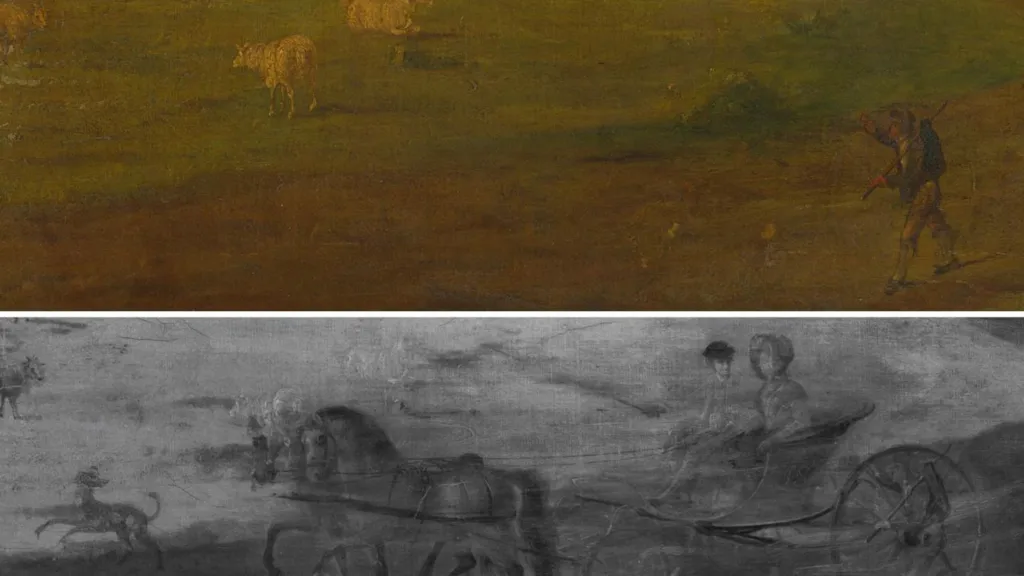
The art world is abuzz this week following what experts are calling an “extraordinary discovery” hidden beneath the surface of a prominent 18th-century oil painting. Using advanced infrared thermal imaging, conservators at the National Trust have uncovered a series of “lost” elements within the painting “Stourhead in its Infancy,” fundamentally changing our understanding of one of Britain’s most iconic landscape depictions.
For centuries, the painting was celebrated as the earliest known visual record of the Wiltshire estate’s world-famous gardens. However, the recent technical analysis has revealed that the artist—long believed to have painted a static, tranquil landscape—originally included a much more bustling scene of Georgian life.
-
The Vanished Travelers: Hidden under layers of sky and foliage, infrared scans revealed a fully rendered horse-drawn carriage occupied by a lady in a fine bonnet and a gentleman.
-
The Spotted Companion: Perhaps most charmingly, the discovery includes a “coach dog” (an early Dalmatian) trotting alongside the carriage, a detail that had been completely obscured by later “overpainting.”
-
The Reasoning: Curators believe the figures were painted over shortly after the work’s completion, likely to shift the focus from the social status of the inhabitants to the “sublime” beauty of the architecture and nature itself.
The discovery was made during routine conservation work in preparation for a 2026 exhibition. Claire Reed, a curator for the National Trust, described the moment the infrared monitors flickered to life:
“To find such an extraordinary discovery hidden beneath its surface is incredibly rare and incredibly exciting. It’s like a puzzle where the pieces have been hiding in plain sight for 250 years.”
The technology used—Short-Wave Infrared (SWIR)—allows researchers to see through the upper pigment layers to the artist’s original “pentimenti” (changes of heart). In this case, the scan showed that the artist hadn’t just sketched these figures; they were fully painted before being “deleted” from history.
The Stourhead revelation is part of a broader “Golden Age of Discovery” in early 2026, driven by a new generation of non-invasive scanning tools.
-
The Budapest Mystery: Just yesterday, 6 April, art historians in Hungary announced the examination of a potential previously unknown Van Gogh. The work, a version of The Dance Hall in Arles, is currently undergoing pigment analysis to confirm its authenticity.
-
The Rembrandt Return: Earlier this month, the 1633 painting Vision of Zacharias in the Temple was officially re-authenticated as a genuine Rembrandt after 65 years of being dismissed as a mere “studio copy.”
-
The Indonesian Cave Breakthrough: While classical art is being scanned, archaeologists in Indonesia recently used laser-ablation dating to identify a 67,800-year-old hand stencil, now the oldest known piece of rock art in human history.
For the public, these discoveries offer a rare glimpse into the creative process—the “first drafts” of history. The National Trust plans to display the Stourhead painting alongside digital “light-boxes” that allow visitors to swipe away the top layers of paint and see the hidden carriage and its faithful coach dog for themselves.

As we look toward the future with AI-generated art and lunar missions, these “extraordinary discoveries” remind us that our past still holds plenty of secrets, tucked away beneath a few millimeters of old oil and varnish.
Art Discovery Log: April 2026
| Artwork | Location | Discovery Type |
| “Stourhead in its Infancy” | Wiltshire, UK | Hidden carriage, lady, and dog |
| “The Dance Hall” (Variant) | Budapest, Hungary | Potential new Van Gogh |
| “Vision of Zacharias” | Global (Private) | Confirmed as authentic Rembrandt |
| Liang Metanduno Stencil | Muna Is., Indonesia | Oldest rock art (67,800 yrs) |
| Titian’s “Ecce Homo” | Limassol, Cyprus | Hidden Renaissance portrait |
Related News:
 The Sad, Strange Story of the World’s Most Radioactive Paradise
 India and US Collaborate to Launch Groundbreaking Satellite for Earth Observation
 British AI Startup Outshines Human Forecasters in Global Prediction Contest
 UK Fighter Jet Purchase Could Breach Nuclear Treaty, Warns CND
 Google at 27: The Untold Story of Ruth Kedar, the Woman Behind the Iconic Logo
 Russia repeatedly targets UK military satellites, warns Space Command chief
 Cooper Unveils £4m Cyber Plan Against Russian Hackers
 Experts Warn Russia’s Burevestnik Missile Could Destabilise Arms Control
 Britain deploys RAF specialists to assist Belgium with drone threats
 Night after night, Belgium is on high alert.
 Hitler’s DNA Confirms He Truly Had Only One Testicle
 Pokémon to open world’s first theme park in Japan next year
 Poll Reveals China Leads World in Trusting AI Technology
 US Clears Nvidia AI Chip Sales to China in Policy Shift
 Iran Signals Permanent Break From Global Internet, Activists Warn
 UK New Car Discounts Near £6,000 as Prices Are Slashed
 Musk Wants City on the Moon Within 10 Years
 Ancient Bone May Prove Legendary War Elephant Crossing of Alps
 ‘There Is a Feeling of the Greatest Outrage’: The Mystery of Stolen Champion Racehorse Shergar
 Indian University Kicked Out of AI Summit for Claiming Chinese Robot Dog as Its Own Invention
 China Shows Off Nunchuck‑Wielding Humanoid Robots for Lunar New Year
 The Chinese AI App Sending Hollywood Into a Panic
 How Do You Modernise Mango Farming? India’s Growers Urged to Innovate as Climate Change Hits
 Bill Gates Pulls Out of India’s AI Summit Over Epstein Files Controversy
 Zuckerberg Defends Meta in Landmark Social Media Addiction Trial
 Etsy Sells Second‑Hand Fashion App Depop to eBay for $1.2bn
 Musk Cuts Starlink Access for Russian Forces – Giving Ukraine an Edge at the Front
 Anthropic AI Refuses Pentagon’s Safety Demand
 Social Media Trial: Woman Says Addiction Began at Six
 Instagram Investigating AI Profiles ‘Fetishising’ Disabled People
 Spain Declassifies Files on 1981 Attempted Coup in Effort to Dispel Conspiracy Theories
 Anthropic Boss Rejects Pentagon Demand to Drop AI Safeguards
 Burning Carcasses and Smoke for Miles — The Outbreak That Killed Millions of Animals
 Brady Tkachuk Denies AI Video Claims After Olympic Gold
 Why Russia Controls Its People With a Flick of a Switch
 Wellness Peptide Craze: Why People Are Injecting Drugs ‘Not for Human Consumption’
 The US Now Has the Medicine for Cheap Swarming Drone Attacks
 Boy George Says He’s Using ChatGPT to Help Write New Songs
 Satellite Images Show Iranian Navy and Nuclear Sites Hit by US‑Israeli Strikes
 Protesters Rally in San Francisco Against OpenAI Deal With Pentagon
 We Have More Privacy Controls Yet Less Privacy Than Ever — The Paradox of Digital Life
 Regulator Contacts Meta Over Workers Watching Intimate AI Glasses Videos
 Study Says Only Two Nations May Survive Nuclear War
 Baba Vanga’s Chilling World War 3 Prediction and Russia’s New Leader
 Tiny Possum and Glider Thought Extinct for 6,000 Years Found in Remote West Papua
 The Suburban Spies Who Sold Britain’s Nuclear Secrets
 Musk’s xAI Permit Sparks Fury Over Power Plant Expansion
 GPS Jamming: The Invisible Battle in the Middle East
 The Kill Line: A Shifting Vision of the American Dream
 ABC Staff Strike Over Pay and AI Concerns
 Cluster Strikes Test Israel’s Missile Defences
 Zelensky Visits Saudi Arabia After Offering Drone Expertise
 One Ant for $220: The New Frontier of Wildlife Trafficking
 How and When to See April’s Full Pink Moon
 How Iran Destroyed US Base’s $500m Battlefield Nerve Centre
 Trump Considers Military Operation to Seize Iran’s Uranium
 Jim Ratcliffe’s £3.5bn Chemical Plant Delayed with Parts Stranded in the Gulf
 Trump Building ‘Massive’ Military Bunker Under White House Ballroom
 The Death-Defying Nuclear Commando Mission That Could End the War
 ‘Excitement’ at Salisbury Plain as UK Conducts Largest Military Parachute Drop in a Decade
 The ‘Simpler Recycling’ Era: England’s New Bin Rules Face a Patchy Rollout
 ‘A Million Things’: The Unprecedented Peril of Seizing Iran’s Uranium Stockpile
 ‘The Counting of a Nation’: India Launches World’s Largest Census Amid Tech Revolution
 ‘At the Doorstep of the Future’: Florida’s Space Coast Braces for Historic Artemis II Launch
 ‘We Go for All Humanity’ — Artemis II Returns Humans to the Lunar Vicinity
 The Orion Capsule: A High-Stakes Vigil in Earth’s Orbit
 Beyond the Atmosphere: A Comprehensive Guide to Artemis II
 A Name for the Nameless: DNA Finally Links 1974 Utah Murder to Ted Bundy
 7.4-Magnitude Earthquake Jolts Eastern Indonesia; Tsunami Warning Lifted
 Breaking the Horizon: Blind Runner to Tackle Brighton Marathon with Smart Glasses
 Lunar Bound: Artemis II Leaves Earth’s Orbit for Historic Deep-Space Journey
 “Homo Sapiens are All of Us”: Artemis II Crew Sends Emotional Message of Unity from Deep Space
 ‘The frontline is like Terminator’: Ukraine’s fighting robots
 Artemis II astronauts capture Earth en route to the Moon
 Apple at 50: Three Products That Changed How We Live
 Behind Enemy Lines: The 12-Hour Race to Save a Downed U.S. F-15E Pilot
 The Silent Side: Orion Emerges After 40 Minutes of “Lunar Solitude”
 Lunar Crossing: Artemis II Enters Moon’s “Sphere of Influence” as Earth Recedes
 The Mosaic of 1926: Newly Released Census Shatters “Monocultural” Myth of Early Irish Free State
 Inside the “Justice Factory”: BBC Enters the Seized Scam Compound with Fake Global Police Stations