Published: 24 April 2026. The English Chronicle Desk. The English Chronicle Online.
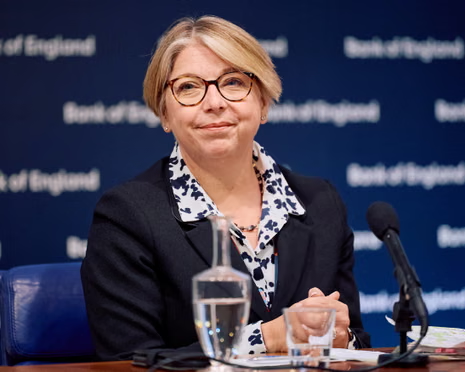
Global financial landscapes currently present a complex picture that demands our very closest attention today. While many international stock markets are celebrating record highs, underlying economic realities appear significantly more fragile. Sarah Breeden, the esteemed deputy governor for financial stability at the Bank of England, has issued a stark warning. She suggests that current market valuations fail to account for significant risks within the global economy. This observation has understandably caused considerable unease among investors who have enjoyed a period of sustained growth. Breeden expressed her concerns during a recent interview, highlighting several key areas that warrant immediate caution. Among these notable concerns are private credit markets and the valuations of artificial intelligence companies. These sectors have experienced rapid expansion, yet they may not reflect a truly sustainable long-term trajectory.
Breeden observed that despite the presence of substantial risks, asset prices continue to reach all-time highs. This divergence between market performance and economic indicators remains a primary point of friction for regulators. Consequently, she expects that some form of market adjustment will occur at some point in the future. The sheer scale of global optimism seems to be shrugging off several persistent geopolitical and economic challenges. For instance, the United States stock market achieved a record high earlier this week despite ongoing turbulence. Investors appear to be dismissing fears that the energy shock sparked by the Iran war is causing damage. This resilience, while impressive, may mask the fundamental pressures currently weighing upon the wider international economy. Furthermore, Japan’s Nikkei 225 index also concluded its trading session at a record closing high very recently. This particular rally was heavily supported by strong performance in technology stocks after positive corporate earnings results.
In contrast, the British FTSE 100 share index remains approximately five percent below its own record high. This peak was reached in late February, just before the conflict in the Middle East began to unfold. Concerns regarding the private credit sector have been steadily intensifying throughout the course of several recent months. This specific area involves potentially risky loans that are funded through the usage of various investors’ money. The Bank of England issued a timely warning at the conclusion of March regarding these stretched valuations. They noted that US technology companies focused on artificial intelligence were particularly exposed to such market pressures. Investor sentiment concerning these riskier credit markets had clearly begun to deteriorate well before the regional conflict. Breeden explicitly articulated that the Bank is worried about a potential private credit crunch moving forward. She distinguished this from a traditional banking-driven credit crunch, suggesting a different set of underlying systemic risks.

The deputy governor emphasized that her primary concern involves the possibility of multiple risks converging simultaneously. She specifically mentioned the potential for a major macroeconomic shock occurring alongside a sudden loss of confidence. If confidence in private credit evaporates while AI valuations readjust, the resulting environment could become quite volatile. The crucial question facing regulators is whether the global financial system is adequately prepared for such scenarios. Breeden admitted that the prospect of these risks crystallising simultaneously is what keeps her awake at night. The focus of the Bank of England remains on how these asset prices might eventually begin to fall. They are carefully monitoring whether there could be a sharp adjustment downwards in the near future. Should such a significant correction manifest, the impact on the broader economy must be carefully managed.
Breeden stated that she is not predicting this adjustment will happen today, tomorrow, or within twelve months. Instead, the focus is entirely on ensuring that the system is resilient if a correction does arrive. Her comments carry weight, particularly when considering the cautious nature usually associated with central bank official communications. The FTSE 100 index experienced a decline of over one half of one percent on Friday following her remarks. This movement occurred amidst a wider market drop as traders reacted to the lack of conflict resolution. Market participants are increasingly concerned that there is no immediate sign of a breakthrough in the Iran war. These anxieties are being compounded by the warnings issued regarding the sustainability of current global equity prices. The intersection of geopolitical tension and financial market vulnerability creates a particularly delicate environment for all major investors.
Financial commentators have been quick to analyze the potential ramifications of the deputy governor’s intervention regarding the markets. Russ Mould, who serves as the investment director at the financial services company AJ Bell, shared his analysis. He suggested that Breeden’s warning of a potential global stock market correction is likely weighing heavily upon the City. It remains quite unusual for a senior Bank of England official to explicitly warn about a market pullback. Such direct commentary from a central bank official is often interpreted by traders as a significant signal. Consequently, this observation might have contributed directly to the decline seen in the FTSE 100 index this Friday. Mould noted that Breeden was not simply referring to the ongoing events surrounding the conflict in the Middle East. She was also referencing broader concerns around a private credit crunch and the high level of equity valuations.
The technology sector, particularly firms involved in artificial intelligence, has been a primary driver of recent market performance. However, these specific high-growth areas are now facing increased scrutiny from those tasked with maintaining systemic financial stability. Investors will now be forced to weigh these institutional warnings against the prevailing optimism that has driven recent gains. The current atmosphere is characterized by a high degree of uncertainty as market participants evaluate these conflicting signals. Whether the global economy is heading toward a period of correction or sustained growth remains an open question. What is clear is that the Bank of England is maintaining a vigilant stance on behalf of stability. The coming months will likely test the resilience of both individual investors and the broader global financial framework. As we move forward, the ability of the system to absorb shocks will become the defining measure of success. Professionals and retail investors alike are watching these developments with an appropriate and measured sense of professional concern.
Related News:
 Scottish Government Mandates Single-Sex Toilets and Changing Facilities in Schools
 Reeves Faces Setback as Labour May Miss Homes Target
 Kate Winslet to Narrate Film Highlighting King’s Environmental Mission
 Trump’s UK Ambassador Urges North Sea Drilling to Strengthen US Ties
 UK Bans Fake Numbers: Scammers Lose Their Trick
 Vibe coding’ named Collins dictionary’s word of the year
BBC to Apologise Over Edited Trump Speech Amid Backlash
Vibe coding’ named Collins dictionary’s word of the year
BBC to Apologise Over Edited Trump Speech Amid Backlash
 Millionaires group urge Reeves to introduce wealth tax to ‘lift kids out of poverty’
 Reeves rejects £1bn plea for NHS redundancy payouts
 PM Condemns Leaks, Vows Loyalty to Ministers and Stability
 Phillipson Accused of Appeasing Unions by Diluting EBacc
 Saka Solidifies Role as Tuchel’s Key England Lieutenant
 Greene Pushes Epstein Files Amid Trump Fallout
 Zelenskyy Signs Fighter Jet Deal Amid Russian Drone Attacks
 Sundar Pichai Cautions on AI Hype and Market Risks
 Shadow Fleet at Sea: Europe’s Battle Against Illicit Oil Shipping
 Snow and Ice Cause Travel Chaos in North Yorkshire
 Director Michael Caton-Jones Reflects on Career and Beginnings
 Inside the Helpline Protecting Missing Children in the UK
 PlayStation PS5 Deals Hit Lowest Prices Ahead of Black Friday
 US Suspends Afghan Immigration After White House Shooting
 Five-Year-Old Dies After Rare Tonsil Surgery Complication
 Starmer Says Labour’s Economic Plan Needs Years to Deliver
 ‘Extinct’ Antelope Returns to Sahara, Bringing Hope
 IndiGo Cancels Hundreds of Flights Amid Pilot Shortages
 Young Britons Face Heaviest Burden from Ageing Population, Lords Warn
 U‑Turn on Farmers’ Inheritance Tax Sparks Political Firestorm
 Aston Villa Remain Arsenal’s Key Obstacle in Title Pursuit
 Irish Beach Tragedy: Irish Drown at Whitehaven Beach in Australia
 The Kill Line: A Shifting Vision of the American Dream
 Inquiry into HMRC child benefit errors launched by NAO
 Family of Alleged Bondi Gunman Seeks Name Suppression
 Rising Costs Force Families to Rethink Days Out
 Air Canada CEO Faces Outcry Over Recent Language Misstep
 Extreme Weather: Europe Shivers as Cyclone Narelle Hits
 Scott Mills Sacked by BBC Over Personal Conduct Claims
 Palantir Boss Defends NHS Deal Amid Government Break Clause
 Asia Turns Back to Coal Amid Middle East Energy Crisis
 Relationship with Trump may be beyond repair, Starmer warned
 Trump’s Six-Week Iranian War: The High Cost of Ignorance
 US and Iran Agree to Two-Week Provisional Ceasefire
 Battle of Britain Tower to House Tourists and Bats
 The Challenger: Will Péter Magyar End the Orbán Era?
 UK Government Poised to Revive Stalled Hillsborough Law
 Democrats Move to Impeach Defense Secretary Pete Hegseth
 Security Alert Near Israeli Embassy as Police Investigate
 Ben Roberts-Smith Denies War Crime Allegations in First Statement
 Home Office Faces Legal Risks Over Asylum Hotel Living
 US-Iran Standoff: Will Trump Deploy Ground Troops?
 Crisis in NHS Surgery Scheduling Hits Patients Hard
 Trump Defiant After Washington Hotel Shooting
 Cross-Border Crisis Shatters Fragile Afghan Peace
 Urban Flood Crisis: A Growing Threat to English Homes
 Ashley Cole: Finding His Voice and Vision in Italy
 New AI Tool To Target Obesity Risk And Transform NHS Care
 Greens Face Internal Row Over Antisemitism Claims
 Tough Fiscal Realities Await Next Scottish Government
 The Burning Lens: An Iranian Artist’s Visual Resistance
 Met Officers Probed Over Al Fayed Abuse Allegations
 One Nation Candidate’s Surprising Ties to Independents
 Aramco Surges as East-West Pipeline Counters Gulf Tensions
 Reform UK Faces Crisis as Newly Elected Councillors Resign
 Starmer Strikes Back as 100 MPs Sign Support Pledge
 Scepticism and tight security as Beijing braces for Trump
 Tensions Flare as Israeli Nationalists March in Jerusalem
 UK Firms Freeze Spending as Iran Conflict Bites
 UK Job Market Squeezed as Iran War Drives Jobless Rate to 5%
 Reeves to Fast-Track Clean Energy Amid Iran Crisis
 The Battle for Wembley Sparking Unprecedented Legal Warfare
 Tony Abbott Returns as New Liberal Party President
 Pope Meets Families in Italy Toxic Waste Zone
 Royal Ascot Allegation Sparks Wider Police Inquiry
 Secret Role of UK Security Services in Troubles Amnesty Law
 Tube Strike Brings Capital to a Standstill Over Shift Disputes
 Teaching Machines Right From Wrong in the Digital Age
 Is Ollie Robinson the Chaos English Cricket Needs Today?
 The Hidden Crisis Eroding Trust in British Communities
 Saving the Scalloped Hammerhead: The Pacific Battle
 Stolen Mobiles Could Soon Become Useless Bricks
 Clean Air Initiatives Spark Major Fall in London Hospital Admissions