Published: 09 September 2025. The English Chronicle Desk
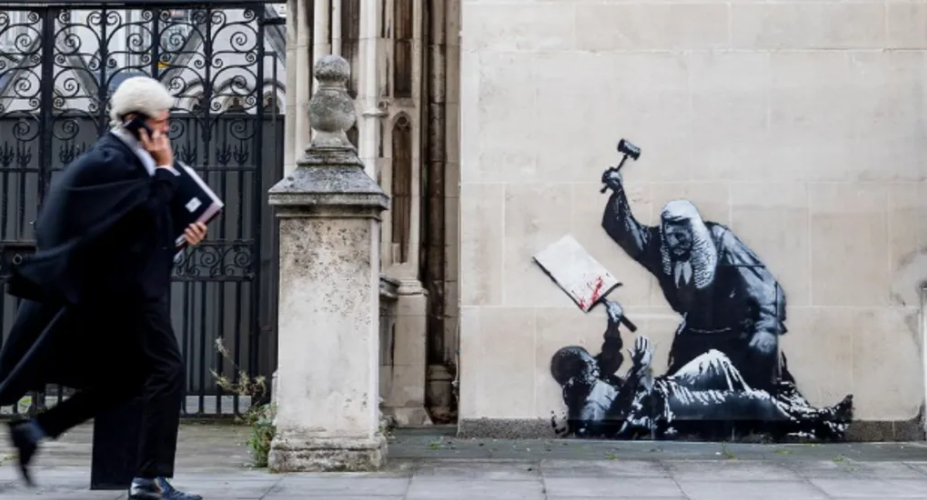
A new work by the elusive street artist Banksy sparked controversy on Monday morning after appearing on the walls of the Royal Courts of Justice in London. The mural, which depicted a judge wielding a gavel against a protester lying on the ground, was quickly obscured by court staff under the instruction of security officials.
Banksy confirmed authorship of the piece by sharing a photograph of it on his official Instagram account. The image, taken on the wall of the Queen’s Building within the court complex, showed passers-by – including a lawyer and a cyclist – next to the striking image. The protester in the artwork clutched a placard marked with a vivid red stain resembling blood, a stark symbol interpreted as a critique of state power.

Witnesses reported that guards were deployed in front of the mural shortly after its discovery. Matteo, a local worker who passed by at around 8.30am, described efforts by security staff to prevent the public from photographing the piece. “I think it’s disgusting that they would just cover it up,” he remarked, linking the act to heightened tensions following the arrests of hundreds during a pro-Palestine protest in London over the weekend.
The protest in question saw police detain nearly 900 people after the banning of activist group Palestine Action. Campaigners and rights advocates have described the crackdown as a direct attack on civil liberties. A spokesperson for Defend Our Juries, an organisation opposing the ban, said: “When the law is used as a tool to crush civil liberties, it does not extinguish dissent – it strengthens it. As Banksy’s artwork shows, the state can try to strip away our civil liberties, but we are too many in number and our resolve to stand against injustice cannot be beaten.”
Officials at HM Courts and Tribunals Service confirmed the decision to remove the artwork, citing legal obligations to protect the character of the Royal Courts of Justice, which is part of a Grade II-listed complex. “We are obliged to maintain its original character,” a spokesperson stated. The Queen’s Building, completed in 1964, is among the legally protected structures included in the National Heritage List for England.

The episode adds to Banksy’s long history of politically charged art. Known for works that challenge authority and address global conflicts, the artist has previously painted on the separation wall erected by Israel in the occupied West Bank. Earlier this year, in May, he shared an image of a stencilled lighthouse in Marseille alongside the words: “I want to be what you saw in me,” continuing his tradition of blending sharp social commentary with haunting imagery.
The covering up of Banksy’s latest work has already stirred public debate about freedom of expression, civil liberties, and the role of art in questioning authority – a conversation that seems unlikely to fade as protests across the UK continue.
Related News:
 Tasers Introduced in UK Prisons to Combat Rising Violence and Protect Staff
 Supreme Court Ruling on Car Finance Scandal Poised to Impact Millions of Motorists and Banks
 Targeted Attack in Bury Sparks Murder Investigation as Community Awaits Justice
 Man Remanded After Children Fall Ill at Leicestershire Summer Camp in Shocking Child Cruelty Case
 Prison System Faced Collapse Under Sunak’s Leadership, Reveals Damning Review
 Hunt Intensifies for Southport Riot Suspects as Police Release Full List of 40 Still at Large
 AI Revolutionises Grooming Gang Investigations as Police Target Cold Cases Across England and Wales
 Diane lost her husband to a reckless driver — and the long wait for justice was nearly just as agonizing.
 UK Begins Migrant Returns Under Landmark Deal with France Amid Rising Channel Crossings
 David Lammy Faces Possible Legal Challenge Over Foreign Office Secondment Scheme
 Police Advised to Disclose Ethnicity of Suspects in High-Profile Cases
 Inquest Finds Agency Worker Failings Led to Unlawful Death of Vulnerable 14-Year-Old
 Sally Rooney Pledges BBC Royalties to Support Palestine Action Despite UK Terror Ban
 Major Brand Has Advert Banned for Suggesting Black Skin Is ‘Problematic’
Government Signs Deal with Iraq to Return Illegal Migrants in Latest Bid to Deter Small Boats
Major Brand Has Advert Banned for Suggesting Black Skin Is ‘Problematic’
Government Signs Deal with Iraq to Return Illegal Migrants in Latest Bid to Deter Small Boats
 Migrant Hotel Chaos as Councils Consider Legal Action to Ban Asylum Seekers
 Merseyside Police Helicopter Crew Cleared After Low-Altitude Pursuit of Suspect
 High Court Rules Against Noel Clarke in Libel Case Against Guardian Publisher
 Angela Rayner Admits Underpaying Stamp Duty on £800,000 Seaside Flat
 Angela Rayner Faces Scrutiny as Stamp Duty Row Deepens
 Tanni Grey-Thompson Faces Abuse Over Opposition to Assisted Dying Bill
 UK Launches Major Crackdown on Networks Profiting from Online Child Sexual Abuse
 First “One In, One Out” Deportation Flight Departs Without Migrants Amid Legal Challenges
 Hillsborough Law to Hold Public Officials Accountable, Promising Jail for Serious Misconduct
 Corbyn and Sultana Clash Over Membership Portal as Divisions Surface in New Leftwing Party
 Commons Speaker Warns UK Parliament Vulnerable to Foreign Espionage After China-Linked Case Dropped
 Mahmood Pledges Reform of Modern Slavery Laws After Court Blocks Deportation Appeal
 Migrants in UK May Need to Contribute or Face Removal, Home Secretary Signals
 Jailed Georgian Opposition Leaders Warn UK of Iranian Links to Ruling Party
 UK Police to Gain New Powers to Manage Repeated Protests, Home Office Announces
 MPs’ pay watchdog seeks to give public greater voice in how politicians are funded
 Digital ID Plans Ignite Debate Over £600m Treasury Tax Boost and Privacy Concerns
 Madeleine McCann Detectives to Testify Against Woman Accused of Stalking the Family
 Boris Johnson Breached Rules on Post-Office Business Contacts
 Afghan Man Guilty of Threatening Nigel Farage in TikTok Video
 Judge Slams Lawyer for Using AI in Asylum Case
 Lucy Powell urged ministers to reconsider costly legal case for Labour donor’s firm
 Starmer Accused of Creating ‘Toxic Downing Street’
 UK Gamer Recruited by Wagner Group Found Guilty of Arson
 Migrant Sex Offender Deported After Erroneous Prison Release
Johnson Approved China’s London ‘Super-Embassy’ in 2018
Migrant Sex Offender Deported After Erroneous Prison Release
Johnson Approved China’s London ‘Super-Embassy’ in 2018
 Five More Prisoners Freed by Mistake in Essex Week
 Nearly 48,000 Zombie Knives Removed from UK Streets in a Year
 Afghan man charged with murder after west London knife attack
 Man Charged Over Cambridgeshire Train Stabbing
 Phillipson urges careful review of gender recognition guidance
 Just Stop Oil Protesters Convicted Amid Climate Defence Row
 Met Police Culture Makes Racial Harm ‘Inevitable’
 Newcastle United Lifts Ban on Fan Over Gender-Critical Views
 British Grandmother to Return Home After Death Sentence in Bali
 Remaining rebel Labour MPs have whip restored
 King Charles to Lead Nation in Remembrance Sunday Service
 Tim Davie resigns as BBC director general amid bias claims
 Government urges schools to ban phones to curb classroom disruption
 Palace to reinstate hyphen in Andrew’s surname
 Pop Stars Call on UK Government to Cap Resale Prices for Fans
 Victims’ commissioner Baroness Newlove dies aged 63
 Reeves Rejects £1bn NHS Payout Plea from Streeting
 Peers Flood Assisted Dying Bill with 942 Amendments
 ‘Fake Admiral’ Sparks Outrage at Remembrance Event
 Nandy says BBC review to probe political board influence
 UK Unveils Fast-Track Deportation and Asylum Overhaul
 Couple Win Damages Over Arrest Linked to WhatsApp Chat
 UK Asylum Overhaul Sparks Debate Over Human Rights and Deportations
 UK Asylum Reforms: Temporary Refugee Status and Faster Deportations
 Mahmood Defends Tough Overhaul of UK Asylum System
 Paralegal Fired After Exposé on Illegal Worker Scam
 Dan Wootton Rejects Catfishing Allegation in Court
 Mahmood Announces Temporary Refugee Status Plan
 Scottish Ministers Express Alarm Over UK Asylum Reforms
 Westminster Advances Legacy Bill Amid Criticism
 Minister Defends Tough New Asylum Reform Plan
 UK Net Migration Falls Sharply After ONS Revisions
 Court to Hear Challenge to Wimbledon Expansion Plan
 Serial Rapist and Former Cop Found Guilty Again
 Gardener Guilty of Brutal Attack on Teacher Partner
 Peers Get Extra Time to Debate Assisted Dying Bill
 Second homes curbs quashed in Gwynedd legal ruling
 Virgin Media Fined £23.8m Over Telecare Safety Failures
 Twelve Prisoners Released in Error, Two Still Missing