Published: March 6, 2026
The English Chronicle Desk
The English Chronicle Online — delivering trusted global reporting with clarity, balance, and depth.
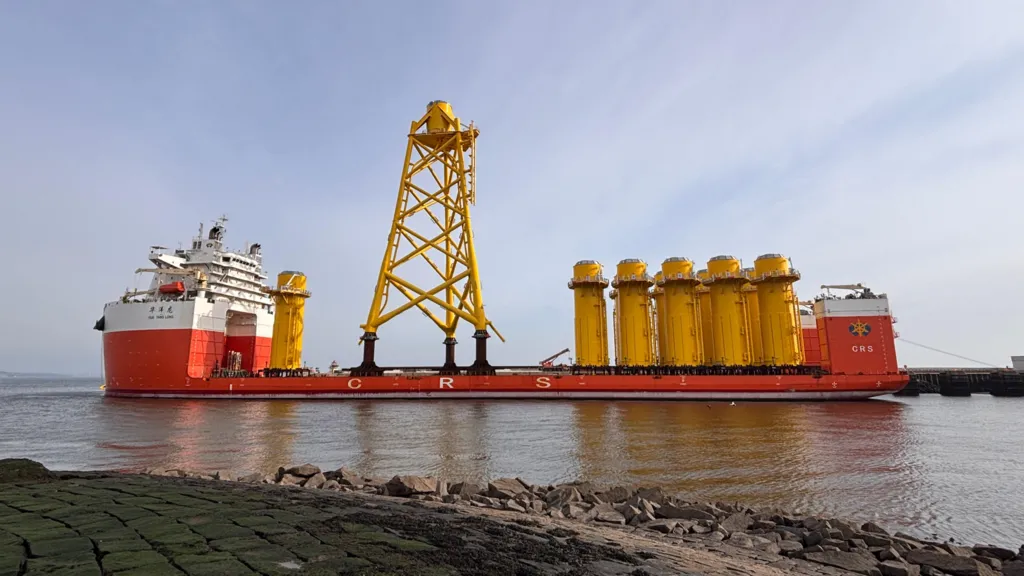
A massive cargo vessel carrying crucial components for offshore wind farms has docked at the Port of Leith in Edinburgh, marking another significant step in Scotland’s expanding renewable energy industry and reinforcing the port’s growing role as a strategic hub for the offshore wind sector.

The vessel arrived loaded with enormous wind turbine parts destined for major offshore energy projects being developed in the North Sea. The shipment includes giant turbine blades, tower sections, and other large structural components that will eventually form part of new offshore wind farms designed to generate clean electricity for thousands of homes across the United Kingdom.
The arrival attracted considerable attention along the waterfront as the scale of the cargo became visible. Individual turbine blades stretched well over 80 metres in length, dwarfing surrounding port infrastructure and highlighting the extraordinary engineering required for modern wind power generation.
Port officials confirmed that the equipment will be temporarily stored and assembled at Leith before being transported offshore to installation sites. Heavy-lift cranes and specialised transport vehicles have been deployed to handle the delicate unloading process, which requires careful coordination due to the sheer size and weight of the components.
Industry specialists say the arrival demonstrates the increasing importance of Scottish ports in supporting the country’s transition to renewable energy. Scotland possesses some of the most favourable wind conditions in Europe, particularly in offshore locations in the North Sea, making it a key centre for wind power development.
Over the past decade, offshore wind capacity in the United Kingdom has expanded rapidly as the government seeks to reduce carbon emissions and strengthen energy security. Major investment programmes have been launched to construct large wind farms far out at sea, where stronger and more consistent winds allow turbines to produce electricity more efficiently than on land.
These projects rely on complex supply chains involving ports capable of handling unusually large components. Wind turbine blades, tower sections and nacelles – the housings that contain generators and other mechanical systems – must often be transported by specialised cargo vessels due to their dimensions.
The Port of Leith has increasingly positioned itself as one of the key logistical centres for this industry. The harbour has undergone extensive upgrades in recent years, including expanded quaysides, reinforced dock surfaces and new heavy-lift capabilities designed specifically for renewable energy projects.
Officials at the port say these improvements allow Leith to handle some of the largest turbine components currently being manufactured for offshore wind farms. The new generation of turbines can exceed 250 metres in total height when installed, with blades longer than the wingspan of a commercial aircraft.
Handling equipment of this scale requires careful planning and specialised infrastructure. Once unloaded from the vessel, the components are typically transported across the port using self-propelled modular transporters, large multi-axle vehicles designed to move heavy industrial equipment with precision.
From there, the parts will be staged for transfer onto installation vessels that will carry them to offshore construction sites. At sea, specialised ships equipped with towering cranes will lift the tower sections into place and assemble the turbines piece by piece on pre-installed foundations anchored to the seabed.
Energy analysts note that the arrival of such cargo reflects the broader growth of renewable infrastructure across the United Kingdom. Offshore wind has become one of the fastest-expanding energy sectors in the country, supported by government policies aimed at achieving net-zero carbon emissions by mid-century.
Large wind farms planned or under construction in the North Sea are expected to supply electricity to millions of households once completed. Several of these projects involve turbines significantly larger than earlier generations, allowing each installation to generate more power with fewer individual units.
The economic impact on local communities is also significant. Port operations, engineering services, logistics firms and maintenance contractors all benefit from the presence of renewable energy supply chains. In Scotland, the offshore wind sector is increasingly viewed as a long-term source of skilled employment and industrial investment.
Edinburgh’s waterfront area, including Leith, has experienced major redevelopment in recent years, partly driven by the expansion of maritime industries linked to renewable energy. Local authorities and port operators hope that the growing volume of offshore wind cargo will strengthen the region’s reputation as a centre for green energy logistics.
Environmental advocates also view such developments as an important part of the global effort to combat climate change. Offshore wind farms produce electricity without emitting greenhouse gases during operation, making them a key element in national strategies to transition away from fossil fuels.
Nevertheless, building and installing these massive structures remains a technically demanding process. The transportation of turbine parts alone requires specialised ships capable of carrying unusually long and heavy loads while maintaining stability during ocean voyages.
Once the components arrive in port, careful scheduling is required to coordinate storage, assembly and onward transport. Any delays can affect installation timelines at sea, where operations are often limited by weather conditions and the availability of specialised vessels.
Port officials say the latest delivery will remain in Leith for several days while unloading operations are completed. Engineers and logistics teams are working around the clock to ensure the turbine components are safely transferred from the ship to the dockside storage areas.
Observers along the waterfront watched as cranes slowly lifted the enormous blades from the vessel’s deck, swinging them gently toward the quay before lowering them onto waiting transport platforms. The precision required for such operations underscores the complexity of modern renewable energy supply chains.

As offshore wind development continues to accelerate, shipments like this are expected to become increasingly common at ports across the United Kingdom.
For Leith, the arrival of the massive cargo vessel represents more than just another delivery. It reflects the growing role of Scottish infrastructure in supporting the global shift toward cleaner energy sources and highlights the scale of the engineering effort required to build the renewable power systems of the future.
With additional offshore wind projects planned in the coming years, industry leaders expect the Port of Leith to remain a critical gateway for turbine components heading to the North Sea, reinforcing Scotland’s position at the forefront of Europe’s renewable energy transition.
Related News:
 Aberdeen Chosen for GB Energy HQ at Marischal Square
 How to Exit Your Broadband Contract Without Paying Exit Fees
 Supreme Court Ruling on Car Finance Scandal Poised to Impact Millions of Motorists and Banks
 Stunning Welsh Island with Historic Fort and Modern Luxuries Hits Market for £3 Million
 UK Jobs Market Faces Strain as Employers Cut Bonuses and Hiring Amid Economic Slowdown
 Chancellor Rachel Reeves Pushes for Sweeping Changes to Environmental Protections to Accelerate Development
 Inflation Latest: Cost of Living Expected to Rise Again in Key Figures Released Today
 Retail Sales See Uptick Amid Errors and Delays as ONS Faces Scrutiny
 UK House Prices Hit Record £299,331 as Market Shows Steady Growth
Shein UK Faces Allegations of Shifting Majority of Profits to Singapore to Reduce UK Tax
UK House Prices Hit Record £299,331 as Market Shows Steady Growth
Shein UK Faces Allegations of Shifting Majority of Profits to Singapore to Reduce UK Tax
 UK Mobile Retailers Lock Doors Amid Surge in Organised Phone Thefts
 UK Retail Sales Rise in August, but Tax Concerns Loom Over Festive Period
 Jaguar Land Rover Extends Production Halt Following Cyber-Attack
 UK Labour Market Shows Signs of Cooling as Wage Growth Slows and Redundancies Rise
 UK Wage Growth Remains High, But Cost of Living Pressures Bite
 British AI Startup Outshines Human Forecasters in Global Prediction Contest
 Vodafone Franchisees Sound Alarm: Mental Health Toll of Commission Cuts Revealed Years Before £120m Court Battle
 Great Britain’s Energy Operator Commits to Strengthening Grid to Prevent Blackouts
 UK Government Backs Return of International Rail Travel to Kent Stations
 Marks & Spencer Staff to Work on Boxing Day for First Time in Five Years Amid Cost-Cutting Measures
 Senior Tories Condemn Badenoch’s Vow to Repeal Climate Change Act as Catastrophic
 Wetherspoon vows to keep prices low amid soaring energy and tax costs
 He-Man Set for Big Comeback as UK Toy Industry Rides ‘Newstalgia’ Wave
 Delivery Apps Could Double the Cost of Your Groceries, Warns Consumer Watchdog
 UK House Price Growth Slows as Buyers Exercise Caution Ahead of Autumn Budget
 Kemi Badenoch Unveils ‘Golden Rule’ to Halve Spending Cuts for Deficit Reduction at Tory Conference
 Royal Mail Fined £21m for Delivery Failures
 Parents spending £5,000 on special school assessments in England
 China warns UK over delayed London mega embassy decision
 New V-Level qualification to transform post-16 education
 Pizza Hut to shut 68 sites after collapsing into administration
 Real living wage set to rise nearly 7% for UK workers in 2026
 Reeves Faces Setback as Labour May Miss Homes Target
 Trump’s UK Ambassador Urges North Sea Drilling to Strengthen US Ties
 ABF May Split Primark from Food Division Amid Tough Market
 M&S Profits More Than Halve After Cyber-Attack
 Tony Blair think tank warns Rachel Reeves must cut taxes if manifesto broken
 Millionaires group urge Reeves to introduce wealth tax to ‘lift kids out of poverty’
 Global markets drop amid tech sell-off and China slowdown
 PM Highlights UK Business at G20 in South Africa
 Mossmorran Plant Closure Hits Cowdenbeath Hard
 Starmer Says Labour’s Economic Plan Needs Years to Deliver
 Virgin Media Fined £23.8m Over Telecare Safety Failures
 Rising Water Bills Lift Troubled Thames Back to Profit
 Historic £100-Weekly Pension Boost Brings Relief for UK Mineworkers
 UK Investment G7: Britain Records Lowest Level Under Starmer
 HMRC Delays Leave Taxpayers Waiting Over a Year for Refunds
MPs warn AI financial risks threaten UK stability
HMRC Delays Leave Taxpayers Waiting Over a Year for Refunds
MPs warn AI financial risks threaten UK stability
 MPs warn AI financial risks threaten UK stability
 Labour Must Revive High Streets to Avoid Election Collapse
 Households in England Face Rising Water Bills in April
 UK New Car Discounts Near £6,000 as Prices Are Slashed
 Study Finds One in Seven England Takeaways Are Dark Kitchens
 Draft Severe Weather Plan Following Storm Flooding
 What is Groundwater Flooding and Why Dorset is Seeing ‘Historical Highs’
 Dozens of Flood Warnings in England After Days of Non-Stop Rain
 Pound Sinks and Borrowing Costs Rise as Starmer Fights for Job
 London Loses Its Grip on Ambitious Young Workers
 Row at David Lloyd Clubs Over £140-a-Month ‘Queue-Jumping’ Pass
 Major UK Clothing Firm Collapses into Administration — 109 Jobs at Risk
 UK Housing Market Shows Early Recovery Signs
 UK economy struggles as growth stalls at 0.1% in late 2025
 Could Manchester Lead the UK’s Economic Revival?
 Royal Mail Blames Poor Weather and Sickness for Delayed Deliveries
 Temperatures Dip Below Freezing as Arctic Air Sweeps Across the UK
 Lloyds Boss Accepts Concern Over Use of Staff Data in Pay Talks
 Jenrick: I’ll Back OBR but There’ll Be No More Cosy Consensus
 Store at Famous Shopping Village to Close After 18 Years Due to Rising Costs
 UK Job Vacancies Hit Five-Year Pandemic Low
 US Will Not Back Out of Tariff Deals with UK and Others, Says Trump Trade Representative
 Luxury Airbnb Cabins With Hot Tubs Must Be Demolished After Planning Ruling
 UK Youth Unemployment Surges Amid Tax Changes
 Strong Rebound for UK Housing Market Sees 6% More Homes
 Reeves Must Back Defence Plan or Face Dismissal, Says Unite Chief
 UK’s First Geothermal Plant Powers 10,000 Homes
 Switching Energy Deal Can Save £200 as Price Cap Falls
 Hornby Sells Scalextric for £20m to Purbeck Capital Partners
 UK house prices rise as market steadies
 Labour’s Employment Shake‑Up ‘Makes Britain Worse Than France’
 Bogus ‘Oxford Professor’ Jailed Over £880k Investment Scam