Published: 3 April 2026 . The English Chronicle Desk. The English Chronicle Online—Monitoring environmental crises and their human impact.
A lethal combination of extreme weather phenomena has paralyzed much of Greece over the last 48 hours. While residents near Athens grapple with the aftermath of a devastating flash flood that claimed the life of a 55-year-old man, the island of Crete has been transformed into a surreal, “apocalyptic” landscape by a massive plume of Saharan dust. The weather front, dubbed Storm Erminio, has triggered red alerts, grounded flight networks, and severed vital ferry links across the Aegean Sea.

The storm’s most tragic consequence occurred in the coastal town of Nea Makri, approximately 25 kilometers northeast of Athens. Early on Thursday, 2 April, emergency responders discovered the body of a man—identified by some reports as a 55-year-old local and others as a Polish national—trapped beneath a vehicle.
-
The Surge: Authorities believe the victim was swept away by a torrent of rushing floodwater while attempting to navigate the streets.
-
Infrastructure Collapse: The deluge was so severe that it submerged the basement of the local police station and split roads in two in the nearby Kallitechnoupoli suburb. In the city center of Athens, traffic remains snarled as utility workers clear hundreds of downed trees and repair ruptured water pipes.
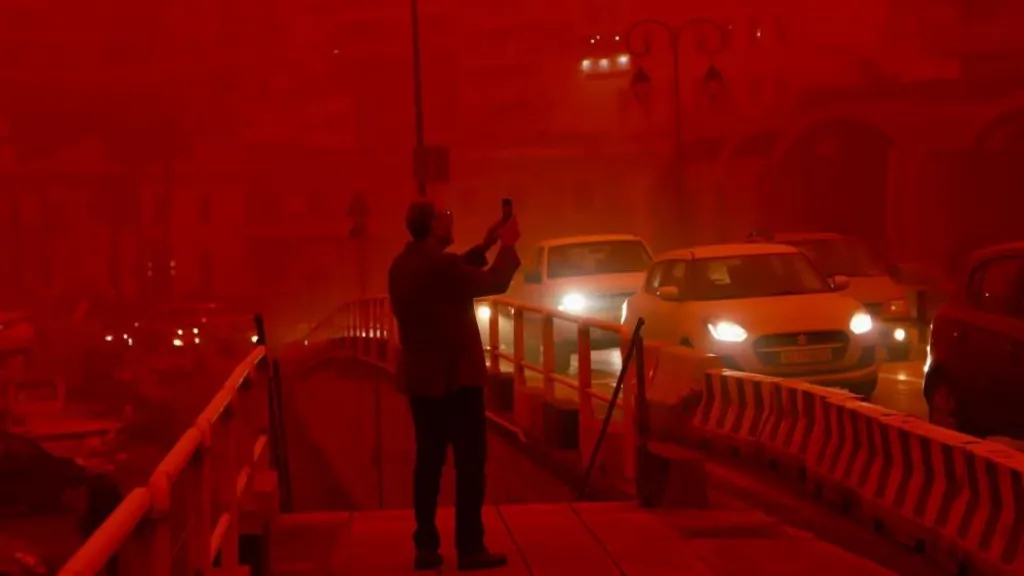
Further south, the island of Crete experienced a meteorological event of staggering intensity. Strong southerly winds dragged a massive cloud of sand from the Sahara Desert across the Mediterranean, turning the sky a deep, eerie red-orange.
-
Visibility Crisis: Dust concentrations exceeded 1,000 micrograms per cubic meter in some areas, forcing the cancellation or rerouting of multiple flights. A British Airways flight from London was forced to divert to Corfu, while a Brussels service was redirected to Athens.
-
Red Alert: The National Meteorological Service maintains a rare Red Warning for western and southern Crete. Residents have been urged to stay indoors to avoid severe respiratory risks associated with the “blood rain”—a phenomenon where dust mixes with falling rain to create crimson droplets.
The Greek Fire Service reported a staggering 674 emergency calls in a 24-hour window, primarily for water pumping and rescuing individuals trapped by rising waters.
-
Island Isolation: All ferry departures from the major ports of Piraeus and Souda remain suspended due to gale-force winds, leaving thousands of travelers stranded ahead of the Easter holiday period.
-
Bridge Collapses: On the island of Poros, raging floodwaters obliterated a small bridge and swept several parked vehicles into the sea. Similar scenes were reported on Paros, where schools remained closed through Friday.
-
Regional Emergency: The dust storm’s reach extended beyond Greece; the city of Tobruk in neighboring Libya declared a state of emergency on Wednesday as visibility dropped to near zero.

While the storm is expected to begin tapering off by late Friday, the combination of infrastructure damage and the lingering dust haze has created a logistical nightmare for the Greek government. As clean-up operations begin, climate experts are once again pointing to the increased frequency of these “extreme spring crossovers”—where winter-like storms collide with desert heat—as a hallmark of shifting global weather patterns.
Storm Erminio & Dust Impact Report (April 2026)
| Region | Primary Impact | Status |
| Nea Makri (Attica) | 1 Fatality (Flood-related) | Recovery Ongoing |
| Crete | Saharan Dust / Red Skies | Red Warning Active |
| Poros & Paros | Infrastructure / Bridge Failure | Schools Closed |
| Piraeus Port | Shipping Prohibition | Moored / Suspended |
| Air Travel | Cancellations (Crete/Santorini) | Severe Disruption |
Related News:
 Shutting North Sea ‘Will Drive Up Carbon Emissions’
 Storm Hernando: Edinburgh Airport Flights Cancelled in US Travel Chaos
 Storm Hernando: Edinburgh Airport Flights Cancelled in US Travel Chaos
 ‘Extinct’ Antelope Returns to Sahara, Bringing Hope
 Guterres Warns Global Cooperation Under Threat at UN’s 80th Year
 Japan Prepares for Kashiwazaki Restart After Fukushima Legacy
 Half the World’s Largest Cities Face Rising Water Stress
 The Sound of Mayhem’: Terror and Loss at Mount Maunganui
 Reindeer Deaths Rise as Finnish Herders Blame Border Wolves
 Storm Leonardo Triggers Election Delay Calls in Iberia
 Dozens of Flood Warnings in England After Days of Non-Stop Rain
 Fast-moving Wildfires Rage Across Southwestern US
 Moment Officers Rescue Injured Bald Eagle From Icy Hudson River
 Snow and Rain Warnings as Cold Snap Continues in the UK
 Flooding May Worsen Before It Improves as More Rain Forecast for the UK
 As Trump Retreats from Climate Goals, China Is Becoming a Green Superpower
 Eight Skiers Found Dead After California Avalanche
 Break from Wintry Weather as UK Temperatures to Climb to 14 °C
 Exciting’ or ‘Frustrating’? East Coast Reacts to Record Snow
 More Than 5,000 Flights Cancelled as US East Coast Digs Out of Record Snow
 Greenpeace $345m Ruling Sparks Appeal Battle
 UK Winter Nowhere Near a Record Breaker Despite Floods and Storms
 UK Records Warmest Day of the Year as Temperatures Exceed 18 °C
 Farmers on Edge as Record Rainfall Dampens Slurry Season
 The Sad, Strange Story of the World’s Most Radioactive Paradise
 Fuel and Remittances: How Iran Conflict Hits India At Home
 Tiny Possum and Glider Thought Extinct for 6,000 Years Found in Remote West Papua
 US Eases Sanctions on Russian Oil Sales to India During Iran Conflict
 Musk’s xAI Permit Sparks Fury Over Power Plant Expansion
 Scotland Braces for 80mph Gales and ‘Intense Rain’
 Bodies of Two Chinese Backpackers Found in Floodwaters
 The Truth Behind Rising Energy Costs and Fossil Fuel Myths
 Millions Left Without Power as Grid Fails
 Extreme Weather: Europe Shivers as Cyclone Narelle Hits
 Tropical Cyclone Narelle Batters the Western Australian Coast
 Trump to Deploy “God Squad” Over Gulf Wildlife Protections
 ‘The Invisible Killer’: Chiang Mai Air Pollution Sparks Health Crisis as Children Suffer Nosebleeds
 ‘The Invisible Killer’: Chiang Mai Air Quality Crisis Sparks Pediatric Health Emergency
 UK Must Act with Courage and Clarity on Israel-Palestine Conflict, Says Foreign Affairs Committee Report
 Yvette Cooper Signals Global Momentum Towards Gaza Peace Deal Amid Humanitarian Crisis
 Chaos at Ibrox as Martin’s Rangers Era Comes to an End
 Russia’s Latest Push to Win US Favors Shows Deep Desperation
 BBC to Apologise Over Edited Trump Speech Amid Backlash
 Greene Pushes Epstein Files Amid Trump Fallout
 Zelenskyy Signs Fighter Jet Deal Amid Russian Drone Attacks
 Shadow Fleet at Sea: Europe’s Battle Against Illicit Oil Shipping
 US Suspends Afghan Immigration After White House Shooting
 Conservatives Pledge to Scrap 2030 Petrol and Diesel Car Ban
 UK Weather: End of Cold Spell in Sight as Temperatures Rise
 Trump Weighs Response to Iran Crackdown as Tehran Says Communication Open With US
 US Clears Nvidia AI Chip Sales to China in Policy Shift
 Gulf states warn Trump Iran strikes risk wider Middle East war
 Sydney Shark Attack Surge Shocks Australia Beaches
 No Gas Boiler Ban as UK Warm Homes Plan Backs Heat Pumps
 Devon hosts first high-density hydro power system
 Portugal Election Delivers Socialist Win as Far Right Surges
 Australian Families Leave Syrian Camp for Home
 ‘I Would Scream in My Sleep’: Alawite Women from Syria Tell of Kidnap and Rape
 Epstein Eyed Record Label Investment to Access Women, Files Suggest
 How Do You Modernise Mango Farming? India’s Growers Urged to Innovate as Climate Change Hits
 Ukraine Negotiator Reveals What It Feels Like Facing Russia
 Drugs, Denial, Stigma: Fiji’s HIV Crisis Hits Children
 Hilary Knight speaks out on Trump’s recent hockey remarks
 American Citizen Killed in Cuba Boat Shooting, U.S. Officials Say
 Iran’s Regime Still Intact — Coming Days Will Test Its Survival
 In Maps: Strikes Across Iran and the Middle East
 Brit ‘in Good Spirits’ Amid Dubai Missile Attacks, Stranded but Safe
 Civilian Deaths in Iran Pass 700 Amid Fear of Bombs and Regime Clampdown
 ‘Every Day Feels Like a Month’: Iranians Describe Life Under ‘Constant’ US‑Israeli Strikes
 Penny Wong silent on Australian crew in sub strike
 Finland Plans to Lift Decades‑Old Ban on Hosting Nuclear Weapons
 Trump Pressures Congress Over Save America Act
 Iran War Puts Trump at Political Risk Amid Rising Prices
 Goma Drone Attack Kills Three as Conflict Escalates
 Queensland Protest Laws Spark Free Speech Backlash
 Trump Nato threats expose Iran strategy vacuum
 Trump Facing Backlash from Epstein Survivors Over Files
 UK Forces Ready to Seize Russian Shadow Fleet Vessels
 Trump Considers Military Operation to Seize Iran’s Uranium
 “It Ends With Trial”: Judge Tosses Blake Lively’s Sexual Harassment Claims Against Justin Baldoni