Published: April 6, 2026
The English Chronicle Desk
The English Chronicle Online
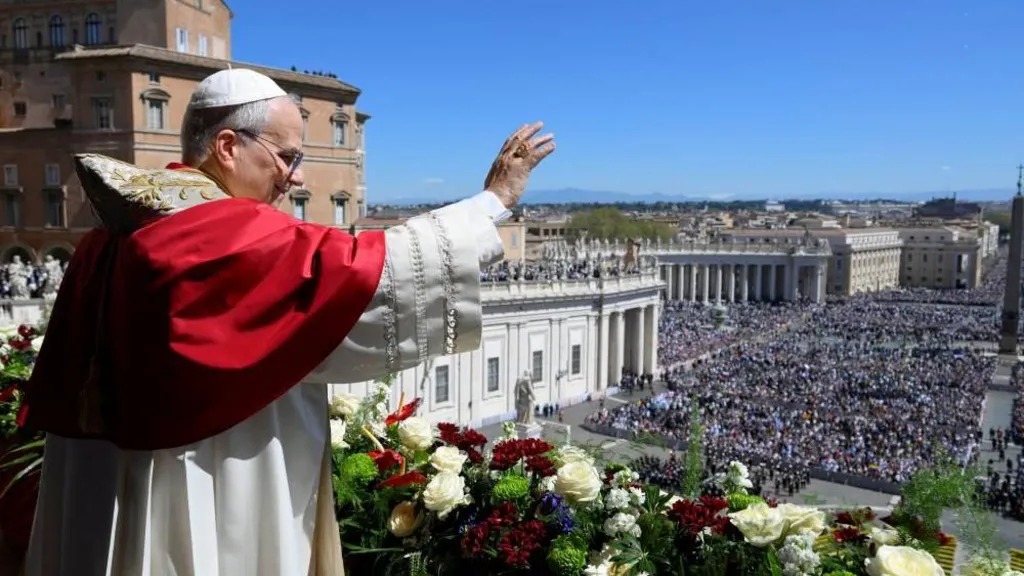
In his first Easter Mass as pontiff, Pope Leo delivered a solemn and far-reaching appeal to global leaders, urging them to reject conflict and commit to peace in a world increasingly marked by division and instability. Speaking before thousands gathered at St. Peter’s Square and millions watching worldwide, his message set the tone for what many observers see as the defining priorities of his papacy.

Easter, the most significant event in the Christian calendar, symbolizes renewal, hope, and the triumph of life over death. Against this backdrop, Pope Leo framed his address as both a spiritual reflection and a political appeal, emphasizing the urgent need for reconciliation in regions plagued by war, humanitarian crises, and geopolitical rivalry.
In his homily, the Pope called on leaders to “choose peace over power, dialogue over destruction, and humanity over ambition.” His words resonated strongly at a time when multiple conflicts continue to destabilize regions across the globe, from ongoing wars to rising tensions between major powers. While he did not single out specific countries, the references were widely interpreted as addressing a broad spectrum of international disputes.
The address also underscored the moral responsibility of political leadership. Pope Leo stressed that decisions made at the highest levels of government carry profound consequences for ordinary people, particularly the most vulnerable. He highlighted the suffering of civilians caught in conflict zones, including displaced families, children, and the elderly, urging leaders to consider the human cost of their policies.
Observers noted that the Pope’s message aligns with the long-standing diplomatic tradition of the Vatican, which has consistently advocated for peace, mediation, and humanitarian engagement. However, the tone of this address suggested a renewed urgency, reflecting the scale and complexity of current global challenges.
Beyond geopolitics, Pope Leo also addressed broader societal issues, linking the pursuit of peace to economic justice and social stability. He argued that inequality, poverty, and exclusion often serve as underlying drivers of conflict, and called for a more equitable distribution of resources. This integrated perspective highlights the interconnected nature of modern crises, where economic and political factors reinforce one another.
The Easter Mass drew an exceptionally large and diverse audience, including pilgrims, tourists, and representatives from various nations. Many attendees described the address as both inspiring and sobering, noting its emphasis on collective responsibility. For believers, the message carried spiritual significance; for policymakers, it served as a pointed reminder of ethical obligations.
International reactions have been mixed but largely attentive. Several leaders welcomed the Pope’s call for peace, echoing the importance of الحوار and cooperation. Others have remained cautious, emphasizing the complexities involved in resolving entrenched conflicts. Analysts suggest that while such appeals may not produce immediate policy changes, they contribute to shaping global discourse and public expectations.
The timing of the address is particularly notable. Easter often serves as a moment of reflection, but this year’s message arrives amid heightened uncertainty. Economic pressures, security concerns, and shifting alliances have created an environment in which calls for stability carry added weight. In this context, Pope Leo’s intervention can be seen as both symbolic and strategic.
Historically, papal addresses have played a role in influencing international relations, albeit indirectly. The Vatican’s moral authority, while not backed by military or economic power, allows it to engage across ideological and political divides. Pope Leo appears intent on leveraging this position, positioning the Church as a voice for moderation and dialogue.
At the same time, challenges remain. The effectiveness of such appeals depends largely on the willingness of political actors to engage in compromise, which is often constrained by domestic pressures and strategic interests. Critics argue that moral exhortations, while valuable, may have limited impact in the face of entrenched geopolitical competition.
Nevertheless, the significance of the address lies in its articulation of a clear ethical framework. By framing peace as a choice rather than an abstract ideal, Pope Leo places responsibility directly on decision-makers. This approach seeks to move beyond rhetoric, encouraging tangible actions that prioritize human welfare.
The speech also reflects an awareness of the evolving role of global institutions. In an era where multilateralism faces increasing strain, the Pope’s call for cooperation highlights the need for renewed commitment to collective solutions. Whether through diplomacy, humanitarian aid, or conflict resolution, the emphasis remains on shared responsibility.
For many within the Catholic community, the address marks an important moment in the early days of Pope Leo’s leadership. It signals continuity with past teachings while also introducing a distinct emphasis on urgency and accountability. As his papacy develops, further statements and actions will likely build on these themes.
In the immediate term, the impact of the Easter message will be measured not only by political responses but also by its resonance among ordinary people. Public opinion can play a crucial role in shaping policy, and appeals that capture widespread attention have the potential to influence broader societal attitudes.
Ultimately, Pope Leo’s first Easter Mass address serves as both a reflection of current global anxieties and a call to transcend them. By urging leaders to choose peace, he has positioned his papacy within the ongoing struggle to navigate a complex and often volatile world. Whether this message translates into meaningful change remains uncertain, but its clarity and intent are unmistakable.
Related News:
 Police Assessing Stansted Airport Private Flights Over Epstein Ties
 Inside Kyiv’s resolve as conflict nears five‑year mark
 What to Watch for During Trump’s State of the Union Address
 US Partially Evacuates Beirut Embassy Amid Rising Iran Tensions
 ‘It’s Eerie’ – Dubai on Edge as City Comes Under Attack
 Muslim Group Wants Mosques to Be Used as Polling Stations Ahead of UK Elections
 Manchester Students Mourn Ayatollah Amid Protest
 Baba Vanga’s Chilling World War 3 Prediction and Russia’s New Leader
 Iranian Players Get Australian Visas After Anthem Protest
 Ecuador Deploys 75,000 Forces in Anti-Gang Drive
 Missing Cuba-Bound Aid Ships Spark Urgent Search
 PM Seeks to Reassure Australians Over Fuel Supply
 ‘Teenage Me Could Not Have Imagined This’ Says First Female Archbishop
 Status Quo Restored: Netanyahu Intervenes After Police Block Latin Patriarch from Holy Sepulchre
 India Begins Mammoth Census for 1.4 Billion People
 UK Must Act with Courage and Clarity on Israel-Palestine Conflict, Says Foreign Affairs Committee Report
 Radioactive Leak at UK’s Nuclear Warhead Base Sparks Outcry Over Safety and Secrecy
 Mutual Inconvenience: Why Alaska Was Chosen for the Trump-Putin Summit on Ukraine
 Hong Kong Summons UK and Australian Envoys Following Asylum Grants to Democracy Activists
 Is the UK Ready to Put Boots on the Ground in Ukraine? Assessing Military Capacity and Challenges
 Channel Crossings Surge: Over 1,000 People Arrive in the UK in Small Boats in a Single Day
 Widow of Charlie Kirk Forgives Killer at Emotional Memorial Service
 Yvette Cooper Signals Global Momentum Towards Gaza Peace Deal Amid Humanitarian Crisis
 Russia’s Latest Push to Win US Favors Shows Deep Desperation
 BBC to Apologise Over Edited Trump Speech Amid Backlash
 Britain deploys RAF specialists to assist Belgium with drone threats
 Trump Urges Herzog to Grant Netanyahu Full Pardon
 Indian authorities demolish Kashmir home linked to Red Fort blast
 Greene Pushes Epstein Files Amid Trump Fallout
 December Run-Off in Chile as Election Produces No Winner
 Canada Passes Carney’s First Budget in Tight Parliamentary Vote
 Shadow Fleet at Sea: Europe’s Battle Against Illicit Oil Shipping
 India’s COP30 Delay Raises Global Climate Concerns
 Georgians Defy Government Crackdown After Year of Protests
 Albanese Opens Door to Bondi Royal Commission Amid Rising Pressure
 EU weighs response amid Greenland tariff crisis with Trump
 EU Says US Ties Have Suffered ‘Big Blow’ After Greenland Crisis
 Israel Moves to Bar MSF From Gaza Operations
 Australian Families Leave Syrian Camp for Home
 Starmer Weighs Fast-Tracking Defence Boost
 US Civil Rights Leader Jesse Jackson Dies Aged 84
 Snow and Rain Warnings as Cold Snap Continues in the UK
 Nine Arrested in France Over Death of Far‑Right Student
 Andrew Arrest Sparks Republic Debate in Australia
 Epstein Eyed Record Label Investment to Access Women, Files Suggest
 Australian PM Says Former Prince Andrew Has Suffered ‘Extraordinary Fall’ but That Won’t Prompt Republic Referendum
 Musk Cuts Starlink Access for Russian Forces – Giving Ukraine an Edge at the Front
 Farage Chagos Islands Row Sparks Fury
 Ukraine Negotiator Reveals What It Feels Like Facing Russia
 Chad Shuts Border With Sudan in Bid to Stop Conflict Spreading
 French Minister Moves to Block US Envoy Kushner from Government Access
 Has Europe truly learned from the failures of 2022?
 American Citizen Killed in Cuba Boat Shooting, U.S. Officials Say
 Iran’s Regime Still Intact — Coming Days Will Test Its Survival
 Trump Faces Questions Over Iran Conflict Plan
 Herzog Asio meeting sparks security storm
 ‘Every Day Feels Like a Month’: Iranians Describe Life Under ‘Constant’ US‑Israeli Strikes
 Finland Plans to Lift Decades‑Old Ban on Hosting Nuclear Weapons
 Minister Meets Crews Who Will ‘Take Out’ Iranian Drones
 Nine Days of Strikes Reshape the Middle East
 Trump Pressures Congress Over Save America Act
 Iran War Puts Trump at Political Risk Amid Rising Prices
 Iranian Football Squad Asylum Drama Shocks Australia
 Ukraine War Becomes Flashpoint in Hungarian Election
 Queensland Protest Laws Spark Free Speech Backlash
 Yvette Cooper: UK Must Follow Principles, Not US Pressure
 Trump Nato threats expose Iran strategy vacuum
 Trump’s Confidence Undimmed — But Every Iran Option Carries Risk
 Israel Says Iran Security Chief Larijani ‘Killed’
 Philippines energy emergency sparks coal power surge
 Trump Facing Backlash from Epstein Survivors Over Files
 Nepal to swear in ex-rapper as new prime minister
 UK Forces Ready to Seize Russian Shadow Fleet Vessels
 US Lawmaker Demands Testimony Over Sarah Ferguson’s ‘Close Epstein Ties’
 ‘Eye in the Sky’ Blinded: Photos Reveal Destroyed US Radar Jet at Saudi Base
 Trump Considers Military Operation to Seize Iran’s Uranium
 ‘The Final Word’: Kathleen Stock’s Polemic Against Assisted Dying Reshapes the UK Debate
 ‘The Cost of Living’: Asia’s Migrant Workers Debate if Gulf Jobs are Worth the Risk of War
 Report Says Pezzullo Acted ‘Recklessly’ in Dealings
 Hungary Claims Plot to Target Gas Pipeline Pre-Vote