Published: 21 August ‘2025. The English Chronicle Desk. The English Chronicle Online.
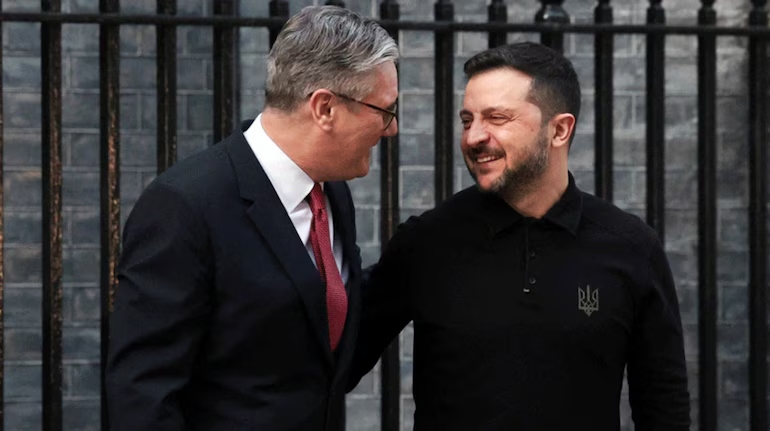
As discussions intensify over the potential deployment of British forces to Ukraine, questions are mounting about whether the United Kingdom is adequately prepared to provide sustained military support. Sir Keir Starmer has led a series of meetings with European allies to explore the creation of a “reassurance” force in Ukraine, aimed at bolstering the country’s defences against future Russian aggression. These deliberations follow a high-profile summit at the White House, described as “historic,” which brought together former US President Donald Trump, Ukrainian President Volodymyr Zelensky, and eight European leaders in an attempt to negotiate a peace settlement with Russia.
Sir Keir has publicly affirmed that the UK is ready to put “boots on the ground and planes in the air” to support Ukraine, while taking the lead in forming a “coalition of the willing.” Trump, however, has ruled out sending American troops, leaving the UK and its allies to consider their commitments more closely. In this context, the Prime Minister has pledged to increase UK defence spending, asserting that “tyrants” such as Russian President Vladimir Putin “only respond to strength.” The government initially aimed to raise defence expenditure to 2.5 per cent of GDP by 2027, targeting 3 per cent by the end of the next term, a goal subsequently revised in line with NATO commitments to five per cent.

While relations with Russia have reached their lowest point since the Cold War, questions remain about the UK’s current military capabilities compared to historical levels. Ministry of Defence figures as of April 2024 indicate the army now operates 219 Challenger II main battle tanks, an increase from 213 the previous year, and 128 Ajax armoured fighting vehicles, although only 91 are currently in active service due to long-standing delays. The Royal Air Force has added four new F-35 fighter jets, bringing the total to 35, while Typhoon jets, submarines, destroyers, and frigates numbers have largely remained constant.
Despite modernisation, the UK’s armed forces are considerably smaller than in 1984, a reflection of peacetime conditions and technological evolution. Advanced systems in aircraft, submarines, and warships provide significantly higher quality and capability than Cold War-era equivalents, but losses in direct combat remain a pressing concern. Much of the army’s armoured equipment dates back decades, with some vehicles originating from the 1960s, while older Type-23 frigates in the navy were designed for a lifespan of 18–21 years and have surpassed 30 years of service. Equipment upgrades, when undertaken, temporarily reduce available numbers, raising questions about readiness for prolonged conflict.
Financial commitments have increased, with current defence spending at 2.3 per cent of GDP, set to rise to 2.5 per cent by 2027. Experts such as James Black of RAND caution that NATO’s two per cent guideline, formulated in a post-Cold War context, is insufficient for high-intensity operations against a capable adversary like Russia. Many military analysts argue that a long-term investment of three per cent or more of GDP is needed to rebuild stockpiles, acquire new technology, and maintain readiness. Sir Keir’s pledge to reach 2.5 per cent by 2027, and a potential 3.5 per cent by 2035, may address stockpile shortfalls but does not represent an immediate improvement in operational capability.
Personnel constraints further complicate the situation. Of roughly 180,000 personnel in the armed forces, only 127,000 are fully trained, with the remainder comprising reserves or untrained staff. Recruitment and retention challenges, exacerbated by reduced competitiveness in pay, demanding working conditions, and declining family support facilities, have resulted in a loss of experienced personnel to civilian jobs. Defence experts warn that expertise is as critical as equipment in modern warfare, particularly as systems become increasingly complex. Training new recruits to full operational capability takes several years, meaning any rapid deployment for peacekeeping or combat would face delays.
Lessons from the ongoing conflict in Ukraine underscore the need for sustained, long-term operational readiness. RAND analyst James Black notes that assumptions of short, high-intensity conflicts are misleading; prolonged war requires continuous resupply, replenishment of missiles and ammunition, and robust industrial support to maintain capabilities. The UK has contributed £7.8 billion in military aid to Ukraine since February 2022, including equipment directly drawn from national stockpiles, further straining available resources. Rebuilding these stockpiles could take four to five years, even with increased procurement, given the limited domestic industrial capacity for advanced defence equipment.

The current size of the armed forces, 45 per cent smaller than in 1984, combined with ageing equipment and supply chain constraints, raises pressing questions about the UK’s capacity to sustain boots-on-the-ground operations in Ukraine. Defence officials acknowledge these challenges, emphasising the need for a comprehensive Strategic Defence Review to address the gaps and prepare the nation’s forces for potential allied conflicts.
While political will and international commitments signal readiness to support Ukraine, analysts caution that actual operational effectiveness will depend on a combination of increased investment, modernisation of equipment, recruitment and retention of skilled personnel, and the ability to sustain prolonged military operations. The UK’s efforts to strengthen its armed forces, though significant, will require careful planning and long-term commitment to ensure that promises of “boots on the ground” translate into a practical, capable, and resilient military presence abroad.
Related News:
 UK Must Act with Courage and Clarity on Israel-Palestine Conflict, Says Foreign Affairs Committee Report
 Starmer and Trump to Meet in Scotland Amid Growing Gaza Ceasefire Pressure
 Minister Dismisses Legal Concerns Over UK’s Pledge to Recognise Palestinian State
 MPs Call on UK Government to Delay Biometric Visa Checks for Gaza Students Amid Humanitarian Crisis
 Radioactive Leak at UK’s Nuclear Warhead Base Sparks Outcry Over Safety and Secrecy
 ‘I’m collateral damage’: ex-minister Tulip Siddiq on her Bangladesh corruption trial
 Mutual Inconvenience: Why Alaska Was Chosen for the Trump-Putin Summit on Ukraine
 “I Don’t Expect to Live a Normal Life”: How a Leeds Teenager Became the Target of a Chinese Bounty
 Ministers Accused of Defamation Over Palestine Action Ban and Mass Arrests
 UK Defence Secretary Says Allied Troops ‘Ready to Act from Day One’ if Ukraine Ceasefire Agreed
 Protests Expected as Israeli Arms Firms Join Global Defence Trade Fair in London
 UK Home Office to Launch French Beach Signage to Warn Asylum Seekers of Risks
 Charlie Kirk Killing Used to Mobilise UK’s Largest Far-Right Rally in Decades
 UK Immigration Figures: Separating Facts from Perceptions
 Far-Right Rally in London Draws Record Crowds Amid Clashes with Police
 Thousands Gather in London to Protest Donald Trump’s Second UK State Visit
 UK and Ireland Set to Unveil New Proposals to Address Northern Ireland’s Troubles Legacy
 Trump Urges UK to “Call Out the Military” to Secure Borders Amid State Visit
Tulip Siddiq Raises Concerns Over Alleged ‘Fake’ Documents in Bangladesh Corruption Trial
Trump Urges UK to “Call Out the Military” to Secure Borders Amid State Visit
Tulip Siddiq Raises Concerns Over Alleged ‘Fake’ Documents in Bangladesh Corruption Trial
 UK Recognises State of Palestine in Push to Preserve Hope for Peace
 UK’s Recognition of Palestine: Symbolic Step or Real Change?
Trump’s UN Speech Criticises London and UK Policies, Draws Far-Right Attention
UK’s Recognition of Palestine: Symbolic Step or Real Change?
Trump’s UN Speech Criticises London and UK Policies, Draws Far-Right Attention
 UK Fighter Jet Purchase Could Breach Nuclear Treaty, Warns CND
 A Third of EU Citizens in UK Report Discrimination by Public Bodies Post-Brexit
 Jailed Georgian Opposition Leaders Warn UK of Iranian Links to Ruling Party
 Russia repeatedly targets UK military satellites, warns Space Command chief
 Pro-Palestine March to Proceed in London Despite Calls to Cancel After Manchester Attack
 UK Universities Warn Students Ahead of 7 October Pro-Palestine Protests
Starmer Considers Stricter Measures on Pro-Palestinian Protest Chants
UK Universities Warn Students Ahead of 7 October Pro-Palestine Protests
Starmer Considers Stricter Measures on Pro-Palestinian Protest Chants
 Public Trust in SNP Hits Historic Low Amid NHS Concerns
 Tony Blair Met Jeffrey Epstein at Downing Street in 2002
 China’s Mega Embassy in London Faces Further Delay
 Johnson Suggests Mandelson Linked to China Spy Controversy
 Minister Blames Deputy for Collapse of China Spy Case
 Shabana Mahmood Warns Border Failings Are Eroding Trust in States
 Witness statements reveal the CPS China spy row collapse in the UK
 Large scale Chinese spying in UK sparks political storm
 Nigel Farage Calls Vladimir Putin ‘A Very Bad Dude’
 Rachel Reeves signals welfare reform ahead of key budget
 Prince Andrew met alleged Chinese spies during Pitch@Palace China trips
 Kosovo agrees to host Britain’s refused asylum seekers
 Plaid Cymru Triumphs in Caerphilly, Ending Labour Century-Long Hold
 Rachel Reeves to lead UK trade push in Saudi Arabia amid rights debate
 British Woman in Iran ‘Losing Hope’ Amid Ongoing Detention
 Johnson Approved China’s London ‘Super-Embassy’ in 2018
 BBC Journalist Held and Interrogated in Vietnam
 Zohran Mamdani becomes New York City’s first Muslim mayor
Zohran Mamdani names all-female transition team for NYC mayoralty
Zohran Mamdani becomes New York City’s first Muslim mayor
Zohran Mamdani names all-female transition team for NYC mayoralty
 Second world war veterans honoured as King leads Remembrance Sunday
 BBC director-general and news chief resign amid bias row
 New review urges UK to repatriate Shamima Begum, others from Syria
 Rama Rebukes Mahmood for Targeting Albanian Families
 Russian Vessel Used Lasers on RAF Pilots, UK Claims
 Ireland Boosts Ukraine Aid as Zelensky Visits Dublin
 Terence Stamp, ’60s British Film Legend and Star of Superman, Dies at 87
 Hong Kong Summons UK and Australian Envoys Following Asylum Grants to Democracy Activists
 Palestine Action Ban Protesters Plan Tactic to Overwhelm Police at Next London Demonstration
 Conservative Influencer Charlie Kirk Fatally Shot During University Debate
UK Rejoining EU ‘Unlikely in My Lifetime,’ Says Starmer’s Europe Reset Negotiator
Conservative Influencer Charlie Kirk Fatally Shot During University Debate
UK Rejoining EU ‘Unlikely in My Lifetime,’ Says Starmer’s Europe Reset Negotiator
 ‘Unite the Kingdom’ Rally Sparks Fears of Far-Right Normalisation Among Minority Britons
 Zarah Sultana Seeks Legal Action After Bitter Clash with Jeremy Corbyn Over Party Membership Funds
 Top Andy Burnham Ally Launches Fierce Critique of Starmer Ahead of Labour Conference
 Mahmood Pledges Reform of Modern Slavery Laws After Court Blocks Deportation Appeal
 Ed Miliband Urges Labour to Confront Billionaire-Backed Opposition to Net Zero Goals
 Digital ID Plans Ignite Debate Over £600m Treasury Tax Boost and Privacy Concerns
 Yvette Cooper Backs Digital ID Plan for UK Teens
 Ministry of Justice fails to file £11bn in spending receipts
 Reform UK candidate fined £19,000 after using AI-generated cases to challenge election
 William Steps Up Over Prince Andrew Palace Response
 Ireland Votes as Two Women Compete for Presidency
 Experts Warn Russia’s Burevestnik Missile Could Destabilise Arms Control
 Green Party Surges Past Labour in Latest UK Poll
 Zarah Sultana Launches Party to Change Politics
 Just Stop Oil Protesters Convicted Amid Climate Defence Row
 Starmer Faces Growing Dissent as Labour MPs Weigh Leadership Challenge
 Peers Flood Assisted Dying Bill with 942 Amendments
 Trump Deploys DHS to Charlotte in Major Arrest Operation
 Pentagon Officials in Ukraine to Discuss War End
 Venezuela Threatens Nobel Winner Machado with Fugitive Status
 Most Tories Expect to Support a Farage-Led Government