Published: 07 October 2025. The English Chronicle Desk.
As the second anniversary of the 7 October Hamas attacks approaches, university leaders across the United Kingdom have issued urgent reminders to students planning to participate in pro-Palestinian demonstrations, emphasizing the legal risks involved. Authorities have stressed that publicly expressing support for a proscribed terrorist organisation constitutes a criminal offence, and students taking part in rallies, vigils, or debates could face serious legal consequences if lines are crossed.
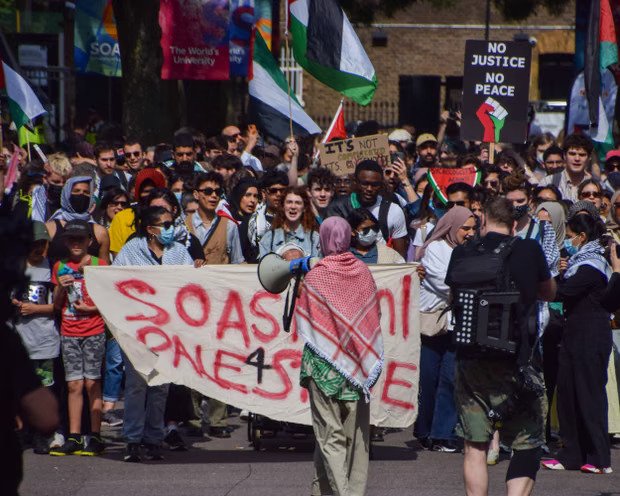
Up to ten events are expected to take place on or near campuses on Tuesday, ranging from vigils and rallies to discussions and marches. One of the more prominent gatherings is an “inter-university” march in London, which will involve students and staff from multiple institutions, including King’s College London, the London School of Economics, University College London, and SOAS. The march, advertised on Instagram under the banner “Inter-university march. Two years of genocide and our institutions remain complicit,” plans a walkout of classes at 2 pm and will culminate at SOAS.

The date marks the anniversary of the Hamas attack on Israel in 2023, which left 1,200 people dead, many more injured or abducted, and sparked the ongoing Israeli military response in Gaza. That response has, over two years, resulted in the deaths of more than 65,000 people, according to international monitors. Universities UK (UUK), the representative body for vice-chancellors and the higher education sector, has described the anniversary as a “potential flashpoint” and urged universities to review security arrangements to prevent escalation.
Vivienne Stern, UUK’s chief executive, highlighted the need for caution: “While universities must be places where contentious views can be expressed, and while universities have a legal duty to uphold free speech, we urge students and staff participating in protests to remember that 7 October is the anniversary of an atrocious attack on innocent people, and that expressing support for a terrorist organisation is a criminal offence.”
Alongside the London march, other events have been planned at universities, including Sheffield and Strathclyde. At Sheffield, the Revolutionary Communist Party is organising a “Rally for Palestine,” while Strathclyde’s Palestine Solidarity Society is hosting a “Protest 4 Palestine.” At King’s College London, Students for Justice for Palestine are holding an evening discussion titled “Why it didn’t start on October 7th.” Stern noted that these activities coincide with a period of heightened concern over antisemitic incidents on campuses. She urged university administrations to maintain close communication with Jewish student groups and to make reporting mechanisms for antisemitism widely available.
Louis Danker, president of the Union of Jewish Students, reinforced these warnings, acknowledging the right to protest but stressing the sensitivity of the date. “We respect the right to protest and the importance of free speech within the law,” Danker said. “There are 365 days in the year and on one of them – 7 October – Jewish students seek the space to mourn their loved ones murdered in southern Israel. Marking ‘two years of resistance’ on this date echoes the explicit justification and glorification of the Hamas terrorist attacks witnessed over the last two years. No Jewish student should have to stand by as others glorify a day that marks such loss for our community.”
In recent days, the UK government has also weighed in. Speaking in the Times, Prime Minister Keir Starmer condemned plans for the protests, calling them “un-British” and emphasising the moral obligation to respect others’ suffering. “Let me just spell that out for a moment: people on our streets calling for the murder of Jewish people they have never even met, for something they are not responsible for. A total loss of empathy and humanity not in some faraway land but right here in the heart of our country,” he stated. “And today, on the anniversary of the atrocities of 7 October, students are once again planning protests. This is not who we are as a country. It’s un-British to have so little respect for others. And that’s before some of them decide to start chanting hatred towards Jewish people all over again.”
The cautionary statements follow a surge in arrests during earlier demonstrations. On Saturday, nearly 500 people were detained in London during protests against the ban on the proscribed organisation Palestine Action, highlighting the potential for significant law enforcement intervention during politically charged events. Universities, in collaboration with police, are now focusing on ensuring that any demonstrations remain lawful and peaceful, while protecting the safety of all students and staff on campus.

With campuses preparing for a day of high tension, university administrators and student organisations face the challenge of balancing free speech with the responsibility to prevent the glorification of violence. Both UUK and Jewish student representatives have emphasised the importance of measured, lawful participation, urging students to be mindful of the legal and ethical boundaries involved. Authorities warn that while freedom of expression remains a fundamental principle, it does not extend to the endorsement of terrorist acts or organisations, a reminder that carries particular weight given the sensitivities surrounding 7 October.
As the anniversary approaches, attention is focused on how universities, law enforcement, and student bodies will navigate the complex intersection of protest rights, security, and community sensitivities. The coming events will serve as a test of both legal boundaries and the capacity of institutions to safeguard students while upholding the values of free and responsible expression.
Related News:
 UK Must Act with Courage and Clarity on Israel-Palestine Conflict, Says Foreign Affairs Committee Report
 Starmer and Trump to Meet in Scotland Amid Growing Gaza Ceasefire Pressure
 Minister Dismisses Legal Concerns Over UK’s Pledge to Recognise Palestinian State
 China-Backed Confucius Institutes at UK Universities Face Uncertainty Under New Free Speech Rules
 MPs Call on UK Government to Delay Biometric Visa Checks for Gaza Students Amid Humanitarian Crisis
 Radioactive Leak at UK’s Nuclear Warhead Base Sparks Outcry Over Safety and Secrecy
 ‘I’m collateral damage’: ex-minister Tulip Siddiq on her Bangladesh corruption trial
 Mutual Inconvenience: Why Alaska Was Chosen for the Trump-Putin Summit on Ukraine
 “I Don’t Expect to Live a Normal Life”: How a Leeds Teenager Became the Target of a Chinese Bounty
 Ministers Accused of Defamation Over Palestine Action Ban and Mass Arrests
 UK Defence Secretary Says Allied Troops ‘Ready to Act from Day One’ if Ukraine Ceasefire Agreed
 Is the UK Ready to Put Boots on the Ground in Ukraine? Assessing Military Capacity and Challenges
 Protests Expected as Israeli Arms Firms Join Global Defence Trade Fair in London
 University of Edinburgh Lecturers Launch Five-Day Strike Amid £140m Budget Cuts
 UK Home Office to Launch French Beach Signage to Warn Asylum Seekers of Risks
 Charlie Kirk Killing Used to Mobilise UK’s Largest Far-Right Rally in Decades
 UK Immigration Figures: Separating Facts from Perceptions
 Far-Right Rally in London Draws Record Crowds Amid Clashes with Police
 Thousands Gather in London to Protest Donald Trump’s Second UK State Visit
 UK and Ireland Set to Unveil New Proposals to Address Northern Ireland’s Troubles Legacy
 Trump Urges UK to “Call Out the Military” to Secure Borders Amid State Visit
Tulip Siddiq Raises Concerns Over Alleged ‘Fake’ Documents in Bangladesh Corruption Trial
Trump Urges UK to “Call Out the Military” to Secure Borders Amid State Visit
Tulip Siddiq Raises Concerns Over Alleged ‘Fake’ Documents in Bangladesh Corruption Trial
 UK Recognises State of Palestine in Push to Preserve Hope for Peace
 UK’s Recognition of Palestine: Symbolic Step or Real Change?
 It Changed My View’: Campaign Encourages Pupils in Deprived Areas to Consider University
Trump’s UN Speech Criticises London and UK Policies, Draws Far-Right Attention
It Changed My View’: Campaign Encourages Pupils in Deprived Areas to Consider University
Trump’s UN Speech Criticises London and UK Policies, Draws Far-Right Attention
 UK Fighter Jet Purchase Could Breach Nuclear Treaty, Warns CND
 A Third of EU Citizens in UK Report Discrimination by Public Bodies Post-Brexit
 Jailed Georgian Opposition Leaders Warn UK of Iranian Links to Ruling Party
 Russia repeatedly targets UK military satellites, warns Space Command chief
 Pro-Palestine March to Proceed in London Despite Calls to Cancel After Manchester Attack
 Starmer Considers Stricter Measures on Pro-Palestinian Protest Chants
 Public Trust in SNP Hits Historic Low Amid NHS Concerns
 Tony Blair Met Jeffrey Epstein at Downing Street in 2002
 China’s Mega Embassy in London Faces Further Delay
 MPs Urge UK to Let Gaza Scholars Bring Their Children
 Johnson Suggests Mandelson Linked to China Spy Controversy
 Minister Blames Deputy for Collapse of China Spy Case
 Shabana Mahmood Warns Border Failings Are Eroding Trust in States
 Witness statements reveal the CPS China spy row collapse in the UK
 Large scale Chinese spying in UK sparks political storm
 Nigel Farage Calls Vladimir Putin ‘A Very Bad Dude’
 Rachel Reeves signals welfare reform ahead of key budget
 Oxford Union president-elect ousted following Charlie Kirk scandal
 The debate over England’s compulsory reading test for 13-year-olds
 Prince Andrew met alleged Chinese spies during Pitch@Palace China trips
 Kosovo agrees to host Britain’s refused asylum seekers
 Plaid Cymru Triumphs in Caerphilly, Ending Labour Century-Long Hold
 Rachel Reeves to lead UK trade push in Saudi Arabia amid rights debate
 British Woman in Iran ‘Losing Hope’ Amid Ongoing Detention
 Johnson Approved China’s London ‘Super-Embassy’ in 2018
 BBC Journalist Held and Interrogated in Vietnam
 Bridget Phillipson Vows to Confront Unions Over Reading Tests
 UK University Suspends Human Rights Research Following Pressure from China
 UK University Faces Counter-Terror Probe Over China Pressure
 Zohran Mamdani becomes New York City’s first Muslim mayor
 Top Christmas Books Reads: Classics to Cozy Romcoms
Zohran Mamdani names all-female transition team for NYC mayoralty
China-critical UK academics face ‘extremely heavy’ pressure from Beijing
Top Christmas Books Reads: Classics to Cozy Romcoms
Zohran Mamdani names all-female transition team for NYC mayoralty
China-critical UK academics face ‘extremely heavy’ pressure from Beijing
 Second world war veterans honoured as King leads Remembrance Sunday
 BBC director-general and news chief resign amid bias row
 New review urges UK to repatriate Shamima Begum, others from Syria
 England’s Special Needs Support Faces Breaking Point
 Rama Rebukes Mahmood for Targeting Albanian Families
 Russian Vessel Used Lasers on RAF Pilots, UK Claims
 Ireland Boosts Ukraine Aid as Zelensky Visits Dublin
 Princess of Wales Launches Animated Video Series to Support Early Childhood Development
 Education Leaders Call for End to Compulsory GCSE Resits in English and Maths
 Thousands of New School Nursery Places to Be Rolled Out Across England
 Tanni Grey-Thompson Faces Abuse Over Opposition to Assisted Dying Bill
 Nigel Farage Unveils Controversial Immigration and Welfare Plans at Reform UK Press Conference
 White Low-Income Pupils in England Show Lowest Levels of School Engagement, Study Finds
 Yvette Cooper Signals Global Momentum Towards Gaza Peace Deal Amid Humanitarian Crisis
 Digital ID Plans Ignite Debate Over £600m Treasury Tax Boost and Privacy Concerns
 Green Party Surges Past Labour in Latest UK Poll
 Children to Learn Local History in Major Curriculum Overhaul
 Labour immigration crackdown could cost UK £4.4bn
 Starmer Faces Growing Dissent as Labour MPs Weigh Leadership Challenge
 Trump Deploys DHS to Charlotte in Major Arrest Operation
 Most Tories Expect to Support a Farage-Led Government