Published: 06 November 2025. The English Chronicle Desk. The English Chronicle Online.
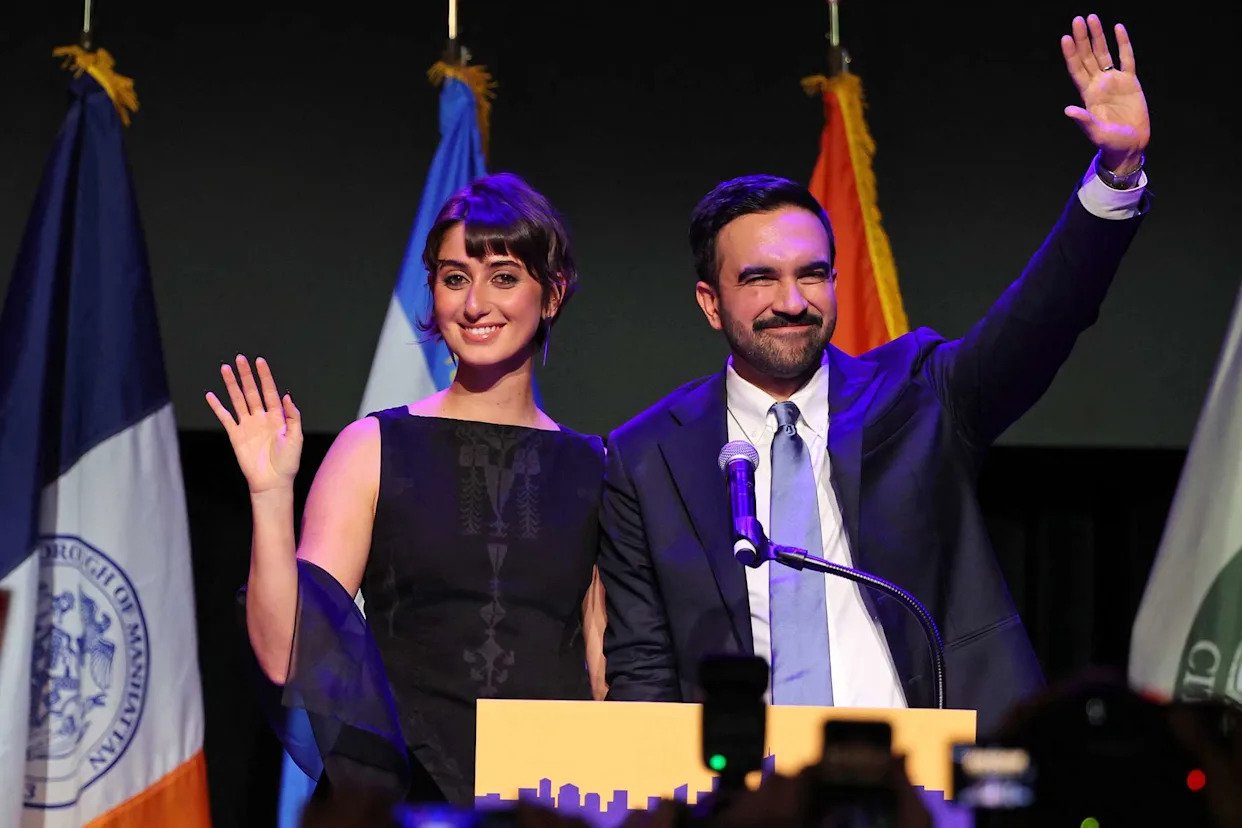
When Zohran Mamdani made history by becoming New York City’s first Muslim and South Asian mayor, his victory speech carried a heartfelt moment that resonated far beyond politics. “To my incredible wife, Rama, hayati,” he said, using the Arabic term for “my life.” “There is no one I would rather have by my side in this moment, and in every moment.”
Those few words captured a partnership that has quietly but powerfully shaped the couple’s journey. While Mamdani’s political rise has been closely documented, less has been known about his wife, Rama Duwaji — an artist, illustrator, and outspoken creative voice on issues of identity, displacement, and justice.
Born in Houston, Texas, in 1997 to Syrian-American parents, Duwaji’s early life was marked by cultural transitions. Her family moved to Dubai when she was nine, where she spent much of her formative years before returning to the United States for her studies. She graduated with a Bachelor’s degree in Communications in 2019, then earned a Master of Fine Arts in Illustration as a Visual Essay from the School of Visual Arts in New York City.

It was in New York, in 2021, that her life intersected with Mamdani’s. The two reportedly met on a dating app, and what started as a casual connection turned into a meaningful partnership. They got engaged in 2024 and married in February 2025 at the Manhattan Marriage Bureau, later holding a second ceremony in Uganda, Mamdani’s birthplace.
Since then, Duwaji has built a career that stands entirely on her own merit. Her artwork — rich in symbolism and layered in meaning — has appeared in major publications such as The New Yorker, The Washington Post, and Vogue. She has collaborated with global brands, including Apple and Spotify, and has exhibited her digital and ceramic works in both the U.S. and abroad. Her style combines digital illustration with traditional craftsmanship, often touching on themes of migration, womanhood, and the politics of belonging.
Despite being married to one of America’s most high-profile progressive politicians, Duwaji has consciously kept a low public profile. She rarely appears at political events and has avoided making campaign speeches. This quiet presence, however, has not shielded her from online scrutiny. During the mayoral campaign, critics questioned her silence, accusing her of distancing herself from Mamdani’s political activities.
Mamdani swiftly defended her on social media, saying, “If you take a look at politics today, you know how vicious it can be. I can take the criticism, but it’s different when it’s about someone you love. Rama isn’t just my wife; she’s an incredible artist who deserves to be known on her own terms.”
Those “terms” are deeply political. Through her art, Duwaji often explores themes of identity, injustice, and resistance. She has described art as “inherently political — in how it’s made, funded, and shared.” Her pieces frequently center on the experiences of displaced people and the humanitarian crises they face.
Earlier this year, Duwaji posted a digital animation that gained widespread attention online. It depicted a young Palestinian girl holding an empty pot, with the phrase “Not a hunger crisis” appearing across the screen. The image then transformed to show several figures holding similar empty pots, overlaid with the words “It is deliberate starvation.” The animation was widely interpreted as a statement on the situation in Gaza and the use of food scarcity as a weapon of war.
Her advocacy extends beyond the Middle East. Duwaji has also expressed criticism of U.S. immigration enforcement, particularly the actions of ICE (Immigration and Customs Enforcement). Through a series of illustrations and essays, she has explored the trauma faced by immigrant families and the bureaucratic machinery that perpetuates their suffering. Rather than direct activism, her method has always been through visual storytelling — allowing art to evoke empathy and awareness where words might fail.
Colleagues describe Duwaji as thoughtful and deeply engaged with global issues, but also intensely private. She prefers to let her art speak for her beliefs, rarely offering public commentary beyond the pieces she publishes. In interviews before her marriage, she emphasized her belief that “artists carry a moral responsibility to reflect the times they live in.”
Now, as New York’s new First Lady, observers are curious about what kind of public role Duwaji will embrace. Her marriage to Mamdani places her in the spotlight, but all indications suggest she will continue to prioritise her creative work over political appearances. Those close to her say she intends to remain focused on projects that amplify marginalised voices and explore the intersections between culture, migration, and human rights.

Her life story already reflects those themes. A Syrian-American who grew up in the Gulf, educated in the United States, and now residing in one of the world’s most diverse cities — Duwaji embodies the global complexity of identity that defines her art. Her illustrations often feature faceless figures in motion, symbolising people caught between borders, or portraits that mix traditional Middle Eastern patterns with contemporary imagery.
Critics and admirers alike see her as part of a new generation of politically conscious artists — individuals who blend personal expression with activism. In that sense, her creative path complements her husband’s political one. Both appear driven by a shared vision of equity and empathy, though they express it through very different mediums: Mamdani through policy and advocacy; Duwaji through lines, colors, and motion.
As New York City prepares to usher in Mamdani’s administration, Duwaji’s presence adds an intriguing dimension to the story. While some First Ladies of major cities take on ceremonial duties or public service causes, others reshape the role entirely. If her past work is any indication, Rama Duwaji may quietly redefine what it means to be a First Lady in a multicultural, politically charged city like New York — using art, rather than speeches, to spark conversation and reflection.
For now, she remains true to herself: an artist whose work refuses to look away from suffering and a partner whose quiet strength continues to support one of the most dynamic new figures in American politics.
Related News:
 Out of reach: stalled newbuilds leave Labour’s social housing targets in tatters
 PM Condemns Leaks, Vows Loyalty to Ministers and Stability
 UK Asylum Reforms: Temporary Refugee Status and Faster Deportations
 Minister Defends Tough New Asylum Reform Plan
 UK Net Migration Falls Sharply After ONS Revisions
 UK Vulnerable to Attack, Defence Committee Finds
 Rama Rebukes Mahmood for Targeting Albanian Families
 Russian Vessel Used Lasers on RAF Pilots, UK Claims
 MP Offers Seat to Help Burnham Challenge Starmer
 English Mayors Set to Introduce Tourist Taxes
 Ex-Classmate Accuses Farage of Dishonesty on Racism Claims
 Millions Face Higher Taxes Under Reeves New Budget
 Peers Get Extra Time to Debate Assisted Dying Bill
 Planned Palestinian Flag Raising at Belfast City Hall Faces Delay Amid Legal Concerns
 UK Military Chiefs Warn Funding Gap Threatens Defence
 Ex-Brexit MEP Rejects Claim of Pro-Russia Payments
 Labour U-turn: Unfair Dismissal Rights Delayed Six Months
 Government righting decades-old injustice for miners
 Army Barracks to House Migrants as Hotels Phase Out
 British Woman in Iran ‘Losing Hope’ Amid Ongoing Detention
 Hospice Cuts Raise Alarm Across England Amid Funding Crisis
 BBC Journalist Held and Interrogated in Vietnam
 Charlie Kaufman: They told me Being John Malkovich would never get made
 Green Party Surges Past Labour in Latest UK Poll
 Celebrities and Charities Demand UK Government Act on Child Poverty
 UK launches search for first-ever ‘town of culture’ to highlight overlooked areas
 Zarah Sultana Launches Party to Change Politics
 Dyche Criticises Corner Decision as Forest Draw with United
 Trump’s UK Ambassador Urges North Sea Drilling to Strengthen US Ties
 FBI Director Kash Patel Defends Girlfriend Amid Government Jet Claims
 French Taxi Driver Cleared in David Lammy Theft Case After Fare Dispute
 MPs Press Rachel Reeves to Hike Gambling Taxes
 One of world’s last dinosaurs on sale for £3m
 Boris Johnson accused of undermining BBC leadership
 ‘Reckless’ cuts to victims’ services will cost more than they save
 Starmer Faces Growing Dissent as Labour MPs Weigh Leadership Challenge
 Mary Earps’s Manchester United Return Faces Mixed Reception
 Sam Kerr Stars in Chelsea Return with Champions League Double
 This kid is something else: Alex Scott’s rise to England call-up
 David Szalay’s ‘Flesh’ Wins 2025 Booker Prize
 Farage appointee to lead Reform youth accused of anti-British views
 Politics latest: Starmer ‘will fight any leadership coup’ as Streeting denies attempt to oust Labour PM
 Son Reveals UK Couple in Iran Resort to Hunger Strike for Help
 Pressure Mounts on Starmer to Sack Chief of Staff Over Briefing Row
 Peers Flood Assisted Dying Bill with 942 Amendments
 England’s Special Needs Support Faces Breaking Point
 US Justice Department Files Lawsuit Against California Over Partisan Voting Maps
 Former Lion Heskey Warns of Shortage of England Strikers
 MoD warned over Excel risks before Afghan data breach
 UK Unveils Fast-Track Deportation and Asylum Overhaul
 UK Asylum Overhaul Sparks Debate Over Human Rights and Deportations
 UK Candidate Moved to Safe House After Election Threats
 Mahmood Defends Tough Overhaul of UK Asylum System
 Mother Watches in Horror as Teen Daughter Dies on Tracks
 South African Detained After Neo-Nazi Rally in Australia
 UK Warns China After MI5 Issues Espionage Alert
 Westminster Advances Legacy Bill Amid Criticism
 Only One Republican Opposes Mass Release of Epstein Files
 Commuters warned as yellow snow and ice alert hits Northern Ireland
 Bangladesh Families Call for Hasina’s Return and Execution
 Labour Faces Historic Decline in Wales
 Serial Rapist and Former Cop Found Guilty Again
 Pentagon Officials in Ukraine to Discuss War End
 PM Highlights UK Business at G20 in South Africa
 Kate Forbes: Motherhood Harder Than Politics
 Welsh Government Christmas 2020 Lockdown Criticised
 Venezuela Threatens Nobel Winner Machado with Fugitive Status
Reeves to Crack Down on Benefit Fraud While Lifting Two-Child Limit
Venezuela Threatens Nobel Winner Machado with Fugitive Status
Reeves to Crack Down on Benefit Fraud While Lifting Two-Child Limit
 Most Tories Expect to Support a Farage-Led Government
 Bill Murray Terrified Wes Anderson but Became His Closest Collaborator
 Labour MP claims devolution bill is ‘blatant discrimination’ against Cornwall
 Trump Envoy to Discuss Ukraine Peace at Kremlin
 India’s Labour Law Overhaul Sparks Fierce Debate
 Video shows Israeli troops kill Palestinians after surrender
 Machynlleth High Street Left Without Christmas Lights
 Jordan Bardella: France’s Young Presidential Contender
 Search underway for British man overboard off Tenerife
 Chinese & Japanese Boats Clash Near Disputed Islands
 Pavarotti statue frozen in Italian ice rink sparks backlash
 UK delays ruling on China embassy plan until January