Published: 11 November 2025. The English Chronicle Desk. The English Chronicle Online.
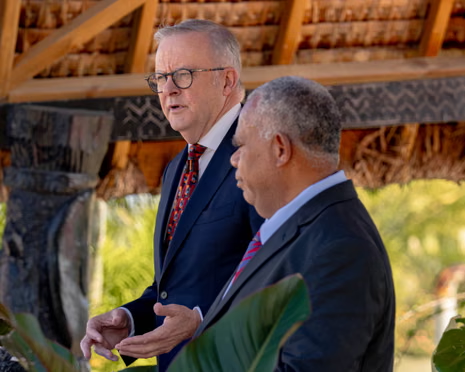
As the world grapples with the intensifying climate crisis, the next Conference of the Parties (COP31) has become a focal point for international attention, not only for its potential to shape global climate policy but also due to a growing deadlock over its host nation. Australia, once widely regarded as the frontrunner to host the summit, now faces uncertainty amid unresolved negotiations with Turkey, raising the possibility that the conference could default to Germany’s Bonn if an agreement is not reached.
The talks are unfolding in the Brazilian city of Belém, on the banks of the Amazon River delta, where delegations from around the world are engaged in intense discussions. Business representatives, government officials, campaigners, and lobbyists are huddled in conference rooms, devising strategies and action plans to address pressing climate challenges. These negotiations are inherently complex, with each delegation balancing national interests and international commitments, and the contest over COP31’s hosting has added an extra layer of tension.
For Australia, the bid had initially been considered almost a certainty. Back in 2022, the country presented a strong proposition to co-host COP31 alongside Pacific nations, highlighting the region’s vulnerability to climate change. The proposal envisioned a conference that would shine a spotlight on rising sea levels and the existential threats faced by Pacific island nations. In 2017, Fiji held the COP presidency, though the talks themselves took place in Bonn. Hosting in Australia would not only have brought the discussions closer to the Pacific but also allowed global delegates to witness firsthand the impacts of climate change on the region.

The bid was strategically advantageous for Australia both domestically and geopolitically. Domestically, it showcased Canberra’s commitment to its Pacific neighbors and reinforced the country’s image as a climate-conscious regional leader. Internationally, the move was seen as an effort to strengthen ties with the Pacific and assert influence in a region where Chinese engagement has been increasing. “Having it close to your home means you can create space for the greatest ambition,” said Shiva Gounden of Greenpeace Australia Pacific. He highlighted the Pacific’s historical role in championing ambitious climate action and the potential for Australia to amplify these efforts by hosting the conference.
Yet, despite the initial confidence surrounding Australia’s bid, the current situation tells a different story. Negotiations with Turkey, another contender for hosting COP31, have reached a stalemate, threatening to derail what had appeared to be a near-certain outcome for Canberra. For years, diplomatic sources had suggested that Australia’s bid was effectively unassailable and that any remaining obstacles with Turkey could be resolved through compromise. However, persistent disagreements over logistics, timing, and political considerations have stalled progress, leaving the final decision hanging in the balance.
The deadlock has wider implications for the global climate agenda. COP conferences are not merely symbolic gatherings; they serve as critical platforms for negotiating emissions reductions, climate financing, and adaptation strategies. Delays or uncertainty surrounding the host nation could distract from the substantive work of the conference and diminish momentum at a time when climate action is urgently needed. Brazil, as the current host of COP negotiations, has expressed concern over the stalemate, emphasizing the importance of resolving the issue swiftly to maintain continuity and focus within the international climate community.
Australia’s bid had been framed as a cooperative effort with the Pacific, positioning the region at the forefront of global climate discussions. Rising sea levels, ocean acidification, and other climate impacts disproportionately affect Pacific island nations, making them critical stakeholders in international climate negotiations. Hosting COP31 in Australia would have provided a visible platform to amplify their voices, ensuring that the realities of climate change in the Pacific were central to global policy discussions. The delay and uncertainty, however, risk sidelining these narratives and complicating the coordination among affected nations.
While Australia continues to assert that it enjoys overwhelming support to host COP31, the inability to reconcile differences with Turkey introduces a degree of unpredictability into the process. If the deadlock is not resolved before the conclusion of the current talks in Belém, hosting responsibilities would automatically default to Bonn, Germany, where the United Nations Framework Convention on Climate Change (UNFCCC) is headquartered. This contingency underscores the procedural safeguards in place to prevent a leadership vacuum, but it also highlights the high stakes involved for all parties negotiating the hosting arrangements.
The stalemate reflects broader dynamics in international climate diplomacy, where national interests, regional alliances, and geopolitical considerations intersect. Australia’s bid was not solely about climate leadership; it was also about asserting influence in the Pacific and countering competing narratives in a region increasingly shaped by global power competition. Turkey, for its part, has its own strategic priorities and motivations, resulting in a negotiation process that is both complex and sensitive.

As COP31 approaches, the deadlock presents a critical challenge for the international climate community. Delegates and observers emphasize that the substantive outcomes of the conference – in terms of emissions reduction commitments, climate financing agreements, and adaptation measures – could be influenced by the political wrangling over the host nation. Ensuring that the conference proceeds with clear leadership and strong regional representation will be essential to maintaining credibility and achieving meaningful progress in global climate governance.
For Australia, the current uncertainty represents both a diplomatic and reputational test. The country must navigate the delicate balance between asserting its regional leadership, maintaining support from Pacific allies, and negotiating a compromise with Turkey to secure the hosting role. The outcome will have implications not only for Australia’s image on the world stage but also for the broader climate diplomacy landscape, affecting how nations perceive the country’s commitment and capacity to lead ambitious climate action.
Observers note that, beyond the immediate negotiations, the situation illustrates the broader challenges of international climate governance. Hosting rights for COP conferences are often intertwined with geopolitical considerations, regional representation, and strategic signaling, reflecting the complex interplay between climate action and global diplomacy. The resolution of the current deadlock will be closely watched by governments, environmental organizations, and civil society actors alike, as it sets a precedent for collaboration and compromise in international climate negotiations.
As the clock ticks down to the conclusion of the talks in Belém, all eyes remain on Australia and Turkey. The coming days will determine whether Australia secures its place as the host of COP31 or whether the responsibility shifts to Bonn, potentially altering the symbolic and strategic dimensions of the next conference. For the Pacific region, for climate advocates, and for global negotiators, the outcome will be a key indicator of the ability of nations to navigate political complexities while addressing one of the most pressing challenges of our time – the climate crisis.
Related News:
 Hospice Cuts Raise Alarm Across England Amid Funding Crisis
 US Super-Rich Are Draining Planet’s Safe Climate Space
 Dyche Criticises Corner Decision as Forest Draw with United
 Britain deploys RAF specialists to assist Belgium with drone threats
 US Senate Passes Funding Bill to End Historic Shutdown
 BBC’s Tim Davie to Address Staff Amid Trump $1bn Threat
 Seven Conditions That Automatically Qualify You for a Free Bus Pass
 Mary Earps’s Manchester United Return Faces Mixed Reception
 Sam Kerr Stars in Chelsea Return with Champions League Double
 This kid is something else: Alex Scott’s rise to England call-up
 A Local Chef’s Guide to Iconic Boston Clam Chowder
 Son Reveals UK Couple in Iran Resort to Hunger Strike for Help
 Hitler’s DNA Confirms He Truly Had Only One Testicle
 US Justice Department Files Lawsuit Against California Over Partisan Voting Maps
 Nigerian Education Reversal: Mother-Tongue Teaching Scrapped
 Former Lion Heskey Warns of Shortage of England Strikers
 Israel Confirms Returned Hostage as Meny Godard
 How Cultures Interpreted the Aurora Through History
 UK Asylum Reforms: Temporary Refugee Status and Faster Deportations
 Orban Says Ukraine Has ‘No Chance’ as EU Support Continues
 Mother Watches in Horror as Teen Daughter Dies on Tracks
 South African Detained After Neo-Nazi Rally in Australia
 Seven Countries, One Winner: Europe’s Best Christmas Market
 Israeli Strike Kills 13 Near Palestinian Camp in Lebanon
 Zelensky Meets US Envoy in Turkey to Push Ukraine Peace Talks
 Only One Republican Opposes Mass Release of Epstein Files
 Commuters warned as yellow snow and ice alert hits Northern Ireland
 UK Vulnerable to Attack, Defence Committee Finds
 Haiti Qualifies for World Cup Despite Coach Never Visiting Country
 US Judge Says Meta Did Not Hold Illegal Social Media Monopoly
 Bangladesh Families Call for Hasina’s Return and Execution
 Rama Rebukes Mahmood for Targeting Albanian Families
 Russian Vessel Used Lasers on RAF Pilots, UK Claims
 Serial Rapist and Former Cop Found Guilty Again
 Woman Meets Boy Whose Life She Saved with Kidney
 Two Officers Injured After Van Deliberately Rams Patrol Car
 Pentagon Officials in Ukraine to Discuss War End
 Ex-Harvard President Pauses Teaching Over Epstein Emails
 Major League Baseball Scores New Broadcast Deals Through 2028
 Vietnam Battles Deadly Floods as Rains Continue
 Raccoons Could Become America’s Next Pet
 Australia to Ban Social Media for Kids Under-16 Starting December
 Scottish Families Take Legal Action Over School CO Leak
 TikTok Star Jessie Yendle Mocked by KFC
 Venezuela Threatens Nobel Winner Machado with Fugitive Status
 At Least Three Dead in Bangladesh Earthquake
 Night Bus Crash in Cambodia Kills 16
 Texas Governor Faces Lawsuit From CAIR
 Vicki Fears Losing Motability Car
 Israel Confirms Hamas Returned Dror Or’s Body
 Trump Envoy to Discuss Ukraine Peace at Kremlin
 Twenty-Four Nigerian Schoolgirls Freed After Abduction
 Millions Face Higher Taxes Under Reeves New Budget
 Peers Get Extra Time to Debate Assisted Dying Bill
 Planned Palestinian Flag Raising at Belfast City Hall Faces Delay Amid Legal Concerns
 Kids Football Coach Removed Over Suspected ‘Drugs Menu’
 Two National Guard Soldiers Critically Injured Near White House
 Pope Leo XIV Begins Historic Trip to Turkey and Lebanon
 Mbappe Scores 4 as Real Madrid Edge Olympiakos
 Man City Lose, Champions League Risk
 Singapore Women Acquitted After Pro-Palestine March
 Sri Lanka Floods Leave 56 Dead, Dozens Missing
 India’s Labour Law Overhaul Sparks Fierce Debate
 Video shows Israeli troops kill Palestinians after surrender
 Scotland Gains 33 New Towns – Life in Growing Communities
 Machynlleth High Street Left Without Christmas Lights
 Government righting decades-old injustice for miners
 Second homes curbs quashed in Gwynedd legal ruling
 Jordan Bardella: France’s Young Presidential Contender
 AI Actress Creator Says Tilly Norwood Won’t Replace Actors
 Search underway for British man overboard off Tenerife
 Chinese & Japanese Boats Clash Near Disputed Islands
 Hong Kong Orders Probe Into Deadly 151-Death Fire
 Pavarotti statue frozen in Italian ice rink sparks backlash
 Barcelona, Atletico set for decisive La Liga showdown
 Maxwell withdraws from IPL 2026 after 13 seasons
 Indonesia to Repatriate Two Dutch Drug Convicts
 EU plans $105bn Ukraine aid using frozen Russian assets
 Global campaign launched to free Palestinian leader Barghouti
 Kenya Signs $2.5bn Health Deal with US Amid Data Concerns