Published: 13 November 2025. The English Chronicle Desk. The English Chronicle Online
Every November, South Korea comes to a standstill for the Suneung, the country’s notoriously demanding college entrance exam. Shops close, flights are delayed to reduce noise, and even the morning commute slows down to accommodate students. By late afternoon, most test-takers emerge from their schools, exhaling in relief and greeting waiting family members.
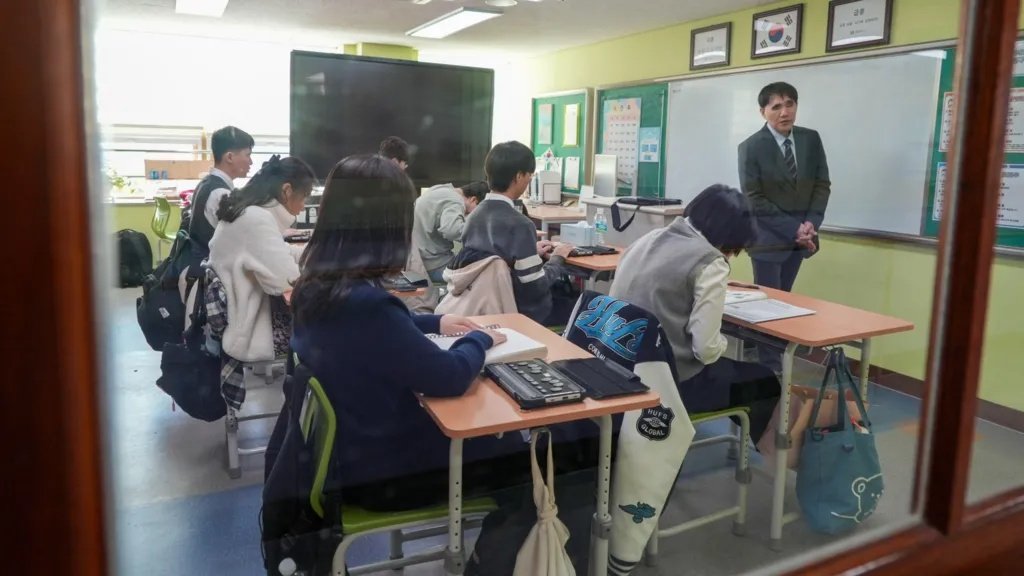
But for blind students, the exam is far from over. Some spend nearly 13 hours in the testing room, tackling the longest version of the Suneung, which combines extended time allowances with physically bulky braille test papers.
On Thursday, more than 550,000 students nationwide sat the Suneung, the highest number of applicants in seven years. The exam spans roughly 200 questions across Korean, mathematics, English, social and natural sciences, an additional foreign language, and Hanja (classical Chinese characters). For most students, it is an eight-hour marathon beginning at 08:40 and ending around 17:40.

Blind students with severe visual impairments receive 1.7 times the standard duration. When taking the extra foreign language section, their exam can stretch until 21:48, with no dinner break. Each braille test booklet can be six to nine times thicker than the standard printed version.
At Seoul Hanbit School for the Blind, 18-year-old Han Donghyun prepares for the extended exam. Born completely blind, Donghyun cannot distinguish light. He uses braille papers and a screen-reading computer to tackle the complex questions. “It’s really exhausting because the exam is so long,” he said. “But there’s no special trick. I follow my study schedule and try to manage my condition.”
The Korean language section is especially challenging for him. A standard test booklet of 16 pages translates into roughly 100 pages in braille. In the mathematics section, he interprets complex graphs and tables using only his fingertips. Since 2016, blind students have been allowed to use a braille notetaker called Hansone, which enables them to record calculations and follow problem-solving steps, similar to sighted students writing in pencil.
Another student, Oh Jeong-won, also 18, described the late afternoon as the hardest period of the day. “Up until lunch, it’s manageable. But around 4 or 5pm, after English and before Korean History, that’s when it gets really tough. There’s no dinner break, so it feels even more exhausting.” For him, the strain is compounded by the need to stay intensely focused with both hands and hearing. “Reading braille with my fingers while listening to audio information feels much more tiring than for sighted students.”

Yet, students say the length of the exam is not the only challenge. Access to study materials is a major barrier. Many popular textbooks and online lectures remain out of reach for blind students. Braille versions are scarce, and creating audio versions often requires text files that are difficult to obtain. Online lectures frequently rely on visual notes, diagrams, and graphics that cannot be accessed through audio alone.
One significant hurdle is the delay in receiving braille versions of the state-produced EBS preparation books, which are core to Suneung preparation. Sighted students typically receive these books between January and March, giving them months of study time. Blind students often get the braille versions only in August or September, leaving less than three months to prepare. “The braille materials weren’t completed until less than 90 days before the exam,” Donghyun said.
The National Institute of Special Education, responsible for producing braille EBS materials, explained that the process takes at least three months per book due to strict guidelines. The institute said it is taking steps to make materials available in separate volumes and reduce delays. The Korean Blind Union has repeatedly raised these issues and plans to file a constitutional petition demanding better accessibility for all textbooks.

Despite the challenges, blind students approach the Suneung with determination and resilience. Donghyun described it as a test of endurance: “There’s almost nothing you can do in life without perseverance. This exam is a process of training my will.” Jeong-won echoed the sentiment, calling it an exercise in perseverance and focus, even when exhaustion sets in.
Their teacher, Kang Seok-ju, praised their remarkable stamina. “Reading braille means tracing raised dots with your fingertips. The constant friction can make hands sore. But they do it for hours, with unwavering focus.” He encourages his students to value completion over perfection: “This exam is where you pour everything you’ve learned since first grade into a single day. Many students feel disappointed afterward, but I want them to leave knowing they did what they could.”
For blind students, the Suneung is not just a test of academic knowledge; it is a testament to years of preparation, determination, and endurance. It is a moment where perseverance is as important as performance, and every page read and calculation traced is a small victory on the long road to higher education.
Related News:
 Children to Learn Local History in Major Curriculum Overhaul
 Greta Thunberg Backs Student Facing UK Visa Revocation
 No link found between paracetamol in pregnancy and autism
 UK Schools Face Staff Exodus Amid Wellbeing Crash
 Delhi’s Toxic Air Crisis Leaves Children Sick and Vulnerable
 Families wait in agony for missing after Hong Kong tower blaze
 Fury After Hong Kong’s Deadliest Fire in Decades
 Southeast Asia floods claim 241 lives, rescue efforts continue
 Tokyo court rules Japan’s same-sex marriage ban constitutional
 Hong Kong Orders Probe Into Deadly 151-Death Fire
 Delhi’s Toxic Air Drives Spike in Respiratory Illnesses
 My Husband Won’t Stop Playing with Lego and It’s Driving Me Nuts
 Calls Grow for a Complete Ban on Smacking as Public Opinion Shifts
 White Low-Income Pupils in England Show Lowest Levels of School Engagement, Study Finds
 One in 12 Secondary Pupils Sent to Isolation Weekly
 Peterborough Mosques Tighten Security After Attack
 Hospice Cuts Raise Alarm Across England Amid Funding Crisis
 UK Woman Loses Child Benefit After Booking Flight She Never Took
 Is a two-week half-term a good deal? Some parents in England aren’t so sure
 UK launches search for first-ever ‘town of culture’ to highlight overlooked areas
 Army Officers Orders to Cut Ties with Men-Only Clubs
 UK University Suspends Human Rights Research Following Pressure from China
 The Lowry Hotel: Manchester’s Iconic Five-Star Retreat
 Prince William Plants Trees with Brazil’s Nature Heroes
 Top Christmas Books Reads: Classics to Cozy Romcoms
 World Whisky Tour: 9 Global Gems
 Kent village told to remove flags before Christmas lights go up
 Audio Books deals and promo codes to explore in November 2025
 Labour immigration crackdown could cost UK £4.4bn
 Earl of Yarmouth Faces £1.3m Legal Bill Over Family Estate
 London’s Childlessness Crisis: Schools Closing as Families Shrink
 Jailed UK climate protesters face extremist-style restrictions
 How to get help when a child goes missing – call 999 urgently
 ‘Reckless’ cuts to victims’ services will cost more than they save
 Suicide Bombing at Islamabad Court Kills 12, Injures Dozens
 From Lego to Pokémon: How Adults Are Driving UK Toy Market Growth
 UK Faces Arctic Blast as Polar Vortex Disruption Brings Heavy Snow
 Shouting Works Best to Deter Gulls, UK Study Finds
 Reeves rejects £1bn plea for NHS redundancy payouts
 Politics latest: Starmer ‘will fight any leadership coup’ as Streeting denies attempt to oust Labour PM
 PM Condemns Leaks, Vows Loyalty to Ministers and Stability
 Son Reveals UK Couple in Iran Resort to Hunger Strike for Help
 Nigeria’s $25m Museum Faces Political Storm Amid Benin Bronzes Debate
 Working-Class Men with Prostate Cancer Left Behind by NHS
 England’s Special Needs Support Faces Breaking Point
 Japan Tourism Stocks Slide Amid China-Taiwan Row
 Australia Mourns Paralympic Champion Paige Greco
 UK Asylum Overhaul Sparks Debate Over Human Rights and Deportations
 Mum Calls for New Licence Rules After Teen Road Death
 Mother Watches in Horror as Teen Daughter Dies on Tracks
 Agency Workers Vote to Join Picket Lines Amid Dispute
 Irish Hero Parrott Says Goal Brought First Tears in Years
 Seven Countries, One Winner: Europe’s Best Christmas Market
 Israeli Strike Kills 13 Near Palestinian Camp in Lebanon
 ‘Traumatic Wait’: Northern Ireland Women Face Breast Cancer Delays
 Commuters warned as yellow snow and ice alert hits Northern Ireland
 Healthy Habits in Your 30s That Boost Life in Your 70s
 Woman Meets Boy Whose Life She Saved with Kidney
 Ex-Harvard President Pauses Teaching Over Epstein Emails
 Raccoons Could Become America’s Next Pet
 Scottish Families Take Legal Action Over School CO Leak
 Kate Forbes: Motherhood Harder Than Politics
 Coffins Now Too Large to Cremate Amid Rising Obesity Crisis
 Labour MP claims devolution bill is ‘blatant discrimination’ against Cornwall
 Men Aren’t Vanishing From Fiction, But Misconceptions Persist
 Vicki Fears Losing Motability Car
 Planned Palestinian Flag Raising at Belfast City Hall Faces Delay Amid Legal Concerns
 Southern Lebanon reels as Israeli strikes shatter communities
 Sri Lanka Floods Leave 56 Dead, Dozens Missing
 India’s Labour Law Overhaul Sparks Fierce Debate
 Video shows Israeli troops kill Palestinians after surrender
 Fibromyalgia Patients Struggle as NHS Fails to Provide Care
 Scotland Gains 33 New Towns – Life in Growing Communities
 Machynlleth High Street Left Without Christmas Lights
 Search underway for British man overboard off Tenerife
 Virgin Media Fined £23.8m Over Telecare Safety Failures
 Oxford Names ‘Rage Bait’ Word of the Year
 Pavarotti statue frozen in Italian ice rink sparks backlash
 Maxwell withdraws from IPL 2026 after 13 seasons
 Indonesia to Repatriate Two Dutch Drug Convicts