Published: 14 November 2025. The English Chronicle Desk. The English Chronicle Online.
When Peter Higgs quietly set down his prediction for what would later be known as the Higgs boson, he could hardly have imagined that the idea would transform modern physics, inspire vast international experiments, and lead to one of the most celebrated scientific discoveries of the century. More than sixty years later, his final gift has brought that remarkable journey full circle. The University of Edinburgh, where Higgs spent the most defining years of his academic life, has announced that the physicist posthumously donated his Nobel Prize medal to the institution, offering a symbolic homecoming for one of the most important ideas in contemporary science.
Higgs, who died in April last year at the age of ninety-four, had been a lecturer at Edinburgh when he developed the theory that first hinted at the presence of a new, all-pervading field through which particles gained their mass. It was 1964, a moment in physics marked by rapid conceptual expansion and fierce debate. Amid that intellectual turbulence, Higgs’s proposal emerged as a beautifully simple explanation for the mechanism underlying mass itself. The idea was bold, ambitious, and at first met with hesitation within the scientific community. Yet it would become foundational to the Standard Model of particle physics and profoundly shape the way researchers understood the structure of the universe.

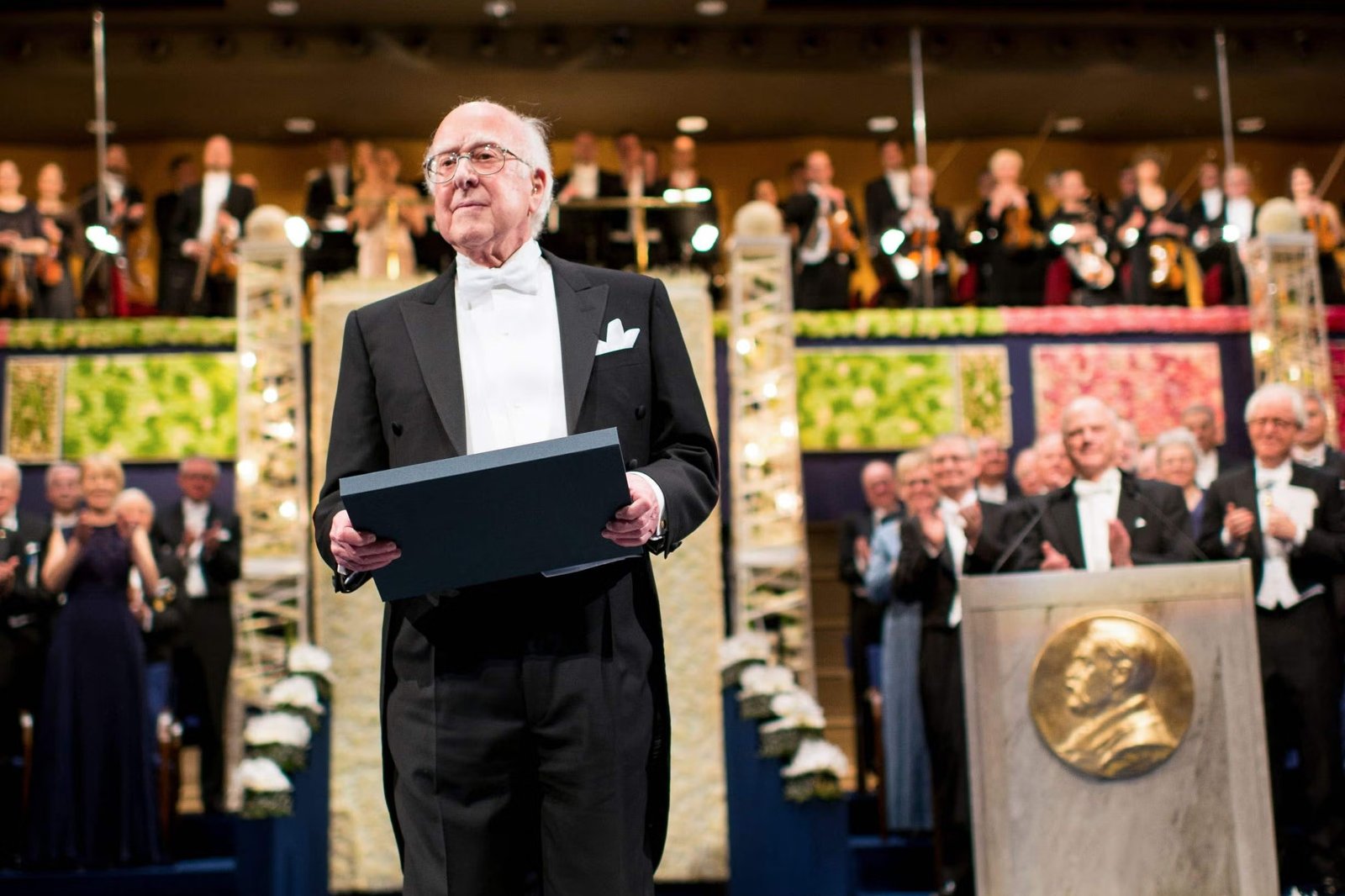
It would take nearly half a century before his quiet theoretical insight could be tested. Not until 2012, with the gigantic machinery of the Large Hadron Collider at CERN in Geneva, did scientists finally confirm the particle’s existence. The discovery created a global scientific sensation. Researchers wept, champagne corks flew across laboratory control rooms, and Higgs, typically modest, sat quietly at the announcement ceremony with tears in his eyes as decades of work were finally validated. The world’s media, still fond of the catchy but often-criticised nickname “the God particle,” arrived in droves. And the Nobel Committee responded the following year, awarding the 2013 Nobel Prize in Physics to Higgs and his colleague François Englert.
Now, more than a decade after that historic moment, Higgs’s medal will return to the very place where the mathematical seeds of his idea were first planted. Professor Sir Peter Mathieson, principal and vice-chancellor of the University of Edinburgh, said the institution was “profoundly honoured” to receive such a meaningful gift. In a statement, he noted that Higgs’s decision to leave the medal in his will represents more than a symbolic gesture. The object, he said, is “an artefact of immense historical significance and a lasting emblem of his legacy,” one that will continue to inspire future generations of students, researchers, and visitors who walk through the university’s doors.
The medal will be preserved by the University’s Centre for Research Collections, which is responsible for caring for some of the most important historical and scientific artefacts associated with the institution. Plans are already underway to display the medal at selected exhibitions, including a special event scheduled for 2026 as part of the annual Higgs Lecture series. For academics and students who work in the fields of theoretical and particle physics, the opportunity to see the medal up close will provide a tangible link to the global scientific breakthrough that began in the quiet lecture rooms of George Square.
Higgs’s connection to the University of Edinburgh was deep and enduring. Born in Newcastle upon Tyne in 1929, he studied at King’s College London before moving to Edinburgh in 1960 to take up a lectureship at the Tait Institute of Mathematical Physics. There, he built a reputation not only for his sharp mathematical insight but also for his gentle manner, modesty, and preference for peaceful contemplation over academic grandstanding. His colleagues recalled him as someone who spoke rarely but thoughtfully, and who had an almost stubborn commitment to the purity of theoretical reasoning. Over the years, he rose steadily through the ranks, eventually becoming chairman of theoretical physics before retiring in 1996 and assuming the title of professor emeritus.
It was during those formative academic years that Higgs published the short but groundbreaking papers that would alter the course of particle physics. His proposal centred on the existence of a universal field spread throughout the cosmos, interacting with subatomic particles in such a way that they gained mass. The strength of that interaction would determine how heavy each particle became. At a time when physicists were struggling to understand why certain particles appeared to have mass while others did not, Higgs’s insight provided a mechanism that elegantly resolved the puzzle. Although initially met with scepticism, the idea became increasingly influential as additional theoretical work and experimental results began to support its predictions.
The nickname “the God particle” emerged decades later, much to Higgs’s dismay. It was coined by Nobel laureate Leon Lederman, who had originally intended to call it the “Goddamn particle,” a frustrated reference to its elusiveness. His publisher objected to the profanity, and the label was softened—though in Higgs’s view, not softened nearly enough. For years he urged colleagues and journalists to abandon the moniker, considering it misleading and unscientific. Yet the name clung stubbornly to public imagination, and by the time CERN made its announcement in 2012, it had become a global shorthand for the breakthrough.
In recognition of Higgs’s achievements and the international reverence for his work, the University of Edinburgh established the Higgs Centre for Theoretical Physics in 2012. The centre is dedicated to advancing research in fundamental physics and nurturing new generations of scholars. Its mission is to support innovative exploration and to provide a collaborative environment where young theorists can pursue ideas as bold and unconventional as those Higgs once introduced. Professor Neil Turok, chairman of the centre, described the Higgs boson prediction as “a theoretical breakthrough, fundamental to our understanding of the laws of physics.” He said it was only fitting that Higgs’s Nobel medal now forms a lasting part of the university’s scientific heritage, a symbol of both the intellectual courage and the patient insight that underpin the greatest scientific advances.
In recent years, the centre has hosted workshops, conferences, and vis
 iting scholars from across the world, further expanding Edinburgh’s role in shaping the future of theoretical physics. Turok remarked that the discovery of the Higgs boson continues to serve as a springboard for those seeking answers to long-standing mysteries, from the nature of dark matter to the evolution of the early universe. For many of these researchers, Higgs’s contributions represent not just a milestone in physics but a reminder that a simple, elegant idea—carefully reasoned and patiently defended—can fundamentally reshape humanity’s understanding of reality.
As researchers prepare to integrate the Nobel medal into upcoming displays, the university community sees the gift not merely as an honour but as a continuation of Higgs’s lifelong commitment to academic discovery. His legacy is woven into lecture halls, laboratories, and the very culture of the physics department he helped define. Now, with his final gesture, he has ensured that future generations will not only study his ideas but also stand face-to-face with the symbol of the world’s recognition of his work.
For the students who will file past the medal at future exhibitions, the story of Peter Higgs will likely serve as a quiet encouragement. It is the story of a man who preferred contemplation to acclaim, who devoted his life to theoretical clarity, and who waited patiently as decades of experimental innovation converged to prove him right. In donating his Nobel Prize to the institution he loved, Higgs has left one last lesson: that the greatest scientific achievements are not merely moments of discovery but enduring contributions to the community of knowledge that outlives us all.
Related News:
 How Bringing Forests Into Preschools Boosts Children’s Health
 England Curriculum Review Recommends Major Changes
 Mortgages and AI Set to Feature in English Schools
 No link found between paracetamol in pregnancy and autism
 Government urges schools to ban phones to curb classroom disruption
 Michele Dougherty Makes History as the UK’s First Female Astronomer Royal
 From ‘Skibidi’ to ‘Mouse Jiggler’: Cambridge Dictionary Expands with Modern Slang and Social Terms
 UK Pupils Fear AI Is Eroding Their Learning Skills
 Six-Figure Tutors Teach Toddlers to ‘Be British’
 Critically Endangered Spider Rediscovered in UK After 40 Years
 Is a two-week half-term a good deal? Some parents in England aren’t so sure
 Bridget Phillipson Vows to Confront Unions Over Reading Tests
 Children to Learn Local History in Major Curriculum Overhaul
 UK Bans Fake Numbers: Scammers Lose Their Trick
 Top Christmas Books Reads: Classics to Cozy Romcoms
 Greta Thunberg Backs Student Facing UK Visa Revocation
 Audio Books deals and promo codes to explore in November 2025
 Experts Urge Legal Right to Timely Cancer Care
 Patients to Test Health at Home to Ease NHS Winter Pressure
 London’s Childlessness Crisis: Schools Closing as Families Shrink
 One of world’s last dinosaurs on sale for £3m
 North Sea oil workers must lose weight or face job loss
 Stephen Fry backs SafeCall to protect missing children
 Northern Lights May Illuminate UK Skies Amid Strong Solar Storm
 England schools to receive AI-generated attendance targets
 Northern Lights may illuminate UK skies this week
 UK Greenlights First Small Nuclear Plant in North Wales
 England’s Special Needs Support Faces Breaking Point
 UK Schools Face Staff Exodus Amid Wellbeing Crash
 Coffins Now Too Large to Cremate Amid Rising Obesity Crisis
 UK Taskforce Unveils Plan to Streamline Nuclear Reactor Rules
 Thinktank Urges Smaller Hospitals to End NHS ‘Permacrisis’
 NHS paediatric leave parents waiting months for answers
 Ofcom urges platforms to limit abuse and curb online ‘pile-ons’
 Schools urged to trial four-day week to ease pressure on teachers in England and Wales
 Oxford Names ‘Rage Bait’ Word of the Year
 Princess of Wales Launches Animated Video Series to Support Early Childhood Development
Education Leaders Call for End to Compulsory GCSE Resits in English and Maths
Princess of Wales Launches Animated Video Series to Support Early Childhood Development
Education Leaders Call for End to Compulsory GCSE Resits in English and Maths
 Thousands of New School Nursery Places to Be Rolled Out Across England
 Jaguar Land Rover Extends Production Halt Following Cyber-Attack
 Persistent Offenders Owe Over £700m in Ulez Fines as TfL Cracks Down on Evasion
 White Low-Income Pupils in England Show Lowest Levels of School Engagement, Study Finds
 New V-Level qualification to transform post-16 education
 Reform UK candidate fined £19,000 after using AI-generated cases to challenge election
 UK Campaigners Launch Bill to Grant Legal Rights to Nature
 Peterborough Mosques Tighten Security After Attack
 Reeves Faces Setback as Labour May Miss Homes Target
 Hospice Cuts Raise Alarm Across England Amid Funding Crisis
 Virgin Trains Moves Closer to Challenging Eurostar Monopoly
 Kate Winslet to Narrate Film Highlighting King’s Environmental Mission
 Trump’s UK Ambassador Urges North Sea Drilling to Strengthen US Ties
 French Taxi Driver Cleared in David Lammy Theft Case After Fare Dispute
 M&S Profits More Than Halve After Cyber-Attack
 Kent village told to remove flags before Christmas lights go up
 Vibe coding’ named Collins dictionary’s word of the year
 Britain deploys RAF specialists to assist Belgium with drone threats
 Palace May Restore Hyphen to Andrew Mountbatten-Windsor’s Name
 Millionaires group urge Reeves to introduce wealth tax to ‘lift kids out of poverty’
 Shouting Works Best to Deter Gulls, UK Study Finds
 Reeves rejects £1bn plea for NHS redundancy payouts
 PM Condemns Leaks, Vows Loyalty to Ministers and Stability
 Phillipson Accused of Appeasing Unions by Diluting EBacc
 Major Rent Reform Ends No-Fault Evictions in England
 Global markets drop amid tech sell-off and China slowdown
 Mum Calls for New Licence Rules After Teen Road Death
 Mother Watches in Horror as Teen Daughter Dies on Tracks
 Google Chief Urges Caution: Don’t Trust AI Blindly
 ‘Traumatic Wait’: Northern Ireland Women Face Breast Cancer Delays
 Healthy Habits in Your 30s That Boost Life in Your 70s
 Serial Rapist and Former Cop Found Guilty Again
 Scottish Families Take Legal Action Over School CO Leak
 Most Tories Expect to Support a Farage-Led Government
 Bill Murray Terrified Wes Anderson but Became His Closest Collaborator
 Labour MP claims devolution bill is ‘blatant discrimination’ against Cornwall
 Karen Carney Stuns on Blackpool Week, Deserves Strictly Final
 Millions Face Higher Taxes Under Reeves New Budget
 Fibromyalgia Patients Struggle as NHS Fails to Provide Care
 Search underway for British man overboard off Tenerife
 Virgin Media Fined £23.8m Over Telecare Safety Failures
 Rising Water Bills Lift Troubled Thames Back to Profit