Published: 19 November 2025 Wednesday . The English Chronicle Desk. The English Chronicle Online
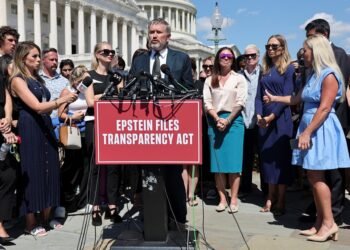
In a rare moment of bipartisanship on Capitol Hill, the US House of Representatives overwhelmingly approved legislation compelling the release of documents tied to convicted sex offender Jeffrey Epstein. The vote was 427 in favor and only a single lawmaker opposed the measure. That lone dissenting vote came from Republican Congressman Clay Higgins of Louisiana, who described his stance as a principled “NO,” citing concerns over the protection of personal information of Epstein’s numerous victims.
“What was wrong with the bill three months ago is still wrong today,” Higgins wrote on X, the social media platform formerly known as Twitter. “It abandons 250 years of criminal justice procedure in America.” His comments highlight the tension between demands for transparency in high-profile criminal cases and the need to protect the privacy and safety of individuals involved in ongoing investigations.
The bill’s passage in the House, which saw near-universal Republican support, was later mirrored in the Senate, clearing the final legislative hurdle before President Donald Trump is expected to sign it into law. The legislation mandates the release of documents related to Epstein’s crimes, including materials that could shed light on his network of associates and possible co-conspirators.
For Higgins, the key issue is the potential harm to innocent parties. “As written, this bill reveals and injures thousands of innocent people – witnesses, people who provided alibis, family members, etc. If enacted in its current form, this type of broad reveal of criminal investigative files, released to a rabid media, will absolutely result in innocent people being hurt,” Higgins argued in his social media post. His position underscores a rarely discussed aspect of high-profile criminal investigations: the collateral impact that public exposure can have on families, friends, and other non-accused parties connected to a case.

Higgins has stated he would be willing to support the bill if amendments were made in the Senate to better protect the privacy of these individuals. However, Senate Republican majority leader John Thune suggested that amendments were unlikely given the overwhelming support the bill received in the House. “When a bill comes out of the House 427 to 1 and the president said he’s going to sign it, I’m not sure that amending it is in the cards,” Thune said.
Before the House vote, only a handful of Republicans had supported the push to bring the legislation to a vote. Representatives Thomas Massie, Lauren Boebert, Nancy Mace, and Marjorie Taylor Greene were the only members of the GOP to sign a petition demanding action, joining all Democrats. The situation shifted dramatically, however, after President Trump dropped his opposition to the measure, paving the way for near-universal Republican support.
Higgins represents Louisiana’s 3rd Congressional District and has built a reputation as one of the most conservative members of the House. His decision to stand alone against the legislation is consistent with his record of unorthodox stances and willingness to publicly dissent from his party when he believes it conflicts with principle.
This is not the first time Higgins has drawn attention for controversial actions. In 2024, the House voted to censure him after he made offensive remarks on social media about Haiti, referring to the nation as “the nastiest country in the western hemisphere” and making derogatory statements about its people. Higgins also drew criticism for posts in 2020 threatening armed protesters attending demonstrations in Louisiana against police brutality. Facebook removed these posts for violating policies against inciting violence.
Prior to entering Congress, Higgins served in law enforcement with Louisiana’s St. Landry Parish Sheriff’s Office. He resigned in 2016 following backlash over a controversial anti-crime video in which he brandished a rifle and made threats against gang members. Despite—or perhaps because of—his outspoken nature and hardline rhetoric, Higgins has cultivated a devoted following in his district, appealing to voters who value his law-and-order stance.
While Higgins has emphasized the need to protect private individuals in the Epstein case, the broader legislative effort reflects a rare convergence of political interests. The release of Epstein-related documents has been a point of national attention since his death in custody in 2019 and the subsequent investigations into his associates and enablers. Lawmakers, journalists, and advocacy groups have argued that transparency is essential to understanding the scope of Epstein’s criminal network and ensuring accountability for those involved.

The bill mandates the disclosure of investigative records, including material gathered during federal and state inquiries into Epstein’s activities. Advocates argue that the release will provide victims and the public with access to critical information that has long been withheld. Critics, however, echo Higgins’ concerns that the breadth of the disclosure could inadvertently expose the identities of witnesses, family members, and others who have no involvement in criminal activity.
Higgins’ solitary dissent has prompted both support and criticism from across the political spectrum. Some praise him for standing on principle, asserting that the protection of individuals’ rights and privacy must take precedence over political expediency. Others, including many victims’ advocates, view his opposition as an unnecessary obstacle to transparency and accountability in one of the most notorious criminal cases of the 21st century.
Despite the debate, the bill’s path to law appears assured. President Trump’s support signals executive approval, and the bipartisan consensus in Congress minimizes the likelihood of further legislative challenges. Once signed, the release of Epstein-related files will mark a significant moment in the ongoing effort to illuminate the full extent of his crimes and the networks that supported them.
For Higgins, the episode may further cement his image as a lawmaker unafraid to challenge his party when conscience dictates. His position highlights the complex interplay between government transparency, victim protection, and political strategy—a balance that lawmakers must navigate in cases of national importance.
The Epstein legislation comes at a time of heightened scrutiny over the US criminal justice system, particularly regarding high-profile cases involving sexual exploitation, abuse of power, and institutional oversight. Observers note that while the public demands accountability and transparency, the legal system also has an obligation to safeguard the rights of innocent individuals connected tangentially to criminal investigations.

As the bill moves toward enactment, the focus will shift to the implementation process, including how documents are reviewed, redacted, and ultimately shared with the public. Legal experts anticipate that safeguards will be necessary to prevent inadvertent disclosure of sensitive personal information, and it remains to be seen how effectively federal agencies can balance transparency with privacy protections.
For Clay Higgins, the moment represents both a political and ethical stance. By casting the lone “no” vote, he underscores the principle that legal processes and procedural safeguards must be respected, even in cases that capture widespread public attention. Whether this position will resonate with constituents or provoke political backlash remains to be seen, but it unquestionably sets him apart in an era of deeply partisan politics.
Ultimately, the vote illustrates the tension between two competing imperatives: the public’s right to know and the protection of individuals who may be caught in the crossfire of highly publicized criminal cases. As Congress and the White House finalize the release of Epstein documents, this debate over transparency, accountability, and privacy will likely continue, shaping how similar cases are handled in the future.
The legislation’s passage and Higgins’ dissent also reflect a broader moment in US politics, where issues of justice, accountability, and personal rights intersect with partisanship, public opinion, and the demands of high-profile legal scrutiny. The story of one lone Congressman standing against a near-unanimous vote serves as a reminder that even in an era of overwhelming political consensus, principled dissent can make a significant mark.
Related News:
 US Justice Department Files Lawsuit Against California Over Partisan Voting Maps
 UK Asylum Reforms: Temporary Refugee Status and Faster Deportations
 South African Detained After Neo-Nazi Rally in Australia
 Minister Defends Tough New Asylum Reform Plan
 UK Net Migration Falls Sharply After ONS Revisions
 Congress Approves Release of Epstein Files, Trump Expected to Sign
 Senedd Suspends Politician Over Offensive Racial Slur
 Trump Slams Democrats With ‘Seditious’ Death Claim
 Texas Governor Faces Lawsuit From CAIR
 Peers Get Extra Time to Debate Assisted Dying Bill
 US National Guard Member Killed in DC Shooting
 ICC to Rule on Duterte’s Provisional Release
 Trump to pause migration from ‘third-world countries’
 Chinese & Japanese Boats Clash Near Disputed Islands
 Putin Meets US Envoy Amid Key Ukraine Peace Talks
 Franklin Turtle, Sabrina Carpenter Slam US Social Media Use
 Trump Administration Dismisses 17 Immigration Judges, Sparking Debate Over Judicial Independence
 Commons Speaker Warns UK Parliament Vulnerable to Foreign Espionage After China-Linked Case Dropped
 UK Police to Gain New Powers to Manage Repeated Protests, Home Office Announces
 Phillipson urges careful review of gender recognition guidance
 French Taxi Driver Cleared in David Lammy Theft Case After Fare Dispute
 Mikie Sherrill Elected New Jersey’s Governor in Key Win
 Who is Rama Duwaji? What Zohran Mamdani’s wife has said about Gaza and ICE as he’s elected NYC mayor
 China-critical UK academics face ‘extremely heavy’ pressure from Beijing
 Met Police Culture Makes Racial Harm ‘Inevitable’
 Remaining rebel Labour MPs have whip restored
 Tim Davie resigns as BBC director general amid bias claims
 Britain deploys RAF specialists to assist Belgium with drone threats
 Seven Conditions That Automatically Qualify You for a Free Bus Pass
 Palace to reinstate hyphen in Andrew’s surname
 PM Condemns Leaks, Vows Loyalty to Ministers and Stability
 Major Rent Reform Ends No-Fault Evictions in England
 Peers Flood Assisted Dying Bill with 942 Amendments
 South Sudan President Removes Vice-President Amid Political Uncertainty
 UK Unveils Fast-Track Deportation and Asylum Overhaul
 Trump Deploys DHS to Charlotte in Major Arrest Operation
 December Run-Off in Chile as Election Produces No Winner
 UK Asylum Overhaul Sparks Debate Over Human Rights and Deportations
 Mahmood Defends Tough Overhaul of UK Asylum System
 Mahmood Announces Temporary Refugee Status Plan
 Scottish Ministers Express Alarm Over UK Asylum Reforms
 British Doctors Arrested in India for Unauthorized Border Crossing
 Westminster Advances Legacy Bill Amid Criticism
 Federal Court Blocks Texas Republican Maps Over Racial Bias
 UK Vulnerable to Attack, Defence Committee Finds
 Paramilitary Murals and Memorials Persist on Public Housing Land
 Bangladesh Families Call for Hasina’s Return and Execution
 Rama Rebukes Mahmood for Targeting Albanian Families
 Russian Vessel Used Lasers on RAF Pilots, UK Claims
 MP Offers Seat to Help Burnham Challenge Starmer
 Court to Hear Challenge to Wimbledon Expansion Plan
 Serial Rapist and Former Cop Found Guilty Again
 Two Officers Injured After Van Deliberately Rams Patrol Car
 Pentagon Officials in Ukraine to Discuss War End
 Trump Signs Bill Releasing Justice Department Files on Epstein
 WhatsApp Messages Expose Nathan Gill’s Bribery
 Venezuela Threatens Nobel Winner Machado with Fugitive Status
 English Mayors Set to Introduce Tourist Taxes
 Ex-Classmate Accuses Farage of Dishonesty on Racism Claims
 Trump Envoy to Discuss Ukraine Peace at Kremlin
 Teens Launch High Court Challenge to Australia’s Social Media Ban
 Millions Face Higher Taxes Under Reeves New Budget
 Planned Palestinian Flag Raising at Belfast City Hall Faces Delay Amid Legal Concerns
 Pope Leo XIV Begins Historic Trip to Turkey and Lebanon
 Zambia’s President Faces Stone-Throwing Anger Amid Challenges
 Singapore Women Acquitted After Pro-Palestine March
 India’s Labour Law Overhaul Sparks Fierce Debate
 Video shows Israeli troops kill Palestinians after surrender
Trump to Recheck Green Cards from 19 Nations After DC Attack
Video shows Israeli troops kill Palestinians after surrender
Trump to Recheck Green Cards from 19 Nations After DC Attack
 Ex-Brexit MEP Rejects Claim of Pro-Russia Payments
 Labour U-turn: Unfair Dismissal Rights Delayed Six Months
 Government righting decades-old injustice for miners
 Second homes curbs quashed in Gwynedd legal ruling
 Guinea-Bissau President Flees After Military Coup
 Jordan Bardella: France’s Young Presidential Contender
 Hong Kong Orders Probe Into Deadly 151-Death Fire
 Twelve Prisoners Released in Error, Two Still Missing
 Kremlin Talks With US Yield No Ukraine Peace Breakthrough
 Indonesia to Repatriate Two Dutch Drug Convicts
 Republicans Hold Tennessee Seat Despite Democratic Surge