Published: 20 November 2025 Thursday. The English Chronicle Desk. The English Chronicle Online
The UK has accused a Russian intelligence vessel of using lasers to interfere with Royal Air Force pilots monitoring its movements near British waters. Defence Secretary John Healey said the incident marked the first time such a tactic had been deployed against UK military aircraft and described the move as “deeply dangerous,” warning that the government was treating the matter with the utmost seriousness.
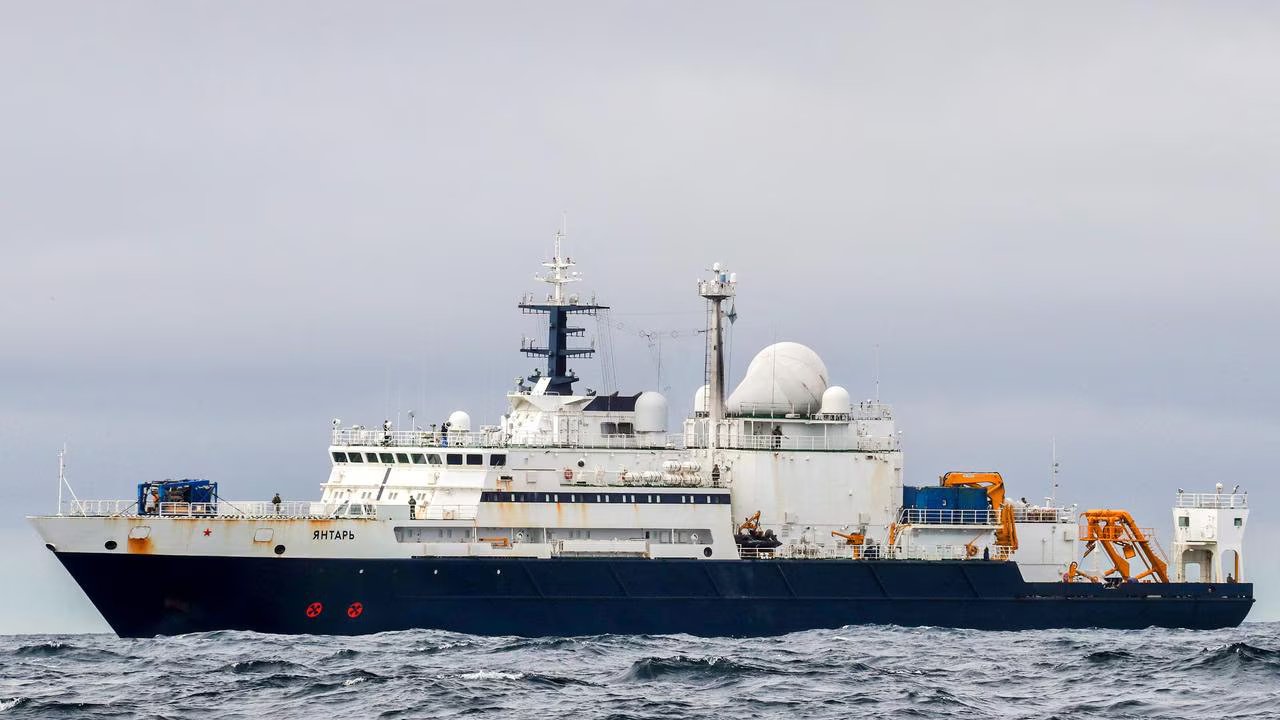
Speaking to reporters, Healey said the Russian ship involved—identified as the Yantar, a vessel long associated with Moscow’s Main Directorate for Deep Sea Research—had been operating north of Scotland in recent weeks. According to the defence secretary, the ship entered UK waters for the second time this year and was being closely tracked by a Royal Navy frigate and RAF Poseidon P-8 maritime patrol aircraft at the time of the incident.
Healey confirmed that the lasers were used while RAF pilots were observing the Yantar’s activity during what he described as a period of “heightened and deliberate” monitoring. The deployment of lasers posed a potential hazard to pilots and aircraft crew, and Healey made it clear that the government was prepared to take further steps if the ship altered its course or escalated its behaviour.
Standing at a Downing Street podium, Healey delivered an unambiguous message to Moscow. “To Russia and to President Putin, I say this: we see you. We know what you are doing. And if the Yantar moves south in the coming days, we are ready.” His comments underscored a growing concern within the UK government about Russian operations in and around British territorial waters, particularly those linked to deep-sea surveillance and potential sabotage capabilities.
Although he did not reveal precisely when the laser incident occurred, Healey said it was understood to have taken place within the last two weeks as the UK military kept the Russian vessel under “constant watch.” The defence secretary also disclosed that he had modified the Royal Navy’s rules of engagement to allow ships to shadow the Yantar more closely whenever it approached or entered the UK’s wider maritime jurisdiction. The aim, he said, was to ensure that Britain could respond rapidly to any suspicious activity.

The Yantar is no ordinary vessel. Commissioned in 2015, it operates under Russia’s highly secretive deep-sea directorate, known as GUGI. This branch of the Russian military is responsible for covert operations on the seabed, including intelligence gathering on undersea infrastructure such as communication cables. Western security officials have long warned that Russia’s deep-sea fleet could pose a threat to critical subsea infrastructure, particularly during periods of international tension. Healey echoed those concerns, describing GUGI as an organisation built to conduct “surveillance in peacetime and sabotage in conflict.”
Although the defence secretary refused to disclose specific “military options” prepared in response to any shift in the Yantar’s behaviour, he insisted that the UK was ready to act. Revealing Britain’s plans, he argued, would only offer Moscow strategic insight. “I will not make President Putin wiser,” he said, suggesting that maintaining operational ambiguity was part of the UK’s deterrence strategy.
Pressed by journalists about the risks associated with laser interference, Healey was unequivocal. Any action that disrupts or threatens RAF pilots, he said, represents a serious danger. Pilots flying maritime patrol aircraft rely heavily on visual and optical equipment to detect and classify vessels at sea. Interference by laser beams can temporarily blind crew members, damage sensors, or compromise a mission’s safety. For Healey, the use of such technology against a British aircraft crossed a line and demanded a firm response.
Shortly after the UK went public with its accusations, the Russian Embassy in London issued its own statement. Moscow denied that its activities posed any threat to the UK or its national interests, insisting that Russia had no intention of targeting British undersea communication systems or any other critical infrastructure. The embassy dismissed the claims as part of what it called London’s “Russophobic path,” accusing the UK government of inflaming tensions in Europe and contributing to instability.
The embassy’s statement argued that Britain’s political rhetoric was responsible for escalating tensions and warned that such an approach could lead to “dangerous situations.” It called on British officials to “refrain from destructive steps” that might worsen the security environment on the continent, placing the blame squarely on London for heightening friction between the two countries.

This clash marks the latest in a series of confrontations involving Russian naval movements around the British Isles. Over the past several years, Western intelligence agencies have repeatedly expressed alarm over the presence of Russian vessels with advanced surveillance and deep-sea technology operating near the UK and other NATO territories. These ships are capable of mapping the seabed, tracing subsea internet and energy cables, and potentially tampering with them in times of crisis.
In response to this growing concern, the UK has stepped up aerial and maritime monitoring of Russian naval activity. The deployment of RAF Poseidon P-8 aircraft—state-of-the-art planes equipped with sophisticated detection systems—has been central to these operations. Paired with Royal Navy ships, they track movements, gather evidence, and assess potential threats. The presence of the Yantar in particular has always prompted heightened alert levels because of its capabilities and its connection to GUGI.
Healey’s announcement also comes during a moment of increased global geopolitical strain. Relations between Russia and Western nations remain deeply fractured due to ongoing international conflicts, cyberattacks, and disputes over territorial claims. Against this backdrop, any activity perceived as aggressive or unusual near NATO waters carries amplified significance.
Sources within the Ministry of Defence have suggested that UK officials are especially wary of vessels like the Yantar because they may engage in intelligence-gathering under the cover of civilian-seeming operations. While Russia insists that its ship is engaged in legitimate oceanographic research, Western analysts believe that its missions often include the mapping of subsea infrastructure, placing it in a uniquely sensitive category.
Healey, aware of these concerns, emphasised that the UK would continue to monitor the ship “every step of the way.” He indicated that the government was determined not to be caught off guard by any attempt to undermine the UK’s security or its strategic assets. While declining to share operational details, he made clear that contingency plans were in place and that Britain would not hesitate to act if necessary.
The incident has also renewed political debate within the UK about the country’s readiness to protect critical infrastructure and respond to unconventional threats. Lawmakers have increasingly called for greater investment in maritime defence, cyber resilience, and underwater surveillance capability. Healey’s remarks seemed to acknowledge those calls, signalling a shift toward a more assertive posture in monitoring foreign activity near UK waters.
Although the Russian Embassy attempted to defuse the situation by denying malicious intent, its response did little to calm British concerns. Instead, its sharp criticism of the UK’s approach added another layer of tension to an already complex diplomatic landscape. As both countries exchange increasingly pointed statements, the possibility of further incidents cannot be ruled out.
For now, the Yantar remains under close observation, and the UK continues to assess the implications of the laser incident. Whether this marks an isolated episode or the beginning of more confrontational encounters at sea will depend on how both nations choose to navigate the next stage of this maritime standoff.
Related News:
 Rama Rebukes Mahmood for Targeting Albanian Families
 British Woman in Iran ‘Losing Hope’ Amid Ongoing Detention
 BBC Journalist Held and Interrogated in Vietnam
 Out of reach: stalled newbuilds leave Labour’s social housing targets in tatters
 Zohran Mamdani becomes New York City’s first Muslim mayor
 Mikie Sherrill Elected New Jersey’s Governor in Key Win
 Who is Rama Duwaji? What Zohran Mamdani’s wife has said about Gaza and ICE as he’s elected NYC mayor
Zohran Mamdani names all-female transition team for NYC mayoralty
Who is Rama Duwaji? What Zohran Mamdani’s wife has said about Gaza and ICE as he’s elected NYC mayor
Zohran Mamdani names all-female transition team for NYC mayoralty
 Second world war veterans honoured as King leads Remembrance Sunday
 Britain deploys RAF specialists to assist Belgium with drone threats
 BBC director-general and news chief resign amid bias row
 PM Condemns Leaks, Vows Loyalty to Ministers and Stability
 US Justice Department Files Lawsuit Against California Over Partisan Voting Maps
 December Run-Off in Chile as Election Produces No Winner
 UK Asylum Reforms: Temporary Refugee Status and Faster Deportations
 UN Security Council Approves Trump’s Gaza Peace Plan
 Minister Defends Tough New Asylum Reform Plan
 UK Net Migration Falls Sharply After ONS Revisions
 Congress Approves Release of Epstein Files, Trump Expected to Sign
 Shadow Fleet at Sea: Europe’s Battle Against Illicit Oil Shipping
 UK Vulnerable to Attack, Defence Committee Finds
 MP Offers Seat to Help Burnham Challenge Starmer
 Pentagon Officials in Ukraine to Discuss War End
 WhatsApp Messages Expose Nathan Gill’s Bribery
 Venezuela Threatens Nobel Winner Machado with Fugitive Status
 Texas Governor Faces Lawsuit From CAIR
 English Mayors Set to Introduce Tourist Taxes
 Ex-Classmate Accuses Farage of Dishonesty on Racism Claims
 Trump Envoy to Discuss Ukraine Peace at Kremlin
 Millions Face Higher Taxes Under Reeves New Budget
 Peers Get Extra Time to Debate Assisted Dying Bill
 Planned Palestinian Flag Raising at Belfast City Hall Faces Delay Amid Legal Concerns
 Pope Leo XIV Begins Historic Trip to Turkey and Lebanon
 Georgians Defy Government Crackdown After Year of Protests
 UK Military Chiefs Warn Funding Gap Threatens Defence
 Putin Intensifies Territorial Demands Before US Talks
 India’s Labour Law Overhaul Sparks Fierce Debate
 Video shows Israeli troops kill Palestinians after surrender
 Trump to Recheck Green Cards from 19 Nations After DC Attack
 Ex-Brexit MEP Rejects Claim of Pro-Russia Payments
 Labour U-turn: Unfair Dismissal Rights Delayed Six Months
 Government righting decades-old injustice for miners
 Chinese & Japanese Boats Clash Near Disputed Islands
 Putin Meets US Envoy Amid Key Ukraine Peace Talks
 Ireland Boosts Ukraine Aid as Zelensky Visits Dublin
 Kremlin Talks With US Yield No Ukraine Peace Breakthrough
 Putin visits India as Ukraine peace, trade push intensifies
 Russia-Ukraine war update: Key events, day 1,379
 Global campaign launched to free Palestinian leader Barghouti
 Kinnock’s Rebuke Echoes Loudly as Corbyn Allies Launch Left-Wing Breakaway: “A Gift to Farage”
 Trump Administration Dismisses 17 Immigration Judges, Sparking Debate Over Judicial Independence
 UK Must Act with Courage and Clarity on Israel-Palestine Conflict, Says Foreign Affairs Committee Report
 Radioactive Leak at UK’s Nuclear Warhead Base Sparks Outcry Over Safety and Secrecy
 Mutual Inconvenience: Why Alaska Was Chosen for the Trump-Putin Summit on Ukraine
 Is the UK Ready to Put Boots on the Ground in Ukraine? Assessing Military Capacity and Challenges
 Public Trust in SNP Hits Historic Low Amid NHS Concerns
 Johnson Suggests Mandelson Linked to China Spy Controversy
 Army Barracks to House Migrants as Hotels Phase Out
 Trump’s UK Ambassador Urges North Sea Drilling to Strengthen US Ties
 French Taxi Driver Cleared in David Lammy Theft Case After Fare Dispute
BBC to Apologise Over Edited Trump Speech Amid Backlash
French Taxi Driver Cleared in David Lammy Theft Case After Fare Dispute
BBC to Apologise Over Edited Trump Speech Amid Backlash
 Palace May Restore Hyphen to Andrew Mountbatten-Windsor’s Name
 Millionaires group urge Reeves to introduce wealth tax to ‘lift kids out of poverty’
 Shouting Works Best to Deter Gulls, UK Study Finds
 Reeves rejects £1bn plea for NHS redundancy payouts
 Major Rent Reform Ends No-Fault Evictions in England
 Greene Pushes Epstein Files Amid Trump Fallout
 Zelenskyy Signs Fighter Jet Deal Amid Russian Drone Attacks
 Stroke Patient Mistaken for Drunk, Care Delayed
 Canada Passes Carney’s First Budget in Tight Parliamentary Vote
 Van Dwellers Face Eviction After Park Misuse Sparks Outcry
 Deadly Russian Strikes Hit Western Ukraine, 20 Killed in Ternopil
 Serial Rapist and Former Cop Found Guilty Again
 Vietnam Battles Deadly Floods as Rains Continue
 Most Tories Expect to Support a Farage-Led Government
 Labour MP claims devolution bill is ‘blatant discrimination’ against Cornwall
 Two National Guard Soldiers Critically Injured Near White House
 Sri Lanka Floods Leave 56 Dead, Dozens Missing
 Jordan Bardella: France’s Young Presidential Contender
 Search underway for British man overboard off Tenerife