Published: 21 January 2026. The English Chronicle Desk. The English Chronicle Online.
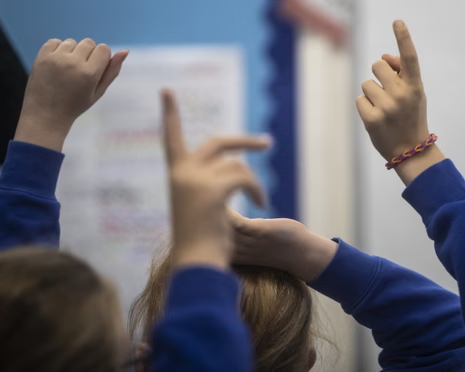
The government is under increasing pressure over Send provision costs as demand for services continues rising sharply. Special educational needs and disabilities (Send) funding has become a critical concern, with thinktanks warning that rising costs risk squeezing mainstream school resources and undermining overall educational quality. The Institute for Fiscal Studies (IFS) report shows that expenditure on children with special needs in England is projected to double between 2015 and 2028, creating significant financial and logistical challenges for local authorities and schools alike.
According to the IFS, the growth in Send spending is outpacing the support capacity for families and institutions. Luke Sibieta, one of the report’s authors, stated that England’s current system is becoming increasingly costly while failing to deliver consistent outcomes for children who require extra support. Sibieta stressed that the government is now facing a “crunch time” scenario, requiring urgent decisions about resource allocation for Send and mainstream education.

The most pressing issue in education today is the growing dysfunction in the Send provision system,” Sibieta explained. “The problems are long-standing, yet they have intensified over the years. Government reform is crucial, but immediate choices are unavoidable: either slow Send spending growth, accept a squeeze on mainstream schools, or find additional funds through taxes or budget adjustments elsewhere.”
The report further notes that local authorities have been forced to divert money from mainstream schools to cover escalating Send provision costs, with approximately £150 million rerouted last year alone. Bill Revans, Send spokesperson for the County Councils Network, highlighted that national Send spending per pupil has risen at twice the rate of funding for mainstream students, reflecting the exponential rise in demand and costs.
One proposed solution is for the government to use falling school rolls to reallocate £1.8 billion toward special needs education by 2028. A forthcoming schools white paper is expected to outline strategies to expand Send provision within mainstream state schools. This could allow more children with Send to attend local schools rather than competing for limited and more expensive special school placements.
Pepe Di’Iasio, general secretary of the Association of School and College Leaders, emphasised that financial considerations should not overshadow the need for tangible improvements in support services. “While many schools provide excellent support for young people with Send, the system overall is not meeting current needs effectively,” Di’Iasio said. The reforms outlined in the white paper will also focus on education, health, and care plans (EHCPs), which legally formalise the support children with special needs receive, including school placements.
The IFS warned that reducing EHCPs or limiting their scope could help slow high-needs spending growth, but such measures would take time to produce savings. Simultaneously, increased investment will remain necessary to enhance mainstream schools’ capacity to accommodate children with additional needs. In response, the Department for Education recently announced £200 million in funding for training school staff in supporting pupils with special needs and disabilities.

A Department spokesperson stated, “This package will help children feel safe and welcome, supporting attendance, attainment, and wellbeing. It marks a key step in making inclusive practice standard across all schools.” Experts agree that while funding is essential, effective implementation, quality training, and strategic planning are equally vital to meet the growing demand for Send provision without compromising mainstream education.
The IFS report reflects the stark reality that unless urgent decisions are made, rising Send costs could continue to strain the education system, highlighting a critical policy juncture for ministers. The balance between funding allocations, inclusive education, and maintaining quality across all schools is now at the forefront of policy debates, making it a pivotal moment for the future of England’s educational landscape.
As the government prepares its schools white paper, the pressure to deliver practical solutions that benefit both children with Send and mainstream pupils will intensify. Stakeholders across education and local authorities continue to call for a system that balances fiscal responsibility with the ethical imperative of providing high-quality education for every child.
The current situation underscores the urgency of addressing systemic inefficiencies while ensuring sustainable support for children with special educational needs. Without swift action, schools and families may face increasing challenges, with potential long-term consequences for educational outcomes and social equity.
Related News:
 Six-Figure Tutors Teach Toddlers to ‘Be British’
 How Bringing Forests Into Preschools Boosts Children’s Health
 Is a two-week half-term a good deal? Some parents in England aren’t so sure
 Posthumous books are messy and fraught – but Virginia Giuffre’s gives her a voice
 Children to Learn Local History in Major Curriculum Overhaul
 UK University Suspends Human Rights Research Following Pressure from China
 UK University Faces Counter-Terror Probe Over China Pressure
 Top Christmas Books Reads: Classics to Cozy Romcoms
 England Curriculum Review Recommends Major Changes
 Greta Thunberg Backs Student Facing UK Visa Revocation
 Audio Books deals and promo codes to explore in November 2025
China-critical UK academics face ‘extremely heavy’ pressure from Beijing
Audio Books deals and promo codes to explore in November 2025
China-critical UK academics face ‘extremely heavy’ pressure from Beijing
 Labour immigration crackdown could cost UK £4.4bn
 London’s Childlessness Crisis: Schools Closing as Families Shrink
 No link found between paracetamol in pregnancy and autism
 Government urges schools to ban phones to curb classroom disruption
 Nigeria’s $25m Museum Faces Political Storm Amid Benin Bronzes Debate
 Algeria Pardons French-Algerian Novelist Sansal After Year in Jail
 South Korea’s College Exam Tests Perseverance of Blind Students
 Phillipson Accused of Appeasing Unions by Diluting EBacc
 ‘I’ve Read 38 Books, but This Is My Standout Favourite’
 England’s Special Needs Support Faces Breaking Point
 Nigerian Education Reversal: Mother-Tongue Teaching Scrapped
 Higgs Donates Nobel Medal to His Beloved University
 UK Schools Face Staff Exodus Amid Wellbeing Crash
 Ex-Harvard President Pauses Teaching Over Epstein Emails
 Scottish Families Take Legal Action Over School CO Leak
 Men Aren’t Vanishing From Fiction, But Misconceptions Persist
 Schools urged to trial four-day week to ease pressure on teachers in England and Wales
 Oxford Names ‘Rage Bait’ Word of the Year
 Cambridge College Faces Backlash Over Private School Recruitment
 Glasgow rector cleared by watchdog in antisemitism case
 Pressure mounts on No 10 over under-16s social media ban
 Jewish MP school visit cancelled after Bristol campaign pressure
 UK Launches First Town of Culture Competition
 Guildford resignation sparks public trust debate in West Midlands
 UK Ministers Drop Foreign Student Targets for Global Education Push
 City & Guilds pay surge sparks backlash amid £22m cuts
 School Suspensions Now Reserved for Only Severe Misbehaviour
 Cambridge Faces Scrutiny Over Arms Investment Transparency
 Harvey Willgoose School Stabbing Red Flags Missed
 Kingsbury stabbing probe led by counter-terror police
 School phone policies drain English staff resources, study finds
 Children’s vocabulary shrinking amid rising screen time concerns
 Councils Urge Means Testing for Send School Transport
 NSW to Introduce Minimum Age for Ebike Riders
 Student Loan Crisis Sparks Outrage Among Graduates in England
 Larry Summers Resigns From Harvard Amid Epstein Files
 London Pupils Warned Against ‘School Wars’ Posts
 New Survey Reveals Troubling Rise in Campus Antisemitism
 UK Parents Voice Concerns Over Special Education Support
 Sydney Teacher Arrested in Teenage Grooming Investigation
 Keir Starmer Vows Strong Action Against Online Tech Giants
 Exhibition Revisits Life of 18th-Century Black Court Figure
 Student Loan Interest May Rise Despite 6% Cap
 School Plate Revolution: England Bans Fried Menu Classics
 City & Guilds Sale Sparks Fees and Pay Uproar
 Canadian astronaut French words ease language row
 UK Universities Face Fines for Speech Failures
 NHS Safety Fears as Nurses Cover Doctor Gaps
 Elite School Teacher Claims Misogynistic Culture Fuels Abuse
 Ability Grouping Boosts High-Flyers Without Harming Others
 Older Than Dinosaurs: Secrets of Mayfly Dance Revealed
 Teacher Alleges Misogyny at Elite School
 Germany to Return Rare Irritator Dinosaur Skull to Brazil
 London Schools Harness VR to Tackle Pupil Stress
 Schools Urged to Remove Pupil Photos as AI Threats Rise
 Tractor Breakdown Tests Lincolnshire Farmers
 Cambridge University in Talks With Saudi Ministry
 Victoria Labor Launches Apprenticeship Expansion Plan
 Gen Z Graduates Face Economic Uncertainty
 Public Confidence in University Degrees Plummets in the UK
 Is a University Degree Still Worth the Cost?
 Ban the Smack: New Study Links Hitting to Poor Grades
 The Hybrid School Revolution Defying the Social Media Ban
 Systemic Failure: White Working-Class Pupils Left Behind
 School Bosses Face Strict Pay Cap
 UK Schools Struggle as Classrooms Top 40C
 Brisbane School Stabbing Leaves Teenager Critical
 Cambridge Professor Jason Arday Found Dead at Home