
Published: 23 March 2026. The English Chronicle Desk. The English Chronicle Online
A shocking incident at one of London’s busiest shopping destinations has taken a decisive turn in court, as a teenage boy admitted to filming a dangerous prank that could have ended in tragedy. The case, centred around a viral video showing a chair being thrown from an upper floor of Westfield Stratford City, has raised serious concerns about the growing culture of reckless online content and its real-world consequences.
The incident, which took place in March last year, captured the attention of millions after footage spread rapidly across social media platforms. The video showed a hooded teenager hurling a heavy blue chair from a height of approximately 50 feet inside the bustling shopping complex. The chair, weighing around 15 kilograms, plunged toward the ground floor where unsuspecting shoppers were walking below.

Miraculously, no one was injured. However, the narrow escape has been described by authorities as a matter of sheer luck rather than control or judgment. The boy who carried out the act had already admitted to criminal damage and recklessly causing a public nuisance. He was subsequently sentenced to an eight-month detention and training order, according to the Crown Prosecution Service.
Now, the second teenager involved in the incident has also admitted his role. The 15-year-old, who filmed the act and later shared it online, appeared at Stratford Magistrates’ Court, where he pleaded guilty to the same offence of recklessly causing a public nuisance. His sentencing is scheduled for 29 April, and the court is expected to consider both the seriousness of the act and its potential consequences.
Prosecutors described the sequence of events in stark detail. The footage shows one of the boys lifting the chair before throwing it over a glass barrier, sending it crashing down toward the lower level. The act was accompanied by laughter and profanity as the pair fled the scene. The video was later uploaded online with a caption acknowledging the danger, stating that it had “almost killed someone.”
The prosecution emphasised that the chair, valued at around £500, was not only a piece of property destroyed but also a potentially lethal object when dropped from such a height. The act, carried out in a crowded public space, demonstrated a complete disregard for the safety of others.
In court, it was revealed that the boys admitted their actions during police interviews. One of them reportedly downplayed the seriousness of the incident, telling officers that it “was not that deep” since no one had been struck. However, authorities have made it clear that the absence of injury does not diminish the severity of the offence.
Further troubling details emerged during the proceedings. The court heard that the teenagers had a history of engaging in similar pranks, including throwing objects from bridges at passing trains. Such behaviour points to a pattern of escalating risk-taking, often driven by the desire to create attention-grabbing content for online audiences.
The incident has had a lasting impact on the sense of safety within the shopping centre. In a victim impact statement, a security officer at Westfield described an atmosphere of unease among visitors following the event. For many shoppers, the idea that such a dangerous act could occur in a public space has shaken their confidence in what should be a secure environment.
This case highlights a broader issue facing modern society: the influence of social media on behaviour, particularly among young people. The pursuit of viral content, likes, and online recognition can sometimes blur the line between entertainment and endangerment. What may begin as a seemingly harmless prank can quickly escalate into actions with potentially life-threatening consequences.
Law enforcement agencies and prosecutors are increasingly encountering cases where digital content plays a central role in criminal activity. The ability to record and instantly share actions with a global audience has amplified both the reach and the impact of such incidents. At the same time, it provides clear evidence that can be used in court, as seen in this case.
Legal experts note that offences like recklessly causing a public nuisance are taken seriously because they involve risks to public safety. The law does not require actual harm to have occurred; the potential for harm is sufficient to warrant prosecution. In this instance, the crowded nature of the shopping centre and the height from which the chair was thrown created a scenario where serious injury or even death was a real possibility.
The upcoming sentencing of the boy who filmed the prank will likely serve as a further reminder of the legal consequences of such actions. Courts often consider factors such as age, intent, and prior behaviour when determining sentences, but the overarching priority remains the protection of the public.
Beyond the legal proceedings, the incident has sparked conversations about the responsibilities of social media platforms and the role of parents, educators, and communities in guiding young people’s behaviour. There is growing recognition that addressing this issue requires a combination of awareness, education, and accountability.

For many observers, the most sobering aspect of the case is how close it came to ending in disaster. A slight change in timing or position could have resulted in serious injury to an innocent shopper. That it did not happen is a matter of chance, not mitigation.
As the legal process continues, the case stands as a stark example of how quickly a moment of reckless decision-making can spiral into a serious criminal matter. It also underscores the need for greater awareness about the real-world consequences of actions taken in pursuit of online attention.
In an age where digital visibility often equates to social currency, the challenge lies in ensuring that the pursuit of recognition does not come at the expense of safety and responsibility. The events at Westfield Stratford City serve as a cautionary tale—one that resonates far beyond the walls of a single shopping centre.
Related News:
 Madeleine McCann Case: German Woman at Centre of Hit-and-Run Theory Speaks Out
 UK Home Office to Launch French Beach Signage to Warn Asylum Seekers of Risks
 Charlie Kirk Killing Used to Mobilise UK’s Largest Far-Right Rally in Decades
 UK and Ireland Set to Unveil New Proposals to Address Northern Ireland’s Troubles Legacy
 UK Recognises State of Palestine in Push to Preserve Hope for Peace
 Jailed Georgian Opposition Leaders Warn UK of Iranian Links to Ruling Party
 Cooper Unveils £4m Cyber Plan Against Russian Hackers
 China’s Mega Embassy in London Faces Further Delay
 Prince Andrew met alleged Chinese spies during Pitch@Palace China trips
 Kosovo agrees to host Britain’s refused asylum seekers
 UK Gamer Recruited by Wagner Group Found Guilty of Arson
 Trump Speaks on Prince Andrew’s Royal Scandal Fallout
 Pregnant UK Teen to Be Freed from Georgian Jail
 Just Stop Oil Protesters Convicted Amid Climate Defence Row
 British Grandmother to Return Home After Death Sentence in Bali
 Second world war veterans honoured as King leads Remembrance Sunday
 New review urges UK to repatriate Shamima Begum, others from Syria
 Emails Show Epstein Funded Mandelson’s Husband After Jail
 Undercover officer deceived women with ‘grotesque and cruel’ lies, spycops inquiry told
 NHS Safety Fears as Nurses Cover Doctor Gaps
 Walsall Rapist Jailed After Hate-Filled Online Trail
 Two Children Die in Wolverhampton House Fire Tragedy
 Two Dead in Adelaide Airport Plane Crash Fire
 China Fireworks Factory Blast Kills 21 in Hunan
 Barrister Criticises Trial After Suicide Case Verdict
 Victim says non-custodial rape sentence ‘rock in my face’
 Farage and Reform UK Reshape British Politics
 Starmer Leadership Under Pressure After Setbacks
 Dreyfus Statue Finally Gets Permanent Paris Home
 Teen Charged After Layla Jeffery Found Dead
 UK’s Largest Muslim Convention Scales Up Security Amid Rising Bigotry
 Westminster Council Threatens Charing Cross Soup Kitchen
 BBC Warned About Missing Clothes of Murder Victim
 Cambridge Professor Jason Arday Found Dead at Home
 UK Must Act with Courage and Clarity on Israel-Palestine Conflict, Says Foreign Affairs Committee Report
 Northern Ireland Family of Three Shot Dead in Maguiresbridge Home Incident
 Targeted Attack in Bury Sparks Murder Investigation as Community Awaits Justice
 Radioactive Leak at UK’s Nuclear Warhead Base Sparks Outcry Over Safety and Secrecy
 Mutual Inconvenience: Why Alaska Was Chosen for the Trump-Putin Summit on Ukraine
 Terence Stamp, ’60s British Film Legend and Star of Superman, Dies at 87
 Merseyside Police Helicopter Crew Cleared After Low-Altitude Pursuit of Suspect
 Is the UK Ready to Put Boots on the Ground in Ukraine? Assessing Military Capacity and Challenges
 Urgent Action Needed on Windrush Compensation as Survivors Speak of “Waiting to Die”
 Shein UK Faces Allegations of Shifting Majority of Profits to Singapore to Reduce UK Tax
 Systemic Racism in Maternity Care Continues to Endanger Black Women in England, MPs Warn
 Northern Ireland Faces Fears of Prolonged Race Riot “Permacrisis”
Channel Crossings Surge: Over 1,000 People Arrive in the UK in Small Boats in a Single Day
Northern Ireland Faces Fears of Prolonged Race Riot “Permacrisis”
Channel Crossings Surge: Over 1,000 People Arrive in the UK in Small Boats in a Single Day
 No Evidence Found to Substantiate Alleged Rape in Oxfordshire Churchyard, Police Confirm
 Massive London Poundland Fire Engulfs High Street
 Paedophile Singer Ian Watkins Dies After Prison Attack
 DNA Test Confirms Alleged Stalker Is Not Madeleine McCann
 Peterborough Mosques Tighten Security After Attack
 French Taxi Driver Cleared in David Lammy Theft Case After Fare Dispute
 UK Bans Fake Numbers: Scammers Lose Their Trick
 I’m a Celebrity 2025 line-up revealed: Osbourne joins
 Palace May Restore Hyphen to Andrew Mountbatten-Windsor’s Name
 Indian authorities demolish Kashmir home linked to Red Fort blast
 Greene Pushes Epstein Files Amid Trump Fallout
 Criminal Gangs Pose as Truckers to Hijack UK Supply Chains
 Deadly Russian Strikes Hit Western Ukraine, 20 Killed in Ternopil
 Royal Navy Shadows Russian Warships Entering the Channel
 Inside the Helpline Protecting Missing Children in the UK
 American Mother Extradited From UK to U.S. on Murder Charges
 Met Police Vetting Failures Let Serial Rapists Remain
 School vetting failure exposed by London abuse case
 SA Police Intensify Search in Gus Lamont Case
 El Mencho Killed as Mexico Faces Violence
 Kelly Wilkinson Inquest Reveals Bail Failure
 Gordon Brown urges court for crimes against children
 Rising Costs Force Families to Rethink Days Out
 Men Bailed After Arson Attack on Jewish Ambulance Service
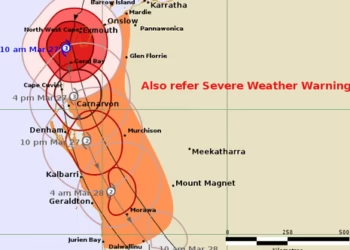 Tropical Cyclone Narelle Batters the Western Australian Coast
 Army Probes Apache Flyover at Kid Rock’s Nashville Estate
 Learner Driver Charged After Expo Tragedy
 Greens Face Internal Row Over Antisemitism Claims
 US ‘Narco Boat’ Strikes Draw Global Outcry
 Pope Meets Families in Italy Toxic Waste Zone
 Shocking Zoo Incident Sparks Attempted Murder Probe
 Ukraine Creates Long-Range Strike Command
 UK Schools Struggle as Classrooms Top 40C