Published: 6 April 2026 . The English Chronicle Desk. The English Chronicle Online—Unlocking the secrets of the past as the 1926 Census enters the public domain.
A century-long seal of secrecy has finally been lifted. On Monday, 6 April 2026, the National Archives of Ireland officially released the digitized records of the 1926 Census—the first headcount taken after the foundation of the Irish Free State. While popular history often paints the Ireland of the 1920s as a somber, insular, and entirely “monocultural” Catholic society, the raw data tells a far more vibrant story. From Russian silk-weavers in Dublin to Italian ice-cream dynasts in Scotland Road, the 1926 records reveal a fledgling nation that was, in the words of lead archivist Dr. Ciara Breathnach, “a surprising and sophisticated mix of people.”

The 1926 Census was taken on the night of 18 April 1926, just three years after the end of the Civil War. While the total population of the 26 counties stood at 2,971,992, the “Place of Birth” and “Occupation” columns reveal a startling level of internationalism:
-
The Jewish Quarter: Dublin’s “Little Jerusalem” (the Portobello area) was at its zenith, with hundreds of families listing births in Lithuania, Latvia, and Russia. These households were centers of tailoring, furniture making, and scholarly life.
-
The Italian Wave: The census tracks the firm establishment of the Italian community, particularly from the Frosinone region. Names that are now Irish institutions—Caffolla, Borza, and Cervi—appear in the records, often listing “Ice Cream Vendor” or “Fish Restaurateur” as their trade.
-
The “Engineers of Empire”: In rural areas, particularly around major infrastructure projects like the Shannon Hydroelectric Scheme, the census captures hundreds of German and Austrian engineers and laborers who brought specialized technical knowledge to the new state.
The “Religion” column provides a nuanced look at a society in transition. While 92.6% of the population identified as Catholic, the remaining 7.4% represented a resilient and diverse minority.
-
The Protestant Exodus: The records catch the immediate aftermath of the revolutionary period, showing a sharp decline in the Church of Ireland and Presbyterian populations, yet highlighting their continued influence in the professional and land-owning classes of Dublin and Cork.
-
The Gaelic Pulse: Despite the diverse influx, the census was a tool of nation-building. It was the first to rigorously track Irish speakers, showing that while the language was under pressure, it remained a living “community tongue” in the Gaeltacht regions of the west.
-
The “Domestic” Minority: The records show a significant number of British-born citizens who chose to remain in the Free State after independence, working as civil servants, teachers, and railway workers.
The release of these records has sparked a national conversation about Irish identity. For a modern Ireland currently navigating its own era of significant inward migration, the 1926 data serves as a historical “mirror.”
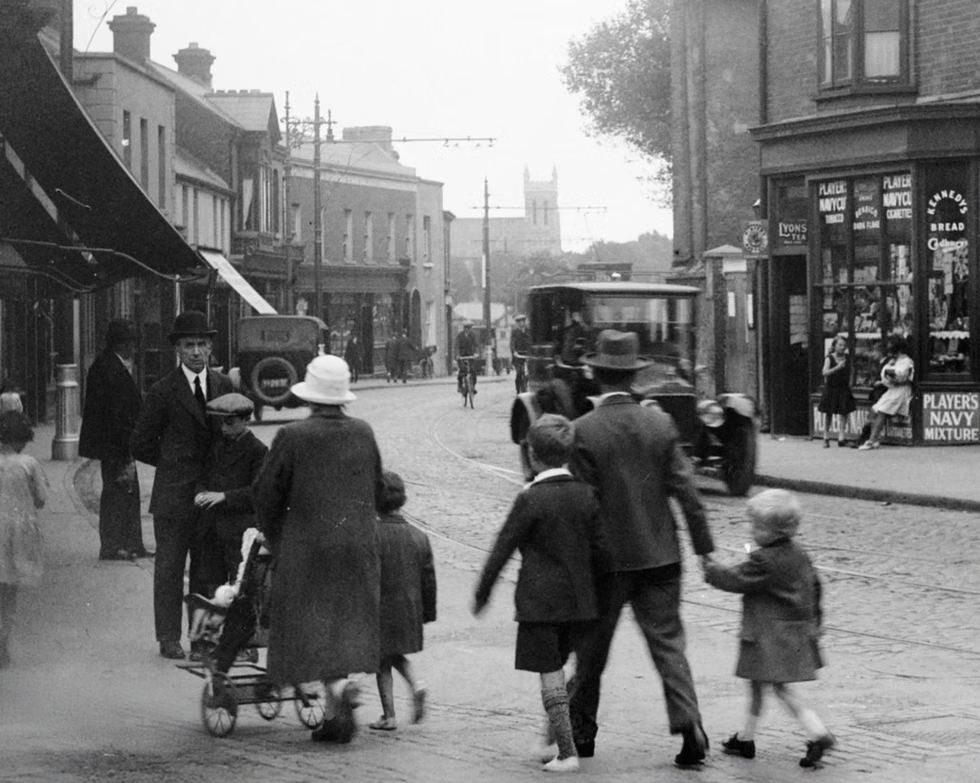
“We tend to look back at 1926 through a black-and-white lens,” says historian Diarmaid Ferriter. “But these forms show a country that was already globalized in its own way. You see French governesses, Chinese sailors in the docks of Cork, and American-born ‘returned’ emigrants bringing jazz-age sensibilities to rural parishes.”
The National Archives website experienced a “mini-meltdown” early Monday morning as thousands of amateur genealogists rushed to find their ancestors. The digitized platform allows users to search by surname, street, and county, offering a high-definition scan of the original handwriting of the “Head of Household” from a century ago.

As the 1926 Census becomes the most-searched database in the country, it is doing more than just helping people find their great-grandparents; it is dismantling the myth of a “closed” Ireland and replacing it with the reality of a nation that has always been a crossroads.
1926 Census Snapshot: Key Demographics
| Category | 1926 Statistic | Historical Note |
| Total Population | 2,971,992 | Lowest point since the Great Famine |
| Foreign-Born Residents | ~100,000 | Includes UK, USA, Russia, and Italy |
| Irish Speakers | 18.3% | Primarily concentrated in the West |
| Religious Minorities | 7.4% | Significant Protestant and Jewish presence |
| Urban/Rural Split | 32% Urban / 68% Rural | A heavily agrarian society |
Related News:
 ‘There Is a Feeling of the Greatest Outrage’: The Mystery of Stolen Champion Racehorse Shergar
 Battle to Save the Crumbling Palace of General Gordon’s Last Stand
 Ancient Bone May Prove Legendary War Elephant Crossing of Alps
 Lunar New Year 2026: Celebrations Around the World
 Tourism Is Booming in 2026 — Just Not Where You Think
 China Shows Off Nunchuck‑Wielding Humanoid Robots for Lunar New Year
 Revealed: The Billions Given to Charity by Ordinary Indians Every Year
 ‘We Pray for Peace’: Indian Filmmaker From Troubled State Who Won a BAFTA
 Inside Atlanta’s Soul Food Revolution
 Thailand Outsiders Face Patronage Wall
 Louvre Museum Director Resigns Months After High‑Profile Heist
 Security Threat Linked to Chinese Dance Group Triggers Bomb Scare for Australian PM
 Rose Wylie: The 91‑Year‑Old Art World Rebel in Her Prime
 Spain Declassifies Files on 1981 Attempted Coup in Effort to Dispel Conspiracy Theories
 Burning Carcasses and Smoke for Miles — The Outbreak That Killed Millions of Animals
 The Sad, Strange Story of the World’s Most Radioactive Paradise
 Rembrandt Painting Worth Millions Rediscovered After 65 Years
 ‘No Gain’ for Notorious Prisoner From Artwork Sale After Auction
 The Little Town Making Nearly All of China’s Lanterns
 The Suburban Spies Who Sold Britain’s Nuclear Secrets
 ‘The Show Must Go On’: Megan Thee Stallion Hospitalized Mid-Performance in Broadway Debut
 National Icon Returned: Ancient Golden Helmet Recovered 14 Months After Dutch Heist
 UK Must Act with Courage and Clarity on Israel-Palestine Conflict, Says Foreign Affairs Committee Report
 Yvette Cooper Signals Global Momentum Towards Gaza Peace Deal Amid Humanitarian Crisis
 Chaos at Ibrox as Martin’s Rangers Era Comes to an End
 Trump Claims Modi Has Agreed to Halt Russian Oil Imports Amid Heightened US Pressure
 Russia’s Latest Push to Win US Favors Shows Deep Desperation
 BBC to Apologise Over Edited Trump Speech Amid Backlash
 Britain deploys RAF specialists to assist Belgium with drone threats
 Trump Urges Herzog to Grant Netanyahu Full Pardon
 Indian authorities demolish Kashmir home linked to Red Fort blast
 Greene Pushes Epstein Files Amid Trump Fallout
 December Run-Off in Chile as Election Produces No Winner
 Zelenskyy Signs Fighter Jet Deal Amid Russian Drone Attacks
 Shadow Fleet at Sea: Europe’s Battle Against Illicit Oil Shipping
 Tiny Curacao Makes History as Smallest Nation to Reach World Cup
 India’s COP30 Delay Raises Global Climate Concerns
 US Suspends Afghan Immigration After White House Shooting
 ‘Extinct’ Antelope Returns to Sahara, Bringing Hope
 Sydney Shark Attack Surge Shocks Australia Beaches
 Portugal Election Delivers Socialist Win as Far Right Surges
 Australian Families Leave Syrian Camp for Home
 ‘I Would Scream in My Sleep’: Alawite Women from Syria Tell of Kidnap and Rape
 Epstein Eyed Record Label Investment to Access Women, Files Suggest
 How Do You Modernise Mango Farming? India’s Growers Urged to Innovate as Climate Change Hits
 Ukraine Negotiator Reveals What It Feels Like Facing Russia
 Drugs, Denial, Stigma: Fiji’s HIV Crisis Hits Children
 Hilary Knight speaks out on Trump’s recent hockey remarks
 American Citizen Killed in Cuba Boat Shooting, U.S. Officials Say
 Tracey Emin Says My Bed Would Be ‘Tidy, Clean and Boring’ If Made Today
 Iran’s Regime Still Intact — Coming Days Will Test Its Survival
 In Maps: Strikes Across Iran and the Middle East
 The Third Day of the US‑Israeli War With Iran
 Brit ‘in Good Spirits’ Amid Dubai Missile Attacks, Stranded but Safe
 Souped‑Up Warhol Exhibition Pops Into City With New Works
 Herzog Asio meeting sparks security storm
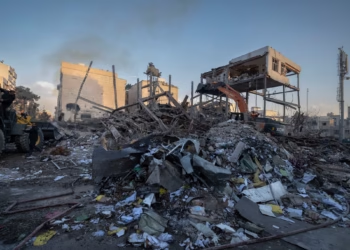 Civilian Deaths in Iran Pass 700 Amid Fear of Bombs and Regime Clampdown
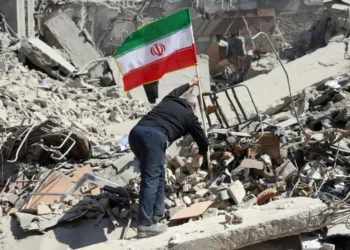 ‘Every Day Feels Like a Month’: Iranians Describe Life Under ‘Constant’ US‑Israeli Strikes
 Petrol Prices Soar as Retailers Accused of Gouging Amid Global Tension
 Penny Wong silent on Australian crew in sub strike
 Finland Plans to Lift Decades‑Old Ban on Hosting Nuclear Weapons
 Minister Meets Crews Who Will ‘Take Out’ Iranian Drones
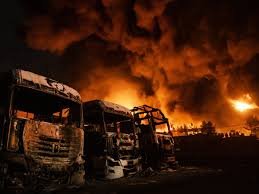 Oil Prices Surge Above $100 Amid Iran War
 Nine Days of Strikes Reshape the Middle East
 Trump Pressures Congress Over Save America Act
 Real Estate Brothers Convicted in Sex Trafficking Trial
 Iran War Puts Trump at Political Risk Amid Rising Prices
 Goma Drone Attack Kills Three as Conflict Escalates
 Queensland Protest Laws Spark Free Speech Backlash
 Trump Nato threats expose Iran strategy vacuum
 Trump’s Confidence Undimmed — But Every Iran Option Carries Risk
 Israel Says Iran Security Chief Larijani ‘Killed’
 Australia Imposes Sudden Travel Ban on Iranian Visitors
 Trump Facing Backlash from Epstein Survivors Over Files
 UK Forces Ready to Seize Russian Shadow Fleet Vessels
 Trump Considers Military Operation to Seize Iran’s Uranium
 “It Ends With Trial”: Judge Tosses Blake Lively’s Sexual Harassment Claims Against Justin Baldoni
 The Banbridge Rescue: 300 Sheep Saved from Massive Hay Shed Inferno
 Report Says Pezzullo Acted ‘Recklessly’ in Dealings
 Oil and Diplomacy: Russian Refineries Burn as Zelenskyy Secures Middle East Shield