**Published: 01 September 2026. The English Chronicle Desk. The English Chronicle Online**
Japan’s biggest companies are stepping up their investment in India as an expanding consumer market, a growing technology sector and rising geopolitical risks surrounding China reshape corporate strategies across Asia.
The latest signs of the shift came during a visit to Japan by India’s Commerce Minister Piyush Goyal, who led the country’s largest-ever business delegation to the country. The visit highlighted the increasingly important commercial relationship between Tokyo and New Delhi at a time when Japanese businesses are looking for new sources of long-term growth.
From shopping centres in Mumbai and Delhi to technology hubs in Bengaluru, Japanese brands are becoming increasingly visible across India. Companies that once treated the country as a secondary market are now expanding their operations, while new entrants are preparing major investments.
Apparel retailers Uniqlo and Muji and premium footwear company Onitsuka Tiger have already established significant Indian operations and are continuing to expand.
Japanese furniture company Nitori has recently entered the Indian market, while convenience store chain Lawson is reportedly preparing an ambitious expansion, with plans to eventually open as many as 10,000 stores in India by 2050, beginning in Mumbai.

The expansion is not confined to consumer businesses. Japanese financial institutions are also becoming increasingly aggressive in the Indian market.
MUFG Bank, Japan’s largest bank, completed a $4.4bn deal last year to acquire a 20% stake in Indian non-bank financial company Shriram Finance. The transaction represented the largest foreign investment in India’s financial sector.
Sumitomo Mitsui Banking Corporation, meanwhile, became the largest shareholder in Yes Bank after acquiring a 24.22% stake.
Together, these developments demonstrate how Japan’s corporate sector is increasingly viewing India as a strategic market rather than simply an alternative manufacturing destination.
## India Offers a New Growth Opportunity
For Japanese businesses, India’s attraction is closely connected to demographics.
Japan has experienced a declining population for more than a decade, creating structural pressure on domestic consumption and limiting opportunities for companies dependent on population growth.
“Japanese companies are having to look to India for growth,” said Vipul Nath Jindal, founder of Next Bharat Ventures, an impact investment fund backed by Suzuki Motor Corporation.
He said Japan’s declining population had created not simply a temporary slowdown but a permanent reduction in the size of the domestic market.
India offers the opposite demographic picture.
Its enormous population, rising household incomes and expanding middle class provide Japanese companies with the prospect of sustained consumer growth over several decades.
The country’s rapidly expanding digital economy is another attraction.
India has developed into a major destination for multinational technology and business operations, while its pool of engineers, software developers and other highly skilled workers has helped attract global companies.
Japanese businesses are increasingly participating in this ecosystem through global capability centres, or GCCs.
These centres perform functions ranging from research and development to corporate strategy, artificial intelligence and other business-critical activities.
More than 100 Japanese companies now operate GCCs in India, according to Deloitte research, making Japan one of the largest contributors to India’s growing network of multinational innovation centres in the Asia-Pacific region.
## A Strategic Hedge Against China
India’s growing importance also reflects changing calculations around China.
Japanese companies have maintained extensive manufacturing and supply-chain relationships with China for decades. However, geopolitical tensions, trade disruptions and concerns about excessive dependence on a single market have encouraged companies to diversify.
This does not mean Japanese businesses are abandoning China.
Instead, many are attempting to reduce their exposure to concentration risk.
Shruti Pandalai, India chair at the Lowy Institute, said Japanese companies were reducing concentration risk following years of supply-chain disruptions and geopolitical tensions.
India therefore represents both an opportunity and a hedge.
Japanese businesses can maintain important operations in China while developing another major Asian market capable of supporting future growth.
The approach is commercially significant because China remains deeply embedded in Japanese manufacturing networks.
Moving production or investment away from China entirely would be expensive and, in many cases, impractical.
India consequently offers a more gradual strategy: diversification rather than complete withdrawal.
## Government Ties Have Created the Foundation
The strengthening of commercial ties is not entirely new.
Japan and India have spent years building closer economic and strategic relations.
After Narendra Modi became India’s prime minister in 2014, the relationship was elevated to what the two countries described as a “special strategic and global partnership”.
The governments also established ambitious economic targets, including efforts to increase the number of Japanese companies operating in India.
One of the most visible symbols of the relationship has been India’s first high-speed railway between Mumbai and Ahmedabad, based on Japan’s Shinkansen technology.
The project has also illustrated some of the difficulties faced by Japanese companies operating in India, including delays, administrative hurdles and disagreements over implementation.
Nevertheless, the broader relationship has continued to deepen.
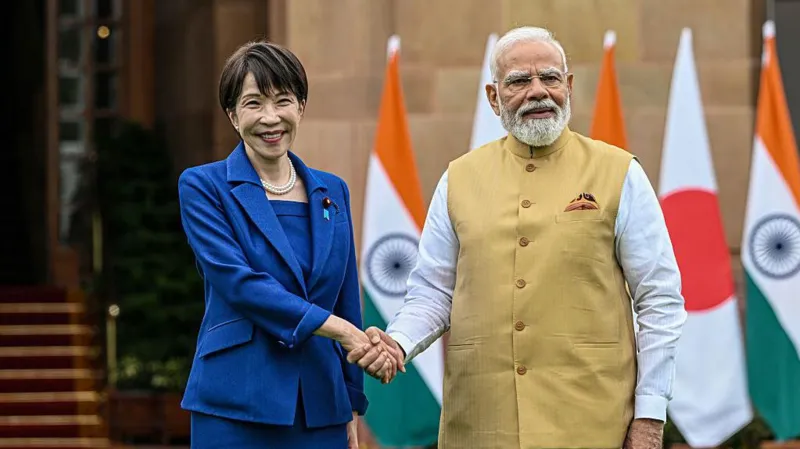
A major summit during Japanese Prime Minister Sanae Takaichi’s first official visit to Delhi in July produced announcements of $12.5bn in Japanese investment through around 120 agreements.
The agreements covered sectors including semiconductors, green energy and other strategic industries.
Piyush Goyal has suggested that Japan could reach its target of investing 10 trillion yen in India earlier than originally anticipated.
The scale of the investment announcements indicates that the relationship is becoming increasingly institutionalised.
## Small Businesses Are Joining the Push
The shift is not being driven exclusively by Japan’s largest corporations.
Japanese small and medium-sized enterprises are also exploring opportunities in India.
Hamamatsu, a Japanese manufacturing centre associated with companies including Suzuki, Honda and Yamaha, has established an India committee to examine how local SMEs can expand into the Indian market.
That development is important because Japan’s industrial economy depends heavily on smaller manufacturers and specialist suppliers.
If these companies begin establishing operations in India, the investment relationship could become considerably broader than the current concentration on major corporations.
Japanese SMEs often possess highly specialised manufacturing expertise, making them potentially valuable partners for India’s ambitions to expand domestic production.
For India, attracting these companies could help strengthen industrial supply chains and improve manufacturing capabilities.
## India Wants More Foreign Capital
The Japanese investment push comes at an important time for India.
Although the country remains one of the world’s fastest-growing major economies, attracting sustained foreign direct investment has been a continuing challenge.
For New Delhi, Japanese capital could help support manufacturing, infrastructure, financial services and advanced technology.
Closer economic cooperation could also reduce India’s dependence on China in strategically important sectors.
India runs a substantial trade deficit with China, and policymakers have increasingly focused on developing alternative supply chains for critical minerals, electronics and advanced manufacturing.
Japanese investment could therefore serve both economic and strategic purposes.
The relationship is not necessarily directed against China, but reducing excessive dependence on Chinese suppliers is increasingly important to both Japan and India.
## China Remains Difficult to Replace
Despite the enthusiasm surrounding India, Japanese companies face a difficult balancing act.
China remains a critical part of the Asian manufacturing system.
Japanese corporations depend on Chinese factories, suppliers and logistics networks across numerous industries.
Pratnashree Basu of the Observer Research Foundation has argued that Japan remains deeply integrated into Chinese manufacturing networks, while India’s integration is more uneven.
That interdependence limits how quickly businesses can redirect investment.
Any coordinated attempt to reduce economic ties with China could impose significant costs on Japanese companies and potentially provoke economic retaliation from Beijing.
For that reason, India’s rise is more likely to complement than immediately replace China’s role.
## Doing Business Remains a Challenge
India’s potential comes with significant obstacles.
Foreign companies have long complained about tax uncertainty, bureaucratic procedures, delays in land acquisition and environmental approvals, and difficulties enforcing contracts.
Japanese investors are no exception.
The Mumbai-Ahmedabad bullet train project has experienced substantial delays, and a former Japanese minister publicly criticised the Indian government over what he described as repeated changes and delays.
Indian officials rejected the criticism.
The dispute nevertheless highlighted an important issue for Japanese businesses: investment decisions depend not only on market size but also on predictability.
Japanese corporations typically make long-term investments and require confidence that regulations, contracts and government commitments will remain stable.
India’s ability to provide that certainty will therefore influence whether the current investment surge becomes a lasting trend.
## A Relationship Moving Beyond Leaders
One of the most significant features of the Japan-India relationship is that it appears increasingly independent of individual political leaders.
Toshiro Nishizaewa of the University of Tokyo has described the decline in Japanese investment in China and the increase in India as a commercially driven diversification strategy rather than simply a government-led geopolitical shift.
Pandalai similarly argues that successive Japanese governments have continued raising economic targets for India.
That suggests the relationship has become embedded in corporate strategies, government institutions and long-term economic planning.
This institutionalisation could make the partnership more resilient to political changes in either country.
## India Faces a Test of Its Opportunity
The challenge for India now is to convert Japanese interest into sustained investment.
The country has the market size, workforce and growth prospects Japanese companies are seeking.
But those advantages must be supported by efficient infrastructure, predictable regulation, faster approvals and reliable contract enforcement.
The recent expansion by retailers, banks, technology operations and manufacturers demonstrates that Japanese companies are willing to make substantial commitments.
The next phase will depend on whether India can maintain the momentum.

For Japan Inc, India offers something increasingly difficult to find elsewhere: a large and expanding market at a time when domestic demand is shrinking and traditional overseas markets face greater uncertainty.
China will remain indispensable to Japanese industry for years to come, but the balance of corporate exposure is changing.
India is emerging as an important second pillar of Japanese economic strategy in Asia, driven simultaneously by commercial opportunity, supply-chain diversification and economic security.
If the investment momentum continues, the consequences could extend well beyond individual corporate deals.
A deeper Japan-India partnership could strengthen India’s manufacturing ambitions, expand Japanese companies’ access to one of the world’s largest consumer markets and gradually reshape the distribution of Japanese capital across Asia.
For Tokyo, the calculation is increasingly straightforward: China remains too important to abandon, but India is becoming too important to ignore.
Related News:
 Pubs and Hotels Face Business Rates Reform Review
 Shein targets $27bn valuation in Hong Kong debut
 Firms on both sides fear damage from US-Canada trade war
 UK Risks Falling Behind in AI Race
 Post Office Scandal Compensation Tops £1 Billion as Victims Finally See Justice
 Tensions Unfold in Market Harborough as Asylum Seeker Hotel Sparks Divisive Protests
 China’s crackdown on civil servant perks sparks economic concerns
 Chancellor Rachel Reeves Pushes for Sweeping Changes to Environmental Protections to Accelerate Development
 Inflation Latest: Cost of Living Expected to Rise Again in Key Figures Released Today
 Shein UK Faces Allegations of Shifting Majority of Profits to Singapore to Reduce UK Tax
 Big Pharma Investment Freeze Puts UK Life Sciences Sector Under Strain
 Jaguar Land Rover Extends Production Halt Following Cyber-Attack
 Great Britain’s Energy Operator Commits to Strengthening Grid to Prevent Blackouts
 UK House Price Growth Slows as Buyers Exercise Caution Ahead of Autumn Budget
 Kemi Badenoch Unveils ‘Golden Rule’ to Halve Spending Cuts for Deficit Reduction at Tory Conference
 New V-Level qualification to transform post-16 education
 Real living wage set to rise nearly 7% for UK workers in 2026
 Reeves Faces Setback as Labour May Miss Homes Target
 Virgin Trains Moves Closer to Challenging Eurostar Monopoly
 Trump’s UK Ambassador Urges North Sea Drilling to Strengthen US Ties
 Ryanair Chief UK Economy ‘Doomed’ Under Labour
 M&S Profits More Than Halve After Cyber-Attack
 Millionaires group urge Reeves to introduce wealth tax to ‘lift kids out of poverty’
 From Lego to Pokémon: How Adults Are Driving UK Toy Market Growth
 Canada Passes Carney’s First Budget in Tight Parliamentary Vote
 Starmer Says Labour’s Economic Plan Needs Years to Deliver
 Historic £100-Weekly Pension Boost Brings Relief for UK Mineworkers
 Starmer Faces Parliamentary Battles Over UK-EU ‘Reset’ Plan
 China Halts Nvidia H200 Chips Despite US Export Approval
 ScottishPower Tops List of Worst UK Energy Suppliers
 Markets Slide As Gold Rally Signals Risk From Trump Greenland Tariff Plan
 City & Guilds pay surge sparks backlash amid £22m cuts
 UK Inflation Hits 3.4% in December, Ending Five-Month Decline
 Trump Fed bid heads to Supreme Court
 India-EU Free Trade Deal Marks Historic Economic Shift
 Telstra AI jobs cuts as automation drive expands
 BT Names New Openreach Chief Amid Major Fibre Expansion
 UK Banks Plot Payment Backup Amid Trump Fears
 UK Unemployment Rate Climbs to 5.2% Peak
 UK shelves £110m border project amid trade strain
 Rachel Reeves Faces Middle East Conflict Test
 Grocery Inflation Rises Amid War Fears
 BrewDog sold Highland estate for knockdown price after abandoning reforestation plans
 Rising Costs Force Families to Rethink Days Out
 UK inflation held at 3% before global energy price hit
 Ticketmaster Fees Rise Despite Recent US Junk Fee Crackdown
 M&S Demands Urgent Action on Rising Violent Retail Crime
 New Era for Sick Pay as Millions Gain Critical Rights
 US and Iran Agree to Two-Week Provisional Ceasefire
 Aegon Sells Historic UK Arm to Standard Life for £2bn
 Central Bank Chiefs Hold Crisis Simulation in Washington
 UK Staycations Rise as Travel Fears Grow
 Former Brexit Chief Calls for Rejoining the EU
 Albanese Rejects Gas Export Tax Push
 Oil Prices Surge Above $120 Amid Iran Blockade Fears
 Millions Face Food Poverty as Consumer Confidence Hits Record Low
 Silent Tracks: Rail Line Without Passengers
 DeepMind Staff Vote to Unionize Over US Military Contract
 Global Conflict Hits Home As Bullock Warns Of Economic Pain
 STV Election Coverage Disrupted Amid Bitter Pay Dispute
 High Stakes in Beijing as Trump and Xi Meet Amid Global Turmoil
 Lotus Boss Pledges Future to Norfolk and Seeks State Support
 Trump and Xi Convene in Beijing for Historic High-Stakes Summit
 Rubles and Resilience: How Russia-China Border Towns Thrive
 UK Eases Russian Oil Sanctions as Fuel Costs Soar
 Kevin Warsh sworn in as Fed chair amid economic backlash
 Mid-Year Surge to Push Average Annual Bills Beyond £1,900
 Tube Strike Brings Capital to a Standstill Over Shift Disputes
 Tube Strike Brings Capital to a Standstill Over Shift Disputes
 No Brutal EV Price War For British Motorists
 Gas Prices Fall Below $4 Following US-Iran Peace Deal
 Is JD Vance the Ultimate Fall Guy for Trump’s Shaky Iran Deal?
 EU Slashes Steel Quotas But Grants UK Favourable Rates
 Sainsbury’s Boss Optimistic As Grocery Inflation Eases
 Trump Faces Backlash Over $2bn Earnings Since Return
 Starling Bank Trims Jobs for AI Future
 Accessible Travel Could Unlock £176bn for UK Economy
 Apollo Launches £5.7bn Bid for Aviation Giant easyJet
 Burnham unveils £65m drought aid for farmers
 Unions Warn Labour Over Zero-Hours Contract Reforms