Published: 27 February 2026. The English Chronicle Desk. The English Chronicle Online.
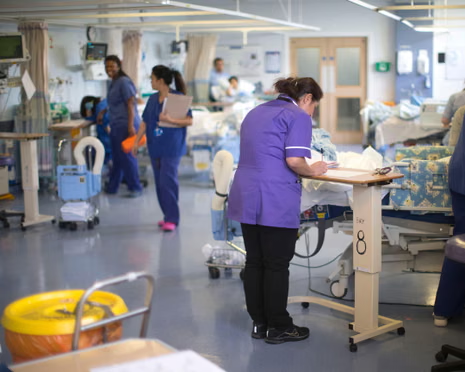
Hospitals and care homes across the UK face a looming crisis as overseas worker numbers collapse. Experts warn that falling immigration of nurses and care staff risks an unprecedented strain on the healthcare system. Home Office data reveal that the number of overseas nurses granted entry to the UK fell by a staggering 93% between 2022 and 2025. Just 1,777 overseas nurses arrived last year, compared with 26,100 in 2022, demonstrating a dramatic reduction in the sector’s international recruitment. Visas for caring personal service occupations, which cover care workers, ambulance staff, and nursing auxiliaries, fell even more sharply, illustrating systemic pressure on frontline support roles.
From 107,847 overseas workers granted entry in 2023, the numbers plunged to only 3,178 by 2025, representing a 97% fall. Alarmingly, just 23 care workers arrived from overseas in the final three months of last year. This trend, highlighted in a study by the charity Work Rights Centre, reflects the impact of increasingly restrictive migration policies, which some economists warn could exacerbate skill shortages, rising inflation, and challenges in meeting the needs of an ageing population. The decline also signals long-term pressures on essential services reliant on migrant professionals.

Overall, skilled worker visa issuance has now dropped for nine consecutive quarters, reaching its lowest point since 2021. The reductions span multiple sectors, including science, education, healthcare, and skilled trades, reflecting the UK government’s systematic tightening of visa conditions. In May 2025, Keir Starmer explicitly stated that every aspect of immigration would be controlled more strictly, promising tougher enforcement measures and lower overall migration numbers. Critics argue this approach has created unintended consequences for industries that depend on overseas recruitment to fill critical workforce gaps.
Royal College of Nursing chief officer Lynn Woolsey described the situation as “the worst of all worlds” for healthcare. She emphasised that domestic recruitment alone is insufficient to cover vacancies left by the collapse in overseas nursing staff. Woolsey warned that without urgent intervention, the UK risks significant strain on hospitals and care facilities, where remaining nurses face excessive workloads and double shifts to meet patient needs. She urged ministers to act promptly, stressing that pushing away overseas professionals while failing to invest in the domestic workforce would jeopardise healthcare delivery.
Dora-Olivia Vicol, chief executive of the Work Rights Centre, highlighted the broader implications for hospitals, research institutions, and schools across the UK. She noted that the sharp decline in migrant professionals raises questions about the true costs of a narrow focus on reducing migration. Vicol warned that the country faces an impending “car crash” in public services, with hospitals unlikely to function effectively amidst 25,000 unfilled nursing positions. Migrant workers who can still enter face higher costs, longer settlement routes, and risks of labour exploitation due to visa restrictions tying them to specific employers.
Visas for science, research, engineering, and technology professionals dropped from 24,843 in 2022 to 9,072 in 2025, reflecting a severe contraction in skilled talent flows. Similarly, teaching and education professional visas declined 71% over two years, while skilled tradespeople visas fell 73%, signalling widespread challenges for workforce sustainability. These trends underscore concerns about the government’s ability to meet infrastructure, healthcare, and education demands without sufficient migrant talent. Vicol warned that these declines threaten fiscal stability, economic growth, and the sustainability of public services.
The National Care Association, representing around 5,000 social care providers, echoed these concerns. Executive chair Nadra Ahmed emphasised that international recruitment remains essential, as domestic applicants fail to meet demand. She highlighted the risk to care recipients if overseas professionals are unavailable, noting that migrant staff have historically played a crucial role in maintaining sector stability. The departure of skilled workers to other European countries such as Germany and Ireland, attracted by better conditions, has further amplified pressures on the UK workforce.
Simon Bottery, senior fellow for social care policy at the King’s Fund, confirmed that reduced overseas recruitment has become a structural reality for social care. He argued that the sector must increasingly focus on cultivating a homegrown workforce to maintain service provision. Ahmed also observed care home closures occurring due to staffing shortages, as providers struggle to replace international recruits who have lost sponsorship rights. The situation presents immediate operational challenges and long-term sustainability concerns for social care across the UK.
The Home Office defended its position, stating that overseas recruitment for care workers ended due to unacceptable levels of abuse and exploitation. Officials argued that tightening skilled worker visa thresholds to degree-level ensures fairer labour practices and greater opportunities for British workers. A spokesperson asserted that net migration has fallen nearly 70% under the current administration, framing the reductions in visa issuance as evidence of effective border and migration control. The department also emphasised its commitment to attracting high-skilled labour, even as lower-skilled roles face stricter limitations.
The consequences of these policies are already evident. Healthcare facilities report escalating pressure as remaining staff juggle larger patient loads. Care homes face rising operational stress, while educational and research institutions struggle to recruit talent necessary for critical programmes. Economists warn that the cumulative impact of shrinking overseas recruitment could slow economic growth, strain public finances, and increase reliance on temporary staffing solutions. Without corrective measures, the UK risks falling behind in essential service delivery and workforce stability compared with other nations.
Despite these challenges, government representatives assert that prioritising domestic workers benefits the long-term economy. They argue that controlling migration fosters higher wages, reduced unemployment among locals, and opportunities to invest in homegrown talent pipelines. However, critics stress that such policies cannot fully replace the experience, skills, and labour contribution of overseas professionals. The healthcare and social care sectors, in particular, have historically relied on migrant staff to supplement domestic shortages and maintain operational continuity.

Analysts suggest that reversing the decline in international recruitment will require significant policy adjustments. Measures could include relaxing visa restrictions, expanding sponsorship schemes, and providing pathways to settlement for critical workers. Simultaneously, investment in training and retaining domestic staff must continue to offset persistent shortages. Without such interventions, the UK faces ongoing operational risks across multiple public services, with hospitals, care homes, and educational institutions operating under increasingly precarious conditions.
The collapse in overseas workforce inflows represents a fundamental challenge for the UK’s public services. Experts insist that balancing migration control with service sustainability is vital to prevent systemic failure. Hospitals, care homes, and schools must adapt to a landscape of fewer migrant staff, while policymakers confront difficult trade-offs between border enforcement and societal needs. The situation highlights the delicate interconnection between immigration policy, workforce planning, and the delivery of essential services for a growing and ageing population.
In conclusion, the decline in overseas workers arriving in the UK signals a serious strain on healthcare, social care, and education sectors. Experts describe the situation as a looming “car crash,” with unfilled nursing positions, fewer care workers, and shrinking skilled labour affecting service delivery nationwide. Without urgent policy intervention and increased domestic workforce development, the UK risks enduring long-term operational and economic consequences. Balancing immigration policy with workforce sustainability remains crucial to maintain public services and protect the well-being of vulnerable populations.
Related News:
 Mother dies after black market weight loss injection
 Young Woman Missed 13 Times by GPs Before Bowel Cancer Diagnosis
 Hospice Cuts Raise Alarm Across England Amid Funding Crisis
 How Bringing Forests Into Preschools Boosts Children’s Health
 The diet that can significantly ease symptoms of IBS
 Celebrities and Charities Demand UK Government Act on Child Poverty
 Long A&E waits causing heartbreaking suffering, charity says
 Experts Warn on Home Birth Risks, Call for Skilled Midwives
 Lancashire council plans to close care homes and day centres
 Britain could face worst flu season on record, NHS warns
 Experts Urge Legal Right to Timely Cancer Care
 Patients to Test Health at Home to Ease NHS Winter Pressure
 London’s Childlessness Crisis: Schools Closing as Families Shrink
 NHS Takes Over Nuffield Hospital in ‘Windfall’ for London Care
 North Sea oil workers must lose weight or face job loss
 Crisis charity to become landlord amid UK housing emergency
 No link found between paracetamol in pregnancy and autism
 UK Disability Pay Gap Means Millions Work for Free From Today
 Shouting Works Best to Deter Gulls, UK Study Finds
 Reeves rejects £1bn plea for NHS redundancy payouts
 NHS trust fined after woman takes life in mental health unit
 Leading doctors issue warning amid ‘bad’ flu season
 UK Centres Used Risky Heart Pump Despite Safety Fears
 Reeves Rejects £1bn NHS Payout Plea from Streeting
 New Campaign Trains Vets to Spot Farmers’ Health Risks
 Stroke Patient Mistaken for Drunk, Care Delayed
 ‘Traumatic Wait’: Northern Ireland Women Face Breast Cancer Delays
 Boris Johnson Oversaw Toxic No 10 Culture, Covid Inquiry Finds
 Welsh Government Christmas 2020 Lockdown Criticised
 Coffins Now Too Large to Cremate Amid Rising Obesity Crisis
 Thinktank Urges Smaller Hospitals to End NHS ‘Permacrisis’
 David Cameron Reveals Prostate Cancer Diagnosis, Advocates Screening
 NHS paediatric leave parents waiting months for answers
 Catherine urges end to stigma around addiction
 11 Best Supermarket Wines Chosen by Experts and Sommeliers
 Inquiry Opens Into Disgraced Surgeon Eljamel Scandal
 Five-Year-Old Dies After Rare Tonsil Surgery Complication
 Fibromyalgia Patients Struggle as NHS Fails to Provide Care
 More Patients Now Contacting GPs Online, Data Shows
 Streeting launches review into mental health and ADHD diagnoses
 Flu cases in Scotland more than double in a week
 People in England’s Poorest Areas Face Higher Lung Health Emergencies
 MND Patients Die Waiting for Home Adaptations in England
 Minor A&E Visits Surge Across England as Hospitals Face Pressure
 Children to Receive Home Vaccines as England Acts
 UK children to get chickenpox jab with MMRV vaccine
 UK Enforces Junk Food Ad Ban Before 9pm
 Salt Intake England: Crisps Comparison Sparks Health Alarm
 Weight Loss Jabs Linked to Rapid Weight Regain, New Study Shows
 Patients Collapsing in NHS Corridors, Watchdog Warns
 Offenders to Receive Health Support During Probation Appointments
 NHS Violence Crisis: Staff Face Daily Assaults
 Celebrity Campaign Highlights SMA Screening Failures
 NHS corridor care crisis sparks fears over patient safety
 Jess’s Rule Urges GPs to Rethink Persistent Symptoms
 UK Glaucoma Rise Signals Looming Eye Health Crisis by 2060
 UK ADHD medication use triples over 13 years, landmark study finds
 Reform UK Health Plan ‘Would Cost £1.7bn’, Streeting Says
 NHS boosts bowel screening accuracy with FIT reform
 UK loses measles-free status amid deaths and jab decline
 Nottingham survivor warns of repeat attacks without mental health reform
 UK vets face reforms to tackle high pet care costs
 Small risk warning raised over weight-loss jabs in UK review
 Study Finds One in Seven England Takeaways Are Dark Kitchens
 Deadly Cancer Postcode Lottery Limits NHS Care
 Pneumonia Surge Pushes England Emergency Cases Higher
 Streeting moves on doctor pay to end strike dispute
 UK reports baby formula toxin poisoning cases across the country
 Children of Close-Relative Parents Face Higher Mortality Risk in England
 North London measles outbreak hits young children
 UK MPs Demand Ban on Brazilian Butt Lifts
 Campaign Demands NHS Action on Placenta Accreta Diagnosis
 NHS Bone Cement Shortage Threatens Surgeries
 NHS Negligence Ruling Raises Payout Costs
 Placenta Accreta Warning as Hunt Urges Action
 Half of Britons Avoid GP When Ill, Survey Reveals Growing Concern
 NHS Maternity Units Cover Up Harmful Childbirth Errors
 Vegetarian Cancer Risk Study Reveals Lower Rates
 M&S and Morrisons Lead Christmas Supermarket Taste Test
 Reeves Faces Setback as Labour May Miss Homes Target