Published: 2 April 2026 . The English Chronicle Desk. The English Chronicle Online- Your definitive source for the Artemis generation and deep space exploration.
Following its spectacular sunset liftoff from the Kennedy Space Center yesterday, the Orion spacecraft, carrying the four-person Artemis II crew, is currently maintaining a high, elliptical orbit around Earth. This “safe zone” phase is a critical tactical pause before the mission’s most daring maneuver: the Translunar Injection (TLI) burn scheduled for later tonight. As of Thursday morning, the crew—Commander Reid Wiseman, Pilot Victor Glover, and Mission Specialists Christina Koch and Jeremy Hansen—are successfully verifying that their home for the next ten days is prepared for the unforgiving environment of cislunar space.

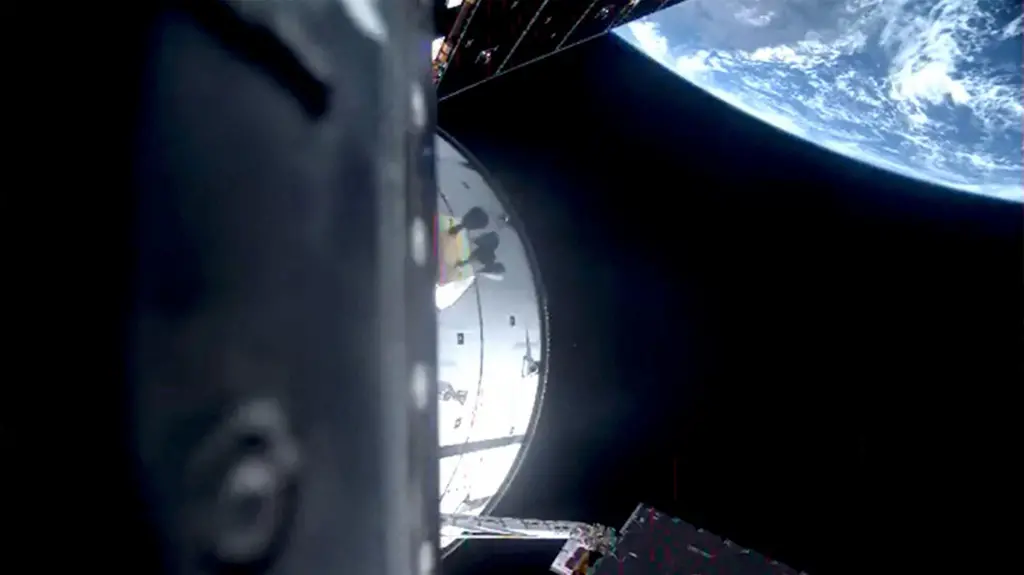
Since reaching orbit, the spacecraft (named Integrity) has already aced several high-consequence milestones. Shortly after launch, flight controllers in Houston confirmed the successful deployment of Orion’s four 24-foot solar array wings, which are now generating the electrical power required for the journey. Perhaps most significantly, Pilot Victor Glover took manual control of the capsule to perform “proximity operations” near the spent upper stage of the SLS rocket. This demonstration was designed to test Orion’s handling and docking capabilities—skills that will be essential for future missions when astronauts must link up with lunar landers or the planned Lunar Gateway station.
The current orbit is a wide-swinging path that brings the crew as close as 115 miles to Earth’s surface before soaring to an apogee of over 43,000 miles. This trajectory is purposeful; it allows the crew to test the life-support systems—the “camper-van sized” interior’s air scrubbers and water recyclers—while still within reach of a quick abort to Earth if a critical failure occurs. NASA Administrator Jared Isaacman confirmed that a brief communication glitch early in the flight was quickly resolved, and the crew is reportedly in high spirits, despite the tight quarters and a minor “instrumentation issue” with a battery sensor that caused a momentary pre-launch stir.
The mission is now counting down to the TLI burn, a massive engine firing that will propel Orion out of Earth’s gravitational grip and toward the Moon. This maneuver will place the crew on a “free-return” trajectory, ensuring that even if their main engine were to fail later, the Moon’s gravity would naturally slingshot them back toward a safe splashdown on Earth.

Artemis II is not just a test of hardware, but a test of human endurance. As the first crew to leave low-Earth orbit since 1972, Wiseman, Glover, Koch, and Hansen are currently the furthest humans from home. Their mission serves as the final validation before Artemis IV attempts to put boots back on the lunar surface in 2028. For now, the world watches the “blue marble” through Orion’s windows along with them, waiting for the final push that will take humanity back into the deep dark of the lunar vicinity.
Related News:
 India and US Collaborate to Launch Groundbreaking Satellite for Earth Observation
 British AI Startup Outshines Human Forecasters in Global Prediction Contest
 History Will Remember Who Showed Up: Pressure Mounts on Keir Starmer to Attend Cop30 Summit
 UK Fighter Jet Purchase Could Breach Nuclear Treaty, Warns CND
 Google at 27: The Untold Story of Ruth Kedar, the Woman Behind the Iconic Logo
 Russia repeatedly targets UK military satellites, warns Space Command chief
 Cooper Unveils £4m Cyber Plan Against Russian Hackers
 Experts Warn Russia’s Burevestnik Missile Could Destabilise Arms Control
 Britain deploys RAF specialists to assist Belgium with drone threats
 Night after night, Belgium is on high alert.
 Hitler’s DNA Confirms He Truly Had Only One Testicle
 Pokémon to open world’s first theme park in Japan next year
 Ukraine to Get 100 French Rafale Jets in Historic Deal
 Poll Reveals China Leads World in Trusting AI Technology
 US Clears Nvidia AI Chip Sales to China in Policy Shift
 Iran Signals Permanent Break From Global Internet, Activists Warn
 UK New Car Discounts Near £6,000 as Prices Are Slashed
 Musk Wants City on the Moon Within 10 Years
 Indian University Kicked Out of AI Summit for Claiming Chinese Robot Dog as Its Own Invention
 China Shows Off Nunchuck‑Wielding Humanoid Robots for Lunar New Year
 The Chinese AI App Sending Hollywood Into a Panic
 How Do You Modernise Mango Farming? India’s Growers Urged to Innovate as Climate Change Hits
 Bill Gates Pulls Out of India’s AI Summit Over Epstein Files Controversy
 Zuckerberg Defends Meta in Landmark Social Media Addiction Trial
 Etsy Sells Second‑Hand Fashion App Depop to eBay for $1.2bn
 Musk Cuts Starlink Access for Russian Forces – Giving Ukraine an Edge at the Front
 Anthropic AI Refuses Pentagon’s Safety Demand
 Social Media Trial: Woman Says Addiction Began at Six
Instagram Investigating AI Profiles ‘Fetishising’ Disabled People
Social Media Trial: Woman Says Addiction Began at Six
Instagram Investigating AI Profiles ‘Fetishising’ Disabled People
 Anthropic Boss Rejects Pentagon Demand to Drop AI Safeguards
 Brady Tkachuk Denies AI Video Claims After Olympic Gold
 Orbital Space Race Heats Up in Arctic North
 The Sad, Strange Story of the World’s Most Radioactive Paradise
 Why Russia Controls Its People With a Flick of a Switch
 Wellness Peptide Craze: Why People Are Injecting Drugs ‘Not for Human Consumption’
 The US Now Has the Medicine for Cheap Swarming Drone Attacks
 Boy George Says He’s Using ChatGPT to Help Write New Songs
 Satellite Images Show Iranian Navy and Nuclear Sites Hit by US‑Israeli Strikes
 Protesters Rally in San Francisco Against OpenAI Deal With Pentagon
 We Have More Privacy Controls Yet Less Privacy Than Ever — The Paradox of Digital Life
 Regulator Contacts Meta Over Workers Watching Intimate AI Glasses Videos
 Study Says Only Two Nations May Survive Nuclear War
 Baba Vanga’s Chilling World War 3 Prediction and Russia’s New Leader
 Tiny Possum and Glider Thought Extinct for 6,000 Years Found in Remote West Papua
 Musk’s xAI Permit Sparks Fury Over Power Plant Expansion
 GPS Jamming: The Invisible Battle in the Middle East
 The Kill Line: A Shifting Vision of the American Dream
 Iran Social Media Strategy Shifts to Information War
 ABC Staff Strike Over Pay and AI Concerns
 Cluster Strikes Test Israel’s Missile Defences
 Zelensky Visits Saudi Arabia After Offering Drone Expertise
 One Ant for $220: The New Frontier of Wildlife Trafficking
 How and When to See April’s Full Pink Moon
 How Iran Destroyed US Base’s $500m Battlefield Nerve Centre
 Trump Considers Military Operation to Seize Iran’s Uranium
 Jim Ratcliffe’s £3.5bn Chemical Plant Delayed with Parts Stranded in the Gulf
 Trump Building ‘Massive’ Military Bunker Under White House Ballroom
 The Death-Defying Nuclear Commando Mission That Could End the War
 Baltic Blackout: Satellite Images Reveal Scorched Russian Oil Hubs After Ukraine Strikes
 ‘Excitement’ at Salisbury Plain as UK Conducts Largest Military Parachute Drop in a Decade
 The ‘Simpler Recycling’ Era: England’s New Bin Rules Face a Patchy Rollout
 ‘A Million Things’: The Unprecedented Peril of Seizing Iran’s Uranium Stockpile
 ‘The Counting of a Nation’: India Launches World’s Largest Census Amid Tech Revolution
 ‘At the Doorstep of the Future’: Florida’s Space Coast Braces for Historic Artemis II Launch
 Artemis II: Humanity Returns to the Moon After Decades
 ‘We Go for All Humanity’ — Artemis II Returns Humans to the Lunar Vicinity
 UK Bans Fake Numbers: Scammers Lose Their Trick
 Vibe coding’ named Collins dictionary’s word of the year
 BBC to Apologise Over Edited Trump Speech Amid Backlash
 Greene Pushes Epstein Files Amid Trump Fallout
 Zelenskyy Signs Fighter Jet Deal Amid Russian Drone Attacks
 Sundar Pichai Cautions on AI Hype and Market Risks
 Civilian Deaths in Iran Pass 700 Amid Fear of Bombs and Regime Clampdown
 ‘Every Day Feels Like a Month’: Iranians Describe Life Under ‘Constant’ US‑Israeli Strikes
 Penny Wong silent on Australian crew in sub strike
 Finland Plans to Lift Decades‑Old Ban on Hosting Nuclear Weapons
 Trump Pressures Congress Over Save America Act
 Iran War Puts Trump at Political Risk Amid Rising Prices
 Goma Drone Attack Kills Three as Conflict Escalates
 Queensland Protest Laws Spark Free Speech Backlash