**Published: 28 August 2026. The English Chronicle Desk. The English Chronicle Online**
For Sudipto Bhattacharya, the final message from his wife contained nothing to suggest that she was in danger.
At 07:57 local time on Wednesday, 26 August, Subhrasree Chakraborty sent him a photograph showing the departure stamp in her passport. Nepalese immigration formalities were complete, she told him. The group was waiting to cross into China for the next stage of their long-awaited pilgrimage to Mount Kailash.
Six minutes later, at 08:03, the messages stopped.
Subhrasree, 43, is now among the Indian nationals reported missing after a catastrophic flash flood struck the Nepal-China border region. Nepal’s latest official figures say 359 bodies have been recovered and 596 foreign nationals from 33 countries remain missing. Indians make up the largest group, with 178 reported missing, of whom 11 have been found.
Many of those missing were tourists and pilgrims travelling towards Mount Kailash and Lake Mansarovar in Tibet. The pilgrimage route had become increasingly busy after travel restrictions and tensions disrupted journeys in previous years.
For Bhattacharya, however, the wider numbers offer little comfort. He wants to know what happened to one person: his wife.
“After 08:03am, what happened? We don’t know anything,” he said.
Subhrasree had dreamed of making the journey for years. She worked as a medical technologist in critical care at a city hospital and was familiar with emergencies, CPR and intensive-care procedures. Her husband also described her as physically fit.
None of that has helped the family understand what happened after the final message.
The photographs she sent home from Kathmandu shortly before disappearing captured the excitement she had felt about the trip. She appeared smiling in a blue tunic at a temple and in other photographs stood among the historic brick and carved-wood architecture of Kathmandu Valley.
“She was very excited,” Bhattacharya said. “This was her dream tour.”
The journey began on Friday, 21 August, when Subhrasree travelled by train from Kolkata to Raxaul. She crossed into Nepal through Birgunj and continued by bus to Kathmandu, arriving that night.
She spent three nights in the capital before travelling north towards Syabrubesi, a mountain settlement and gateway to the Langtang region. The journey on 25 August was difficult. A landslide blocked the road for several hours before the Nepalese army cleared the route.
Yet when Subhrasree spoke to her husband, there appeared to be little indication of the disaster that was approaching.
“She kept saying the weather was good,” he recalled. “She said it was rather warm, it was raining sometimes.”
The following morning, she left her hotel shortly after 07:00.
She spoke to Bhattacharya by telephone and continued exchanging messages with him. Around an hour later, she told him that Nepalese immigration formalities had been completed and that the group was waiting to cross into Tibet.
Pilgrims travelling through the route normally cross from the Nepalese side towards the Chinese immigration facility at Gyirong. The border area was among the locations devastated by the sudden flood.
Bhattacharya believes his wife may have been inside or close to the Chinese immigration facility when the disaster struck.
Then the connection disappeared.
Initially, he was not immediately alarmed. He knew that communications could become unreliable as the group moved towards Tibet.
“I knew there would be connectivity issues on the Tibet side,” he said. “So I waited for the next message.”
By around 15:00, however, reports of the disaster had begun appearing in the media. Bhattacharya started calling other pilgrims in his wife’s group.
Nobody answered.
He contacted the tour operator and attempted to reach the managers accompanying the group. Again, there was no response.
The uncertainty has left the family searching for information from authorities on both sides of the border.
“Have they been rescued? Was this group among those rescued in China?” Bhattacharya asked. “We want to know more.”
He has appealed for authorities to provide a clear list showing who has been rescued, who remains missing and who has died.
“Please get me a list from the Chinese government,” he said. “Missing, dead and rescued. We need an update.”
His description of the days since the disaster captures the distress faced by hundreds of families waiting for information.
“What do I tell you? Sleepless nights, working on the phone,” he said.
Subhrasree is not the only member of the pilgrimage community whose family has been left without answers.
The family of 54-year-old Rina Banerjee, an unmarried private tutor from Kolkata, does not even know with certainty which side of the border she was on when communication stopped.
Banerjee was travelling alone with a tour operator as part of the same pilgrimage. Her family had spoken to her by video call while she was in Kathmandu and remembered her as happy and excited about the trip.
Her nephew, Dwaipayan Mukherjee, said she had travelled in the mountains before and was accustomed to hiking.
“She was quite fit,” he said. “We have gone hiking. We are used to going to the mountains.”
Banerjee had also told relatives about the landslide encountered by the group on the previous day. The travellers were reportedly delayed for several hours before continuing their journey.
The following morning, the tour operator sent a group photograph showing Banerjee outside the Nepalese immigration centre. Like Subhrasree, she had reportedly received her departure stamp.
Then came the silence.
“I don’t know whether they crossed the border or not,” Mukherjee said. “Whether they were on the Chinese side or the Nepal side, we are still wondering.”
Their uncertainty reflects the extraordinary difficulties facing authorities trying to reconstruct what happened during the disaster. Nepal’s Ministry of Foreign Affairs has established an emergency response team specifically to coordinate search and rescue, verify information and provide consular assistance concerning foreign nationals. The ministry has also urged families and members of the public to rely on official channels rather than circulating unverified information.
The disaster itself unfolded with devastating speed.
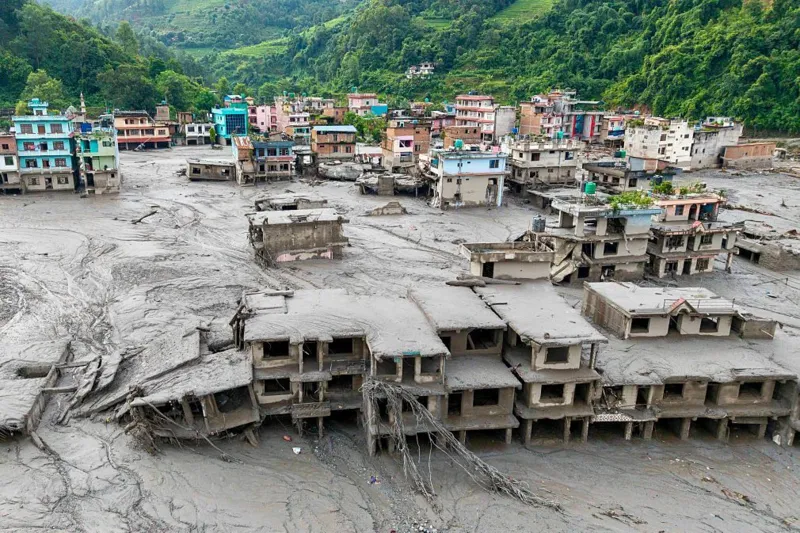
A glacial collapse in the Himalayas triggered a massive surge of water, rock, mud and debris through river systems near the Nepal-China border. Initial reports had suggested an earthquake, but subsequent geological analysis indicated that the seismic signal was generated by a glacial collapse and debris flow rather than a conventional earthquake.
The flooding destroyed homes, roads, bridges and other infrastructure, severely complicating rescue operations. Across the border in Tibet, Chinese authorities have separately reported hundreds of people missing, including many foreign nationals.
A significant proportion of those caught in the disaster were travelling towards Mount Kailash. The Kathmandu Post reported that hundreds of pilgrims had been preparing to cross into Tibet when the flood struck, with travel agencies struggling to establish contact with their clients.
The Nepalese government’s latest official list shows the scale of the international dimension of the disaster. Australians, Canadians, Americans, Britons, Malaysians, Ukrainians, Indians and nationals of numerous European and Asian countries are among those still unaccounted for.
For families such as Bhattacharya’s, however, statistics cannot resolve the central question.
Subhrasree had travelled without her family because she wanted to fulfil a personal ambition that had remained with her for years. Her husband remembers her excitement, the photographs from Kathmandu and the messages describing the journey.
Now those final communications have become the last record of her whereabouts.
Rina Banerjee’s family faces a similar uncertainty. Her relatives know she was at the Nepalese immigration facility, but they do not know whether she crossed into China before the flood or was still on the Nepalese side.
The distinction matters because the disaster affected both sides of the border and rescue operations have been complicated by destroyed infrastructure and limited communications.
Authorities continue to search for survivors while collecting information from tour operators, diplomatic missions and families. Nepal’s emergency response team has asked people with information about missing foreign nationals to contact its dedicated emergency channels.
The latest official figures remain subject to change as rescue teams reach previously inaccessible areas and authorities reconcile reports from different sources. Nepal’s government has specifically warned against relying on unverified information, an indication of how difficult it has been to establish a definitive account of who was present and who survived.
For Bhattacharya, there is still hope that his wife and other members of the group could have survived.
But hope has been accompanied by an unbearable wait.
The final message from Subhrasree was ordinary in its content: immigration was complete, and the group was waiting to continue its journey.
Then, within six minutes, there was nothing more.
A pilgrimage that had been years in the making had suddenly become a desperate search for answers. Her family now waits for authorities to establish what happened at the border crossing and whether the missing pilgrims were among those rescued, displaced or still stranded somewhere beyond the reach of communications.
Until those answers arrive, the families can do little but keep calling, checking official updates and waiting for the message they have been hoping to receive since that morning.
For two families in Kolkata, the question remains painfully simple: did Subhrasree Chakraborty and Rina Banerjee make it across the border?
Related News:
 Venezuela Quake Death Toll Surpasses 4,000
 Wildfires Force Mass Evacuations in France And Spain
 Powerful 7.7-Magnitude Earthquake Hits Eastern Indonesia
 Wildfires rage across Europe as hundreds arrested in France
 Nepal-Tibet Flood Leaves 270 Dead and 1,400 Missing
 Nepal Flood Death Toll Tops 300 as Second Flood Feared
 Kent Nurse Missing After Nepal-Tibet Flash Flood
 UK Must Act with Courage and Clarity on Israel-Palestine Conflict, Says Foreign Affairs Committee Report
 Tottenham Takes On Newcastle
 Radioactive Leak at UK’s Nuclear Warhead Base Sparks Outcry Over Safety and Secrecy
 Terence Stamp, ’60s British Film Legend and Star of Superman, Dies at 87
 Hong Kong Summons UK and Australian Envoys Following Asylum Grants to Democracy Activists
 Is the UK Ready to Put Boots on the Ground in Ukraine? Assessing Military Capacity and Challenges
 Channel Crossings Surge: Over 1,000 People Arrive in the UK in Small Boats in a Single Day
 Macron Phones Trump Over Traffic Jam in New York
 Comey Indictment Deepens Fears of Political Retribution Under Trump
 Yvette Cooper Signals Global Momentum Towards Gaza Peace Deal Amid Humanitarian Crisis
 “It Was Very Tough, But I Love Life”: Former Israeli Hostage Rebuilds Life After Family Killed by Hamas
 Chaos at Ibrox as Martin’s Rangers Era Comes to an End
 Trump Claims Modi Has Agreed to Halt Russian Oil Imports Amid Heightened US Pressure
 Russia’s Latest Push to Win US Favors Shows Deep Desperation
 BBC to Apologise Over Edited Trump Speech Amid Backlash
 Britain deploys RAF specialists to assist Belgium with drone threats
 Trump Urges Herzog to Grant Netanyahu Full Pardon
 Indian authorities demolish Kashmir home linked to Red Fort blast
 Greene Pushes Epstein Files Amid Trump Fallout
 December Run-Off in Chile as Election Produces No Winner
 Zelenskyy Signs Fighter Jet Deal Amid Russian Drone Attacks
 Shadow Fleet at Sea: Europe’s Battle Against Illicit Oil Shipping
 Tiny Curacao Makes History as Smallest Nation to Reach World Cup
 India’s COP30 Delay Raises Global Climate Concerns
 US Suspends Afghan Immigration After White House Shooting
 Georgians Defy Government Crackdown After Year of Protests
 ‘Extinct’ Antelope Returns to Sahara, Bringing Hope
 Irish Beach Tragedy: Irish Drown at Whitehaven Beach in Australia
 Sanctioned oil tankers sail Channel amid Russia scrutiny
 Greenland Crisis Forces Europe to Draw a Line With Trump
 South Korea Jails Ex-President in Martial Law Ruling
 Pentagon Signals Reduced Role in Deterring North Korea
 UK and US Drop in Global Corruption Index Rankings
 SA Police Intensify Search in Gus Lamont Case
 Canberra Poster Seizure Sparks Free Speech Row
 Evo Morales Returns After Mysterious Absence
 Jacinda Ardern Moves To Australia Following Her US Fellowships
 Jacinda Ardern Move Sparks Kiwi Reflection
 Middle East Airspace Crisis Strands Thousands
 Nick Greiner Warns Over Election Review Fallout
 Kelly Wilkinson Inquest Reveals Bail Failure
 Tehran Strikes Mark War’s Most Devastating Night
 Injured Mojtaba Khamenei Elevated as Iran Leader
 Gordon Brown urges court for crimes against children
 Gaza Detainee Abuse: Israel Drops Charges Against Soldiers
 The Kill Line: A Shifting Vision of the American Dream
 Oil Prices Jump After Trump Claims Iran Oil Hub Destroyed
 Pakistan Targets Militant Hideouts in Afghanistan
 Lebanon Ground Campaign Raises Occupation Fears
 ICE detention warning sparks fear among immigrants
 Air Canada CEO Faces Outcry Over Recent Language Misstep
 Extreme Weather: Europe Shivers as Cyclone Narelle Hits
 Asia Turns Back to Coal Amid Middle East Energy Crisis
 Relationship with Trump may be beyond repair, Starmer warned
 Trump’s Six-Week Iranian War: The High Cost of Ignorance
 Artemis II Returns After Historic Moon Flyby
 Trump Brokers Landmark Lebanon Ceasefire Amid Regional Hopes
 Ben Roberts-Smith Denies War Crime Allegations in First Statement
 RFU Backs Borthwick Despite England’s Poor Six Nations
 Infantino Defends Soaring World Cup 2026 Ticket Costs
 Trump Announces 3-Day Russia–Ukraine Ceasefire Deal
 Trump Rejects Tehran Peace Plan as Regional Truce Crumbles
 Fear and Betrayal: The Chilling Case of Kouri Richins
 Trump Sends 5,000 More US Troops to Poland
 Maldives Cave Diving Tragedy Raises Safety Alarm
 NDIS Overhaul Sparks Intense Clash Across Australia
 Britain’s Crowning Butterfly Takes the Nation by Storm
 Fifa Official Under Investigation Over Hand Gesture Controversy
 Grief and Devotion Amidst the Rubble of Nabatieh
 Canada Secure Historic Last 16 Spot with Late Goal
 England and Norway Fans Turn Miami Into World Cup Carnival
 Olympus Awaits Unesco Heritage Recognition
 Families Fly to Nepal in Search of 33 Missing Britons