**Published: 13 August 2026. The English Chronicle Desk. The English Chronicle Online**
At least 12 people have been killed and 20 others injured, including two children, after a wave of Russian missile and drone strikes hit Ukraine’s capital Kyiv and surrounding areas, according to Ukrainian officials.
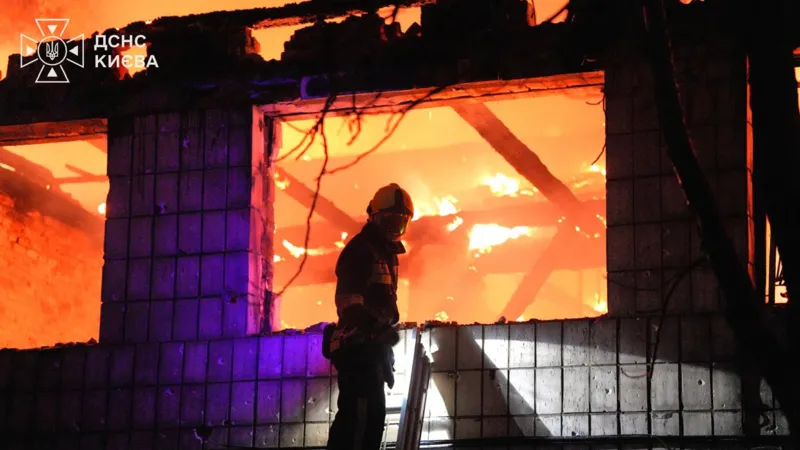
The overnight attacks struck several locations across Kyiv and the wider region, damaging residential buildings and other infrastructure. Six of those killed were railway workers employed by Ukraine’s state railway company Ukrzaliznytsia after a depot was hit in the capital.
The latest strikes come amid a sustained campaign of Russian drone and missile attacks against Ukraine and follow several days of heavy bombardment of Kyiv. Ukrainian officials say the continuing attacks are placing further pressure on the country’s air-defence systems while increasing the risks to civilians and critical infrastructure.

Russia said its forces had carried out a “massive strike using high-precision weapons”, claiming that military and energy facilities in Ukraine were the intended targets. Moscow has repeatedly said that its attacks are directed at strategic infrastructure rather than civilians, although Ukrainian authorities have reported repeated casualties in residential areas and other civilian locations.
The Russian authorities also said one person had been killed in Ukrainian strikes in Russia’s western Belgorod region.
In Kyiv, eight people were reported killed overnight, while fires broke out in three districts of the city. Emergency crews worked through the night to search damaged buildings and extinguish fires.
A further four people were killed in the nearby town of Boryspil after a residential building was struck, according to Ukrainian officials.
Ukrainian President Volodymyr Zelensky said nearly 350 rescue workers had been deployed across Kyiv and the surrounding region following the attacks. He said Russia had launched a large number of drones and ballistic missiles during the overnight assault.
The latest bombardment represents another serious test for Ukraine’s air-defence network, which has been under sustained pressure since Russia launched its full-scale invasion in February 2022.
## Railway workers among the victims
The deaths of six railway workers have highlighted the impact of the latest attacks on Ukraine’s transport infrastructure and the people responsible for keeping essential services operating during wartime.
Ukrzaliznytsia is one of Ukraine’s most important state-owned enterprises and has played a central role in maintaining passenger and freight connections throughout the war. Railway workers have continued operating services despite repeated attacks on stations, tracks, depots and other infrastructure.
The railway depot in Kyiv was among the locations hit during the overnight strikes. Officials said six employees were killed in the attack.
The railway network has become particularly important since the beginning of the war because trains are used not only for civilian travel but also for the movement of humanitarian supplies and essential goods.
The attacks therefore raise concerns about the continued vulnerability of transport infrastructure, particularly as Russia maintains pressure on Ukraine’s energy and logistics systems.
For families of those killed, however, the immediate focus has been on the human cost of the attack. Ukrainian authorities said two children were among those injured during the overnight bombardment.
## Kyiv faces sustained attacks
The latest strikes came after several consecutive days of Russian drone and missile attacks against Kyiv.
Ukrainian officials have described the pattern as an apparent attempt to exhaust the country’s air defences and undermine civilian morale. Repeated overnight attacks force emergency services to remain on alert for extended periods and require residents to spend long periods in shelters or other protected locations.
The attacks also create difficulties for hospitals, transport networks, utilities and local authorities, particularly when multiple locations are hit simultaneously.
Russia has continued to use a combination of drones and missiles in its attacks on Ukraine. Ukrainian officials have increasingly warned about the challenge posed by ballistic missiles because of their speed and the limited time available for air-defence systems to respond.
Zelensky said the latest attack involved a “significant number” of jet drones and ballistic missiles. The scale of the attack meant that rescue teams had to work across several locations during the night.
The Ukrainian government has repeatedly appealed to its international partners for additional air-defence systems and ammunition, arguing that protecting major cities and critical infrastructure remains one of the country’s most urgent military requirements.
## Wider attacks across Ukraine
The overnight bombardment was not limited to Kyiv.
Zelensky said eight other Ukrainian regions were also attacked. The geographic spread of the strikes added to the pressure on emergency services and local authorities dealing with damage in multiple areas.
An Indian national was among the casualties, Ukrainian officials said. Interior Minister Ivan Vyhivsky later identified the man as a 26-year-old Indian citizen who was killed in Boryspil on his birthday.
His death adds an international dimension to the latest attack and underlines the risks faced by foreign nationals living or working in Ukraine while the conflict continues.
The attacks follow another deadly incident in the Kyiv region on Friday, when 38 people were killed after strikes hit a weapons depot. Ukrainian authorities said shells, mines and drones stored at the site detonated following the attack, causing widespread explosions.
The repeated incidents have demonstrated how dangerous the security environment remains around the Ukrainian capital and its surrounding areas.
## Modi urges Putin to end war
The latest strikes came only a day after Indian Prime Minister Narendra Modi called on Russian President Vladimir Putin to bring the war to an end.
Speaking at a security summit in Kyrgyzstan, Modi said that every day spent in war pushed humanity backwards and that steps towards peace could provide renewed hope.
India has maintained close diplomatic and economic ties with Russia while also calling for a peaceful resolution to the conflict. Modi has made similar appeals to Putin on previous occasions.
India’s relationship with Moscow has also attracted international attention because of its continued purchases of discounted Russian oil. Those purchases have become an important part of India’s energy strategy, while providing Russia with a significant source of export revenue.
Despite its ties with Moscow, New Delhi has repeatedly stressed the importance of dialogue and diplomacy in resolving the war.
Modi’s latest comments came as Russian forces continued their attacks on Ukraine, highlighting the gap between international calls for peace and the ongoing military reality on the ground.
## Ukraine strikes Russian port
The latest escalation has also involved Ukrainian attacks on targets inside Russia.
A drone attack struck the major Russian Baltic Sea port of Ust-Luga, causing a fire, according to Leningrad regional Governor Aleksandr Drozdenko.
Ust-Luga is an important commercial port and handles millions of tonnes of petroleum products each year. Ukrainian authorities have argued that infrastructure connected to Russia’s energy exports can be considered a legitimate military target because the revenues generated by those activities help finance Moscow’s war effort.
Russia, however, has consistently condemned Ukrainian attacks on its territory and infrastructure.
The expanding range of attacks illustrates how the conflict has developed into a confrontation in which both sides are targeting infrastructure that they say contributes to the opposing side’s military capabilities.
## Growing pressure on civilians
More than four years after Russia launched its full-scale invasion, civilian populations across Ukraine continue to face the threat of missile and drone attacks.
Kyiv has generally had stronger air-defence protection than many other Ukrainian cities, but repeated large-scale attacks have demonstrated that even the capital remains vulnerable.
For residents, the danger is not limited to the initial explosions. Damage to electricity networks, transport infrastructure, residential buildings and other services can create longer-term disruption.

Emergency workers also face significant risks as they search damaged buildings and respond to fires while further attacks remain possible.
The latest deaths are therefore likely to increase pressure on the Ukrainian government and its international partners to strengthen air-defence capabilities and improve protection for critical infrastructure.
At the same time, the continued attacks underline the difficulty of achieving a diplomatic breakthrough while military operations remain active on both sides.
For Kyiv, the immediate challenge is to protect civilians and maintain essential services under sustained bombardment. For international governments, the latest escalation presents another reminder of the continuing human and strategic costs of the war.
As rescue teams continue assessing the damage from the latest strikes, the deaths of 12 people, including railway workers and civilians, have once again brought the war’s consequences into sharp focus.
The attacks demonstrate that despite repeated international calls for negotiations and an end to hostilities, Ukraine remains exposed to a sustained and destructive campaign of missile and drone strikes.
Related News:
 UK Must Act with Courage and Clarity on Israel-Palestine Conflict, Says Foreign Affairs Committee Report
 MPs Call on UK Government to Delay Biometric Visa Checks for Gaza Students Amid Humanitarian Crisis
 Trump Pushes for Peace: Plans Surprise Meeting with Putin and Zelensky to End Ukraine War
 Radioactive Leak at UK’s Nuclear Warhead Base Sparks Outcry Over Safety and Secrecy
 Mutual Inconvenience: Why Alaska Was Chosen for the Trump-Putin Summit on Ukraine
 Terence Stamp, ’60s British Film Legend and Star of Superman, Dies at 87
 Where Is Prince William and Kate Middleton’s New House? Inside the Historic Lodge Set to Become Their ‘Forever Home’
 FIFA Eyes Biennial Club World Cup from 2029, Plans Possible Expansion
 EuroMillions Record-Breaking £210m Jackpot Won by Lucky Lottery Ticket Holder
 Is the UK Ready to Put Boots on the Ground in Ukraine? Assessing Military Capacity and Challenges
 Shein UK Faces Allegations of Shifting Majority of Profits to Singapore to Reduce UK Tax
 British Couple Among 16 Killed in Lisbon Funicular Tragedy
 Protests Expected as Israeli Arms Firms Join Global Defence Trade Fair in London
 Serbia Humiliated 0-5 by England in World Cup Qualifier
 Thousands Gather in London to Protest Donald Trump’s Second UK State Visit
 Trump Urges UK to “Call Out the Military” to Secure Borders Amid State Visit
 British AI Startup Outshines Human Forecasters in Global Prediction Contest
 Liverpool Vs outhampton Set for Carabao Cup Clash at Anfield
Trump’s UN Speech Criticises London and UK Policies, Draws Far-Right Attention
Liverpool Vs outhampton Set for Carabao Cup Clash at Anfield
Trump’s UN Speech Criticises London and UK Policies, Draws Far-Right Attention
 UK Fighter Jet Purchase Could Breach Nuclear Treaty, Warns CND
 A Third of EU Citizens in UK Report Discrimination by Public Bodies Post-Brexit
 Jailed Georgian Opposition Leaders Warn UK of Iranian Links to Ruling Party
 Russia repeatedly targets UK military satellites, warns Space Command chief
 Pro-Palestine March to Proceed in London Despite Calls to Cancel After Manchester Attack
 Public Trust in SNP Hits Historic Low Amid NHS Concerns
 Cooper Unveils £4m Cyber Plan Against Russian Hackers
 Johnson Suggests Mandelson Linked to China Spy Controversy
 Kane’s Double Seals England’s World Cup Qualification
 Witness statements reveal the CPS China spy row collapse in the UK
 Nigel Farage Calls Vladimir Putin ‘A Very Bad Dude’
 China warns UK over delayed London mega embassy decision
 Rachel Reeves signals welfare reform ahead of key budget
 Kosovo agrees to host Britain’s refused asylum seekers
 Fabio Wardley stuns Joseph Parker to earn Usyk title shot
 British Woman in Iran ‘Losing Hope’ Amid Ongoing Detention
 Johnson Approved China’s London ‘Super-Embassy’ in 2018
 BBC Journalist Held and Interrogated in Vietnam
 Top Christmas Books Reads: Classics to Cozy Romcoms
 UPS Cargo Plane Crash in Kentucky Kills Seven
 Just Stop Oil Protesters Convicted Amid Climate Defence Row
 Tension and Turmoil at Aston Villa v Maccabi Match
 I’m a Celebrity 2025 line-up revealed: Osbourne joins
 Lando Norris Dominates Brazil GP to Strengthen F1 Title Bid
 Palace May Restore Hyphen to Andrew Mountbatten-Windsor’s Name
 Ronaldo Confirms Final World Cup and Plans Retirement
 Rama Rebukes Mahmood for Targeting Albanian Families
 Royal Navy Shadows Russian Warships Entering the Channel
 Barron Trump police call heard in London assault trial
 Trump Pulls Canada from His Controversial ‘Board of Peace’ Plan
 UK and EU Signal Fresh Push for Defence Cooperation Talks
 Starmer Condemns ‘Depraved’ Russian Strikes on Ukraine
 Sydney Protest Pepper Spray Clash During Herzog Visit
 Trump Tariffs Threat Spark UK and EU Alarm
 Middle East evacuation plans for Britons
 Iranian Australian community divided after vigils
 Trump rebukes Starmer over Iran strikes
 US Iran strikes strain special relationship
 UK Rescue Flight Delayed Amid Middle East War
 Gordon Brown urges court for crimes against children
 Yvette Cooper: UK Must Follow Principles, Not US Pressure
 UK Minister Denies Iran Missile Threat to Britain
 Teen Admits Filming Westfield Chair Prank
 Tropical Cyclone Narelle Batters the Western Australian Coast
 Army Probes Apache Flyover at Kid Rock’s Nashville Estate
 Relationship with Trump may be beyond repair, Starmer warned
 UK Stands Firm on Falklands Amid US Rift
 Premier League drama defines crucial weekend
 RFU Backs Borthwick Despite England’s Poor Six Nations
 Fear and Betrayal: The Chilling Case of Kouri Richins
 Tragedy in the Maldives: Inside the Deep Sea Rescue
 Farage and Reform UK Reshape British Politics
 Starmer Leadership Under Pressure After Setbacks
 Britain’s Crowning Butterfly Takes the Nation by Storm
 New South Wales Premier Chris Minns Signals Tough Road Ahead for Labor
 Violent London Clash After World Cup Semi-Final Match
 UK’s Largest Muslim Convention Scales Up Security Amid Rising Bigotry
 Former Diplomats Urge UK and France to Act on Palestine
 Ghent Professors Questioned Cofnas Appointment
 Australia Races to Find Tourists Missing in Nepal
 Europe Faces Winter Gas Supply Anxiety