Published: 27 August 2026 | The English Chronicle Desk | The English Chronicle Online
The Australian government is working urgently to establish the whereabouts of at least 35 Australians reported missing after a catastrophic flash flood devastated parts of the Nepal-Tibet border region, as rescuers continue searching an area where roads, bridges and communications networks have been severely damaged.
Assistant Minister for Foreign Affairs Matt Thistlethwaite said Australian officials were “working around the clock” to verify the welfare of those unaccounted for. The figure was compiled from information supplied by Nepali tourism authorities and officials working in the disaster zone, although Australian authorities have stressed that the number could change as further information becomes available.
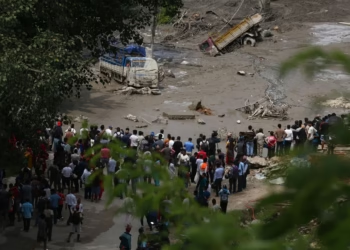
The disaster has created an extraordinarily difficult situation for governments attempting to account for their citizens. Entire sections of roads have disappeared, bridges have been destroyed and telecommunications infrastructure has been badly damaged, leaving officials reliant on fragmented reports from tour operators, local authorities and people who have managed to escape the affected areas.
Thistlethwaite said Australian diplomatic personnel based in Kathmandu were working closely with Nepali authorities and that a crisis response team would be sent towards the affected region once conditions allowed.

“We’re trying to make contact with those tour operators,” he said, explaining that officials were also investigating whether Australians travelling independently rather than as part of organised groups could be among the missing.
The timing of the disaster has added to the urgency. Nepal is experiencing a busy period for trekking and adventure tourism, while the wider region also attracts pilgrims travelling to religious sites in the Himalayas. The combination of mountainous terrain, international tourism and the sudden nature of the flooding has made it particularly difficult to determine how many people were in the worst-hit locations when the disaster struck.
Authorities have reported that almost 1,400 people are missing across Nepal and Tibet, with foreign nationals making up a significant proportion of those unaccounted for. Nepalese police have reported that 270 bodies have been recovered, while Chinese state media has reported hundreds of people missing on the Tibetan side of the border.
Australians are among nationals from several countries affected by the disaster, including people from India, the United States, Canada and the United Kingdom.
The Australian government has been particularly concerned about tourists who were travelling in groups. One of the Australians reported missing was travelling with Kathmandu Holiday Tours and Travel, highlighting the important role that tour operators are playing in helping authorities reconstruct the movements of travellers in the affected area.
The scale of the disaster has also complicated efforts to determine whether missing people remain trapped, have been evacuated to another location or are safe but unable to communicate with relatives and authorities.
Foreign Affairs Minister Penny Wong said additional Department of Foreign Affairs and Trade personnel were being deployed, including specialists experienced in crisis response.
“There are many Australians who are concerned about friends or family who may be in the region,” Wong said, acknowledging the anxiety facing relatives as governments attempt to establish reliable information.
She said Australian officials would be cautious about confirming individual cases until they had made contact with next of kin. The government has therefore continued to emphasise that the preliminary number of missing Australians could change as information is verified.
Prime Minister Anthony Albanese also expressed concern for those affected and their families. He said obtaining reliable information from Nepal remained difficult and that the government was liaising with Nepali authorities and tourism operators to establish the welfare of Australians in the region.
“We extend our deepest sympathies to those affected by the significant flooding in Nepal and Tibet, China,” Albanese said.
Australia’s ambassador to Nepal, Simon Ernst, has also expressed his sadness over the destruction. A joint statement issued by the embassies of Australia, Finland, France, Norway, Switzerland and the United Kingdom in Nepal described the flooding in Rasuwa and Nuwakot districts and surrounding areas as devastating and expressed solidarity with the people of Nepal.
The Australian response is being coordinated alongside Nepal’s own emergency operations. Nepalese authorities are continuing to use helicopters to reach isolated communities and transport survivors from areas where roads have been destroyed.
The disaster’s mountainous geography has made conventional search-and-rescue operations exceptionally challenging. In several locations, rescuers must work around unstable ground, collapsed infrastructure and thick deposits of mud and debris.
Nepal’s embassy in Canberra has also requested assistance from the Australian government. Saroj Paneru, the embassy’s second secretary, said Nepal would seek both financial assistance and technical support as emergency teams continued searching for missing people.
The embassy is also working to verify the number of Australians affected. Paneru said Nepal’s tourism industry was gathering information about travellers who were in the affected areas when the flooding occurred.
“Once we have that data and all the details have been received, we will communicate all of this to the Australian government and the embassy in Kathmandu,” he said.
The disaster has placed enormous pressure on tourism companies, which are attempting to determine the locations of their customers while simultaneously dealing with damaged infrastructure and disrupted communications.
For families in Australia, the uncertainty has been particularly distressing. A confirmed death or survival provides a clear outcome, but the absence of reliable communications leaves relatives waiting for information about loved ones who may have been separated from their groups.
Australian authorities have urged people with knowledge that an Australian travelled to the affected region to contact the Department of Foreign Affairs and Trade. Australians requiring urgent consular assistance have also been directed to Australia’s consular emergency services.
The government has said it is considering whether additional Australian assistance, including Australian Defence Force capabilities, could eventually be deployed. Thistlethwaite said officials were consulting the ADF about how quickly a specialist response team could be prepared.
However, he stressed that decisions would depend on conditions on the ground. Sending personnel or equipment into a region where infrastructure has been destroyed and further hazards may exist could itself create risks for emergency workers.
“We need to wait and see what the situation is on the ground there first,” Thistlethwaite said, while emphasising Australia’s readiness to assist Nepal where appropriate.
The flooding has also highlighted the vulnerability of Himalayan communities and tourists to sudden geological and environmental disasters. Initial reports suggested an earthquake may have been responsible, but subsequent scientific analysis indicated that a collapse involving glacial rock and ice generated the seismic shock and debris-laden flood.

The resulting torrent travelled rapidly through valleys, leaving residents and visitors with little time to respond. The destruction of transport links has subsequently slowed rescue operations and made it difficult for governments to establish the full scale of the human toll.
For Australia, the immediate priority remains identifying missing citizens and providing support to their families. Officials are expected to receive more information as Nepali authorities, tour operators and emergency workers gradually regain access to isolated areas.
Until then, Australian families remain dependent on an evolving investigation in one of the world’s most difficult disaster environments.
The search for the missing Australians is therefore part of a much larger international rescue effort involving several governments and emergency agencies. As helicopters continue flying into affected areas and authorities compile lists of missing people, the coming days will be crucial in determining the fate of those still unaccounted for.
Related News:
 Storm Dave Disrupts Travel but Conditions Set to Ease
 London Tube Heat Reaches Dangerous Levels
 Olympus Awaits Unesco Heritage Recognition
 Heavy Casualties Feared as Flash Flood Sweeps Nepal-Tibet Border
 South Africa’s Garden Route Gem Faces Looming Water Crisis
 Teen Admits Filming Westfield Chair Prank
 Glasgow Central Set for Full Reopening After Fire
 Moldova River Crisis Exposes War’s Hidden Cost
 Cyclone Vaianu Forces Mass Evacuations in New Zealand
 Chornobyl Still at Risk 40 Years After Disaster
 Escobar’s Hippos May Be Moved to India Zoo
 Two Dead in Adelaide Airport Plane Crash Fire
 China Fireworks Factory Blast Kills 21 in Hunan
 Tractor Breakdown Tests Lincolnshire Farmers
 Britons Build Emergency Supplies Amid Rising Fears
 Sycamore Gap Artwork Chosen After Public Vote
 Pope Meets Families in Italy Toxic Waste Zone
 Essex valley emerges as rising English wine hub
 Farage and Reform UK Reshape British Politics
 Starmer Leadership Under Pressure After Setbacks
 Thailand Tightens Visa Rules to Curb Tourist Misbehavior
 England and Norway Fans Turn Miami Into World Cup Carnival
 UK Schools Struggle as Classrooms Top 40C
 Venezuela Quake Death Toll Surpasses 4,000
 Three-Quarters of England’s Riverbanks Still Off Limits
 Powerful 7.7-Magnitude Earthquake Hits Eastern Indonesia
 London’s 2026 ‘Great Stink’ Raises Sewer Concerns
 Five Years of Taliban Rule Leave Afghanistan in Crisis
 Wildfires rage across Europe as hundreds arrested in France
 Burnham unveils £65m drought aid for farmers
 Queue row erupts on Wales’ highest mountain
 France Faces Calls to Ban Alpine Marmot Hunting
 Ghent Professors Questioned Cofnas Appointment
 UK Must Act with Courage and Clarity on Israel-Palestine Conflict, Says Foreign Affairs Committee Report
 Radioactive Leak at UK’s Nuclear Warhead Base Sparks Outcry Over Safety and Secrecy
 Mutual Inconvenience: Why Alaska Was Chosen for the Trump-Putin Summit on Ukraine
 Terence Stamp, ’60s British Film Legend and Star of Superman, Dies at 87
 Where Is Prince William and Kate Middleton’s New House? Inside the Historic Lodge Set to Become Their ‘Forever Home’
 Is the UK Ready to Put Boots on the Ground in Ukraine? Assessing Military Capacity and Challenges
 Shein UK Faces Allegations of Shifting Majority of Profits to Singapore to Reduce UK Tax
 Thousands Gather in London to Protest Donald Trump’s Second UK State Visit
 Liverpool Vs outhampton Set for Carabao Cup Clash at Anfield
 A Third of EU Citizens in UK Report Discrimination by Public Bodies Post-Brexit
 Public Trust in SNP Hits Historic Low Amid NHS Concerns
 Johnson Suggests Mandelson Linked to China Spy Controversy
 Rachel Reeves signals welfare reform ahead of key budget
 Just Stop Oil Protesters Convicted Amid Climate Defence Row
 I’m a Celebrity 2025 line-up revealed: Osbourne joins
 Palace May Restore Hyphen to Andrew Mountbatten-Windsor’s Name
 Royal Navy Shadows Russian Warships Entering the Channel
 Trump Tariffs Threat Spark UK and EU Alarm
 Rolling Hills and Heritage: A Car-Free Break in Leicestershire
 Middle East Airspace Crisis Strands Thousands
 Iranian Australian community divided after vigils
 UK Rescue Flight Delayed Amid Middle East War
 Gordon Brown urges court for crimes against children
 UK Energy Reform Could Cut Bills by £200
 Rising Costs Force Families to Rethink Days Out
 Tropical Cyclone Narelle Batters the Western Australian Coast
 Army Probes Apache Flyover at Kid Rock’s Nashville Estate
 Relationship with Trump may be beyond repair, Starmer warned
 UK Stands Firm on Falklands Amid US Rift
 Crackdown Backfires on UK Climate Protesters
 Coalition pushes fossil fuel phaseout plan
 Greens Face Internal Row Over Antisemitism Claims
 RFU Backs Borthwick Despite England’s Poor Six Nations
 Barrister Criticises Trial After Suicide Case Verdict
 US Awaits Iran Reply on New Ceasefire Proposal
 Fear and Betrayal: The Chilling Case of Kouri Richins
 UK Faces Mass Water Shortages by 2055, Lords Warn
 Maldives Cave Diving Tragedy Raises Safety Alarm
 Discontent grows around Putin amid war strain
 Britain’s Crowning Butterfly Takes the Nation by Storm
 British Teens in EU Face Soaring UK University Fees
 Sydney Records Hottest June Since 1859 as Expert Warns New High a ‘Signature’ of Global Warming
 Houthis Strike Saudi Arabia as Middle East Tensions Rise
 Westminster Council Threatens Charing Cross Soup Kitchen
 Former Diplomats Urge UK and France to Act on Palestine
 Rain to return with thunderstorms and flood risk
 Nepal-Tibet Flood Leaves 270 Dead and 1,400 Missing