Published: 12 October 2026. The English Chronicle Desk. The English Chronicle Online
A newly identified Roman military fort in Pembrokeshire, Wales, could provide important archaeological evidence behind a medieval Welsh legend involving the fourth-century emperor Magnus Maximus. The discovery of Roman coins, pottery, tiles and military structures near Frenni Fawr hill has raised the possibility that a traditional story preserved for centuries may have been rooted in historical events rather than being entirely mythical.
The discovery is attracting attention from archaeologists because the site appears to be the only known Roman military installation close to the location associated with the emperor in the medieval Welsh tale. Although the findings do not conclusively establish that Magnus Maximus personally camped there, they offer new evidence that Roman soldiers were present in the landscape described by the story.
The excavation is being led by Dr Mark Merrony, a Roman-period specialist at the University of Oxford. His research has identified a substantial fortified enclosure in the countryside of Pembrokeshire, offering fresh insight into the Roman military presence in an area where evidence of such activity has previously been limited.

The story at the centre of the investigation comes from *The Dream of Macsen Wledig*, one of the narratives preserved in the Mabinogion, a collection of medieval Welsh tales featuring legendary rulers, magical events and heroic adventures. In the story, Macsen Wledig, the Welsh name associated with Magnus Maximus, undertakes military movements and establishes a camp near Frenni Fawr, the easternmost peak of the Preseli Hills.
For generations, the account has occupied a space between folklore and history. Medieval storytelling often combined remembered events, political traditions and imaginative elements, making it difficult for modern researchers to separate historical details from literary invention. Until recently, there had been no identified Roman fort or marching camp on Frenni Fawr itself or in the surrounding area that could provide direct archaeological support for the account.
Merrony’s discovery has now brought a new dimension to that debate. He identified the site in 2024, approximately 3.5 kilometres south-west of the hill’s summit, after satellite imagery revealed a distinctive outline in an overgrown field. The shape suggested that the site might contain the remains of an ancient enclosure.
When Merrony visited the location, he noticed a Roman tile fragment. That initial find encouraged further investigation and eventually led to the identification of additional archaeological material. Subsequent work, supported by the University of Oxford and crowdfunding, has allowed researchers to begin examining the site more systematically.
The latest excavation has confirmed the presence of a substantial Roman military installation, strengthening the argument that the area had a more significant role in Roman activity than previously recognised. The discovery is particularly notable because the site lies in a remote part of Wales, far from some of the better-known centres of Roman administration and settlement.
Among the most striking discoveries are two coins dating from the late fourth century. Merrony’s brother, Nick, found the coins during the excavation after jokingly suggesting that a couple of coins would be useful evidence for the theory connecting the site to Magnus Maximus. The unexpected discovery prompted excitement because the date broadly corresponds to the period associated with the emperor.
Magnus Maximus ruled in the western Roman Empire during the late fourth century and was closely associated with Britain before his defeat and death in 388. His career became part of the historical and legendary traditions of Britain and Wales, where later accounts connected him with the country’s political origins and ancestral narratives.
The coins are an important chronological clue, but they cannot independently prove that Magnus Maximus visited the fort. Coins could remain in circulation for years, and objects found at a military site do not necessarily establish that a particular emperor was present. Their significance lies in the way they complement the fort’s structure, other artefacts and the geographical details preserved in the Mabinogion.
Merrony has described the discovery as fascinating because the archaeological evidence may help explain a story that has endured for nearly 1,700 years. He argues that if the emperor was present in the area, a military force would likely have accompanied him. The existence of a fortified Roman site near the location named in the tale makes that possibility more plausible, although further investigation will be needed to establish the precise relationship between the archaeological remains and the legend.
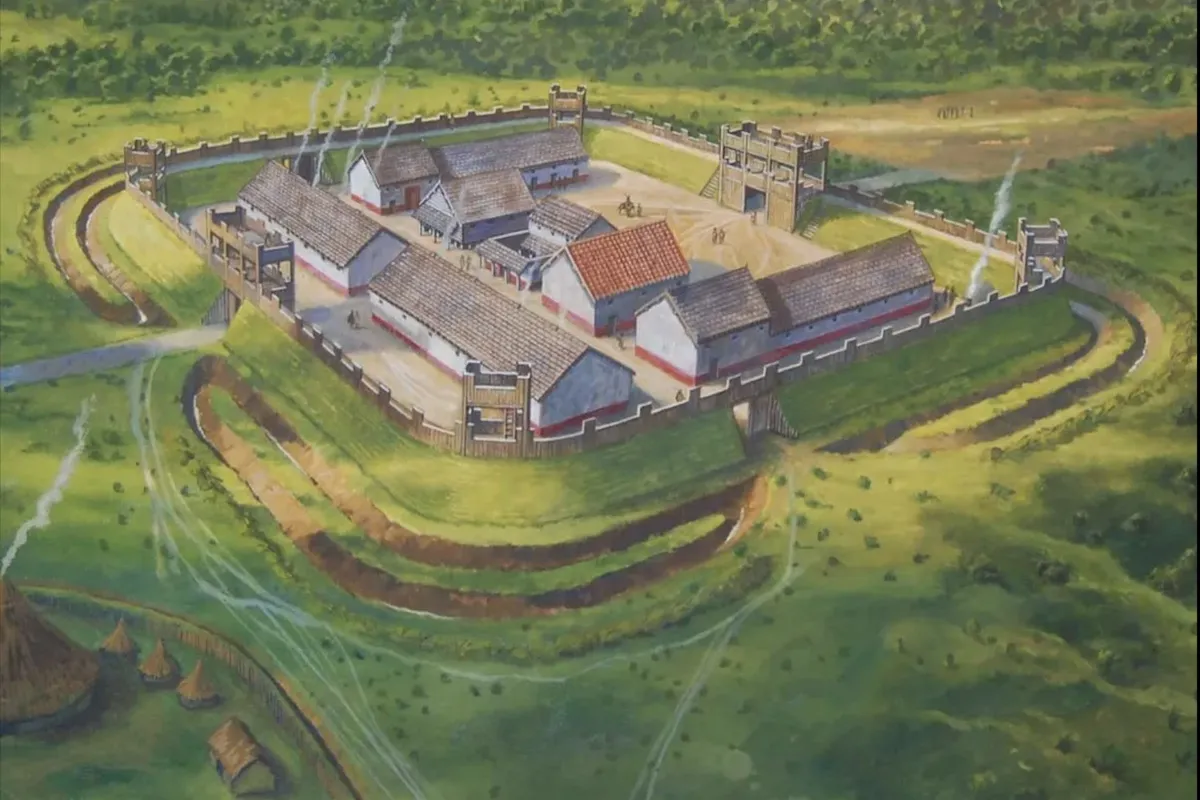
The fort itself is substantial. Measuring approximately 180 metres by 150 metres, it occupies a sloping position with a commanding view of the surrounding landscape. Researchers believe it may have accommodated around 500 troops, suggesting that it was designed to support a sizeable military presence rather than serving merely as a small temporary outpost.
Its layout also provides important evidence of its Roman character. The enclosure has a distinctive playing-card shape, with rounded corners, and includes a road running at a right angle through the site. Such features are consistent with known Roman military planning, helping archaeologists distinguish the structure from other forms of historic settlement.
The excavations have uncovered large quantities of Roman tiles, numerous pottery fragments, an unusual iron stylus and extensive areas of compacted clay flooring. These materials provide clues about the activities that took place within the enclosure and the way its buildings were constructed and used.
Researchers have also identified preserved wagon ruts, offering a rare glimpse of movement across the site. Such traces can help archaeologists understand how supplies, equipment and people moved through a military installation. When examined alongside building remains and other artefacts, they contribute to a more detailed picture of everyday life at the fort.
Geophysical surveys have further revealed a rectangular building near the centre of the enclosure and a larger rectangular structure immediately to its south. Merrony believes the arrangement is consistent with a headquarters building and a commander’s residence. The proposed headquarters appears to have been oriented towards the east, which he interprets as potentially reflecting a military design intended to face the direction of a perceived enemy.
If confirmed through further excavation, these structures could help researchers understand how the fort was organised and what role it played in the region. Headquarters buildings were central to Roman military administration, while commanders’ residences formed part of the infrastructure required to manage troops and coordinate operations.
The presence of a fort capable of accommodating hundreds of soldiers also raises questions about relations between Roman forces and the local Celtic population. The discovery challenges assumptions that the area may have remained largely peaceful during the period of Roman influence. A fortified military installation could indicate a need to maintain control, protect strategic routes or respond to local resistance, although the precise circumstances surrounding its establishment remain uncertain.
Merrony’s earlier research has already contributed to a reassessment of Roman activity in the region. His discoveries include Roman villas at Ford in Pembrokeshire and Cutteslowe in Oxfordshire. In 2022, he also identified a Roman road along the southern shoulder of the Preseli Hills, challenging assumptions that Roman infrastructure did not extend significantly into parts of Wales.
The newly identified fort adds another important piece to that wider picture. Roads, military installations and civilian settlements together can reveal how Roman authority operated beyond major administrative centres. The site may help explain how soldiers travelled through the region, how local communities interacted with Roman power and whether the landscape held strategic importance during the late Roman period.
The research is expected to feature in *Antiqvvs*, a quarterly magazine devoted to archaeology, ancient art and history. Magnus Maximus will also be discussed in Merrony’s forthcoming book on Roman emperors, extending the findings beyond the excavation itself and placing them within a broader historical account.
Despite the excitement, archaeologists will need to maintain a distinction between what the physical evidence establishes and what remains speculative. The fort confirms a Roman military presence near the landscape described in the medieval story, while the late fourth-century coins provide a potentially relevant chronological connection. Neither finding, on its own, proves that Magnus Maximus personally established the camp.
Further excavations and analysis could clarify the site’s period of occupation, its military function and the relationship between its construction and the emperor’s activities. Researchers may also uncover evidence that helps determine whether the fort was a short-lived installation or part of a longer Roman presence in the area.

For now, the discovery offers a compelling example of how archaeology can illuminate the historical background of stories preserved through centuries of oral and written tradition. The Mabinogion remains a work of medieval literature, but the newly identified fort suggests that at least some of the geographical and military details associated with its account may reflect a real past.
The possibility that an ancient Welsh legend preserves a memory of Roman military activity has captured the imagination of researchers because it connects physical remains with a cultural tradition that has survived for generations. As investigations continue near Frenni Fawr, the site may help deepen understanding of Roman Wales and the enduring relationship between historical evidence, folklore and collective memory.
Related News:
 How Bringing Forests Into Preschools Boosts Children’s Health
 England Curriculum Review Recommends Major Changes
 Mortgages and AI Set to Feature in English Schools
 No link found between paracetamol in pregnancy and autism
 Government urges schools to ban phones to curb classroom disruption
 Higgs Donates Nobel Medal to His Beloved University
 Tech Trends and the Battle Against Exam Hall Cheating
 Michele Dougherty Makes History as the UK’s First Female Astronomer Royal
 From ‘Skibidi’ to ‘Mouse Jiggler’: Cambridge Dictionary Expands with Modern Slang and Social Terms
 Is a two-week half-term a good deal? Some parents in England aren’t so sure
 Children to Learn Local History in Major Curriculum Overhaul
 UK Bans Fake Numbers: Scammers Lose Their Trick
 Top Christmas Books Reads: Classics to Cozy Romcoms
 Greta Thunberg Backs Student Facing UK Visa Revocation
 Audio Books deals and promo codes to explore in November 2025
 Patients to Test Health at Home to Ease NHS Winter Pressure
 London’s Childlessness Crisis: Schools Closing as Families Shrink
 Northern Lights may illuminate UK skies this week
 England’s Special Needs Support Faces Breaking Point
 Coffins Now Too Large to Cremate Amid Rising Obesity Crisis
 UK Taskforce Unveils Plan to Streamline Nuclear Reactor Rules
 NHS paediatric leave parents waiting months for answers
 Ofcom urges platforms to limit abuse and curb online ‘pile-ons’
 Oxford Names ‘Rage Bait’ Word of the Year
 Starmer’s communications chief to outline media strategy overhaul
 Cambridge College Faces Backlash Over Private School Recruitment
 UK Threatens Action Against X Over Sexualised AI Images
 UK Launches First Town of Culture Competition
 City & Guilds pay surge sparks backlash amid £22m cuts
 AI job losses UK: Britain faces sharper employment shock
 School Suspensions Now Reserved for Only Severe Misbehaviour
 Barnsley tech town leads UK AI transformation
 Childnet Censorship Row Over Teen Safety Speeches
 Send spending gap leaves deprived areas behind
 Councils Urge Means Testing for Send School Transport
 Student Loan Crisis Sparks Outrage Among Graduates in England
 Facial Recognition Error Leads to Wrongful Arrest in Milton Keynes
 New Era for UK Special Needs Support
 Cancer Death Rate in Britain Falls by Nearly a Third
 Scientists Unveil Heavier Proton at CERN LHC
 Traffic: The Science Behind Why Slower Cars Always Catch Up
 Student Loan Interest May Rise Despite 6% Cap
 City & Guilds Sale Sparks Fees and Pay Uproar
 Older Than Dinosaurs: Secrets of Mayfly Dance Revealed
 Germany to Return Rare Irritator Dinosaur Skull to Brazil
 Tractor Breakdown Tests Lincolnshire Farmers
 Cambridge South Signals New Era for British Rail Travel
 British Paralympian Set to Make History in Earth Orbit
 Is a University Degree Still Worth the Cost?
 Stolen Mobiles Could Soon Become Useless Bricks
 UK Ministers Lobby Trump Over Under-16s Social Media Ban
 The Hybrid School Revolution Defying the Social Media Ban
 British Teens in EU Face Soaring UK University Fees
 UK Schools Struggle as Classrooms Top 40C
 Ghent Professors Questioned Cofnas Appointment
 UK Risks Falling Behind in AI Race
 London Launches First Self-Driving Taxis
 Internal Exclusions Surge in England’s Schools
 Councils spend £125m on illegal children’s care
 McLaren to Create 1,000 UK Jobs in £450m Investment
 Nats Boss Summoned as UK Flight Chaos Continues
 Essential Books for Understanding the AI Debate
 Tom Watson Takes Senior Role at Palantir
 Headteachers Warn New Ofsted System Is Harming Wellbeing
 Labour Apprenticeship Scheme Faces Slow Start
 UK Unveils Centre to Counter Foreign Disinformation
 Roman Finds Reveal Bath’s Suburban Past
 UK Plans New Centre to Counter Information Warfare
 TalkTalk Races to Sell Arms as Administration Looms
 Africa Urged to Transform Universities for Young Talent
 Drones Could Speed Up Defibrillator Delivery
 Labour Urged to Rebuild Progressive Coalition
 London Facial Recognition Trial Ends With False Alert
 UK University Strikes Spread as Financial Pressure Grows
 BT Broadband Pauses Raise Digital Switchover Concerns
 UK Scam Losses Surge as Hackers Hijack Social Accounts
 Kagan and Soai Win 2026 Nobel Chemistry Prize
 Britons Demand Greater Honesty on Climate Crisis
 UK Water Firms Earn Millions From Industrial Wastewater
 UK Must Build Its Own AI to Protect National Security