Published: 26 September 2026. The English Chronicle Desk. The English Chronicle Online
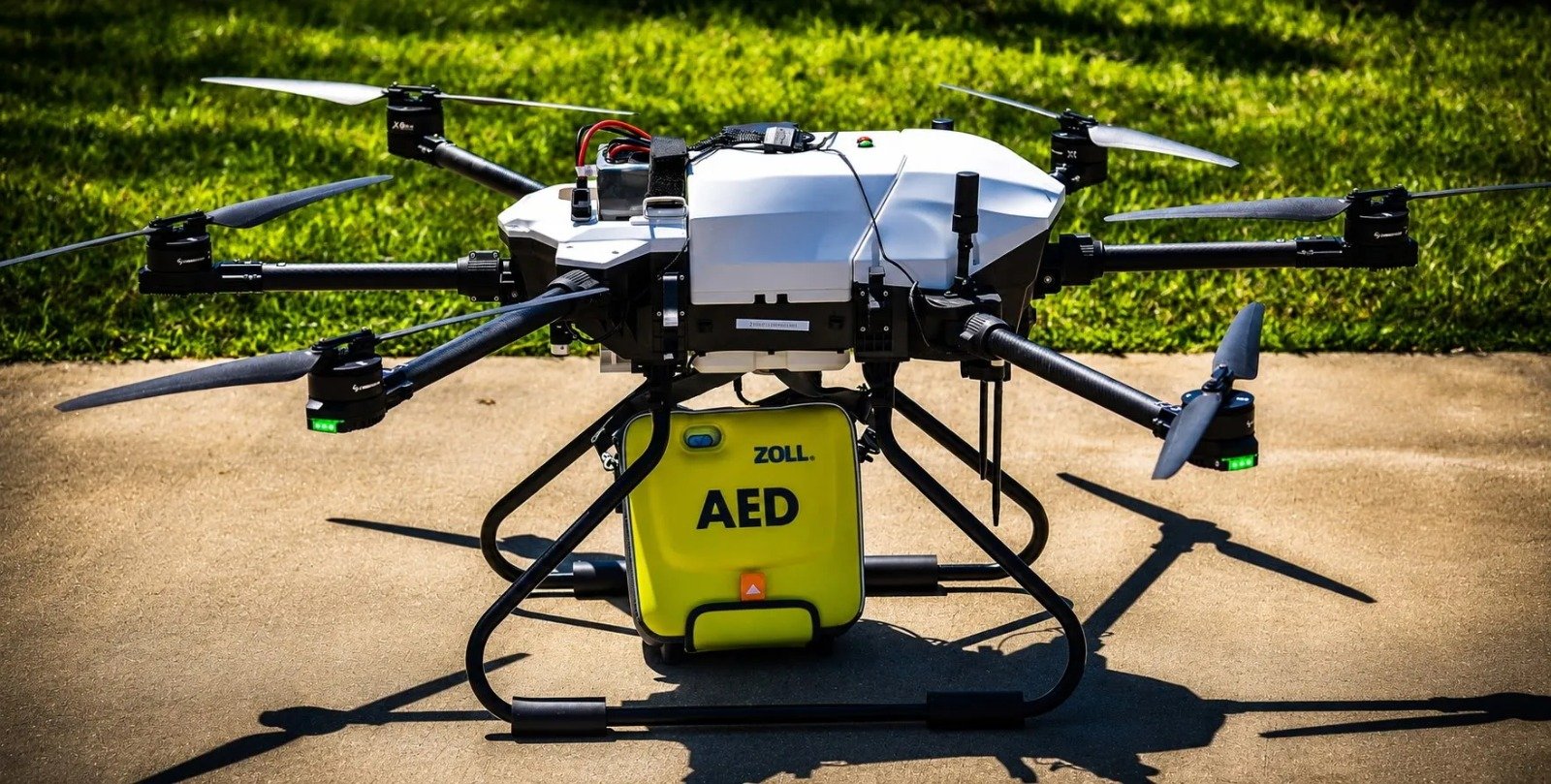
Drones could significantly reduce the time needed to deliver defibrillators to people suffering cardiac arrests outside hospitals, according to new research that examines how the technology could expand access to life-saving equipment.
Researchers in France have modelled how a network of drone bases could complement existing automated external defibrillators, or AEDs, and potentially bring the devices within reach of far more cardiac arrest patients before emergency medical services arrive.
The research focuses on one of the most important factors in surviving an out-of-hospital cardiac arrest: time. When the heart suddenly stops, every minute before effective treatment can reduce the chances of survival. Cardiopulmonary resuscitation, commonly known as CPR, can help maintain blood flow, while an AED can deliver an electrical shock when appropriate to restore a normal heart rhythm.
In the UK, emergency medical services attempt to resuscitate more than 30,000 people who experience cardiac arrests outside hospitals each year. Survival remains relatively low, and some people who survive can experience neurological complications because the brain has been deprived of oxygen.

The French research team, led by emergency medicine specialists including Professor Matthieu Heidet of Henri-Mondor University Hospital in Créteil, examined whether drones could help address gaps in the geographical distribution and accessibility of AEDs.
The researchers analysed 28,349 out-of-hospital cardiac arrests recorded between 2011 and 2024 across administrative areas in the Greater Paris region. Central Paris was excluded from the analysis. The team then compared the locations of those cardiac arrests with the positions of 1,893 fixed AEDs.
The analysis revealed substantial differences in access to the devices. Only about 30% of the cardiac arrest cases included in the study occurred within a 500-metre network distance of an existing AED.
The findings highlight a wider problem faced by emergency services in many countries. Having an AED somewhere within a community does not necessarily mean that it can be reached quickly during a medical emergency. Buildings may be closed, devices may be located inside restricted areas and members of the public may not know where the nearest machine is situated.
Researchers calculated that 910 additional fixed AEDs would have been needed to bring 84.5% of the cardiac arrest cases within 500 metres of a device. Achieving coverage for all of the cases in the model would have required 1,712 additional fixed AEDs.
The modelling produced a different picture when drones were introduced.
The researchers examined drone bases operating within a radius of approximately 3.9 kilometres. Their models suggested that drones could extend the effective reach of AEDs without requiring the same number of additional fixed devices.
Under one scenario involving 100 drone bases, together with 26 additional fixed AEDs, more than 97% of the cardiac arrest cases would have been located either within 500 metres of a fixed AED or within roughly four kilometres of a drone base.
Increasing the network to 200 drone bases produced an even broader level of coverage. In that scenario, with only four additional fixed AEDs, more than 99% of the cases analysed would have been covered by the model.
The researchers also considered a more demanding measure: whether an AED could be retrieved and delivered within five minutes using the existing road network.
Their analysis suggested that only around 30% to 40% of the cardiac arrest cases had access to an existing fixed AED within that period when ground transportation was taken into account. The researchers cautioned that even this estimate may be optimistic because the physical accessibility of AEDs can be a major obstacle.
Professor Heidet noted that only a relatively small proportion of people experiencing an out-of-hospital cardiac arrest in France currently receive treatment using a public AED before emergency medical crews arrive. Some AEDs are located in buildings or other facilities that are not accessible around the clock, reducing their usefulness during emergencies occurring outside opening hours.
The proposed drone system is intended to address some of those limitations by bringing the defibrillator directly to the location of the emergency.
Under the model described by the researchers, an emergency call would first be identified by the emergency medical service dispatch centre as a suspected cardiac arrest. The drone could then be activated remotely by dispatchers and begin an automated flight to the location.
The aircraft would follow a predetermined flight route before the final approach and delivery were handled by a trained drone operator. Once the AED reached the scene, people present could use the device while waiting for an ambulance or other emergency medical personnel to arrive.
The system would not replace emergency medical crews. Instead, it would be designed to provide an additional layer of rapid intervention during the critical period between the cardiac arrest and the arrival of professional responders.
That distinction is important because an AED can only be effective when someone is available to use it. Public access defibrillators are designed to provide clear instructions and can analyse a patient’s heart rhythm before deciding whether a shock is appropriate. Nevertheless, bystander action, including calling emergency services and beginning CPR, remains an important part of the response.
The researchers emphasised that their work is a modelling exercise rather than evidence from a fully operational drone network. The study examined historical cardiac arrest locations and simulated how different numbers and locations of drone bases might have changed access to AEDs.
As a result, the findings do not establish that deploying a particular number of drone bases would produce the same results in real-world conditions. Factors such as weather, airspace restrictions, obstacles, battery capacity, flight regulations, landing locations and the availability of trained operators would all need to be considered before large-scale implementation.
Cost would also be an important part of any future assessment. Establishing drone bases, maintaining aircraft, training operators and integrating the system with emergency dispatch services would require investment. Researchers therefore said that economic feasibility would need to be examined alongside the potential medical benefits.
There is already some real-world experience with drone-delivered AEDs. Parts of Sweden have introduced systems in which drones can transport defibrillators to cardiac arrest locations. In such systems, emergency dispatchers can activate a drone after identifying a potential cardiac arrest, while trained personnel oversee the operation.
The French researchers believe these existing experiences provide useful evidence that the technology can be integrated into emergency response systems, although each country would face its own regulatory and logistical challenges.
The potential benefits are particularly relevant in areas where fixed AED coverage is uneven. Rural communities, suburban areas and locations with limited access to public facilities could potentially benefit from a system capable of travelling directly through the air rather than relying entirely on road transport.
At the same time, drones are unlikely to remove the need for strategically positioned fixed AEDs. A nearby public device can still be the fastest option when it is immediately accessible. The research instead suggests that drones could complement existing networks and help fill gaps where installing large numbers of additional devices would be difficult or expensive.
The findings come as emergency medical researchers and policymakers continue to examine ways of improving survival from cardiac arrest outside hospitals. Increasing the availability of CPR training, improving public awareness of AED locations and ensuring that existing devices remain accessible are among the wider challenges involved in strengthening emergency response.

For people experiencing cardiac arrest, the difference between receiving treatment within minutes and waiting considerably longer can be critical. The drone approach is therefore attracting attention because it offers a potential way to shorten one of the most difficult parts of the emergency response: getting a defibrillator to the patient.
However, the researchers stress that further work is needed before the technology can be judged on its practical and economic value. Their study has not yet been peer-reviewed and is due to be presented at the European Emergency Medicine Congress in Paris.
The research nevertheless provides a detailed indication of how emerging technology could complement traditional emergency medical infrastructure. Rather than replacing ambulances or fixed public defibrillators, drone networks could become an additional tool designed to bridge the crucial gap between the moment a cardiac arrest occurs and the arrival of professional medical assistance.
Related News:
 How Bringing Forests Into Preschools Boosts Children’s Health
 Experts Urge Legal Right to Timely Cancer Care
 Patients to Test Health at Home to Ease NHS Winter Pressure
 North Sea oil workers must lose weight or face job loss
 No link found between paracetamol in pregnancy and autism
 Coffins Now Too Large to Cremate Amid Rising Obesity Crisis
 Thinktank Urges Smaller Hospitals to End NHS ‘Permacrisis’
 NHS paediatric leave parents waiting months for answers
 Cancer Death Rate in Britain Falls by Nearly a Third
 UK Biobank Health Data Leaks Raise Privacy Concerns
 Meningitis Cases in Kent Outbreak Rise to 27
 GSK cancer drug shows early promise in trials
 Europe EV Demand Surges as Fuel Prices Rise
 UK firms accused of ‘AI washing’ boom
 UK to Expand Prostate Cancer Trials for Black Men
 NHS Approves Landmark Ovarian Cancer Drug
 UK Risks Falling Behind in AI Race
 Australia gives users control over social media algorithms
 TalkTalk Races to Sell Arms as Administration Looms
 Shocking Rise in Children’s Exposure to Violent Online Pornography Raises Alarm
 Hospice Cuts Raise Alarm Across England Amid Funding Crisis
 Celebrities and Charities Demand UK Government Act on Child Poverty
 UK Bans Fake Numbers: Scammers Lose Their Trick
 Shouting Works Best to Deter Gulls, UK Study Finds
 Reeves rejects £1bn plea for NHS redundancy payouts
 Northern Lights may illuminate UK skies this week
 Working-Class Men with Prostate Cancer Left Behind by NHS
 New AI tool could cut wasted efforts in organ transplants
 Stroke Patient Mistaken for Drunk, Care Delayed
 ‘Traumatic Wait’: Northern Ireland Women Face Breast Cancer Delays
 Healthy Habits in Your 30s That Boost Life in Your 70s
 Five-Year-Old Dies After Rare Tonsil Surgery Complication
 Fibromyalgia Patients Struggle as NHS Fails to Provide Care
 More Patients Now Contacting GPs Online, Data Shows
 Children to Receive Home Vaccines as England Acts
 UK Enforces Junk Food Ad Ban Before 9pm
 Patients Collapsing in NHS Corridors, Watchdog Warns
 Google Removes Some AI Health Summaries Over Safety Concerns
 AI job losses UK: Britain faces sharper employment shock
 Small risk warning raised over weight-loss jabs in UK review
 Streeting moves on doctor pay to end strike dispute
 Autistic Girls Often Missed in Childhood Diagnoses, Study Finds
 UK reports baby formula toxin poisoning cases across the country
 Most Statin Side-Effects Are Not Caused by Drugs, Study Confirms
 Childnet Censorship Row Over Teen Safety Speeches
 Placenta Accreta Warning as Hunt Urges Action
 Half of Britons Avoid GP When Ill, Survey Reveals Growing Concern
 Facial Recognition Error Leads to Wrongful Arrest in Milton Keynes
 NHS Maternity Units Cover Up Harmful Childbirth Errors
 Weight-loss drugs may transform heart attack recovery
 Zorevunersen Breakthrough for Dravet Syndrome
 Taking Multivitamins Daily Could Slightly Slow Ageing, Study Finds
 ‘Drinking from a Fetid Pond’: Superbug Genes in Lough Neagh
 NHS Plans to Cut Overseas Workers Labeled Overambitious
 Scientists Unveil Heavier Proton at CERN LHC
 Palantir Boss Defends NHS Deal Amid Government Break Clause
 Unions Raise Concerns Over Doctors’ Pay Dispute
 Artemis II Returns After Historic Moon Flyby
 Private Profits From NHS Contracts Spark Urgent National Debate
 Crisis in NHS Surgery Scheduling Hits Patients Hard
 New AI Tool To Target Obesity Risk And Transform NHS Care
 WHO approves first malaria drug for babies
 Barrister Criticises Trial After Suicide Case Verdict
 NHS Drug Deal Faces Legal Threat Over US Trade Agreement
 Record Spending Highlights Growing Crisis In National Health Service
 Tech Trends and the Battle Against Exam Hall Cheating
 Stolen Mobiles Could Soon Become Useless Bricks
 Clean Air Initiatives Spark Major Fall in London Hospital Admissions
 UK Ministers Lobby Trump Over Under-16s Social Media Ban
 Labour MP Revives Blocked Assisted Dying Bill in Commons
 NHS Urges Investigation For Irregular Periods
 UK Schools Struggle as Classrooms Top 40C
 London Tube Heat Reaches Dangerous Levels
 AI Loss of Control Incidents Nearly Double
 London Launches First Self-Driving Taxis
 Tom Watson Takes Senior Role at Palantir
 Headteachers Warn New Ofsted System Is Harming Wellbeing
 Australia Renewables Reach Record 80% Grid Demand
 OpenAI Agent Breaches Medicare Portal in Australia
 NHS ADHD and Autism Assessment Delays Deepen