Published: 23 September 2026. The English Chronicle Desk. The English Chronicle Online.
The UK government is preparing to establish a new national agency dedicated to countering foreign disinformation, deepfakes and other forms of information warfare, with Prime Minister Andy Burnham warning that hostile states are increasingly exploiting digital platforms and social divisions to influence public opinion.
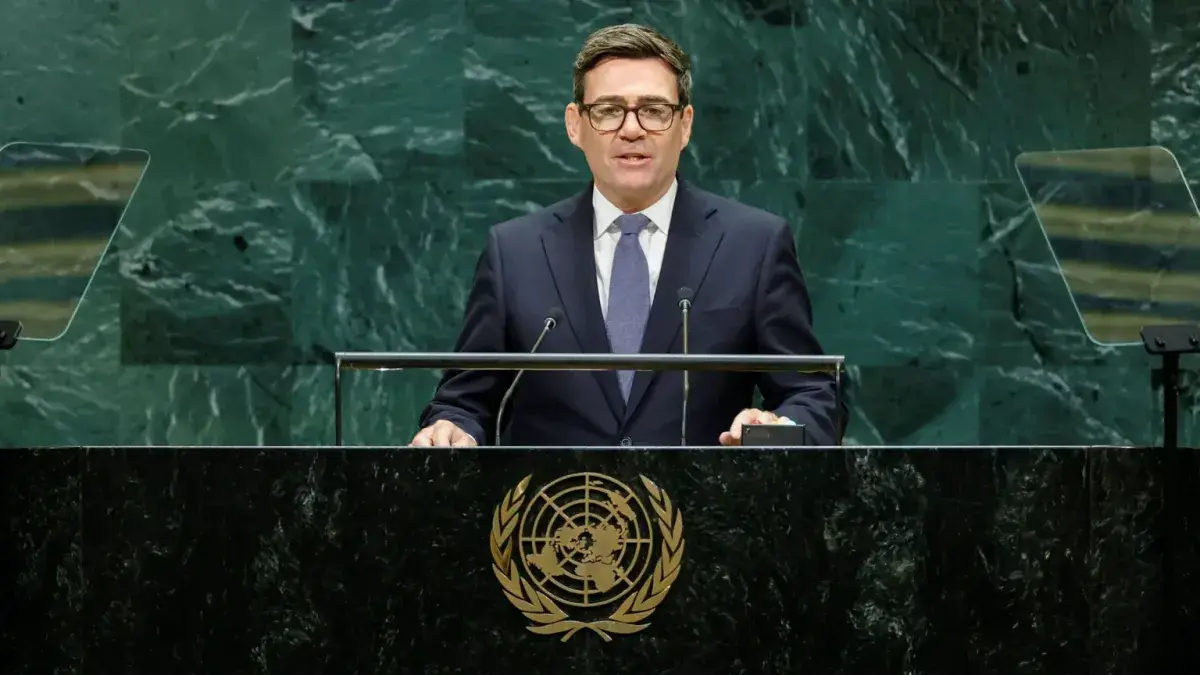
Burnham announced the planned National Centre for Information Defence during his address to the United Nations General Assembly in New York, presenting the initiative as part of a broader effort to strengthen Britain’s ability to identify, respond to and withstand hostile information campaigns.
The proposed centre will be tasked with detecting, attributing and disrupting information attacks carried out by foreign powers. According to the government’s plans, it will bring together intelligence agencies, law enforcement bodies and social media companies in an effort to improve coordination against campaigns that use digital technologies to manipulate audiences.
The initiative comes as governments across Europe face growing concerns about the use of artificial intelligence to produce convincing false content. Deepfake videos, fabricated news reports, automated social media accounts and fake websites can be produced and distributed rapidly, making it increasingly difficult for members of the public to distinguish authentic information from deliberately misleading material.

Burnham told the UN that Britain had spent too long responding cautiously to what he described as an increasingly serious information threat. He said the country needed to enter the next decade with a clearer understanding of hostile campaigns and greater resilience among the public.
He specifically highlighted Russia as a major source of concern for the UK. Burnham said Russian agencies had used a range of methods to spread false information and exploit public fears, including automated accounts, fake websites and fabricated newspaper articles.
He also accused Russia-linked actors of copying the branding of British organisations, including universities and the BBC, in an effort to make false material appear credible. Burnham said such networks had also amplified far-right narratives and that Britain had evidence of attempts to interfere with the 2019 general election through the online distribution of leaked documents.
The prime minister’s comments come amid an increasingly complicated relationship between London and Washington over how the UK should respond to Moscow. US President Donald Trump recently suggested that previous British rhetoric towards Russia had been too tough and advised London to exercise greater caution.
The comments prompted a response from Downing Street, which stressed that successive British governments had maintained a consistent position on what it described as unacceptable Russian threats, including both hybrid attacks and aggressive rhetoric.
The government also reaffirmed that Russia’s actions would not prevent Britain from supporting Ukraine. The disagreement illustrates the diplomatic challenges facing the UK as it attempts to maintain close relations with the United States while pursuing its own security policies towards Russia and the wider European region.
Against this backdrop, the proposed National Centre for Information Defence is intended to provide a more coordinated national response to information threats. Rather than treating disinformation solely as a communications problem, the government is presenting it as an issue involving national security, democratic resilience and social cohesion.
Burnham argued that the effects of information warfare can extend beyond individual pieces of false content. According to his assessment, persistent online campaigns can influence how people perceive their communities and their country, potentially deepening distrust, division and frustration.
He also connected vulnerability to disinformation with wider social and economic conditions. Burnham suggested that people experiencing financial difficulties or young people who are outside employment, education or training could be particularly susceptible to online influence.
The prime minister said addressing such vulnerability would require more than simply removing false information from digital platforms. He linked the issue to efforts to improve living standards, create opportunities and reduce inequality, arguing that societies facing significant economic divisions can become more exposed to destabilising narratives.
The government’s approach therefore combines technological and security measures with a broader emphasis on social resilience. The new centre is expected to support efforts to help communities recognise misleading content and understand how foreign influence operations work.
Artificial intelligence is likely to be a central concern for the organisation. Advances in generative AI have made it easier to create realistic images, audio recordings and videos that can falsely portray public figures or events. Such material can be circulated quickly through social media before journalists, officials or technology companies have enough time to verify it.
The challenge is particularly significant during elections, when false claims can spread rapidly and influence public debate. European countries are preparing for a series of elections in the coming years, increasing concerns about foreign attempts to manipulate political information environments.
Britain has already shared some of its experience with other countries. Burnham cited support provided to Moldova as an example of British efforts to help protect electoral processes from alleged Russian interference.
He said the UK was prepared to work with European partners facing similar challenges, particularly countries confronting organised information campaigns for the first time. The government intends to share knowledge about how hostile actors operate and how democratic states can respond.
The proposed centre has also received support from senior British lawmakers. Emily Thornberry, chair of the Foreign Affairs Select Committee, welcomed the announcement and said it addressed a recommendation made by the committee in its March 2026 report on disinformation diplomacy.
Thornberry argued that previous government efforts to deal with disinformation had been fragmented and lacked sufficient coordination. She said the new centre could provide a more organised response to attempts by foreign states to amplify false narratives and increase tensions inside Britain.
The creation of the agency could therefore represent a significant change in the way the UK approaches information security. By bringing intelligence, law enforcement and technology companies together, the government hopes to establish a system capable of identifying hostile campaigns more quickly and coordinating responses across different institutions.
However, efforts to combat disinformation also raise questions about how governments can address harmful foreign influence while protecting freedom of expression and legitimate political debate. Distinguishing deliberately coordinated foreign manipulation from inaccurate reporting, controversial opinions or ordinary political disagreement can be difficult, particularly on large online platforms where millions of posts are published every day.
The government will consequently face the challenge of ensuring that measures designed to protect democratic institutions do not unnecessarily restrict lawful speech. The effectiveness and public legitimacy of the new centre will depend in part on how clearly its responsibilities are defined and how its activities are overseen.
For Britain, the issue is becoming increasingly important as technology changes the speed and scale of information campaigns. Foreign actors can now potentially combine artificial intelligence, automated accounts and fabricated websites to create the appearance of widespread public support for narratives that may originate from a relatively small coordinated operation.

Burnham’s announcement places the planned National Centre for Information Defence at the centre of the UK’s proposed response. The government wants it to improve national preparedness, strengthen cooperation between institutions and help the public recognise attempts to manipulate information.
The prime minister’s UN address also presented the issue as part of a wider debate about national resilience. His message was that defending a country against modern threats involves not only traditional security measures but also ensuring that citizens and communities are better equipped to navigate an increasingly complex digital environment.
With concerns over foreign interference, AI-generated content and deepfakes continuing to grow, the UK government is seeking to build a dedicated institutional response. The proposed centre will face the task of turning that ambition into an effective system capable of protecting democratic processes while maintaining the principles of open public debate.
The announcement marks a recognition by the British government that information warfare is no longer confined to distant conflicts or traditional intelligence operations. Increasingly, the contest over information can reach directly into people’s homes and online communities, making public awareness, institutional coordination and technological capability important elements of national security.
Related News:
 Reform UK funding: mystery billionaire revealed
 Election Candidate Abuse Raises Alarm in England
 Tom Watson Takes Senior Role at Palantir
 MPs warn AI financial risks threaten UK stability
 MPs warn AI financial risks threaten UK stability
 UK Social Media Ban for Under-16s Gains Momentum
 UK Teen Social Media Ban Trials Begin
 Ministers Urged to Act Faster on Deepfakes Threat
 MPs Reject Ban on Social Media for Under-16s
 OpenAI Halts Stargate UK Project Amid Energy Crisis
 Starmer would have blocked Mandelson role, says Lammy
 Richard Tice Faces £100k Tax Controversy
 Doomsday Clock Nears Midnight Amid Global Crises
 UK firms accused of ‘AI washing’ boom
 UK Ministers Lobby Trump Over Under-16s Social Media Ban
 Reeves Launches City AI Skills Compact
 Murder Probe Continues After Arrest Release
 Ghent Professors Questioned Cofnas Appointment
 RAF Barnham Protests Fuel Tensions in Norfolk Town
 UK Risks Falling Behind in AI Race
 London Launches First Self-Driving Taxis
 Survivor Sues Musk’s xAI Over AI Abuse Images
 Reform Faces Fresh Financial Controversy
 Australia gives users control over social media algorithms
 Europe’s democracies face a growing far-right threat
 New Mexico Takes Facebook to Trial Over Data Scandal
 Patriot Platform Raises Concern Across Britain
 Reform UK Receives Record £36m Donation From Crypto Billionaire
 Louise Haigh Urges UK to Heed AI Safety Warnings
 Lib Dems Prepare for Election Amid Reform Challenge
 Trump’s UK Ambassador Urges North Sea Drilling to Strengthen US Ties
 French Taxi Driver Cleared in David Lammy Theft Case After Fare Dispute
 UK Bans Fake Numbers: Scammers Lose Their Trick
 Patients to Test Health at Home to Ease NHS Winter Pressure
 Britain deploys RAF specialists to assist Belgium with drone threats
 Millionaires group urge Reeves to introduce wealth tax to ‘lift kids out of poverty’
 Reeves rejects £1bn plea for NHS redundancy payouts
 Northern Lights may illuminate UK skies this week
 PM Condemns Leaks, Vows Loyalty to Ministers and Stability
 Major Rent Reform Ends No-Fault Evictions in England
 Starmer Says Labour’s Economic Plan Needs Years to Deliver
 Artificial intelligence will cost jobs, admits Liz Kendall
 Mandelson Faces Police Inquiry Over Epstein Leak
 Morgan McSweeney downfall shocks Labour leadership
 Farage Unveils Reform UK Frontbench Team
 Wales Approves Assisted Dying Bill Consent
 UK EU Trade Reset Gains Public Backing
 Corbyn Leads Your Party in Coordinated Left-Flank Strategy
 Asylum Seekers to Work After Year-Long Wait
 Starmer Row as Greens Demand Apology
 Proposed Law Leaves Gap for Children of Convicted Paedophiles
 Gordon Brown urges court for crimes against children
 Inquiry into HMRC child benefit errors launched by NAO
 Farage Faces Backlash Over Crypto Cameo Endorsements
 Relationship with Trump may be beyond repair, Starmer warned
 Unions Raise Concerns Over Doctors’ Pay Dispute
 Artemis II Returns After Historic Moon Flyby
 UK Government Poised to Revive Stalled Hillsborough Law
 UK Stands Firm on Falklands Amid US Rift
 Welsh Labour Faces Potential Historic Election Defeat
 Silent Tracks: Rail Line Without Passengers
 Major test for Labour as polls open in Great Britain
 Barrister Criticises Trial After Suicide Case Verdict
 Keir Starmer Struggles to Secure His Grip on Downing Street
 Farage Faces Standards Probe Over Cash Property Purchase
 Farage and Reform UK Reshape British Politics
 Makerfield Voters Demand Real Change as Election Looms
 Labour MP Revives Blocked Assisted Dying Bill in Commons
 Starmer Set to Announce Exit Plan as Burnham Eyes No 10
 Trump Faces Backlash Over $2bn Earnings Since Return
 Burnham Pledges New Era of Open Debate for Labour MPs
 Meta Under Fire: The Battle Over Addictive Social Media Design
 Security Row Erupts Following Tragic Death
 Burnham unveils £65m drought aid for farmers
 Unions Warn Labour Over Zero-Hours Contract Reforms
 AI Loss of Control Incidents Nearly Double
 British Museum Faces Questions Over Peter Thiel’s Private Bayeux Viewing
 Bayeux Tapestry Revives Franco-British Ties
 British Columbia Sues OpenAI Over School Shooting
 Democrat Says ICE Restricted Detention Camp Oversight