Published: 05 September 2026. The English Chronicle Desk. The English Chronicle Online.
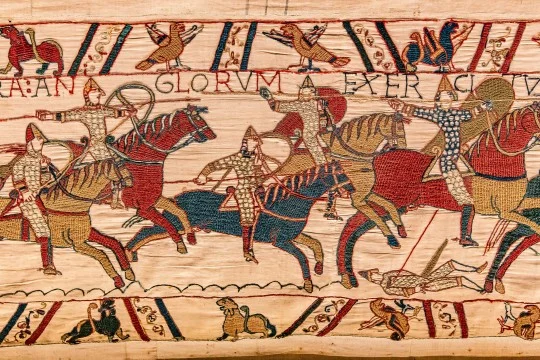
The return of the Bayeux Tapestry to Britain for a major exhibition in London has become more than a landmark cultural event. After centuries of rivalry, cooperation, conflict and reconciliation between Britain and France, the arrival of the medieval masterpiece has provided an unusually powerful symbol of renewed Franco-British friendship.
French President Emmanuel Macron’s decision to make the long-discussed loan happen represents the culmination of a commitment first announced in 2018. At that time, Britain and France were experiencing strained relations following Britain’s decision to leave the European Union. Macron nevertheless argued that the two countries remained bound together by geography and shared history.
Eight years later, that history has taken physical form in London.
The tapestry, which depicts the Norman conquest of England and the events surrounding the Battle of Hastings in 1066, has crossed the English Channel once again. Its exhibition at the British Museum has brought together British and French political leaders and cultural figures in an event intended to demonstrate how shared history can provide a foundation for renewed cooperation.
For Andy Burnham, Britain’s latest prime minister, the loan represents a significant gesture of goodwill from France. He has described the exhibition as evidence of the friendship between the two nations and as an example of how international collaboration can produce benefits that extend beyond politics.

Macron has similarly presented the tapestry as something far more significant than an ancient embroidered artwork. In his view, it represents a chapter in French, British and European history and carries a message about the relationship between the two countries that stretches far beyond the events depicted on its fabric.
The symbolism is particularly striking because the Bayeux Tapestry itself was created for political purposes.
The precise circumstances surrounding its creation remain uncertain. Most historians believe it was probably produced in Canterbury, although the identity of the person who commissioned it and the exact intentions behind it remain subjects of scholarly debate.
One widely accepted theory is that Bishop Odo of Bayeux, William the Conqueror’s half-brother and an important Norman figure in England, commissioned the work. Odo also became Earl of Kent following the Norman conquest, giving him a direct connection to both sides of the Channel.
The tapestry tells a carefully constructed story of Harold, the English earl who eventually became king, and William, Duke of Normandy. At the centre of the narrative is Harold’s alleged oath to support William’s claim to the English throne. Harold later becomes king himself, providing the justification presented for William’s invasion.
Historian David Musgrove argues that this political explanation is crucial to understanding the tapestry. Rather than simply celebrating Norman military success, the artwork helped explain why William believed his invasion was justified.
In that respect, the tapestry remains surprisingly modern. Political leaders have long attempted to construct narratives explaining and legitimising military action, and the Bayeux Tapestry can be understood as an early example of that process.
Yet historians caution against treating it as straightforward propaganda.
Leonie Hicks, a professor of medieval studies, has noted that the tapestry contains a far more complicated portrayal of conquest and warfare. While William is clearly presented favourably, the artwork also contains disturbing images showing the human cost of conflict.
Among the scenes are a burning house, civilians fleeing, fallen soldiers and bodies being stripped of their possessions. These details offer a stark reminder that behind political claims and military victories were ordinary people who suffered the consequences of war.
That dimension is especially significant because much of the actual embroidery was probably carried out by English women. Some of those involved may have personally experienced the consequences of the Norman conquest through the deaths or displacement of family members.
The tapestry’s political life did not end with the Norman period. Over the centuries, it repeatedly became an object of political fascination.
The artwork was recorded in the treasury of Bayeux Cathedral in the late 15th century, where it was displayed publicly for several days each year. During the French Revolution, it narrowly avoided being destroyed or repurposed.
Napoleon Bonaparte later recognised its political usefulness. While preparing plans for an invasion of Britain in the early 19th century, he had the tapestry displayed in Paris. The image of an earlier cross-Channel invasion was clearly relevant to the political atmosphere of the time.
The planned invasion ultimately failed, and the tapestry returned to Bayeux.
During the Second World War, the artwork attracted the attention of Nazi Germany. Nazi officials reportedly regarded it as an important representation of their racial and historical ideology and planned to transport it to Germany. Those plans were disrupted before they could be carried out.
Its survival through revolution, war and political upheaval has contributed to the tapestry’s extraordinary status today.
Britain has attempted to bring the artwork across the Channel on several occasions. A British request was made as early as 1931. Another attempt was made in connection with the coronation of Queen Elizabeth II in 1953, when France initially agreed before conservation concerns resulted in the decision being reversed.
A further proposal in 1966, marking the 900th anniversary of the Battle of Hastings, also failed. Another attempt during the 1980s similarly came to nothing.
The latest loan therefore represents the culmination of decades of unsuccessful efforts.
It also required political determination from both countries because the decision was not universally welcomed in France. Conservation specialists, artists and others raised concerns about the risks involved in moving such an exceptionally fragile and historically important object.
Macron nevertheless remained committed to the project.
His determination can be understood partly through his broader approach to international diplomacy. Macron has consistently sought to present himself as a major European and international statesman, and cultural diplomacy has formed an important part of that image.
But there is also a deeper strategic reason for improving relations with Britain.
Since Brexit, Britain and France have continued to disagree over numerous issues, particularly in the context of Britain’s relationship with the European Union. Nevertheless, changing international circumstances have encouraged closer cooperation.
The war in Ukraine, European defence and security, migration and the broader challenges posed by US President Donald Trump’s approach to international affairs have created areas in which British and French interests increasingly overlap.
These shared concerns have helped push the two countries closer together despite their disagreements.
Helen Drake, a professor of French and European studies, has described the changing international environment as an important factor in the renewed relationship. Britain and France may still compete and negotiate aggressively, but both countries face external pressures that make cooperation increasingly valuable.
The Bayeux Tapestry therefore arrives in Britain at an unusually significant moment.
Its presence in London does not erase centuries of rivalry, nor does a cultural exhibition resolve disagreements over trade, migration, European policy or security. Franco-British relations have always contained an element of tension alongside friendship.
That contradiction is part of what makes the tapestry such an appropriate symbol.
The artwork itself tells a story of invasion, political rivalry, contested legitimacy and profound human suffering. Yet nearly a thousand years later, the same object is being used to encourage cooperation between the societies that emerged from that complicated history.
The warmth surrounding the London exhibition should therefore not be mistaken for the disappearance of political differences.
France can celebrate its relationship with Britain while continuing to defend its interests in negotiations with the UK and the European Union. Britain can welcome the French gesture while maintaining its own priorities.
Those realities are not necessarily contradictory.
Indeed, the ability to disagree while continuing to cooperate may be one of the defining characteristics of the relationship between the two countries.

The Bayeux Tapestry has survived precisely because history rarely moves in a straight line. It has been celebrated, politicised, threatened, transported and protected across generations.
Now, its temporary presence in London offers another chapter.
For visitors, it is an extraordinary medieval artwork telling the story of one of the most consequential events in English history. For historians, it remains an invaluable and deeply complicated source. For politicians, it has become a symbol of diplomacy.
And for Britain and France, it provides a reminder that shared history can be both a source of conflict and a foundation for friendship.
Nearly a thousand years after William’s forces crossed the Channel, the tapestry has made the journey in the opposite direction under entirely different circumstances.
This time, it has not arrived as an instrument of conquest.
It has arrived as a gesture of cooperation.
Related News:
 Ceasefire Standoff Deepens in Ukraine War
 Deadly Russian Air Raids Strike Across Ukraine
 British Woman in Iran ‘Losing Hope’ Amid Ongoing Detention
 BBC Journalist Held and Interrogated in Vietnam
 Zohran Mamdani becomes New York City’s first Muslim mayor
Zohran Mamdani names all-female transition team for NYC mayoralty
Zohran Mamdani becomes New York City’s first Muslim mayor
Zohran Mamdani names all-female transition team for NYC mayoralty
 Second world war veterans honoured as King leads Remembrance Sunday
 BBC director-general and news chief resign amid bias row
 Rama Rebukes Mahmood for Targeting Albanian Families
 Russian Vessel Used Lasers on RAF Pilots, UK Claims
 Ireland Boosts Ukraine Aid as Zelensky Visits Dublin
 EU weighs response amid Greenland tariff crisis with Trump
 US Africa aid remarks spark anger after leaked State email
 EU Says US Ties Have Suffered ‘Big Blow’ After Greenland Crisis
 Starmer China visit raises human rights pressure on Beijing
 UK and EU Signal Fresh Push for Defence Cooperation Talks
 Cory Bernardi joins One Nation for SA election
 Starmer Condemns ‘Depraved’ Russian Strikes on Ukraine
 Trump Warns Over Chagos Islands Deal
 Trump and Chagos Deal Rift Over Iran Strikes
 Andrew Mountbatten-Windsor Arrest After FBI Radar
 Farage Chagos Islands Row Sparks Fury
 Trump Tariffs Threat Spark UK and EU Alarm
 UK Allows US Base Use Amid Iran Tensions
 Trump Rebukes Starmer Over Iran Strikes Row
 UK Prepares Aircraft Carrier for Middle East Crisis
 Gordon Brown urges court for crimes against children
 Yvette Cooper: UK Must Follow Principles, Not US Pressure
 UK Minister Denies Iran Missile Threat to Britain
 Army Probes Apache Flyover at Kid Rock’s Nashville Estate
 Relationship with Trump may be beyond repair, Starmer warned
 Italian Town Buys Mussolini Villa to Keep Away Fascist Fans
 Hungary election: Orbán faces biggest test amid scandal
 Charles Faces Trump Test in High-Stakes US Visit
 UK Stands Firm on Falklands Amid US Rift
 Asylum deal sparks fears over Syria deportations
 Global order shifts amid Trump-era turmoil
 Koh-i-noor Diamond Row Reignites Colonial Debate
 France Faces Record Presidential Crowded Race Amid Far-Right Surge
 Norway Doubles Down on Oil and Gas for Europe Energy Security
 Starmer Faces Revolt After Crushing Election Losses
 Putin Declares Russia Victory at Scaled Victory Day Parade
 UK Pushes for New EU Goods Trade Deal
 Reeves Fights to Keep Treasury Role Amid Labour Turmoil
 Zelenskyy warns over Oreshnik threat as Kyiv hit
 Former ICC prosecutor condemns US sanctions
 Irish Gangland Figure Fails in Dublin Election Bid
 Farage and Reform UK Reshape British Politics
 Starmer Leadership Under Pressure After Setbacks
 EU and UK Set July Date for Critical Post-Brexit Summit
 Angela Merkel’s Portrait Unveiled: A Quiet Berlin Story
 UK Nations Brace for Potential Breakup Amid Reform Surge
 UK Government Cancels Higher Education Programme for Women and Girls
 New South Wales Premier Chris Minns Signals Tough Road Ahead for Labor
 Le Pen to Run for President Despite Embezzlement Conviction
 Labour MPs Urge Burnham to Revive UK Aid Target
 Dreyfus Statue Finally Gets Permanent Paris Home
 Farage Defends £5m Gift Amid Threats
 Russian Missiles Intensify Pressure on Kyiv
 Former Diplomats Urge UK and France to Act on Palestine
 Exeter Approves Saudi Military Training Partnership
 Ukraine Villagers Demand Answers After Deadly Arms Depot Strike
 British Man Faces Deportation Threat in Sweden
 Green Leader Targets Starmer’s Former Seat
 Trump’s UK Ambassador Urges North Sea Drilling to Strengthen US Ties
BBC to Apologise Over Edited Trump Speech Amid Backlash
Trump’s UK Ambassador Urges North Sea Drilling to Strengthen US Ties
BBC to Apologise Over Edited Trump Speech Amid Backlash
 Millionaires group urge Reeves to introduce wealth tax to ‘lift kids out of poverty’
 Reeves rejects £1bn plea for NHS redundancy payouts
 PM Condemns Leaks, Vows Loyalty to Ministers and Stability
 Greene Pushes Epstein Files Amid Trump Fallout
 Wales Approves Assisted Dying Bill Consent
 Jacinda Ardern Move Sparks Kiwi Reflection
 Asylum Seekers to Work After Year-Long Wait
 Injured Mojtaba Khamenei Elevated as Iran Leader
 Inquiry into HMRC child benefit errors launched by NAO
 Air Canada CEO Faces Outcry Over Recent Language Misstep
 UK Government Poised to Revive Stalled Hillsborough Law
 Silent Tracks: Rail Line Without Passengers
 RFU Backs Borthwick Despite England’s Poor Six Nations
 Major test for Labour as polls open in Great Britain