Published: 09 May 2026. The English Chronicle Desk. The English Chronicle Online.
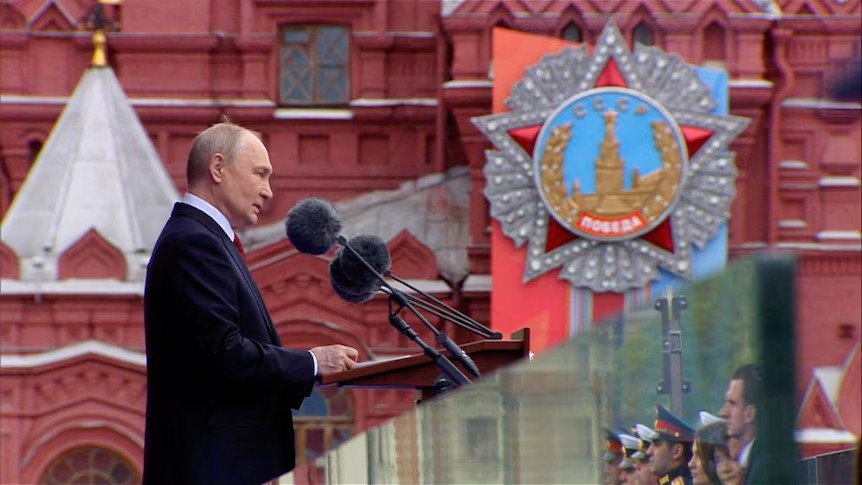
Vladimir Putin has declared that Russia will “always be victorious” as he presided over a significantly scaled-back Victory Day parade in Moscow’s Red Square, held under intense security measures and heightened fears of potential Ukrainian strikes. The annual commemoration, traditionally one of the most symbolic displays of Russian military power, took place in a markedly subdued atmosphere this year, reflecting both the ongoing strain of the war in Ukraine and growing domestic unease.
Addressing the assembled crowd, Putin drew heavily on historical imagery from the Second World War, framing Russia’s current military campaign in Ukraine as a continuation of what he described as an existential struggle against hostile forces. He praised Russian troops currently engaged in what the Kremlin continues to call the “special military operation,” saying they were carrying forward the legacy of past generations who fought against fascism.
He told the audience that Russian forces were confronting what he characterised as a broad coalition of adversaries, asserting that despite these challenges, Russia’s military would prevail. His remarks echoed familiar themes in recent Kremlin rhetoric, which has increasingly linked the Ukraine war to the Soviet Union’s wartime victory narrative, often blurring historical distinctions in service of political messaging.

However, beneath the confident tone of his speech, the event itself highlighted a more complex and uncertain reality for the Kremlin. Security across Moscow was significantly intensified in the days leading up to the parade, with widespread disruptions to internet services and strict controls imposed throughout the capital. Authorities cited security concerns amid ongoing Ukrainian drone and missile activity targeting Russian territory, measures that underscored the persistent vulnerability felt even in the heart of Moscow.
Unlike previous years, this year’s parade lacked the usual display of heavy military hardware. Tanks, missiles, and armoured vehicles, which have been a defining feature of the event since 2017, were notably absent. Instead, attendees were shown pre-recorded presentations highlighting Russia’s drone capabilities and strategic nuclear forces, signalling a shift from physical spectacle to symbolic projection of military strength.
The guest list also reflected Russia’s evolving geopolitical alignments. A small number of foreign leaders attended, including representatives from Belarus, Kazakhstan, and Uzbekistan, underscoring Moscow’s continued reliance on regional partnerships amid strained relations with much of the Western world. A notable feature of the parade was the participation of North Korean troops, who marched across Red Square as part of a growing military and political alignment between Moscow and Pyongyang. Their presence marked one of the most visible demonstrations yet of North Korea’s deepening involvement in Russia’s war effort in Ukraine.
The overall duration of the parade was significantly shorter than in previous years, lasting approximately 45 minutes, roughly half the usual length. Observers noted the reduced scale as emblematic of the pressures facing the Russian state, both militarily and economically, after more than two years of sustained conflict.
Despite a last-minute announcement of a three-day ceasefire and prisoner exchange involving Ukraine, tensions remained high in the lead-up to the event. The ceasefire, reportedly facilitated with involvement from international diplomatic channels, was framed by some analysts as an attempt to ensure the parade could proceed without disruption. Ukrainian officials had earlier dismissed similar proposals as politically motivated gestures intended to shield symbolic Russian events from potential attacks.
In a notable exchange, Ukrainian President Volodymyr Zelenskyy issued a pointed response ahead of the parade, stating that Ukraine would “permit” Russia to hold its commemoration by refraining from attacks during the period, a remark widely interpreted as a sardonic commentary on Moscow’s request for restraint.
Inside Russia, the broader context of the parade has been increasingly shaped by signs of domestic strain. Economic pressures have intensified, with inflation rising and public spending heavily directed toward sustaining the war effort. While military production has supported certain sectors of the economy, broader indicators suggest slowing growth and increasing fiscal stress, with concerns mounting over long-term sustainability.
Public sentiment has also shown signs of fatigue. Repeated disruptions, including internet blackouts and heightened security restrictions, have contributed to growing frustration among sections of the population. Although official polling continues to show significant levels of support for the government, analysts note that the cumulative impact of prolonged conflict, economic pressure, and international isolation is beginning to reshape public mood.
On the battlefield, the war has reached a largely static phase in many regions, with neither Russian nor Ukrainian forces achieving decisive breakthroughs in recent months. Fighting continues to be characterised by attritional warfare, with heavy casualties reported on both sides and ongoing strikes against critical infrastructure. Despite these conditions, there is little indication of a near-term diplomatic resolution.
Kremlin officials have maintained a firm position regarding future negotiations. Senior aides have indicated that Moscow does not see conditions as favourable for renewed talks involving Ukraine and international mediators unless significant territorial concessions are made by Kyiv. Ukrainian authorities have rejected such conditions outright, insisting on the restoration of territorial integrity as a prerequisite for any meaningful negotiations.

The symbolism of this year’s Victory Day parade was further underscored by Putin’s seating arrangement, which placed him alongside soldiers who had participated in the Ukraine conflict rather than veterans of the Second World War. This departure from tradition was widely interpreted as an effort to directly link contemporary military operations with the historical narrative of Soviet victory.
While state media continued to emphasise themes of resilience and strength, independent analysts and some pro-government commentators acknowledged the more restrained nature of the event. The absence of large-scale military displays, combined with heightened security concerns and a reduced international presence, contributed to an atmosphere markedly different from the highly choreographed demonstrations of earlier years.
As Russia continues to navigate a prolonged and costly conflict, the Victory Day parade served both as a reaffirmation of official messaging and a reflection of underlying pressures. The contrast between declared confidence and visible constraint highlighted the complex reality facing the Kremlin as it seeks to maintain domestic stability while sustaining military operations abroad.
With no clear end to the war in sight and diplomatic channels remaining limited, the coming months are likely to prove critical in determining both the trajectory of the conflict and the internal dynamics within Russia itself.
Related News:
 Zelenskyy warns over Oreshnik threat as Kyiv hit
 UK Prepares Aircraft Carrier for Middle East Crisis
 Trump orders US troop pullout from Germany
 Activists allege abuse after Gaza flotilla seizure
 Ukraine strikes Tuapse as oil disaster worsens
 Global order shifts amid Trump-era turmoil
 Ceasefire Standoff Deepens in Ukraine War
 Middle East Crisis Escalates as Oil Routes Shake Markets
 Discontent grows around Putin amid war strain
 Former ICC prosecutor condemns US sanctions
 Houthis Strike Saudi Arabia as Middle East Tensions Rise
 Taliban global ties grow as rights fears mount
 Trump dismisses concerns over 250-day carrier deployment
 Shock US Raid: Maduro Pleads Not Guilty in Manhattan Court
 Machado Trump medal gesture reshapes Venezuela power struggle
 Trump Receives Machado’s Nobel Medal in White House Meeting
 Iran unrest slows under brutal crackdown and global tensions
 EU weighs response amid Greenland tariff crisis with Trump
 US Considers Asylum for British Jews Amid Rising Antisemitism
 EU Says US Ties Have Suffered ‘Big Blow’ After Greenland Crisis
 Russia Strikes Kyiv and Kharkiv as Peace Talks Enter Day Two
 Thousands Protest ICE Operations in Nationwide US Day of Action
 Epstein Files Reveal Trump Officials’ Emails with Financier
 Thousands Protest ICE in New York Against Trump Deportation Campaign
 Yvette Cooper: UK Must Follow Principles, Not US Pressure
 ‘The frontline is like Terminator’: Ukraine’s fighting robots
 Italian Town Buys Mussolini Villa to Keep Away Fascist Fans
 Hungary election: Orbán faces biggest test amid scandal
 RAF Typhoons scrambled amid Russian drone threat near Nato
 Ukraine Urges UK to Seize Russian Oil Tankers
 US Calls Australia Media Law “Foreign Extortion”
 USS Gerald R Ford Ends Record Naval Deployment
 Oil Prices Surge Above $120 Amid Iran Blockade Fears
 Trump likens US Navy actions to ‘pirates’
 Australia pushes Pacific security pact amid China tension
 Indiana Republicans Defy Trump in Key Vote Test
 Trump Announces 3-Day Russia–Ukraine Ceasefire Deal
 Tensions Emerge in Netanyahu-Trump Alliance
 France Faces Record Presidential Crowded Race Amid Far-Right Surge
 Norway Doubles Down on Oil and Gas for Europe Energy Security
 Hunger increasingly weaponised in global conflicts
 Irish Gangland Figure Fails in Dublin Election Bid
 Deadly Russian Air Raids Strike Across Ukraine
 Trump’s Iran Legacy Hangs on Tehran Deal
 Millions Gather for Khamenei’s Six-Day State Funeral
 Le Pen to Run for President Despite Embezzlement Conviction
 Seoul proposes historic peace talks to replace Korean War armistice
 Israeli Strike in Southern Lebanon Kills Seven
 BBC to Apologise Over Edited Trump Speech Amid Backlash
 Britain deploys RAF specialists to assist Belgium with drone threats
 Greene Pushes Epstein Files Amid Trump Fallout
 December Run-Off in Chile as Election Produces No Winner
 Shadow Fleet at Sea: Europe’s Battle Against Illicit Oil Shipping
 Spoof “Make America Go Away” Caps Rally Denmark Over Greenland
 Pentagon Signals Reduced Role in Deterring North Korea
 UK and US Drop in Global Corruption Index Rankings
 Canberra Poster Seizure Sparks Free Speech Row
 Evo Morales Returns After Mysterious Absence
 Jacinda Ardern Moves To Australia Following Her US Fellowships
 Jacinda Ardern Move Sparks Kiwi Reflection
 Nick Greiner Warns Over Election Review Fallout
 New Zealand Covid Response Praised Despite Lingering Scars
 Injured Mojtaba Khamenei Elevated as Iran Leader
 Gordon Brown urges court for crimes against children
 Pakistan Targets Militant Hideouts in Afghanistan
 Air Canada CEO Faces Outcry Over Recent Language Misstep
 Relationship with Trump may be beyond repair, Starmer warned
 Reform UK Pledges To Halt Visas Over Reparations Demands
 Trump Signals Hope for New Iran Talks as Ceasefire Fades
 Trump Brokers Landmark Lebanon Ceasefire Amid Regional Hopes
 Investigation Into Anti-Trump Motives After Gala Shooting
 Putin Signals War End as Russian Momentum Stalls
 Romania’s Judicial Crisis: A System Under Siege
 Scepticism and tight security as Beijing braces for Trump
 Philippine Senator Flees After Days Under Senate Siege
 Tony Abbott Returns as New Liberal Party President
 Pope Meets Families in Italy Toxic Waste Zone
 Aukus Deal Facing Fierce Backing and Historic Criticism
 Trump’s Mount Rushmore Speech: A Divisive Anniversary
 Trump Swaps Planes Amid Iran Tensions