Published: 03 July 2026. The English Chronicle Desk. The English Chronicle Online.
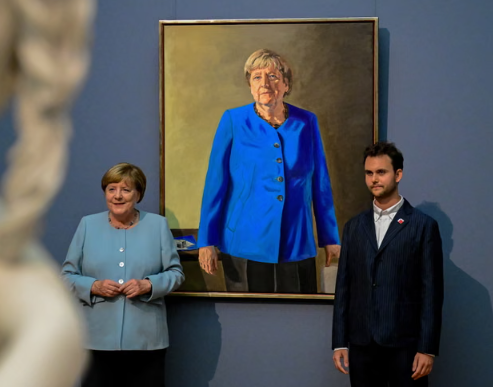
Over several months, a unique partnership blossomed within a private studio tucked away in the government district of Berlin. A young artist and his distinguished subject, the former German chancellor Angela Merkel, worked closely together on a secret creative project. For many hours at a time, while Jérémie Queyras painted her portrait, they bonded through long, thoughtful conversations about various topics. They often spent time in comfortable silence, or they enjoyed listening to classical music, taking turns to choose their favorite pieces to accompany the creative process. The final result of what Merkel, now seventy-one, affectionately called their little adventure was unveiled to an invited audience of family and friends this week at the neo-baroque Bode-Museum in Berlin.
The museum, famous for its grand collection of old master paintings and sculptures, is now the temporary home to a large, looming image of the former chancellor. She is depicted wearing a blue version of one of her many trademark blazers, complete with the large buttons the public grew to know so well. In this striking oil painting, she appears slightly cramped, with her face showing signs of being a little frayed from her time at the helm. It is a subtle sign that the immense strain of being in power for sixteen years has left a permanent, visible mark on her features.
Queyras, who is twenty-eight, admitted he would never have come up with the idea himself, but he was persuaded to reach out to Merkel by an acquaintance who knew the former leader would eventually be searching for a portrait artist. He wondered who in the world would possibly know him, but he decided to send Merkel a handwritten letter back in 2022. He carefully enclosed some color photocopies of his own paintings, then waited three long years for a reply from her office. When the two finally met in her Berlin office, Queyras noted that she gracefully ignored his scruffy sneakers and gave him the commission, having never actually seen any of his original works in person, though she felt he had made a good impression.
The painter, who was born in Paris but grew up in southern Germany, admitted he had felt a little overwhelmed by the daunting task and had candidly shared his doubts with Merkel during their early meetings. The two discussed what the true meaning of a portrait was and why a traditional oil painting might be preferable to a modern photograph. She kindly advised him to take his time to decide whether he really wanted such a high-profile job, warning him that his life after the painting would likely be very different. According to reports in Die Zeit, she cautioned him that he might feel the resentment of other artists who had not received the commission, or even face hostility from the far right, who view Merkel as the ultimate agent of doom and could pursue him with intense suspicion.
In preparation for the long project, Merkel arranged for Queyras to have secret access to the chancellery so he could carefully view the gallery of portraits featuring her seven male predecessors who served as post-second-world-war German leaders, from Konrad Adenauer to Gerhard Schröder. Perhaps most strikingly, Merkel is reported to have paid Queyras herself, rather than letting the German taxpayers pick up the bill for this private work. According to various reports, this was specifically done so her personal ownership of the portrait cannot be disputed in the future. The painting can be loaned to the chancellery for display, but Merkel would be able to take it back should the political landscape shift and the far right ever gain real power.
The portrait will be on public display until October, at which point it will be moved to the chancellery, where it will hang next to a painting of Merkel’s arch-rival Schröder, whose own apparently self-mocking portrait by Jörg Immendorff has frequently been compared to the embossed coin of a Roman emperor. Queyras said he had given considerable thought to the specific challenge of how to paint Merkel’s hands, given their history. In office, she had invented a famous rhombus-shaped way to hold them as a coping mechanism, but both the artist and the subject felt this would be far too clichéd for this particular portrait.
Instead, her left hand casually rests on the arm of a chair with three fingers, while her right hand simply hangs down. She shows her characteristic sense of unease, and a slight hint of impatience, looking as though she is ready to flee if she absolutely has to. Directly behind her, the few odds and ends on a table are items she once had on her own office desk. Social media users have been poring over the fine details, hoping to interpret the hidden significance of these small items. There is a yellow cardboard file, which serves as a nod to her prosaic style of government and the analogue era, and a small silver cube, a gift from when she entered office, on which is engraved one word on each square: In der Ruhe liegt die Kraft, meaning that in serenity strength lies.
Fittingly, it has now been five years since Merkel left office, and Germany is currently experiencing something of a wave of nostalgia for the long era of her steady, calm rule. This sentiment is currently encapsulated in the popularity of lo-fi merkelwave, a lengthy melody featuring Merkel’s own voice and including some of her most famous phrases, such as the line noting that the internet is uncharted territory for all of us, and the assurance that we have managed so much, we will manage this at the height of the 2015 refugee arrivals. Queyras said Merkel had been one of the defining influences of his childhood, noting that since he was eight and well into his adulthood, she was always there in the background of his life. He expressed a sincere hope that viewers would immediately recognize Merkel in the picture, yet still get to know her from a completely new and human perspective.
Related News:
 EU weighs response amid Greenland tariff crisis with Trump
 EU Says US Ties Have Suffered ‘Big Blow’ After Greenland Crisis
 Italy Arrests Protesters Amid Milan Olympic Chaos
 Mandelson Faces EU Inquiry Over Epstein Links
 Romania Gambling Crackdown: Cities Can Ban Betting Shops
 ‘Earthquake for France’: Marseille May Vote Far-Right
 Italian Town Buys Mussolini Villa to Keep Away Fascist Fans
 Hungary election: Orbán faces biggest test amid scandal
 Asylum deal sparks fears over Syria deportations
 Global order shifts amid Trump-era turmoil
 Ceasefire Standoff Deepens in Ukraine War
 France Faces Record Presidential Crowded Race Amid Far-Right Surge
 Norway Doubles Down on Oil and Gas for Europe Energy Security
 Putin Declares Russia Victory at Scaled Victory Day Parade
 Hybrid village stores fight rural decline
 Zelenskyy warns over Oreshnik threat as Kyiv hit
 Cannes filmmakers split over AI’s role in cinema
 Former ICC prosecutor condemns US sanctions
 Irish Gangland Figure Fails in Dublin Election Bid
 Hungary Targets Oligarchs with Proposed Landmark Wealth Tax
 Deadly Russian Air Raids Strike Across Ukraine
 The Obamalisk: Inside the Controversial $850m Presidential Center
 EU and UK Set July Date for Critical Post-Brexit Summit
 Lib Dems Demand Bold EU Reset to Salvage British Economy
 UK Nations Brace for Potential Breakup Amid Reform Surge
 Le Pen to Run for President Despite Embezzlement Conviction
 Meta Under Fire: The Battle Over Addictive Social Media Design
 Dreyfus Statue Finally Gets Permanent Paris Home
 Farage Defends £5m Gift Amid Threats
 Trump’s UK Ambassador Urges North Sea Drilling to Strengthen US Ties
BBC to Apologise Over Edited Trump Speech Amid Backlash
Trump’s UK Ambassador Urges North Sea Drilling to Strengthen US Ties
BBC to Apologise Over Edited Trump Speech Amid Backlash
 Millionaires group urge Reeves to introduce wealth tax to ‘lift kids out of poverty’
 Reeves rejects £1bn plea for NHS redundancy payouts
 PM Condemns Leaks, Vows Loyalty to Ministers and Stability
 Greene Pushes Epstein Files Amid Trump Fallout
 December Run-Off in Chile as Election Produces No Winner
 Shadow Fleet at Sea: Europe’s Battle Against Illicit Oil Shipping
 Georgians Defy Government Crackdown After Year of Protests
 ICC to Rule on Duterte’s Provisional Release
 Starmer Says Labour’s Economic Plan Needs Years to Deliver
 Australia grants Asio powers to designate hate groups under new laws
 Trump press secretary attacks reporter over ICE question
 Spoof “Make America Go Away” Caps Rally Denmark Over Greenland
 Trump Fed bid heads to Supreme Court
 Pentagon Signals Reduced Role in Deterring North Korea
 EU launches Grok AI probe into X over explicit images
 Artificial intelligence will cost jobs, admits Liz Kendall
 Partial US Government Shutdown Hits Homeland Security Funding
 Mandelson Faces Police Inquiry Over Epstein Leak
 UK and US Drop in Global Corruption Index Rankings
 Canberra Poster Seizure Sparks Free Speech Row
 Wales Approves Assisted Dying Bill Consent
 Jacinda Ardern Move Sparks Kiwi Reflection
 Asylum Seekers to Work After Year-Long Wait
 New Zealand Covid Response Praised Despite Lingering Scars
 Injured Mojtaba Khamenei Elevated as Iran Leader
 Inquiry into HMRC child benefit errors launched by NAO
 Air Canada CEO Faces Outcry Over Recent Language Misstep
 Relationship with Trump may be beyond repair, Starmer warned
 UK Government Poised to Revive Stalled Hillsborough Law
 Democrats Move to Impeach Defense Secretary Pete Hegseth
 Investigation Into Anti-Trump Motives After Gala Shooting
 Silent Tracks: Rail Line Without Passengers
 Arteta urges Arsenal to step up in Atlético semi-final
 Major test for Labour as polls open in Great Britain
 Wes Streeting faces narrow road to Labour members’ favour
 Keir Starmer Struggles to Secure His Grip on Downing Street
 Farage Faces Standards Probe Over Cash Property Purchase
 Makerfield Voters Demand Real Change as Election Looms
 Labour MP Revives Blocked Assisted Dying Bill in Commons
 Starmer Set to Announce Exit Plan as Burnham Eyes No 10
 Trump Faces Backlash Over $2bn Earnings Since Return
 AOC Backs El-Sayed in Tight Michigan Senate Primary
 Trump’s Mount Rushmore Speech: A Divisive Anniversary
 Trump’s Red-Card Intervention Hurts the US World Cup
 Farage Warns Sky News Following Financial Inquiry
 Trump Swaps Planes Amid Iran Tensions
 Ann Widdecombe, Formidable Political Figure, Dies at 78
 Rotterdam Museum Honours Artist With Peanut Butter Floor
 Houthis Strike Saudi Arabia as Middle East Tensions Rise