Published: 29 April 2026. The English Chronicle Desk. The English Chronicle Online
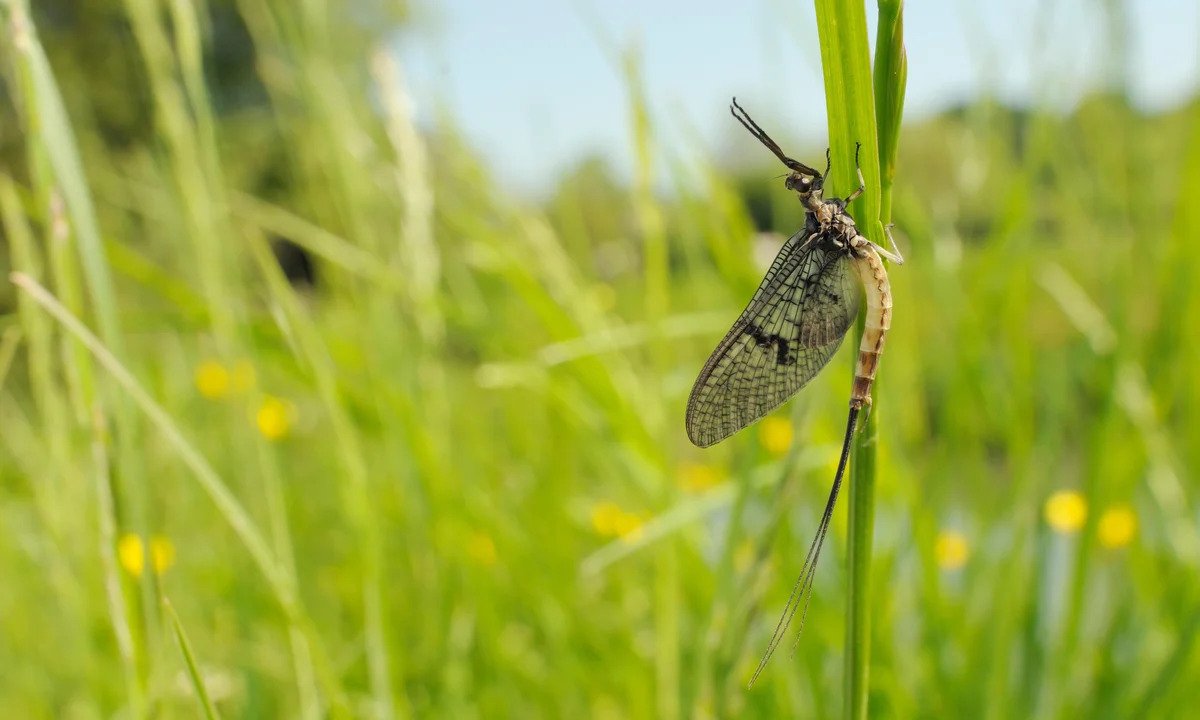
Along riverbanks across Britain, a fragile yet extraordinary natural performance unfolds every spring and summer evening. As daylight fades over waters such as the River Thames, swarms of mayflies rise into the air and begin a strange, almost hypnotic ritual. The males climb sharply upward, hover briefly in mid-air, then tip their bodies and drift back downwards in a slow, gliding descent with wings and tails extended. To the human eye, it appears like a choreographed dance suspended between water and sky.
For centuries, this aerial display has fascinated scientists, poets and observers of nature alike. Mayflies themselves are among the oldest winged insects on Earth, having first appeared roughly 300 million years ago, long before dinosaurs roamed the planet. Ancient writings, including references in early Mesopotamian literature, even mention their fleeting lives as symbols of transience and fragility.
Yet despite their ancient lineage, one question has long puzzled entomologists: why do male mayflies perform this unusual vertical flight pattern? New research now offers a compelling answer, revealing that this seemingly chaotic movement may be essential for survival and reproduction.

Scientists at the University of Oxford have recently reconstructed mayfly flight behaviour in unprecedented detail. Using advanced 3D imaging and high-speed filming of swarms observed in areas such as Richmond, researchers tracked individual insects through complex aerial trajectories. The findings suggest that the mayfly’s iconic up-and-down motion is not random at all, but a highly evolved communication and navigation strategy.
According to the study, male mayflies rely on vertical flight positioning to distinguish potential mates in dense swarms. By flying upward and then descending, males reduce the likelihood of horizontal overlap with other insects. In essence, this movement helps them avoid confusion in an environment where thousands of nearly identical bodies are moving simultaneously.
The challenge for the male mayfly is surprisingly complex. In low light conditions, males and females can appear almost indistinguishable, even at close range. In such conditions, misidentification is common, and the consequences are costly in evolutionary terms. Because adult mayflies live for only a few hours to a few days, every moment is critical. There is no time for wasted mating attempts.
Dr Samuel Fabian, a research fellow at the University of Oxford who specialises in insect flight behaviour, explained that the males are remarkably unselective in their pursuit of potential mates. In experimental simulations, even clearly non-living objects were sometimes treated as mating targets.
The research suggests that by maintaining a strict vertical movement pattern, male mayflies reduce the risk of chasing incorrect targets. Any object that drops below their visual horizon is effectively ignored, allowing them to concentrate their limited energy on insects positioned above them, where females are more likely to be found.
This behavioural strategy is particularly important given the chaotic nature of mayfly swarms. Tens of thousands of individuals may occupy a single airspace simultaneously, creating one of the most visually dense mating systems in the animal kingdom. Within this moving cloud, precision is not just useful but necessary for reproductive success.
Despite their abundance and long evolutionary history, mayflies today are facing increasing environmental pressures. Scientists warn that populations in many regions, including parts of Britain, are declining sharply. Once-common summer “hatches” that filled the air with shimmering insects are becoming less frequent, especially in lowland rivers and chalk streams.
Environmental experts link this decline to a combination of pollution, agricultural runoff, habitat disruption and rising water temperatures. Freshwater ecosystems, which mayflies depend on during their larval stage, are particularly sensitive to changes in water quality. Even relatively low levels of contamination can severely reduce survival rates.
Recent ecological surveys have indicated that Britain has already lost a significant proportion of its mayfly diversity over recent decades. These losses are not only important for biodiversity but also for the wider health of river ecosystems, where mayfly larvae play a crucial role in food chains and water quality indicators.
The decline has been described by conservationists as part of a broader global “insect crisis”, in which many insect populations are falling at alarming rates. Insects, which form the foundation of most terrestrial ecosystems, are essential for pollination, decomposition and nutrient cycling. Their disappearance has wide-reaching consequences for both wildlife and human food systems.
Researchers emphasise that mayflies are particularly sensitive indicators of environmental change. Because their larvae develop in freshwater systems for most of their life cycle, any deterioration in river conditions is quickly reflected in their populations. This makes them valuable biological markers for assessing ecological health.
Dr Fabian noted that the persistence of mayfly behaviour over hundreds of millions of years highlights both their evolutionary resilience and the fragility of their current situation. The same dance that once occurred in prehistoric rivers continues today above urban waterways, yet its survival is increasingly uncertain.
He also stressed the importance of public awareness. While mayflies may appear insignificant due to their short adult lifespan, their ecological role is substantial. They are a key food source for fish and other wildlife, and their presence often signals clean, oxygen-rich water systems.

For now, scientists encourage the public to appreciate the spectacle while it remains visible in parts of the UK. The mayfly’s brief, delicate dance across evening skies is not only a biological marvel but also a reminder of how ancient life continues to shape modern ecosystems.
As research continues, the hope is that better understanding of mayfly behaviour and environmental needs will contribute to stronger conservation efforts. Protecting rivers and reducing pollution may help ensure that this 300-million-year-old performance does not fade from the natural world.
In the end, the mayfly’s dance is more than a curiosity. It is a living connection to Earth’s distant past, a finely tuned survival strategy, and a quiet warning about the future of the planet’s most vulnerable ecosystems.
Related News:
 Canadian astronaut French words ease language row
 Chornobyl Still at Risk 40 Years After Disaster
 Tractor Breakdown Tests Lincolnshire Farmers
 UK Schools Struggle as Classrooms Top 40C
 London’s 2026 ‘Great Stink’ Raises Sewer Concerns
 Gen Z turns to BirdTok for a gentler digital escape
 How Bringing Forests Into Preschools Boosts Children’s Health
 England Curriculum Review Recommends Major Changes
 Mortgages and AI Set to Feature in English Schools
 No link found between paracetamol in pregnancy and autism
 Government urges schools to ban phones to curb classroom disruption
 England schools to receive AI-generated attendance targets
 Higgs Donates Nobel Medal to His Beloved University
 Ban Social Media for Under-16s, Teachers Demand Action
 Ocean Warming Drives Massive Marine Life Loss, Study Warns
 Moldova River Crisis Exposes War’s Hidden Cost
 Heavier SUVs Accelerate Britain’s Pothole Crisis
 Exhibition Revisits Life of 18th-Century Black Court Figure
 NHS Safety Fears as Nurses Cover Doctor Gaps
 Reform UK funding: mystery billionaire revealed
 RAF Typhoons scrambled amid Russian drone threat near Nato
 Disneyland Adds Facial Recognition at Entrances
 Record May Heat to Cold Front in Eastern Australia
 Germany to Return Rare Irritator Dinosaur Skull to Brazil
 Doomsday Clock Nears Midnight Amid Global Crises
 Britons Build Emergency Supplies Amid Rising Fears
 Father’s diaries reveal doubts over Hawking
 Sycamore Gap Artwork Chosen After Public Vote
 Pope Meets Families in Italy Toxic Waste Zone
 UK rejects EV charging VAT cut amid Treasury clash
 Study Launches Into Brain Injury Risks in Women’s Rugby
 Public Confidence in University Degrees Plummets in the UK
 UN Issues Urgent Warning: Imminent Return of El Niño
 Tech Trends and the Battle Against Exam Hall Cheating
 British Teens in EU Face Soaring UK University Fees
 Sydney Records Hottest June Since 1859 as Expert Warns New High a ‘Signature’ of Global Warming
 London Tube Heat Reaches Dangerous Levels
 Olympus Awaits Unesco Heritage Recognition
 Three-Quarters of England’s Riverbanks Still Off Limits
 Weight-Loss Drugs Offer Food Savings Mainly to High Earners
 Cambridge Professor Jason Arday Found Dead at Home
 Burnham unveils £65m drought aid for farmers
 Virgin Trains Moves Closer to Challenging Eurostar Monopoly
 UK Bans Fake Numbers: Scammers Lose Their Trick
 Vibe coding’ named Collins dictionary’s word of the year
 Patients to Test Health at Home to Ease NHS Winter Pressure
 Britain deploys RAF specialists to assist Belgium with drone threats
 Northern Lights may illuminate UK skies this week
 Phillipson Accused of Appeasing Unions by Diluting EBacc
 New AI tool could cut wasted efforts in organ transplants
 Sundar Pichai Cautions on AI Hype and Market Risks
 Google Removes Some AI Health Summaries Over Safety Concerns
 City & Guilds pay surge sparks backlash amid £22m cuts
 EU launches Grok AI probe into X over explicit images
 ABC Facebook Page Briefly Hacked, Adult Photos Posted
 Meta trial over child exploitation claims begins
 BT Names New Openreach Chief Amid Major Fibre Expansion
 Send spending gap leaves deprived areas behind
 Tech Trends Set to Transform Life in 2026
 Stewart Brand on Musk, Bezos and a Life of Long Thinking
 New Era for UK Special Needs Support
 Adelaide University Faces Backlash Over Event Cancellation
 The Kill Line: A Shifting Vision of the American Dream
 ‘Drinking from a Fetid Pond’: Superbug Genes in Lough Neagh
 Rising Costs Force Families to Rethink Days Out
 M&S Demands Urgent Action on Rising Violent Retail Crime
 Artemis II Returns After Historic Moon Flyby
 UK Banks to Deploy Controversial Mythos AI Tool Next Week
 Schools Struggling to Support SEN Pupils Amid Crisis
 Coalition pushes fossil fuel phaseout plan
 WHO approves first malaria drug for babies
 Greens Face Internal Row Over Antisemitism Claims
 Court Upholds Landmark Win for Transgender Rights
 Starmer Leadership Under Pressure After Setbacks
 Stolen Mobiles Could Soon Become Useless Bricks
 UK Ministers Lobby Trump Over Under-16s Social Media Ban
 The Hybrid School Revolution Defying the Social Media Ban
 Trump’s Mount Rushmore Speech: A Divisive Anniversary
 Telstra Software Fault Triggers Massive Nationwide Outage
 Westminster Council Threatens Charing Cross Soup Kitchen