Published: 24 August 2026 | The English Chronicle Desk | The English Chronicle Online
Visitors to Wales’ highest mountain are being urged to show consideration for fellow walkers after arguments broke out over people skipping queues at the summit of Yr Wyddfa, also known as Snowdon.
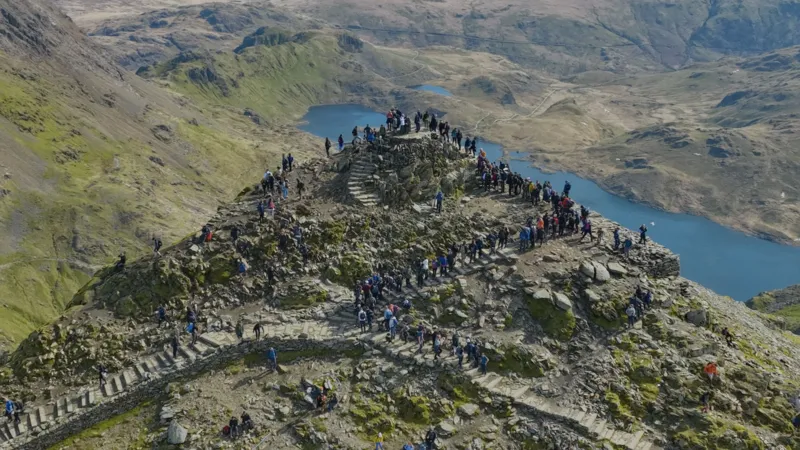
The 1,085m (3,560ft) mountain has attracted exceptionally large summer crowds during periods of hot weather, with some visitors reportedly waiting more than an hour to reach the summit’s famous metal plate and take photographs.
Videos shared on social media have captured heated exchanges between people waiting in line and those attempting to move ahead of them. The dispute has raised an unusual question for one of Wales’ most popular natural landmarks: when does an informal queue become an expected part of responsible behaviour on a mountain?
For many visitors, the answer is clear. They argue that the queues are not simply about courtesy but also help prevent dangerous congestion around the summit, where narrow stone steps and uneven terrain can make movement difficult.

Others take a very different view, saying that a mountain should not operate like an amusement park attraction and that walkers should be free to make their way to the summit without waiting in a formal line.
The disagreement has become increasingly visible as Yr Wyddfa continues to experience heavy visitor numbers.
Crowds create bottlenecks at the summit
Yr Wyddfa sits within Eryri National Park, formerly widely known as Snowdonia, and is one of Britain’s best-known mountain destinations. Its popularity has grown significantly over recent years, attracting experienced climbers, families, tourists and people seeking photographs from the summit.
The summit itself has become a particular pressure point. Visitors often gather around a metal plate or trig point that marks the top of the mountain, with many stopping to take photographs and record videos after completing the climb.
During busy periods, this can create a bottleneck on the final approach.
With large numbers of people attempting to reach the same small area, walkers can find themselves waiting for others to move before they can safely continue. National park officials have therefore encouraged visitors to be patient and considerate, particularly when crowds are heavy.
Alun Jones, an area warden for Eryri National Park Authority, urged people heading for the summit marker to respect those already waiting and not to skip the queue.
Although there is generally no formal requirement for visitors to stand in a line, the practice has increasingly become an accepted way of managing the congestion.
For some walkers, however, that expectation has become a source of frustration.
‘We’re not at Alton Towers’
The debate was illustrated by comments from walkers who offered sharply different views about whether queuing should be expected on a mountain.
Tina Millard from West Bromwich argued that visitors should not have to wait in line simply to reach the summit.
“It’s a mountain, you should just be able to go up and that’s it,” she said.
“We’re not at Alton Towers for a ride. It’s a mountain, it’s for everyone.”
Her comments reflect the view that a natural landscape should not be treated like a managed attraction where visitors are assigned a place in a queue.
Another walker, Carl Lynch from Dunstable in Bedfordshire, suggested that visitors should spend only a short time at the summit marker before allowing others through.
“It should be: ‘go up there, two minutes and then move on for everyone else’. Simple as that,” he said.
Other walkers believe the situation is different because of the physical environment.
Lucy Taylor said she believed people should wait their turn because the concentration of visitors around the summit could create safety problems.
“I think you should queue because it’s really quite dangerous and everyone’s trying to get up there – it’s just not safe,” she said.
The competing arguments highlight the difficulty of managing a hugely popular mountain without turning the experience into something resembling a conventional tourist attraction.
Social media brings the dispute into the spotlight
The controversy gained wider attention after videos of visitors skipping the queue circulated online.
One recent video showed Manchester man Marc Screeton being heckled after moving past people waiting for their turn. He defended his decision by saying: “Imagine queuing on a mountain? No chance.”
The video quickly became part of a broader online debate about whether queueing at a mountain summit is a matter of safety, courtesy or unnecessary social pressure.
The argument is not entirely new. In May, two charity walkers attempting the Three Peaks Challenge were booed by people waiting at the summit after they moved past the queue to touch the trig point.
Jamie Richardson, 32, and Richard Thiedeman, 34, from Lincolnshire were climbing Yr Wyddfa as part of a fundraising challenge for a friend living with motor neurone disease.
Richardson said he was met with boos after reaching the summit marker and recalled one person attempting to stop him.
He said someone told him he “should be ashamed” of himself.
However, Richardson argued that there was no official system enforcing a queue and that visitors were ultimately making their own choices.
“There is no policing of it at all, it is purely free will, if you want to queue you can,” he said.
An unwritten social contract
The debate has also attracted interest from philosophers, who say the issue demonstrates how people routinely follow social rules even when there is no formal requirement to do so.
Johann Go, an assistant professor of ethics at University College London, described queuing as an example of an “unwritten and unspoken” social contract.
He argued that when people see others voluntarily restricting themselves by waiting, deliberately moving ahead can be interpreted as disregarding the time and effort of those around them.
The principle is not unique to mountains. Queues are common in everyday life because people generally accept that taking turns provides a predictable and relatively fair way of dealing with limited space or access.
At Yr Wyddfa, however, the absence of a formal queueing system creates a grey area.
Visitors are not necessarily breaking a specific rule when they walk past others. Yet their actions can still provoke anger when those waiting believe everyone should follow the same informal convention.
Pressure on Eryri National Park
The dispute comes as Eryri National Park continues to deal with the wider consequences of rising visitor numbers.
Hot weather has encouraged more people to head outdoors, placing additional pressure on popular routes and facilities.
National park wardens have reminded visitors to follow the countryside code by taking their rubbish home, leaving gates as they find them and taking precautions to reduce the risk of wildfires.
They have also encouraged people to behave responsibly around busy parts of the mountain and to wait their turn where congestion develops.
The problem is particularly significant because Yr Wyddfa is not a purpose-built tourist attraction. Its paths, slopes and summit environment were not designed to accommodate unlimited numbers of visitors arriving simultaneously.
Large crowds can make movement slower and potentially increase the risks associated with slips, falls and people attempting to pass each other in confined areas.
Balancing access with safety
The argument over queues ultimately reflects a wider challenge facing some of Britain’s most popular natural landmarks.
The appeal of a mountain such as Yr Wyddfa lies partly in its openness. Visitors can walk, climb and explore without the rigid structure associated with theme parks or other commercial attractions.
But popularity can undermine that sense of freedom.
When hundreds or thousands of people converge on a relatively small summit, some form of cooperation becomes necessary. Even if queueing is not compulsory, waiting one’s turn can reduce conflict and help people move through crowded areas more safely.
At the same time, visitors who have climbed a difficult route may reasonably expect to enjoy the summit without feeling as though they have entered a tightly controlled tourist attraction.
Finding the balance will become increasingly important as visitor numbers fluctuate with weather conditions and the mountain’s popularity continues.

For now, Eryri officials are relying largely on courtesy rather than enforcement.
The message from wardens is straightforward: visitors should be considerate and avoid skipping queues where they have formed.
Whether that appeal is enough remains uncertain. But the increasingly heated arguments suggest that the informal rules surrounding Britain’s mountains can become surprisingly contentious when thousands of people are competing for the same few minutes at the top.
For many walkers, reaching the summit of Yr Wyddfa is the culmination of a demanding journey. For others, the experience should also include the understanding that everyone who has made the climb deserves a fair opportunity to enjoy the view.
As crowds continue to gather, that unwritten agreement may prove just as important as the mountain paths themselves.Checkout our latest news>>
Related News:
 Storm Dave Disrupts Travel but Conditions Set to Ease
 London Tube Heat Reaches Dangerous Levels
 Rolling Hills and Heritage: A Car-Free Break in Leicestershire
 Undercover officer deceived women with ‘grotesque and cruel’ lies, spycops inquiry told
 UK Banks Maintain £100 Contactless Limit Despite FCA Rule Change
 Rising Costs Force Families to Rethink Days Out
 Glasgow Central Set for Full Reopening After Fire
 UK Aviation Watchdog Clips Heathrow’s Fee Hike Wings
 EU Biometric Border Checks Delayed for UK Travellers
 Archbishop Prays for Middle East Peace in First Easter Sermon
 10 Scenic Stays in Scotland’s Highlands & Islands
 Kezia Dugdale Warns of Possible Reversal of Equal Rights Gains
 Synagogue Arson Attempt Sparks Security Fears
 NHS Safety Fears as Nurses Cover Doctor Gaps
 Walsall Rapist Jailed After Hate-Filled Online Trail
 Two Children Die in Wolverhampton House Fire Tragedy
 Reform UK funding: mystery billionaire revealed
 Farke’s Leeds revival: from pressure to FA Cup glory chase
 Two Dead in Adelaide Airport Plane Crash Fire
 John Terry Faces Backlash Over Political Posts
 UK may ban protests amid rising antisemitism fears
 Greens Face Internal Row Over Antisemitism Claims
 Barrister Criticises Trial After Suicide Case Verdict
 Tractor Breakdown Tests Lincolnshire Farmers
 Labour Members Turn Against Starmer Leadership
 Britons Build Emergency Supplies Amid Rising Fears
 Sycamore Gap Artwork Chosen After Public Vote
 Victim says non-custodial rape sentence ‘rock in my face’
 Essex valley emerges as rising English wine hub
 Farage and Reform UK Reshape British Politics
 Starmer Leadership Under Pressure After Setbacks
 Thailand Tightens Visa Rules to Curb Tourist Misbehavior
 Public Confidence in University Degrees Plummets in the UK
 UK Nations Brace for Potential Breakup Amid Reform Surge
 Cornwall Van Dwellers Face Eviction in Housing Crisis
 British Teens in EU Face Soaring UK University Fees
 England and Norway Fans Turn Miami Into World Cup Carnival
 UK Schools Struggle as Classrooms Top 40C
 Italy’s Beach Lunch Ban Sparks Holiday Backlash
 EasyJet Takeover Sparks Fears Over Passengers’ Future
 Olympus Awaits Unesco Heritage Recognition
 Three-Quarters of England’s Riverbanks Still Off Limits
 Westminster Council Threatens Charing Cross Soup Kitchen
 BBC Warned About Missing Clothes of Murder Victim
 Cambridge Professor Jason Arday Found Dead at Home
 London’s 2026 ‘Great Stink’ Raises Sewer Concerns
 Burnham unveils £65m drought aid for farmers
 Kate Winslet to Narrate Film Highlighting King’s Environmental Mission
 Trump’s UK Ambassador Urges North Sea Drilling to Strengthen US Ties
 UK Bans Fake Numbers: Scammers Lose Their Trick
 Millionaires group urge Reeves to introduce wealth tax to ‘lift kids out of poverty’
 Reeves rejects £1bn plea for NHS redundancy payouts
 PM Condemns Leaks, Vows Loyalty to Ministers and Stability
 Inside the Helpline Protecting Missing Children in the UK
 PlayStation PS5 Deals Hit Lowest Prices Ahead of Black Friday
 Five-Year-Old Dies After Rare Tonsil Surgery Complication
 Starmer Says Labour’s Economic Plan Needs Years to Deliver
 Starmer Faces Parliamentary Battles Over UK-EU ‘Reset’ Plan
 Met Police Vetting Failures Let Serial Rapists Remain
 Fatal Bolton Taxi Crash Claims Three Teens and Driver
 ScottishPower Tops List of Worst UK Energy Suppliers
 Judi Dench Champions Fight to Save London’s Green Spaces
 Crowborough Camp Welcomes First Asylum Seekers
 Blue Badge Abuse: The Rising Tide of Public Hostility
 Scott Parker Leaves Burnley After Premier League Drop
 Silent Tracks: Rail Line Without Passengers
 RFU Backs Borthwick Despite England’s Poor Six Nations
 Major test for Labour as polls open in Great Britain
 Keir Starmer Struggles to Secure His Grip on Downing Street
 Farage Faces Standards Probe Over Cash Property Purchase
 Closing the Gap: UK Pensions Commission Demands Action
 Russian Electronic Attack Targets UK Defence Chief Jet
 UK Shoppers Face Prolonged Price Rises At Tills
 Tube Strike Brings Capital to a Standstill Over Shift Disputes
 Makerfield Voters Demand Real Change as Election Looms
 Ryanair Faces Probe Over Mandatory Family Seating Fees
 Britain’s Crowning Butterfly Takes the Nation by Storm
 Stirchley Community Housing Scheme Faces Crisis
 Watchdog Warns Ministers to Pause Impending HS2 Reset
 EU Slashes Steel Quotas But Grants UK Favourable Rates