Published: 15 August 2026.The English Chronicle Desk. The English Chronicle Online.
Five years after the Taliban returned to power in Afghanistan, the country is facing a crisis that extends far beyond the end of the war that once dominated international attention. An economy struggling to absorb a rapidly growing population, shrinking humanitarian assistance, worsening food insecurity and the systematic exclusion of women and girls have combined to leave millions of Afghans facing increasingly limited choices.
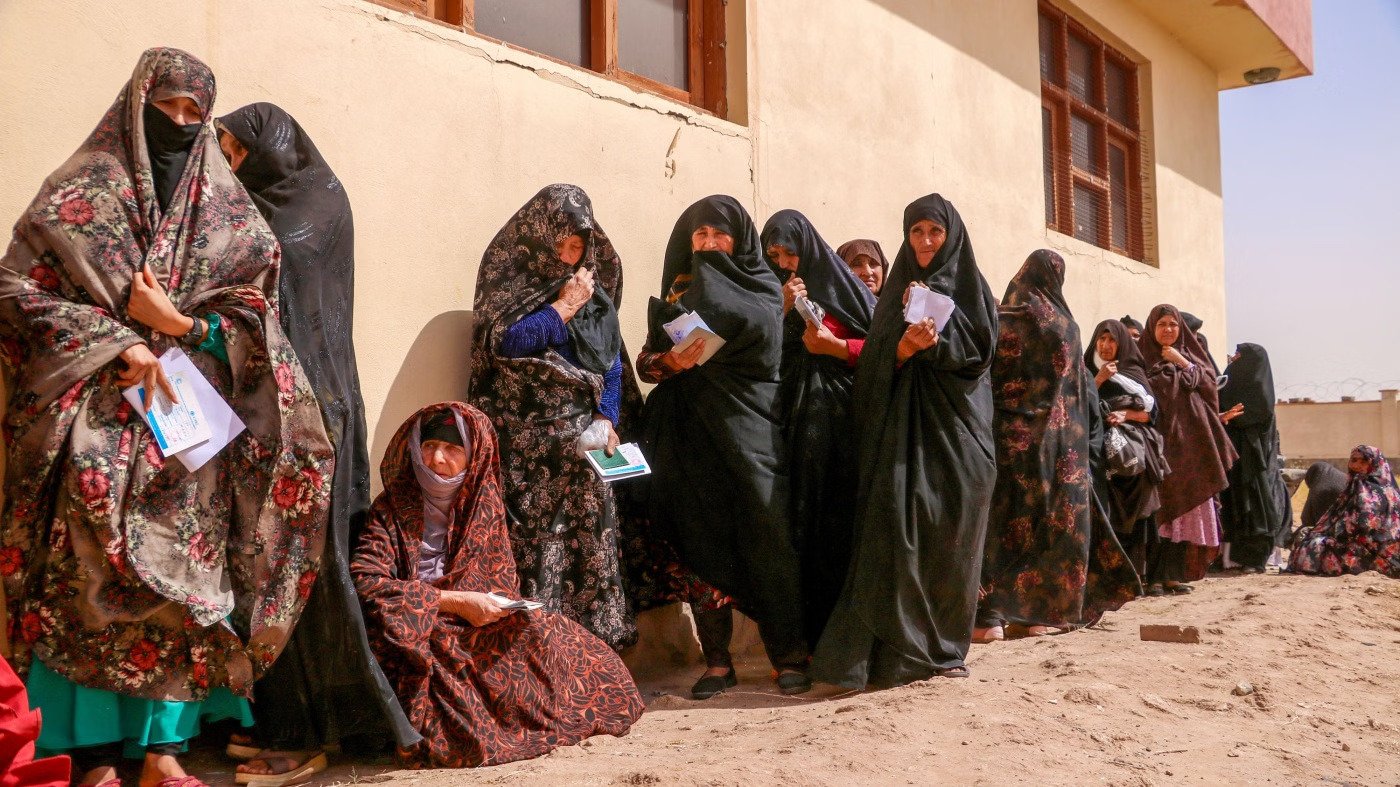
For families living on the margins, the consequences are painfully personal. In Kabul, Malika, a 46-year-old mother of four, says poverty forced her family to make what she describes as the most painful decision of her life: marrying off her teenage daughter for 200,000 afghanis, equivalent to about £2,270.
The family had reached a point where food was scarce and hunger was a daily reality. Malika says her daughter cried privately but understood that refusing the marriage could leave the entire household without enough food to survive.
Nearly two years later, the money received from the marriage is almost gone. Malika can no longer afford to send her two youngest daughters, aged 12 and nine, to school. Instead, they work in a clothing factory alongside their 16-year-old sister for very low wages.

Her husband works pushing a handcart, but often returns home without earning anything. The family is among millions struggling in an economy that has been weakened by unemployment, reduced international assistance and the disruption of established economic relationships.
Afghanistan’s current emergency is quieter than the years of fighting that preceded the Taliban takeover in 2021, but that relative calm has not translated into improved living conditions for much of the population.
Nearly half of Afghanistan’s population is expected to require humanitarian assistance during 2026. More than 14 million people are projected to experience acute food insecurity, while millions of children remain at serious risk of malnutrition.
The economic foundations of the country have also weakened considerably since the Taliban seized power. Foreign trade has fallen, imports have increasingly exceeded exports and government finances have contracted.
The Taliban’s most recently published budget, covering the 2023 fiscal year, was about $2.44bn, less than half the approximately $6bn budget recorded under the previous government in 2021. In another sign of fiscal pressure, Afghanistan’s authorities abolished the public pension system in 2024.
Economic activity has shown some expansion, but growth has struggled to keep pace with the country’s rapidly increasing population. Millions of Afghans have returned from neighbouring countries following deportation and migration crackdowns, placing additional pressure on employment, housing, healthcare and food supplies.
Inflation has added another burden. After averaging 3.6% in 2025, inflation reached 7.6% by March 2026, driven by higher food prices, supply disruptions and increased demand.
Unemployment has also risen sharply since the Taliban takeover. Hundreds of thousands of jobs have disappeared, while reductions in international assistance have weakened public services and reduced the resources available to vulnerable households.
Humanitarian organisations warn that the consequences are particularly severe for children. An estimated 21.9 million Afghans, around 45% of the population, will need humanitarian assistance in 2026. Children make up a substantial share of those in need, with millions facing acute malnutrition.
The humanitarian funding crisis has made the situation even more difficult. The United States was previously Afghanistan’s largest source of humanitarian and development assistance, providing billions of dollars after the Taliban takeover. But the suspension of US humanitarian funding in January 2025 removed a major source of support.
The impact on healthcare has been severe. More than 440 health clinics have reportedly been forced to close or reduce services because of funding shortages. The proportion of Afghans without access to healthcare increased significantly, while humanitarian organisations have struggled to provide food to severely malnourished children.
The crisis has unfolded alongside one of the world’s most extensive restrictions on women and girls.
Since returning to power, the Taliban have prevented girls from continuing beyond primary education and barred women from universities. Women have also been excluded from large sections of the workforce and public life.
Restrictions have extended into everyday activities. Women have been prevented from using public parks and gyms, while later regulations imposed further controls on their presence and behaviour in public spaces.
More recently, changes to marriage regulations have intensified concerns about child marriage and domestic abuse. Rights organisations say the combination of poverty, exclusion from education and economic dependence is creating conditions in which families may feel increasingly pressured to marry off daughters.
The effects of these restrictions can be measured economically as well as socially. Female participation in the labour force has fallen dramatically since the Taliban takeover. Women who previously worked as journalists, healthcare workers, educators and professionals have lost employment opportunities.
The loss of women from education and employment also carries long-term consequences for the country’s ability to provide essential services. Afghanistan needs doctors, teachers, engineers, journalists, entrepreneurs and other professionals, yet millions of girls are now growing up without access to the education necessary to enter those professions.
For many young women, the restrictions have transformed expectations about adulthood.
Nilofar, a 13-year-old girl from Bamiyan, completed the final year of schooling currently available to girls before her education ended. Her parents have arranged for her to marry an older relative she has never met.
She says her parents told her that her education was finished and that it was time to marry, reflecting the economic and social pressures facing families with daughters who are no longer permitted to continue their schooling.
The consequences can be seen in hospitals as well. Shamim, 17, is already a mother. She left school at around the age of 12, was married at 15 and became pregnant less than a year later.
Her family received 200,000 afghanis from the marriage, some of which was used to purchase household goods while the remainder went towards paying debts.
Such stories illustrate how economic hardship and restrictions on women’s rights can reinforce each other. When girls are denied education and families lack sufficient income, marriage can become an economic survival mechanism, despite the long-term consequences for the girls involved.
Afghanistan now sits at the bottom of international measures assessing women’s inclusion, justice and security. Human rights organisations and UN officials have described the systematic exclusion of women and girls as a form of gender apartheid.
The humanitarian crisis is also being intensified by the return of millions of Afghans from neighbouring countries.
Since 2023, almost six million people have returned from Iran and Pakistan following intensified measures against undocumented migrants. The United Nations expects millions more to return during 2026.
The scale of those movements presents a major challenge for a country already struggling to provide employment, healthcare, education and housing to its existing population.
Relations with Pakistan have also deteriorated sharply. Islamabad has accused the Taliban of allowing militants from the Tehrik-e-Taliban Pakistan to operate from Afghan territory, allegations the Taliban denies.
The dispute has occasionally escalated into armed clashes, airstrikes and border closures. Civilians on both sides have been affected, while restrictions on cross-border movement have disrupted trade and livelihoods in communities that depend heavily on the frontier.
Despite the worsening humanitarian and human rights situation, the Taliban has gradually expanded its international engagement.
Russia has formally recognised the Taliban government and entered into military cooperation, while China and the United Arab Emirates have accepted Taliban-appointed ambassadors. Taliban officials have also held discussions with European representatives on migration.
That growing diplomatic engagement has generated concern among human rights campaigners, who fear that international governments are becoming increasingly willing to work with the Taliban without demanding substantial improvements in women’s rights.
For Afghan women who have lost access to education, employment and public life, such engagement can appear to prioritise geopolitical interests over fundamental freedoms.

The dilemma facing the international community is increasingly clear. Governments need channels through which they can address migration, security, humanitarian assistance and regional stability. Yet deeper diplomatic engagement can also risk normalising a system that has imposed sweeping restrictions on half of its population.
Five years after the Taliban takeover, Afghanistan therefore presents a complicated picture. The end of large-scale conflict has reduced some forms of violence, but it has not ended the country’s emergency. Instead, the crisis has shifted into poverty, hunger, institutional weakness, exclusion and a shrinking humanitarian safety net.
For families such as Malika’s, the consequences are measured not in diplomatic agreements or economic statistics but in meals missed, schools abandoned and daughters married before they are ready.
The country’s future will depend heavily on whether Afghanistan can rebuild an economy capable of supporting its growing population and whether humanitarian assistance can reach those most in need. But the prospects for long-term recovery remain closely linked to the rights and participation of women and girls.
As Afghanistan enters its sixth year under Taliban rule, millions continue to live with the consequences of policies that have reshaped nearly every aspect of social and economic life. The fighting may have faded from international headlines, but for many Afghans the emergency remains a daily reality.
Related News:
 Israeli Strike in Southern Lebanon Kills Seven
 Immigration Judges Fear Pressure in Trump Era
 Dreyfus Statue Finally Gets Permanent Paris Home
 Taliban global ties grow as rights fears mount
 Is America Ready for an AOC Presidential Run?
 Iran Leader Blames Protesters, Says They Serve Trump
 Thousands Protest ICE in New York Against Trump Deportation Campaign
 Nine Killed in Karachi Consulate Protest
 Anti-Regime Iranians Turn Anger Toward Trump
 Iran Crisis Tests Trump’s Global Leadership
 Canadian astronaut French words ease language row
 Chornobyl Still at Risk 40 Years After Disaster
 Athens Mayor Moves to Tackle Overtourism Crisis
 RAF Typhoons scrambled amid Russian drone threat near Nato
 Southeast Asia Turns to Russia Amid Energy Crisis
 Escobar’s Hippos May Be Moved to India Zoo
 Police Suspect Help in Missing Alice Springs Girl Case
 Cartel crackdown raises fears of fresh violence
 US states redraw maps after voting rights ruling
 Judge halts deportation of Yemeni refugees in US
 Activists allege abuse after Gaza flotilla seizure
 UK may ban protests amid rising antisemitism fears
 China Fireworks Factory Blast Kills 21 in Hunan
 Australia pushes Pacific security pact amid China tension
 BJP Sweeps West Bengal in Historic Breakthrough
 US ‘Narco Boat’ Strikes Draw Global Outcry
 Afghan Families Left in Limbo Face Risk of Deportation
 Trump Announces 3-Day Russia–Ukraine Ceasefire Deal
 France Faces Record Presidential Crowded Race Amid Far-Right Surge
 US Awaits Iran Reply on New Ceasefire Proposal
 One Nation Stuns Australia With Historic Farrer Win
 Hormuz Talks Near Critical Stage
 China mine blast death toll rises to 90
 Trump’s Revenge Drive Deepens GOP Divide
 Maldives Cave Diving Tragedy Raises Safety Alarm
 Discontent grows around Putin amid war strain
 Former ICC prosecutor condemns US sanctions
 Farage and Reform UK Reshape British Politics
 Starmer Leadership Under Pressure After Setbacks
 Millions Gather for Khamenei’s Six-Day State Funeral
 New Footage Revives Peter Falconio Mystery
 Ukraine Creates Long-Range Strike Command
 Le Pen’s Popularity Holds Despite Conviction
 Venezuela Quake Death Toll Surpasses 4,000
 Houthis Strike Saudi Arabia as Middle East Tensions Rise
 Seoul proposes historic peace talks to replace Korean War armistice
 BBC to Apologise Over Edited Trump Speech Amid Backlash
 Britain deploys RAF specialists to assist Belgium with drone threats
 Greene Pushes Epstein Files Amid Trump Fallout
 Trump Deploys DHS to Charlotte in Major Arrest Operation
 December Run-Off in Chile as Election Produces No Winner
 Canada Passes Carney’s First Budget in Tight Parliamentary Vote
 Shadow Fleet at Sea: Europe’s Battle Against Illicit Oil Shipping
 Georgians Defy Government Crackdown After Year of Protests
 Trump Policies Boost China’s Global Rise, Survey Finds
 Pentagon Signals Reduced Role in Deterring North Korea
 UK and US Drop in Global Corruption Index Rankings
 Canberra Poster Seizure Sparks Free Speech Row
 Evo Morales Returns After Mysterious Absence
 The Dangerous Rise of Remigration Across Modern Europe
 Jacinda Ardern Moves To Australia Following Her US Fellowships
 Jacinda Ardern Move Sparks Kiwi Reflection
 Nick Greiner Warns Over Election Review Fallout
 Injured Mojtaba Khamenei Elevated as Iran Leader
 Gordon Brown urges court for crimes against children
 Oil Prices Jump After Trump Claims Iran Oil Hub Destroyed
 Pakistan Targets Militant Hideouts in Afghanistan
 Air Canada CEO Faces Outcry Over Recent Language Misstep
 Relationship with Trump may be beyond repair, Starmer warned
 Italian Town Buys Mussolini Villa to Keep Away Fascist Fans
 Trump Brokers Landmark Lebanon Ceasefire Amid Regional Hopes
 Ben Roberts-Smith Denies War Crime Allegations in First Statement
 UK Stands Firm on Falklands Amid US Rift
 Oil Prices Surge Above $120 Amid Iran Blockade Fears
 Trump orders US troop pullout from Germany
 Barrister Criticises Trial After Suicide Case Verdict
 Trump’s Mount Rushmore Speech: A Divisive Anniversary
 England and Norway Fans Turn Miami Into World Cup Carnival
 Olympus Awaits Unesco Heritage Recognition
 Powerful 7.7-Magnitude Earthquake Hits Eastern Indonesia