Published: 18 January 2026. The English Chronicle Desk. The English Chronicle Online
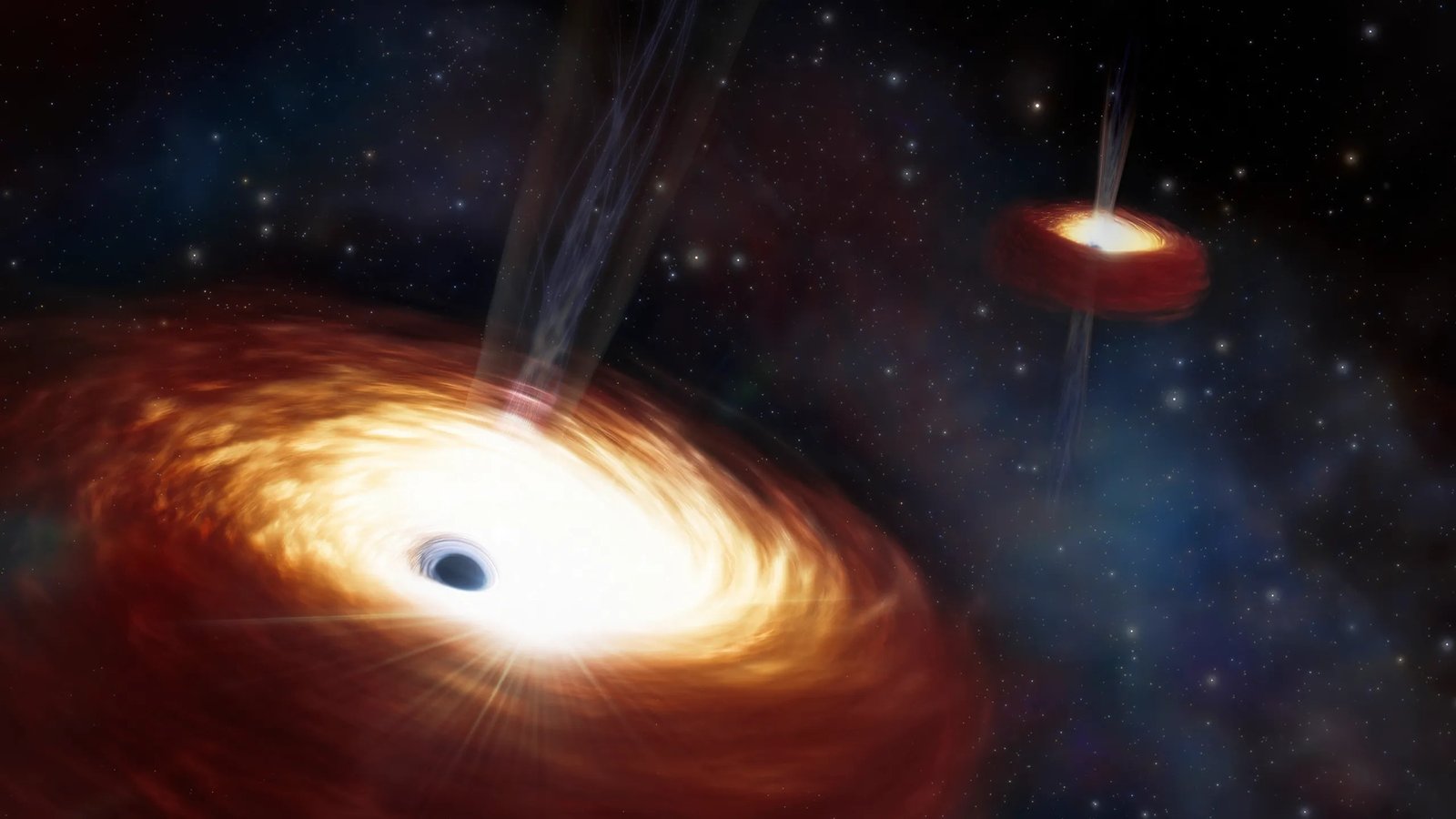
For decades, black holes have occupied a strange place in the human imagination. They are often depicted as dark, devouring monsters of the cosmos, regions of space so extreme that nothing, not even light, can escape their grasp. Yet behind this ominous reputation lies one of the most important keys to understanding how the universe works. Now, astronomers are preparing to take a historic step that could transform both scientific knowledge and public perception of these enigmatic objects: the creation of the first-ever moving image, or “movie,” of a black hole in action.
The ambitious effort is being led by the Event Horizon Telescope (EHT), a global collaboration of astronomers and institutions that stunned the world in 2019 by unveiling the first image of a black hole’s shadow. That image, showing a glowing ring surrounding a dark centre, offered humanity its first direct glimpse of a supermassive black hole. The new goal goes far beyond a single snapshot. Scientists now aim to capture a sequence of images that, when combined, will reveal how matter behaves as it spirals around the edge of a black hole’s event horizon.

At the centre of this groundbreaking project is the supermassive black hole located in the heart of the Messier 87 galaxy, commonly known as M87. This colossal object, with a mass equivalent to about six billion suns, sits some 55 million light-years away from Earth. Despite the immense distance, its sheer size makes it an ideal target for detailed observation. Astronomers plan to observe M87 intensively throughout March and April, tracking subtle changes in the glowing disc of material that orbits just outside the event horizon.
Sera Markoff, the newly appointed Plumian professor of astronomy and experimental philosophy at the University of Cambridge, described the upcoming observations as nothing short of revolutionary. As a founding member of the EHT consortium, Markoff has been deeply involved in the project from its early stages. She believes the transition from still images to moving ones will dramatically accelerate scientific understanding. According to her, the ability to observe changes over time could speed up progress in black hole research by an order of magnitude, opening doors to insights that static images simply cannot provide.
One of the most significant questions the movie may help answer concerns the speed at which black holes rotate. Measuring a black hole’s spin is crucial because it offers clues about how these objects grow. Some theories suggest black holes gradually increase in size by steadily accreting surrounding gas and dust, a process that would cause them to spin faster and faster. Other theories propose that black holes grow mainly through mergers with other black holes, a more chaotic process that could slow their rotation. Observing motion near the event horizon may allow scientists to distinguish between these competing ideas.
The observations could also shed light on one of the most dramatic phenomena associated with black holes: relativistic jets. These narrow, powerful streams of particles can extend far beyond their host galaxies, influencing star formation and galactic evolution on vast scales. The black hole in M87 is particularly famous for producing enormous jets that punch through the galaxy and into intergalactic space. Understanding how these jets are launched remains one of the biggest unsolved mysteries in astrophysics, and the upcoming movie could provide vital clues.
Despite their fearsome reputation, black holes are increasingly seen by scientists as essential players in the cosmic ecosystem. Markoff has often spoken about how misunderstood these objects are. Rather than acting as indiscriminate vacuum cleaners that swallow everything in their path, black holes interact with their surroundings in complex ways. They help regulate the growth of galaxies by heating or expelling gas, thereby influencing when and where new stars can form. In this sense, black holes are not destroyers but architects of cosmic structure.
The technical challenge of creating a black hole movie is immense. The Event Horizon Telescope is not a single instrument but a network of 12 radio telescopes spread across the globe, from Antarctica to Spain and South Korea. By linking these telescopes together using a technique called very long baseline interferometry, astronomers effectively create an Earth-sized telescope capable of resolving extraordinarily fine details. As the Earth rotates, different telescopes come into view of the target, allowing the EHT to build up a complete image over time.
During the upcoming observation campaign, the rotation of the Earth will enable astronomers to capture a full image of M87’s black hole roughly every three days. Because the black hole is so massive, changes in its surrounding disc occur slowly enough for these snapshots to be stitched together into a coherent moving sequence. This delicate balance between motion and stability makes M87 uniquely suited for this type of study.
However, even after the observations are complete, patience will be required. The vast amount of data collected by the EHT cannot be transmitted over the internet due to its sheer size. Instead, the information is stored on physical hard drives, some of which are located at telescopes in remote places such as Antarctica. These drives can only be shipped once weather conditions allow, meaning scientists may have to wait months before data processing can begin in earnest. As a result, the world is unlikely to see the finished movie until well after the observations take place.
Beyond the scientific implications, the project also carries deep symbolic significance. The original black hole image captured the public imagination, appearing on front pages around the world and sparking widespread fascination with astrophysics. A moving image promises to be even more powerful, offering a dynamic glimpse into one of the universe’s most extreme environments. For many, it could transform black holes from abstract concepts into tangible, observable phenomena.
Markoff’s role in this endeavour is particularly notable given her recent appointment as Plumian professor, one of the oldest and most prestigious academic positions in astronomy. The professorship was established in 1704 under the guidance of Sir Isaac Newton, and its past holders include some of the most influential figures in the history of science, such as Sir Arthur Eddington, Sir Fred Hoyle and Lord Martin Rees. Being named the 17th Plumian professor places Markoff in a lineage that spans more than three centuries of astronomical discovery.
She has spoken openly about her unconventional path into science, noting that she did not come from a scientific or academic family. Her early fascination with astrophysics grew from reading science fiction and comic books rather than formal training. At one point, she even considered attending art school. Yet those imaginative stories about black holes and distant galaxies planted a seed that eventually led her into a career at the forefront of modern astronomy. Today, she often jokes that she gets to “do sci-fi for a living.”

Markoff hopes to use her position at Cambridge to inspire a new generation of scientists, particularly those from under-represented backgrounds. She believes that making science more inclusive is not only a matter of fairness but also essential for innovation. Diverse perspectives, she argues, lead to better questions and more creative solutions, qualities that are vital when exploring the deepest mysteries of the universe.
As astronomers prepare their instruments and finalise plans for the upcoming campaign, anticipation continues to build. The prospect of watching matter swirl around a black hole in real time represents a profound leap forward in human knowledge. It is a reminder that even in the most extreme corners of the cosmos, there is still much to learn, and that curiosity, collaboration and perseverance can push the boundaries of what is possible.
If successful, the first movie of a black hole will not only deepen scientific understanding but also offer humanity a rare opportunity to witness the universe in motion at its most extreme. In doing so, it may help redefine black holes not as cosmic villains, but as central characters in the grand story of the cosmos.
Related News:
 How Bringing Forests Into Preschools Boosts Children’s Health
 Critically Endangered Spider Rediscovered in UK After 40 Years
 Virgin Trains Moves Closer to Challenging Eurostar Monopoly
 Biggest Supermoon of the Year to Dazzle Sky on Wednesday
 UK Water Firms Ordered to Act Over ‘Forever Chemicals’ Threat
 UK Bans Fake Numbers: Scammers Lose Their Trick
 England Curriculum Review Recommends Major Changes
 Mortgages and AI Set to Feature in English Schools
 Vibe coding’ named Collins dictionary’s word of the year
 Experts Urge Legal Right to Timely Cancer Care
 Patients to Test Health at Home to Ease NHS Winter Pressure
 One of world’s last dinosaurs on sale for £3m
 North Sea oil workers must lose weight or face job loss
 No link found between paracetamol in pregnancy and autism
 Britain deploys RAF specialists to assist Belgium with drone threats
 Government urges schools to ban phones to curb classroom disruption
 NHS frontline staff forced to cover gaps as managers remain scarce
 Northern Lights May Illuminate UK Skies Amid Strong Solar Storm
 Night after night, Belgium is on high alert.
 Tech firms to test AI safeguards against child abuse images
 England schools to receive AI-generated attendance targets
 Stop using ChatGPT to write speeches, AI minister tells MPs
 Northern Lights may illuminate UK skies this week
 New laws to bolster UK’s defences against cyber attacks on NHS, transport and energy
 UK Greenlights First Small Nuclear Plant in North Wales
 New Research Explains Severe Diabetes in Children
 Hitler’s DNA Confirms He Truly Had Only One Testicle
 Working-Class Men with Prostate Cancer Left Behind by NHS
 Higgs Donates Nobel Medal to His Beloved University
 New AI tool could cut wasted efforts in organ transplants
 How Cultures Interpreted the Aurora Through History
 From War to Wales: Teen Innovator Eyes Net Zero Future
 From Baby Teeth to Bioengineering: The Future of Self-Healing Teeth
 Ukraine to Get 100 French Rafale Jets in Historic Deal
 Sundar Pichai Cautions on AI Hype and Market Risks
 Google Chief Urges Caution: Don’t Trust AI Blindly
 US Judge Says Meta Did Not Hold Illegal Social Media Monopoly
 Poll Reveals China Leads World in Trusting AI Technology
 Healthy Habits in Your 30s That Boost Life in Your 70s
 Cardiff Shopper ‘Branded a Thief’ by Facewatch System
 Raccoons Could Become America’s Next Pet
 Australia to Ban Social Media for Kids Under-16 Starting December
 Coffins Now Too Large to Cremate Amid Rising Obesity Crisis
 UK Taskforce Unveils Plan to Streamline Nuclear Reactor Rules
 Thinktank Urges Smaller Hospitals to End NHS ‘Permacrisis’
 NHS paediatric leave parents waiting months for answers
 Ofcom urges platforms to limit abuse and curb online ‘pile-ons’
 X’s New Location Disclosure Policy: What It Means for User Safety
 Extraordinary’ Object Found at Orkney Neolithic Site
 Asahi says 1.5 million customers’ data potentially leaked in cyber-attack
 Australians Angry as BOM Website Revamp Backfires
 AI Actress Creator Says Tilly Norwood Won’t Replace Actors
 YouTube Warns Kids Will Be Less Safe Under Australia Ban
 Starmer’s communications chief to outline media strategy overhaul
 TikTok Shop Emerges as a Gamechanger for UK Small Businesses
 UK Car Sales Pass 2 Million as Chinese Brands Surge
 AI Grok Sparks Child Safety Alarm in the UK
 Election Deepfakes Pilot Launched for Scottish and Welsh Votes
 Headline: Cancel Zombie Subscriptions to Save Hundreds Annually
 Indonesia blocks Grok chatbot over sexual content risk
 Elon Musk warns of UK clampdown on X free speech
 Lammy and Vance unite against AI abuse images on X
 Ban Social Media for Under-16s, Teachers Demand Action
 Google Removes Some AI Health Summaries Over Safety Concerns
 Nasa ISS Medical Evacuation: Crew-11 To Return Early
 UK Threatens Action Against X Over Sexualised AI Images
 US Clears Nvidia AI Chip Sales to China in Policy Shift
 Amazon Milton Keynes closure sparks concern for UK warehouse workforce
 Musk’s X Blocks Grok AI from Creating Sexualized Images
 BP’s Influence Sparks Controversy in UK STEM Education
 AI will transform human jobs, enhancing skills, says minister
 TikTok to Strengthen Age Verification Across the EU
 Kate Winslet to Narrate Film Highlighting King’s Environmental Mission
 Trump’s UK Ambassador Urges North Sea Drilling to Strengthen US Ties
BBC to Apologise Over Edited Trump Speech Amid Backlash
Trump’s UK Ambassador Urges North Sea Drilling to Strengthen US Ties
BBC to Apologise Over Edited Trump Speech Amid Backlash
 Millionaires group urge Reeves to introduce wealth tax to ‘lift kids out of poverty’
 Reeves rejects £1bn plea for NHS redundancy payouts
 PM Condemns Leaks, Vows Loyalty to Ministers and Stability
 Phillipson Accused of Appeasing Unions by Diluting EBacc
 Saka Solidifies Role as Tuchel’s Key England Lieutenant