Published: 26 February 2026. The English Chronicle Desk. The English Chronicle Online.
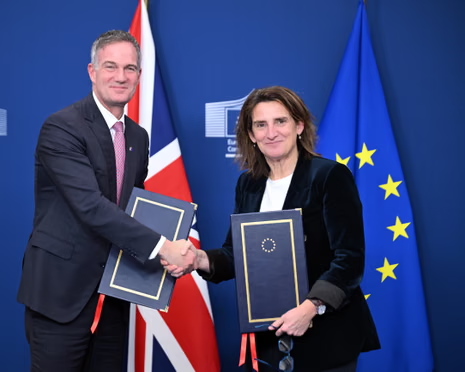
The UK EU trade reset has gathered steady public support, ministers say. Speaking in Brussels, Business Secretary Peter Kyle insisted voters are focused on future growth, not past arguments. He argued that people want practical cooperation that strengthens trade and boosts jobs. His remarks followed the signing of a new competition cooperation agreement with the European Commission. The agreement marks another step in the evolving UK EU trade reset.
Kyle described the deal as a vindication of Labour’s strategy since entering government. He said relationships with European partners have matured through consistent dialogue. According to him, alignment on competition policy will reduce friction for companies operating across borders. Officials on both sides believe that closer cooperation could encourage investment and innovation. The UK EU trade reset, he suggested, is already delivering tangible progress.
Alongside Kyle in Brussels was Teresa Ribera, who welcomed the agreement warmly. She called it a privilege to formalise stronger links between regulators. Ribera said the accord reinforces good cooperation already visible in day-to-day engagement. Her comments highlighted a tone of renewed trust between London and Brussels. That atmosphere has been central to the UK EU trade reset narrative.
The new arrangement focuses on competition enforcement and merger oversight. Regulators aim to coordinate investigations where companies operate in both markets. By sharing information more efficiently, authorities hope to prevent conflicting decisions. Business leaders have long sought clarity when navigating parallel UK and EU rules. The agreement signals that both sides recognise shared economic challenges.
Kyle emphasised that the British public supports pragmatic engagement. He argued voters chose a government promising improved relations with Europe. In his view, people are not yearning for pre-Brexit arrangements. Instead, they prefer steady progress that protects national interests while unlocking opportunity. The UK EU trade reset, he said, reflects that balanced approach.
Polling in recent months has shown nuanced public opinion on Europe. While divisions remain, many respondents favour smoother trade links. Exporters in manufacturing and services have voiced similar priorities. They want reduced bureaucracy and greater certainty in cross-border commerce. Ministers believe these sentiments create political space for gradual alignment.
Attention now turns to the proposed “Made in Europe” procurement initiative. The scheme is expected to prioritise European products in public contracts. It forms part of a broader industrial strategy debate within the bloc. Some member states argue it would bolster resilience and domestic employment. Others caution against excessive protectionism that could restrict competition.
The initiative is closely linked to the forthcoming Industrial Accelerator Act. European policymakers see it as a tool to reduce dependency on external suppliers. Recent global shocks have exposed vulnerabilities in supply chains. By strengthening regional manufacturing, leaders hope to safeguard economic stability. Questions remain about how the UK might engage with this framework.
Ribera declined to reveal whether Britain would participate immediately. She avoided pre-empting formal announcements scheduled in Brussels. However, she stressed her support for cooperation that fosters prosperity and fairness. Her remarks suggested openness to constructive UK involvement. That message will resonate with businesses seeking integrated supply chains.
Kyle clarified that he was not in Brussels to demand concessions. He framed his visit as an opportunity to listen and build trust. The tone contrasts with earlier post-Brexit tensions. He highlighted collaboration in aerospace, particularly through Airbus projects spanning Britain and continental Europe. Such partnerships illustrate how intertwined certain industries remain.

Manufacturing leaders argue that joint ventures sustain skilled employment. Aerospace supply chains often cross borders multiple times before completion. Streamlined regulatory alignment can therefore lower costs significantly. The government hopes that practical steps under the UK EU trade reset will protect these sectors. Officials also point to green technology and life sciences as growth areas.
Kyle was candid about limitations of the original trade agreement. The Trade and Cooperation Agreement, negotiated under Boris Johnson, established a foundation but left gaps. He described it as insufficiently ambitious for present challenges. Both sides now confront inflationary pressures and shifting global markets. Updating mechanisms, he argued, is essential for competitiveness.
European leaders appear receptive to deeper engagement. Roberta Metsola recently suggested relations should advance further. Her comments indicated support within the European Parliament for expanded cooperation. Yet political sensitivities remain across member states. Balancing national priorities with collective strategy will require careful negotiation.
The conversation also intersects with UK relations beyond Europe. Kyle addressed questions about trade ties with the United States. Uncertainty has arisen around the continuity of arrangements discussed previously. He expressed hope for clarity from Washington in coming days. Businesses are monitoring developments closely.
In Washington, US Trade Representative Jamieson Greer signalled continuity on tariff levels. He indicated that a 10 per cent rate secured earlier would remain. His comments suggested a desire for policy stability. For UK exporters, predictable terms are vital when planning investments. Ministers see diversified partnerships as complementary to European engagement.
Economic analysts note that Britain’s largest trading partner remains the EU. Even modest improvements in regulatory cooperation could yield measurable gains. Reduced duplication in compliance processes can lower administrative burdens. Over time, this may support small and medium enterprises expanding abroad. The UK EU trade reset therefore carries practical economic implications.
Critics caution that expectations should remain realistic. Full single market access is not on the table. The government insists sovereignty over rules remains intact. Instead, the strategy emphasises selective alignment where mutual benefit exists. That calibrated approach aims to avoid reopening divisive debates.
Supporters argue that incremental progress builds confidence gradually. By demonstrating goodwill in technical areas, trust can deepen. Successful cooperation on competition policy may encourage broader dialogue. Environmental standards and digital regulation could follow similar patterns. Each step would reinforce the broader trajectory.
Business groups have welcomed the constructive tone. They highlight the value of predictable regulatory environments. Investment decisions often depend on clarity around long-term policy direction. When governments communicate consistent intentions, markets respond positively. The UK EU trade reset seeks to provide that reassurance.

Political observers note that symbolism matters as much as substance. Signing agreements in Brussels sends a visible message of engagement. It contrasts sharply with confrontational episodes seen in earlier years. For many voters, reduced tension itself feels like progress. Stability can foster economic confidence even before concrete benefits materialise.
As discussions continue, both sides face domestic pressures. European governments balance industrial ambitions with internal competition concerns. The UK government must demonstrate tangible economic dividends. Transparent communication will therefore be essential. Clear explanations can prevent misunderstandings from escalating.
Ultimately, the trajectory of UK-European relations remains evolving. The competition cooperation agreement is one chapter in a longer story. It reflects pragmatic recognition of shared interests. While ideological debates persist, economic realities exert powerful influence. The UK EU trade reset encapsulates that pragmatic turn.
For businesses and workers alike, outcomes will matter more than rhetoric. If streamlined processes reduce costs and boost exports, public support may solidify. If cooperation stalls, scepticism could resurface quickly. Much will depend on sustained political will on both sides. The coming months will reveal whether momentum continues.
For now, ministers emphasise steady progress over grand gestures. They present cooperation as practical problem-solving rather than ideological compromise. That framing resonates with many voters seeking stability. The UK EU trade reset stands as a central pillar of that message. Its success could shape Britain’s economic path for years ahead.
Related News:
 British Woman in Iran ‘Losing Hope’ Amid Ongoing Detention
 BBC Journalist Held and Interrogated in Vietnam
 Green Party Surges Past Labour in Latest UK Poll
 Celebrities and Charities Demand UK Government Act on Child Poverty
 Trump’s UK Ambassador Urges North Sea Drilling to Strengthen US Ties
 FBI Director Kash Patel Defends Girlfriend Amid Government Jet Claims
 French Taxi Driver Cleared in David Lammy Theft Case After Fare Dispute
 Boris Johnson accused of undermining BBC leadership
 ‘Reckless’ cuts to victims’ services will cost more than they save
 Millionaires group urge Reeves to introduce wealth tax to ‘lift kids out of poverty’
 Starmer Faces Growing Dissent as Labour MPs Weigh Leadership Challenge
 Reeves rejects £1bn plea for NHS redundancy payouts
 Politics latest: Starmer ‘will fight any leadership coup’ as Streeting denies attempt to oust Labour PM
 PM Condemns Leaks, Vows Loyalty to Ministers and Stability
 Major Rent Reform Ends No-Fault Evictions in England
 Peers Flood Assisted Dying Bill with 942 Amendments
 England’s Special Needs Support Faces Breaking Point
 MoD warned over Excel risks before Afghan data breach
 UK Asylum Overhaul Sparks Debate Over Human Rights and Deportations
 UK Candidate Moved to Safe House After Election Threats
 Mahmood Defends Tough Overhaul of UK Asylum System
 UK Warns China After MI5 Issues Espionage Alert
 UK Vulnerable to Attack, Defence Committee Finds
 Labour Faces Historic Decline in Wales
 Rama Rebukes Mahmood for Targeting Albanian Families
 PM Highlights UK Business at G20 in South Africa
 Kate Forbes: Motherhood Harder Than Politics
 Welsh Government Christmas 2020 Lockdown Criticised
 Most Tories Expect to Support a Farage-Led Government
 Labour MP claims devolution bill is ‘blatant discrimination’ against Cornwall
 Millions Face Higher Taxes Under Reeves New Budget
 Peers Get Extra Time to Debate Assisted Dying Bill
 Planned Palestinian Flag Raising at Belfast City Hall Faces Delay Amid Legal Concerns
 Starmer Says Labour’s Economic Plan Needs Years to Deliver
 Culture secretary to review Telegraph takeover by Daily Mail owner
 Andy Burnham Apologises for Past LGBTQ+ Police Discrimination
 Plans to Limit Jury Trials Face Retreat After Mounting Opposition
 Jenrick Reform defection deepens Tory civil war
 Right Must Unite After Jenrick Defection, Urges Rees-Mogg
 UK Ministers Drop Foreign Student Targets for Global Education Push
 MPs warn AI financial risks threaten UK stability
 MPs warn AI financial risks threaten UK stability
 No Gas Boiler Ban as UK Warm Homes Plan Backs Heat Pumps
 Hugh Grant Joins Call for Under-16 Social Media Ban in UK
 Shinzo Abe’s killer receives life sentence in Japan
 Lords Vote Piles Pressure on Starmer Over Social Media Ban
 Planned Troubles Board Game Sparks Outrage in Northern Ireland
 Reform UK Health Plan ‘Would Cost £1.7bn’, Streeting Says
 Police response times face strict new national limits
 Labour policing overhaul sparks fears over growing central control
 Tories criticised after Braverman defection sparks mental health row
 Burnham Westminster return hopes fade amid Labour rift
 Starmer warns of toxic division politics in Reform challenge
 Starmer China visit raises human rights pressure on Beijing
 Labour Must Revive High Streets to Avoid Election Collapse
 Calls Grow for King Charles to Apologise for Crown’s Role in Slavery
 Starmer Signals UK Return to EU Defence Pact Talks
 Palantir contracts face UK halt calls over transparency
 Labour Thinktank Row Deepens Over Journalist Probe Claims
 Sarwar call shakes Labour as No 10 calms fears
 Labour Lord Doyle Apologises Over Paedophile Ties in Political Storm
 Palestine Action Verdict Sparks Debate on Activist Tactics
 Cabinet Secretary Shake-Up Triggers Due Diligence Warning
 Starmer Faces Inquiry Calls Over Thinktank Probe
 Royal Mail Delivery Crisis Deepens Amid Weather Chaos
 Labour Together probe scandal sparks fresh Cabinet Office investigation
 Farage to Name Jenrick as Reform Chancellor Pick
 Farage Unveils Reform UK Frontbench Team
 NHS Negligence Ruling Raises Payout Costs
 Civil Service Pay: Union Urges Ministers to End ‘Barking Mad’ Limits
 Antonia Romeo appointment sparks criticism
 Trump and Chagos Deal Rift Over Iran Strikes
 Andrew Mountbatten-Windsor Arrest After FBI Radar
 Farage Chagos Islands Row Sparks Fury
 Trump Tariffs Threat Spark UK and EU Alarm
 Gasfield Deal Sparks Debate Over Fracking in Lincolnshire
 Reform UK targets workers’ rights repeal
 Ministers Urged to Ban Crypto Political Donations
 Mandelson Denounces Arrest Over ‘Baseless’ Fleeing Claims
 Russian Trade Routed Through British Islands Exposed