
Published: 25 March 2026. The English Chronicle Desk. The English Chronicle Online.
A landmark ruling in the United States has placed the global technology giant Meta under intense scrutiny after a jury ordered the company to pay $375 million in civil penalties. The decision, widely described as a turning point, centres on the Meta child exploitation case and its alleged failure to protect young users across its platforms.
The verdict followed a lengthy trial in New Mexico, where jurors concluded that Meta misled consumers about safety standards. The case highlighted serious concerns about how platforms like Facebook and Instagram handled harmful activity, including child sexual exploitation. Prosecutors argued that the company’s design choices contributed directly to the risks faced by vulnerable users.
New Mexico attorney general Raúl Torrez described the outcome as a historic victory for families. He stated that the ruling sends a powerful message that companies cannot ignore the safety of children. According to Torrez, evidence presented during the trial showed executives were aware of dangers but failed to act responsibly.
The lawsuit, filed in December 2023, built upon investigative reporting and internal documents revealing troubling patterns. Authorities argued that Meta’s platforms had become environments where harmful interactions could flourish. These claims were supported by testimony from experts, law enforcement officers, and former employees.
At the centre of the Meta child exploitation case were allegations that the company prioritised growth over safety. Prosecutors maintained that warning signs had been repeatedly ignored despite internal concerns raised by staff. They argued that this negligence allowed harmful behaviours to persist and, in some cases, escalate.

Meta has strongly rejected the verdict and confirmed it will appeal the decision. A spokesperson stated that the company disagrees with the findings and believes the arguments presented were selective. The company maintains that it continues to invest heavily in safety measures and technological improvements.
Despite these assurances, the trial revealed uncomfortable details about internal operations. Documents presented in court suggested that both employees and external advisors had flagged risks linked to user interactions. These warnings, according to prosecutors, were not adequately addressed in a timely manner.
One of the most striking elements of the case involved a law enforcement operation known as Operation MetaPhile. Investigators used undercover techniques to identify individuals attempting to exploit minors through social media. Evidence from this operation played a significant role in illustrating how predators used messaging tools to target victims.
The court also examined Meta’s decision to introduce end-to-end encryption in its messaging services. While the company argued this move enhanced user privacy, critics claimed it limited the ability of authorities to detect criminal behaviour. Prosecutors said encryption made it harder to gather evidence in cases involving child exploitation.
Testimony from the National Center for Missing and Exploited Children raised further concerns about reporting practices. Witnesses stated that while Meta generated large volumes of reports about harmful content, many lacked actionable detail. Investigators described these reports as overwhelming and sometimes ineffective for real-world enforcement.
The Meta child exploitation ruling also focused on the company’s use of artificial intelligence in moderation systems. While automation helped identify certain harmful materials, critics argued it produced excessive false positives. This, they claimed, diverted resources and hindered efforts to identify genuine threats.
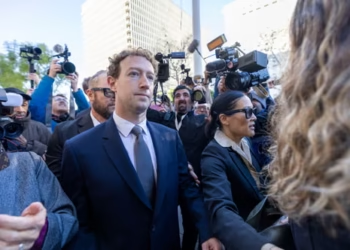
During the trial, senior executives including Mark Zuckerberg and Instagram head Adam Mosseri provided testimony. Both acknowledged that risks exist on large platforms but described them as unavoidable challenges. They emphasised the scale of operations and the difficulty of monitoring billions of interactions daily.
Meta pointed to initiatives such as enhanced safety features for teenage users as evidence of progress. These measures included default privacy settings and restrictions aimed at limiting harmful contact. However, critics argued that such steps were introduced too late to prevent damage already caused.
Legal experts have described the verdict as significant because it challenges long-standing protections enjoyed by technology companies. For years, firms like Meta relied on Section 230 of the Communications Decency Act to shield themselves from liability. In this case, however, the court determined that the lawsuit focused on product design rather than user content.
This distinction proved crucial in allowing the case to proceed. The judge ruled earlier that Meta could not use constitutional protections to dismiss claims related to its platform structure. This decision opened the door for a full trial and ultimately the jury’s verdict.
The financial penalty represents the maximum allowed under New Mexico law, calculated at $5,000 per violation. While substantial, legal analysts believe the broader implications may be even more impactful. The ruling could encourage similar cases in other jurisdictions, potentially reshaping how platforms approach safety.
Public reaction has been mixed but largely supportive of stronger accountability measures. Many parents and educators have expressed concern about the influence of social media on young people. The verdict has reinforced calls for tighter regulation and improved oversight of digital platforms.
The Meta child exploitation case also intersects with ongoing legal battles across the United States. In Los Angeles, a separate lawsuit involving multiple technology companies is still unfolding. Families and school districts allege that platforms were intentionally designed to be addictive, contributing to mental health issues among young users.
Companies including Snap and TikTok have reached settlements in that case, while Meta continues to contest the allegations. YouTube is also involved and denies wrongdoing. Observers believe the outcome of these cases could define the next phase of regulation in the technology sector.
Back in New Mexico, the legal process is far from over. A second phase of proceedings is scheduled to begin in May, where additional penalties may be considered. Authorities are also seeking court-ordered changes to platform design to enhance child protection measures.
Proposed reforms include stronger age verification systems and improved detection of harmful behaviour. Officials have also suggested limiting encrypted communications where they may shield criminal activity. These proposals highlight the ongoing tension between privacy rights and safety concerns.

Legal commentators say the swift jury deliberation reflects broader public sentiment. Concerns about online safety have grown steadily in recent years, particularly among families. This case appears to have tapped into those anxieties, influencing the outcome.
For Meta, the ruling presents both financial and reputational challenges. The company now faces increased pressure to demonstrate meaningful improvements in safety practices. Failure to do so could result in further legal action and regulatory scrutiny worldwide.
The Meta child exploitation verdict may ultimately serve as a defining moment for the technology industry. It signals a shift towards greater accountability and a willingness to challenge established legal protections. As governments and courts continue to examine platform responsibilities, companies may need to rethink how they balance growth with user safety.
For families affected by online harm, the decision offers a sense of validation and hope. It suggests that even the largest corporations can be held responsible when systems fail to protect vulnerable users. Whether this leads to lasting change remains to be seen, but the impact of this case is already being felt across the digital landscape.
Related News:
 Virgin Trains Moves Closer to Challenging Eurostar Monopoly
 UK Bans Fake Numbers: Scammers Lose Their Trick
 Vibe coding’ named Collins dictionary’s word of the year
 Experts Urge Legal Right to Timely Cancer Care
 Patients to Test Health at Home to Ease NHS Winter Pressure
 One of world’s last dinosaurs on sale for £3m
 North Sea oil workers must lose weight or face job loss
 Britain deploys RAF specialists to assist Belgium with drone threats
 Government urges schools to ban phones to curb classroom disruption
 NHS frontline staff forced to cover gaps as managers remain scarce
 Stop using ChatGPT to write speeches, AI minister tells MPs
 Northern Lights may illuminate UK skies this week
 New laws to bolster UK’s defences against cyber attacks on NHS, transport and energy
 Hitler’s DNA Confirms He Truly Had Only One Testicle
 Working-Class Men with Prostate Cancer Left Behind by NHS
 Higgs Donates Nobel Medal to His Beloved University
 New AI tool could cut wasted efforts in organ transplants
 How Cultures Interpreted the Aurora Through History
 From War to Wales: Teen Innovator Eyes Net Zero Future
 From Baby Teeth to Bioengineering: The Future of Self-Healing Teeth
 Sundar Pichai Cautions on AI Hype and Market Risks
 Google Chief Urges Caution: Don’t Trust AI Blindly
 US Judge Says Meta Did Not Hold Illegal Social Media Monopoly
 Poll Reveals China Leads World in Trusting AI Technology
 Healthy Habits in Your 30s That Boost Life in Your 70s
 Raccoons Could Become America’s Next Pet
 Australia to Ban Social Media for Kids Under-16 Starting December
 Coffins Now Too Large to Cremate Amid Rising Obesity Crisis
 UK Taskforce Unveils Plan to Streamline Nuclear Reactor Rules
 NHS paediatric leave parents waiting months for answers
 Ofcom urges platforms to limit abuse and curb online ‘pile-ons’
 AI Actress Creator Says Tilly Norwood Won’t Replace Actors
 YouTube Warns Kids Will Be Less Safe Under Australia Ban
 Starmer’s communications chief to outline media strategy overhaul
 UK Car Sales Pass 2 Million as Chinese Brands Surge
 AI Grok Sparks Child Safety Alarm in the UK
 Indonesia blocks Grok chatbot over sexual content risk
 Google Removes Some AI Health Summaries Over Safety Concerns
 Nasa ISS Medical Evacuation: Crew-11 To Return Early
 US Clears Nvidia AI Chip Sales to China in Policy Shift
 Amazon Milton Keynes closure sparks concern for UK warehouse workforce
 BP’s Influence Sparks Controversy in UK STEM Education
 AI will transform human jobs, enhancing skills, says minister
 Astronomers Prepare for First-Ever Movie of a Black Hole
 MPs warn AI financial risks threaten UK stability
 MPs warn AI financial risks threaten UK stability
 EU launches Grok AI probe into X over explicit images
 ABC Facebook Page Briefly Hacked, Adult Photos Posted
 Pornhub blocks new UK users over age checks dispute
 Amazon mistakenly signals new global layoffs to employees
 AI breast screening cuts later cancer diagnoses by 12%, study finds
 UK Launches First Rapid-Charging Battery Train This Weekend
 AI News “Nutrition” Labels Proposed for Transparency
 UK New Car Discounts Near £6,000 as Prices Are Slashed
 Most Statin Side-Effects Are Not Caused by Drugs, Study Confirms
 Childnet Censorship Row Over Teen Safety Speeches
 BT Names New Openreach Chief Amid Major Fibre Expansion
 AI fears hit UK wealth and comparison sites
 Tech Trends Set to Transform Life in 2026
 Starmer Targets AI Chatbots Over Child Safety Concerns
 UK Anti-Slavery Watchdog Urges Adult Sites Overhaul
 Toxic e-waste found in dolphins raises urgent health concerns
 How Ancient Scottish Rocks Challenge ‘Snowball Earth’ Theory
 Ayahuasca Psychedelic DMT Shows Potential as Depression Therapy
 Stewart Brand on Musk, Bezos and a Life of Long Thinking
 Facial Recognition Error Leads to Wrongful Arrest in Milton Keynes
 Social Media Trial: Woman Says Addiction Began at Six
 UK Social Media Ban for Under-16s Gains Momentum
 UK Teen Social Media Ban Trials Begin
 Zorevunersen Breakthrough for Dravet Syndrome
 Revealed: UK AI Push Faces Phantom Investment Claims
 Taking Multivitamins Daily Could Slightly Slow Ageing, Study Finds
 Ministers Urged to Act Faster on Deepfakes Threat
 MPs Reject Ban on Social Media for Under-16s
 Tesla Enters British Energy Market Following Ofgem Approval
 Social Media Giant Trial Reaches Final Jury Decision
 Cern Prepares First-Ever Antimatter Transport Test
 The Molten Mystery of L98-59d: A New Class of Liquid Planet
 Cannabis Mental Health Doubts Grow After Major Study
 Scientists Unveil Heavier Proton at CERN LHC