Published: 26 March 2026. The English Chronicle Desk. The English Chronicle Online.
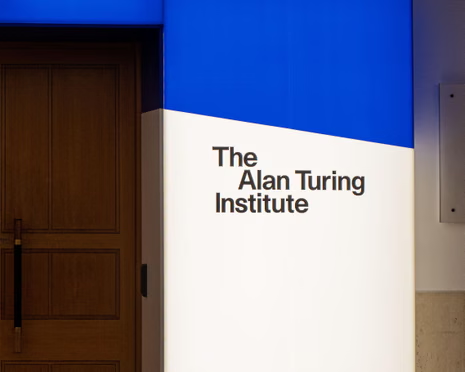
The prestigious Alan Turing Institute is currently facing significant pressure from the national charity watchdog regarding its internal management. This formal intervention follows a series of serious complaints raised by whistleblowers within the renowned research organisation. The Charity Commission has now issued critical regulatory advice to the board of trustees at the institute. This guidance focuses on essential legal duties such as financial oversight and the management of change. The charity watchdog stepped in after staff members expressed deep concerns about the future of the body. These concerns centered on the strategic direction and the overall stability of the national AI center. Recent reports suggest that the institute was navigating a period of intense institutional and financial uncertainty. The official regulatory advice serves as a firm reminder of the responsibilities held by the board. Trustees are legally bound to ensure that the charity operates with transparency and complete accountability.
The investigation began last summer after a group of concerned employees submitted a detailed formal complaint. This complaint highlighted eight specific areas where the staff felt the leadership had failed significantly. One of the most pressing issues involved the potential collapse of the entire research institute. This fear arose from government warnings regarding the long term funding of the vital organisation. Peter Kyle the former technology secretary had previously issued a letter discussing future financial support levels. The staff claimed that the board failed to address these external threats with sufficient urgency. They also alleged that a letter of confidence delivered in 2024 was largely ignored by leaders. Such claims painted a picture of an organisation struggling with internal communication and executive transparency. The charity watchdog took these allegations seriously and launched a formal compliance case immediately after.

Doug Gurr the former boss of Amazon UK currently chairs the board of the institute. The whistleblower group alleged that he and other trustees failed to provide a clear strategy. They argued that the leadership did not fulfill its core legal duties during a crisis. These duties include the protection of the charity assets and ensuring its public mission. The Charity Commission has now completed its thorough review of these very troubling staff allegations. While the case is now closed the commission did not launch a full inquiry. A statutory inquiry is a more severe form of investigation used for serious misconduct. However the watchdog made it clear that the current situation still required formal guidance. This indicates that the charity watchdog found areas where the board could have performed better. The trustees must now demonstrate they are following this advice to avoid further action.
Legal experts have noted that this outcome is a significant development for the institute. Jennifer Sigafoos from the University of Liverpool shared her professional perspective on the recent ruling. She suggested that the commission was likely not fully satisfied with the initial board responses. The decision to issue formal guidance shows that the trustees needed a clear reminder. Experts believe that the complainants will feel a sense of vindication from this result. Their concerns were not dismissed but were instead used to shape new regulatory requirements. At the same time the board may feel relieved that the case is closed. They now have a roadmap to improve their governance and regain the public trust. The charity watchdog will continue to monitor the progress of the institute very closely. This monitoring ensures that the advice provided is implemented into the daily operations.
The institute has responded to the findings with a public statement regarding the case. A spokesperson expressed satisfaction that the compliance case has finally reached a formal conclusion. They thanked the regulator for the constructive engagement throughout the entire investigative process. The institute pledged to use the advice to strengthen its internal governance and leadership. This commitment is crucial as the organisation moves into a new phase of research. The charity watchdog noted that the trustees have already begun taking steps for improvement. These steps are intended to fortify the foundation of the UK’s leading AI body. Despite the closure of the case the regulator remains vigilant about future developments. If the board ignores the new guidance the commission could reopen the investigation. This serves as a persistent check on the power of the institute leadership.
The turmoil at the institute has already led to significant changes in senior leadership. Jean Innes the former chief executive resigned following the government intervention and staff complaints. Her departure marked a turning point for the organisation during a period of transition. The government had previously urged the institute to focus more on national security matters. This shift in focus is reflected in the appointment of the new chief executive. George Williamson has taken over the lead role at the Alan Turing Institute recently. He previously led His Majesty’s Government Communications Centre which handles sensitive national security tasks. His background suggests a move toward a more secure and defense oriented research agenda. This strategic shift aligns with the demands made by government officials in recent months. The charity watchdog will likely observe how this new leadership handles the regulatory advice.
A source close to the whistleblowers stated that the outcome validates their original claims. They believe the reminder of basic legal duties was necessary for the current board. The staff group had worried that the institute was drifting away from its mission. By involving the regulator they hoped to steer the organisation back toward stable ground. The role of the charity watchdog is to protect the public interest in charities. In this case the watchdog acted as an essential referee between staff and leadership. The Alan Turing Institute holds a unique position in the British scientific community. It receives significant public funding and manages sensitive data for the entire United Kingdom. Therefore the standards of governance at the institute must remain exceptionally high at all times. The recent guidance aims to ensure those high standards are met without exception.

The broader implications for the UK research sector are also being discussed by observers. Many believe that this case highlights the challenges of managing high profile scientific bodies. These organisations must balance government expectations with the needs of their expert research staff. When communication breaks down the intervention of the charity watchdog becomes a necessary last resort. The institute must now work to rebuild its internal culture and professional reputation. Clearer lines of accountability will be essential for the future success of the organisation. The board is expected to provide more transparent updates on its financial decisions. They must also show how they are responding to the needs of their employees. The goal is to create a more resilient and focused national research institute. With the watchdog watching the pressure to perform has never been higher.
Moving forward the institute will focus on its new mandate involving national security. This transition requires careful management to maintain the quality of its diverse scientific research. The board of trustees must ensure that this change does not compromise legal duties. Transparency in how the government influences research priorities will be a key factor. The charity watchdog has provided the necessary framework for this transition to occur safely. It is now up to the leadership to prove they can follow through. The eyes of the scientific community are fixed on the Alan Turing Institute. Its success is vital for the technological advancement of the United Kingdom in 2026. By following the advice of the regulator the institute can move past this. A stronger governance structure will benefit the staff and the public alike.
Related News:
 How Bringing Forests Into Preschools Boosts Children’s Health
 Critically Endangered Spider Rediscovered in UK After 40 Years
 UK Bans Fake Numbers: Scammers Lose Their Trick
 England Curriculum Review Recommends Major Changes
 Mortgages and AI Set to Feature in English Schools
 Experts Urge Legal Right to Timely Cancer Care
 Patients to Test Health at Home to Ease NHS Winter Pressure
 One of world’s last dinosaurs on sale for £3m
 North Sea oil workers must lose weight or face job loss
 No link found between paracetamol in pregnancy and autism
 Government urges schools to ban phones to curb classroom disruption
 Northern Lights May Illuminate UK Skies Amid Strong Solar Storm
 Northern Lights may illuminate UK skies this week
 UK Greenlights First Small Nuclear Plant in North Wales
 Higgs Donates Nobel Medal to His Beloved University
 Coffins Now Too Large to Cremate Amid Rising Obesity Crisis
 UK Taskforce Unveils Plan to Streamline Nuclear Reactor Rules
 Thinktank Urges Smaller Hospitals to End NHS ‘Permacrisis’
 NHS paediatric leave parents waiting months for answers
 Ofcom urges platforms to limit abuse and curb online ‘pile-ons’
 Starmer’s communications chief to outline media strategy overhaul
 UK Car Sales Pass 2 Million as Chinese Brands Surge
 AI Grok Sparks Child Safety Alarm in the UK
 Lammy and Vance unite against AI abuse images on X
 UK Threatens Action Against X Over Sexualised AI Images
 Amazon Milton Keynes closure sparks concern for UK warehouse workforce
 AI will transform human jobs, enhancing skills, says minister
 TikTok to Strengthen Age Verification Across the EU
 MPs warn AI financial risks threaten UK stability
 MPs warn AI financial risks threaten UK stability
 AI job losses UK: Britain faces sharper employment shock
 Pornhub blocks new UK users over age checks dispute
 UK New Car Discounts Near £6,000 as Prices Are Slashed
 Barnsley tech town leads UK AI transformation
 Childnet Censorship Row Over Teen Safety Speeches
 Revenge Porn Crackdown: 48-Hour Rule Warning
 UK Anti-Slavery Watchdog Urges Adult Sites Overhaul
 Facial Recognition Error Leads to Wrongful Arrest in Milton Keynes
 UK Social Media Ban for Under-16s Gains Momentum
 Met police to trial handheld facial recognition checks in London
 UK Teen Social Media Ban Trials Begin
 Cancer Death Rate in Britain Falls by Nearly a Third
 Ministers Urged to Act Faster on Deepfakes Threat
 MPs Reject Ban on Social Media for Under-16s
 Scientists Unveil Heavier Proton at CERN LHC
 Traffic: The Science Behind Why Slower Cars Always Catch Up
 The Night an AI Bot Threw a Party in Manchester
 OpenAI Halts Stargate UK Project Amid Energy Crisis
 Heavier SUVs Accelerate Britain’s Pothole Crisis
 Europe EV Demand Surges as Fuel Prices Rise
 Liz Kendall: UK Must Seize AI Growth Despite Risks
 Reform UK funding: mystery billionaire revealed
 Tatooine Dreams: 27 New Worlds Found With Double Suns
 Virtual Racing Faces New Era of Anti-Doping Measures
 Cambridge South Signals New Era for British Rail Travel
 Alarm as Sextortion and AI Abuse Threaten UK Children
 UK rejects EV charging VAT cut amid Treasury clash
 UK firms accused of ‘AI washing’ boom
 British Paralympian Set to Make History in Earth Orbit
 UK to Expand Prostate Cancer Trials for Black Men
 NHS Approves Landmark Ovarian Cancer Drug
 Tech Trends and the Battle Against Exam Hall Cheating
 Aviva Exposes Record £230m in Fraudulent AI Claims
 Stolen Mobiles Could Soon Become Useless Bricks
 UK Ministers Lobby Trump Over Under-16s Social Media Ban
 AI Lawyer Triumphs in Landmark English Court Victory
 How the ‘Happy Vowel’ Defines Class in Manchester
 UK Mobile Connectivity Trails Global Peers
 Reeves Launches City AI Skills Compact
 London’s 2026 ‘Great Stink’ Raises Sewer Concerns
 Reeves Faces Setback as Labour May Miss Homes Target
 Kate Winslet to Narrate Film Highlighting King’s Environmental Mission
 Trump’s UK Ambassador Urges North Sea Drilling to Strengthen US Ties
 Vibe coding’ named Collins dictionary’s word of the year
 The Kill Line: A Shifting Vision of the American Dream
 Inquiry into HMRC child benefit errors launched by NAO
 Rising Costs Force Families to Rethink Days Out
 Artemis II: Humanity Returns to the Moon After Decades
 National Energy Grant Proposed to Slash UK Household Bills
 Robots Outpace Humans in Beijing Half-Marathon