Published: 13 April 2026. The English Chronicle Desk. The English Chronicle Online.
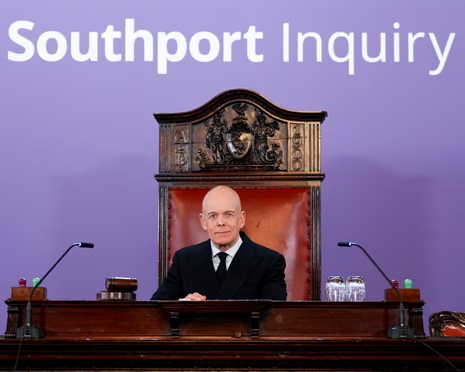
The horrific events that unfolded in Southport have left a deep scar on the nation. A damning inquiry has now revealed that this tragedy was entirely preventable and unnecessary. Sir Adrian Fulford led the investigation into the actions of multiple state agencies and individuals. His findings paint a picture of catastrophic systemic failures across the entire public sector. The report highlights an inappropriate merry-go-round of bodies passing the buck to each other. This culture of refusing to accept responsibility must end immediately to protect our children. The deaths of three young girls were not a sudden bolt of lightning today. Instead, the violence had been clearly and repeatedly signposted over several long years. Professionals who met Axel Rudakubana expressed serious fears that he would eventually kill. Despite these stark warnings, the teenager remained free to carry out his ferocious assault.
The inquiry focused on the events leading up to the attack in July 2024. Rudakubana targeted a Taylor Swift-themed holiday club during a busy summer morning in Merseyside. Three innocent girls lost their lives while ten other people suffered terrible stab wounds. The perpetrator was only seventeen years old when he committed these truly heinous crimes. He had been on the radar of the state for nearly five years before. The report argues that the multi-agency model for troubled young people completely failed. Sir Adrian Fulford insists that ministers must now establish a dedicated new oversight agency. This body would be responsible for managing complex offenders who pose a serious risk. There was a fundamental lack of clarity regarding which organisation was the lead agency. Numerous systems designed to provide protection were either ineffective or simply not used properly.

The consequences of these administrative failures have been described as nothing short of catastrophic. The inquiry also raised profound concerns about the actions of the killer’s own parents. Alphonse Rudakubana and Laetitia Muzayire were described as being both misguided and deeply irresponsible. They discovered their son was building a lethal arsenal of weapons before the attack. However, they failed to report this to the police due to personal fears. They worried their son would be arrested or taken into state care instead. If they had shared these concerns, the tragedy would almost certainly have been prevented. The report notes that the family’s silence on the day of the attack was fatal. This lack of transparency allowed the killer to reach the dance studio unnoticed. The inquiry criticises the parents for failing to protect the wider community from danger.
Sir Adrian Fulford also addressed the role of the killer’s confirmed autism diagnosis. Professionals repeatedly used his condition as an excuse for his increasingly violent behaviour. The judge described this tendency as both unacceptable and superficial in its clinical application. Using a diagnosis to justify unpredictable aggression led to a dangerous lack of intervention. While many professionals acted in good faith, their shortcomings were still incredibly significant. There was a depressing failure at both organisational and individual levels to manage risk. Cases were passed from one agency to another in a cycle of hand-offs. This pattern of referrals and assessments resulted in no meaningful action being taken. The inquiry concludes that this culture lies at the heart of the entire tragedy. Without a central point of accountability, the killer was able to slip through.
The history of the killer’s contact with the state begins in late 2019. At just thirteen years old, he called Childline to admit to having murderous thoughts. He confessed to taking a kitchen knife into his school on ten separate occasions. Just two months later, he attacked a fellow pupil with a heavy hockey stick. This assault resulted in a broken wrist for the victim at the high school. Police discovered a knife in his backpack and arrested him for carrying a blade. These early indicators of extreme risk were not properly understood by the local authorities. Information was not shared effectively between the police, schools, and social services providers. Consequently, the significance of these violent events was seriously underestimated by the state. Opportunities to intervene and change his path were lost during those crucial years.
One of the most striking missed opportunities occurred during the spring of 2022. Rudakubana went missing from his home and was eventually found on a public bus. He was carrying a knife and told officers he wanted to stab someone. He even admitted to thinking about using deadly poison against other human beings. Instead of making an arrest, two rookie police officers simply took him home. They advised his parents to hide their kitchen knives to keep him safe. If he had been arrested, his home would have likely been searched thoroughly. This search would have uncovered ricin seeds and terrorist material on his computer. The inquiry believes this was a critical moment where the attack could stop. Sir Adrian Fulford stated that sensible steps would have prevented this dreadful event. He dismissed the idea that these findings rely solely on the benefit of hindsight.
The report also examines the role of Prevent, the national counter-terrorism agency. Rudakubana was referred to this agency three times for making very concerning remarks. He had also searched for dangerous material online while using computers at his school. Prevent dismissed his case every time because he lacked a clear political ideology. They did not see him as a follower of jihadism or right-wing extremism. Counter-terrorism officers have now accepted that these dismissals were a very grave mistake. The inquiry criticised agencies for failing to investigate his chilling and violent internet use. He was obsessed with degrading and misogynistic content which fed his desire for violence. This digital obsession led him to build a terrifying collection of lethal weapons. His arsenal included knives, a crossbow, petrol bombs, and materials for making poison.

The judge is now considering a second phase for this very detailed inquiry. He may recommend new powers to monitor the internet use of dangerous young people. This would target those who are believed to pose a significant threat to society. The pervasive failure to act on the killer’s dangerousness was a fundamental issue. Sir Adrian Fulford wants to ensure that such an obsession cannot grow unchecked. Prime Minister Keir Starmer has already promised to act on the inquiry’s recommendations. He stated that it is absolutely right to implement these findings without delay. The government will look closely at how to improve accountability within state organisations. Starmer emphasised that there must always be consequences for such significant professional failures. The nation now waits to see if these promises will lead to change.
The town of Southport continues to mourn the three young lives lost so tragically. Bebe King, Alice da Silva Aguiar, and Elsie Dot Stancombe will never be forgotten. Their families have endured unimaginable pain while seeking the truth about this horrific day. This report provides some answers but also highlights a systemic lack of care. The failure to protect these children is a weight the state must carry. We must ensure that the lessons from this inquiry lead to real action. No other community should have to face such a preventable and dark day. The English Chronicle will continue to follow the government’s response to this report. We remain committed to seeking justice for the victims and their grieving families. The safety of our children must always be the highest priority for everyone. This landmark inquiry serves as a final warning to all public institutions. Responsibility must be taken before another tragedy occurs on our city streets.
Related News:
 UK Banks Granted Reprieve as BoE Delays Basel III Capital Rules Until 2028
 Singapore Corruption Scandal: Details Emerge on Iswaran’s Luxury Flight and Ties to Tycoon Ong Beng Seng
 Corfu Beyond the Crowds: Discovering Serenity in Southern Villages and Hidden Taverns
 Peter Andre Praises Son Junior’s ‘Quiet Season’ Amid Ongoing Family Dispute
 Massive 641-Mile Storm Set to Batter UK with 15 Hours of Rain and Strong Winds
 Jeremy Clarkson’s Pub: A Sunday Lunch Like No Other
 Scottish Government Mandates Single-Sex Toilets and Changing Facilities in Schools
 Reeves Faces Setback as Labour May Miss Homes Target
 Kate Winslet to Narrate Film Highlighting King’s Environmental Mission
 Trump’s UK Ambassador Urges North Sea Drilling to Strengthen US Ties
 Federal Immigration Shift: Officers Leave Louisiana for Minneapolis
 Fatal Bolton Taxi Crash Claims Three Teens and Driver
 Australia grants Asio powers to designate hate groups under new laws
 Friedman Uninvited From 2024 Adelaide Writers’ Week
 ScottishPower Tops List of Worst UK Energy Suppliers
 Judi Dench Champions Fight to Save London’s Green Spaces
 Crowborough Camp Welcomes First Asylum Seekers
 BBC Funding Crisis: Tim Davie Warns of Jeopardy Ahead
 ABC Facebook Page Briefly Hacked, Adult Photos Posted
 Artificial intelligence will cost jobs, admits Liz Kendall
 Older Women Vanish from BBC Screens, Review Confirms Bias
 Meta trial over child exploitation claims begins
 Streeting moves on doctor pay to end strike dispute
 Ben Stokes injury joke after brutal ball strike
 UK and US Drop in Global Corruption Index Rankings
 Send spending gap leaves deprived areas behind
 Hidden Crisis: Domestic Abuse Suicide Toll in UK
 UK Unemployment Rate Climbs to 5.2% Peak
 Canberra Poster Seizure Sparks Free Speech Row
 BBC World Cup Presenting Duties Shared Among Trio
 Wales Approves Assisted Dying Bill Consent
 CPS Updates Guidance on Honour-Based and Dowry Abuse
 Stewart Brand on Musk, Bezos and a Life of Long Thinking
 English Cricket Faces Moral Crisis Over Indian Investment
 Jacinda Ardern Move Sparks Kiwi Reflection
 Middle East Airspace Crisis Strands Thousands
 Kelly Wilkinson Inquest Reveals Bail Failure
 Asylum Seekers to Work After Year-Long Wait
 Princess Eugenie steps down as patron of anti-slavery charity
 New Zealand Covid Response Praised Despite Lingering Scars
 Injured Mojtaba Khamenei Elevated as Iran Leader
 The Kill Line: A Shifting Vision of the American Dream
 Inquiry into HMRC child benefit errors launched by NAO
 Family of Alleged Bondi Gunman Seeks Name Suppression
 Rising Costs Force Families to Rethink Days Out
 Air Canada CEO Faces Outcry Over Recent Language Misstep
 Extreme Weather: Europe Shivers as Cyclone Narelle Hits
 Scott Mills Sacked by BBC Over Personal Conduct Claims
 Palantir Boss Defends NHS Deal Amid Government Break Clause
 Asia Turns Back to Coal Amid Middle East Energy Crisis
 Relationship with Trump may be beyond repair, Starmer warned
 Trump’s Six-Week Iranian War: The High Cost of Ignorance
 US and Iran Agree to Two-Week Provisional Ceasefire
 Battle of Britain Tower to House Tourists and Bats
 The Challenger: Will Péter Magyar End the Orbán Era?
 UK Government Poised to Revive Stalled Hillsborough Law
 Kyiv and Odesa Mourn After Deadly Wave of Russian Strikes
 Medellín’s Green Revolution: A Global Climate Blueprint
 Robots Outpace Humans in Beijing Half-Marathon
 US Forces Seize Iranian Ship Near Hormuz Blockade
 Japan’s Youth Defend Pacifist Constitution
 Investigation: Offshore Loans and Sanctions
 Trump Defiant After Washington Hotel Shooting
 Cross-Border Crisis Shatters Fragile Afghan Peace
 Urban Flood Crisis: A Growing Threat to English Homes
 The Fear Gap: Why Europe Feels Less Safe Than It Is
 US Military Pacific Boat Strike Kills Three People
 Dettol Apologises for ‘Toxic Men’ Advert Backlash in China
 UK Care Crisis: Row Explodes Over New Visa Settlement Rules
 Sainsbury’s Boss Optimistic As Grocery Inflation Eases
 US Advance Past Bosnia in World Cup Thriller
 Trump’s Mount Rushmore Speech: A Divisive Anniversary
 Trump’s Red-Card Intervention Hurts the US World Cup
 US Airman Avoids British Court in Indecent Exposure Case
 Britain’s Mini Fan Craze Sparks Major Waste Crisis
 Trump Swaps Planes Amid Iran Tensions
 Ann Widdecombe, Formidable Political Figure, Dies at 78
 UK Schools Struggle as Classrooms Top 40C
 Yemen Accuses Iran of Violating National Sovereignty
 Houthis Strike Saudi Arabia as Middle East Tensions Rise