Published: 11 November 2025. The English Chronicle Desk. The English Chronicle Online.
A tragic suicide bombing outside a district courthouse in Islamabad, Pakistan, has claimed the lives of twelve people and left at least twenty-seven others injured, authorities confirmed on Tuesday. The attack, which took place in one of the capital’s central areas, has sent shockwaves across the city and heightened security concerns in a nation that has seen intermittent bouts of militancy in recent years.
According to Pakistan’s Interior Minister Mohsin Naqvi, the bomber had reportedly planned to gain access to the courthouse but was unable to enter the building. “The attacker detonated the bomb close to a police vehicle after waiting for approximately fifteen minutes,” Naqvi said, adding that authorities are prioritizing the identification of the bomber and those responsible for orchestrating the attack, promising that all involved parties will be brought to justice.
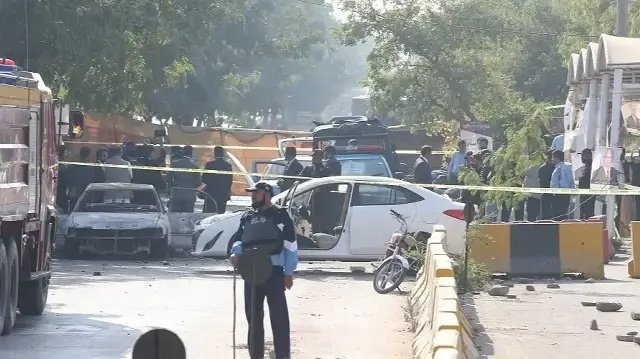
The blast occurred in a highly trafficked area outside the courthouse, where lawyers, staff, and members of the public were present. Early footage from the scene depicted the charred remains of a vehicle engulfed in flames, with police cordons securing the perimeter. Eyewitnesses described scenes of chaos and panic as people scrambled to seek safety amid the destruction.

Rustam Malik, a lawyer who was attempting to park his car outside the courthouse at the time of the blast, recounted the harrowing moments to AFP. “It was a loud bang, and complete chaos followed immediately. Lawyers and people were running inside the complex. I saw two dead bodies lying near the gate and several cars on fire,” he said. His account illustrates the suddenness and intensity of the attack, highlighting the terror inflicted on ordinary citizens going about their daily routines.
Pakistani President Asif Ali Zardari strongly condemned the attack, emphasizing that such acts of violence have no place in the country. His office issued a statement expressing sorrow for the victims and calling on law enforcement agencies to ensure swift and effective action to prevent future attacks. The president’s condemnation underscores the government’s determination to uphold security, particularly in urban centers like Islamabad, which have largely remained free from large-scale attacks in recent years.
Hospital sources confirmed that the twenty-seven injured individuals were receiving medical care at nearby facilities. Doctors indicated that the injuries ranged from severe burns to shrapnel wounds, and that emergency response teams were working to stabilize the victims. Authorities have appealed for calm among residents, urging people to avoid the area as security forces conducted investigations and collected evidence from the blast site.
The incident marks a rare instance of suicide bombing in Islamabad, a city that has generally maintained a lower profile in terms of militant attacks compared to other parts of Pakistan. Analysts suggest that the attack may have been aimed at destabilizing the judiciary and undermining public confidence in security arrangements, as courts and legal institutions are pivotal to the country’s governance and rule of law.
Officials have launched a full-scale investigation, with law enforcement agencies working to trace any networks that may have facilitated the attack. The Interior Ministry has vowed that intelligence and counterterrorism units will work collaboratively to prevent further incidents, while also seeking to provide reassurance to residents who may be fearful in the aftermath.
Eyewitness accounts have painted a vivid picture of the chaos at the scene. In addition to Malik’s description, several other bystanders reported hearing the explosion from blocks away, and some described witnessing panicked crowds fleeing the area. Vehicles were overturned or engulfed in flames, and smoke billowed across the street, adding to the sense of emergency. The psychological impact on residents, many of whom were unaccustomed to such violent episodes in the capital, is expected to be significant.
Security analysts note that while Islamabad has generally been spared the intensity of attacks seen in other regions of Pakistan, this bombing reflects the persistent threats posed by extremist elements. The attack also underscores the ongoing challenge of protecting high-profile institutions such as courts, government offices, and public service locations from acts of terror. Experts have emphasized the importance of enhanced surveillance, intelligence sharing, and rapid emergency response to mitigate future risks.
The Islamabad bombing has also prompted international reactions, with various governments and human rights organizations expressing concern and solidarity with Pakistan. Calls for restraint and measured responses have been issued to ensure that security operations do not inadvertently escalate tensions or create further civilian hardships. The international community has underscored the need for continued collaboration to counter violent extremism and maintain urban security.
In the aftermath of the blast, authorities have deployed additional security personnel around key government buildings and critical infrastructure. Emergency protocols have been activated, and law enforcement agencies are reviewing access points and screening measures to prevent potential follow-up attacks. Public advisories have been issued, warning residents to remain vigilant while encouraging calm and cooperation with officials conducting the investigation.

For families of the victims, the attack is a stark reminder of the human cost of violence. Local community leaders and advocacy groups have called for support for the bereaved and for comprehensive measures to prevent further tragedies. Religious and civic leaders have organized prayers and vigils, emphasizing solidarity, peace, and resilience in the face of terror.
Authorities have also begun examining forensic evidence, including surveillance footage, vehicle debris, and explosive residues, to piece together the sequence of events leading to the detonation. Investigators are seeking to identify any accomplices, sponsors, or networks that may have facilitated the attack, with the goal of preventing similar incidents in the future.
As Pakistan mourns the lives lost in Islamabad, there is widespread recognition of the need for continued vigilance, intelligence-driven security measures, and strengthened public awareness. The attack serves as a sobering reminder of the fragility of safety in urban centers and the persistent challenges faced by nations confronting violent extremism.
While the investigation continues, officials have assured citizens that law enforcement and counterterrorism forces are fully mobilized. The government has reiterated its commitment to protecting public institutions, securing streets and public spaces, and ensuring that perpetrators are held accountable through the legal system.
The Islamabad suicide bombing stands as a stark testament to both the vulnerabilities faced by urban centers and the resilience of those committed to justice and public safety. The coming days will be crucial in providing both immediate humanitarian assistance to the injured and long-term strategies to safeguard the capital from similar acts of violence, while reaffirming the rule of law in Pakistan.
Related News:
 Shook the ground under my feet: Panic as car blast hits near Delhi’s Red Fort
 Delhi Car Blast Kills Eight, Declared Terror Incident
 Early Trends Suggest Modi’s Alliance Leading in Key Bihar Election
 Tragedy Strikes Indian Pilgrims in Saudi Bus Accident
 Israeli Strike Kills 13 Near Palestinian Camp in Lebanon
 Trump Says Crown Prince Knew Nothing About Khashoggi Death
 Southern Lebanon reels as Israeli strikes shatter communities
 Sri Lanka Floods Leave 56 Dead, Dozens Missing
 India’s Labour Law Overhaul Sparks Fierce Debate
 Video shows Israeli troops kill Palestinians after surrender
 Families wait in agony for missing after Hong Kong tower blaze
 Tokyo court rules Japan’s same-sex marriage ban constitutional
 Chinese & Japanese Boats Clash Near Disputed Islands
 Putin Meets US Envoy Amid Key Ukraine Peace Talks
 Indonesia to Repatriate Two Dutch Drug Convicts
 Philippine Supreme Court Halts Impeachment of Sara Duterte, Fuelling 2028 Election Speculation
 Afghanistan Earthquake Devastates Villages, Claims Over 800 Lives
 British Woman in Iran ‘Losing Hope’ Amid Ongoing Detention
 BBC Journalist Held and Interrogated in Vietnam
 US Super-Rich Are Draining Planet’s Safe Climate Space
 UK University Suspends Human Rights Research Following Pressure from China
 UK University Faces Counter-Terror Probe Over China Pressure
 Top Christmas Books Reads: Classics to Cozy Romcoms
 World Whisky Tour: 9 Global Gems
 UPS Cargo Plane Crash in Kentucky Kills Seven
 Just Stop Oil Protesters Convicted Amid Climate Defence Row
 Tension and Turmoil at Aston Villa v Maccabi Match
 BBC to Apologise Over Edited Trump Speech Amid Backlash
 Lando Norris Dominates Brazil GP to Strengthen F1 Title Bid
 Britain deploys RAF specialists to assist Belgium with drone threats
 Palace May Restore Hyphen to Andrew Mountbatten-Windsor’s Name
 US Senate Passes Funding Bill to End Historic Shutdown
 BBC’s Tim Davie to Address Staff Amid Trump $1bn Threat
 Thailand Suspends Cambodia Border Peace Deal Amid Tensions
 Ronaldo Confirms Final World Cup and Plans Retirement
 Ukraine-Russia war latest: Putin’s troops exploit bad weather to force Kyiv withdrawal from multiple towns
 Trump Claims Victory as Longest Shutdown Ends
 Hamas Fighters in Gaza Tunnels Stall Ceasefire Progress
 Algeria Pardons French-Algerian Novelist Sansal After Year in Jail
 Thai King Embarks on Historic China Visit After 50 Years
 Hitler’s DNA Confirms He Truly Had Only One Testicle
 Japan Deploys Police to Curb Deadly Bear Attacks
 England Maintain Perfect World Cup Qualifying Record with Win Over Serbia
 US Justice Department Files Lawsuit Against California Over Partisan Voting Maps
 Oklahoma Governor Grants Last-Minute Clemency to Death Row Inmate
 US Pushes Global Effort to Stop Arms Flow to Sudan RSF Forces
 Israel Confirms Returned Hostage as Meny Godard
 Trump Deploys DHS to Charlotte in Major Arrest Operation
 Japan Tourism Stocks Slide Amid China-Taiwan Row
 South Korea Gains US Support for Nuclear Submarine Programme
 Orban Says Ukraine Has ‘No Chance’ as EU Support Continues
 Irish Hero Parrott Says Goal Brought First Tears in Years
 Nigeria Misses World Cup Again After Play-Off Loss
 Why India is Unlikely to Return Sheikh Hasina to Face Execution
 Why Russian Liberals Push Strongly Pro-Israel Narratives
 Zelensky Meets US Envoy in Turkey to Push Ukraine Peace Talks
 Haiti Qualifies for World Cup Despite Coach Never Visiting Country
 Poll Reveals China Leads World in Trusting AI Technology
 Rama Rebukes Mahmood for Targeting Albanian Families
 Russian Vessel Used Lasers on RAF Pilots, UK Claims
 Pentagon Officials in Ukraine to Discuss War End
 Vietnam Battles Deadly Floods as Rains Continue
 Venezuela Threatens Nobel Winner Machado with Fugitive Status
 At Least Three Dead in Bangladesh Earthquake
 Barcelona Returns to Camp Nou vs Athletic Bilbao
 Night Bus Crash in Cambodia Kills 16
 Texas Governor Faces Lawsuit From CAIR
 Israel Confirms Hamas Returned Dror Or’s Body
 Trump Envoy to Discuss Ukraine Peace at Kremlin
 Twenty-Four Nigerian Schoolgirls Freed After Abduction
 Two National Guard Soldiers Critically Injured Near White House
 Delhi’s Toxic Air Crisis Leaves Children Sick and Vulnerable
 Pope Leo XIV Begins Historic Trip to Turkey and Lebanon
 Mbappe Scores 4 as Real Madrid Edge Olympiakos
 Man City Lose, Champions League Risk
 Singapore Women Acquitted After Pro-Palestine March
 A Colourful Cultural Escape in Mexico’s Querétaro
 Rare shark attack kills woman, injures man at remote NSW beach
 Hong Kong Orders Probe Into Deadly 151-Death Fire
 Maxwell withdraws from IPL 2026 after 13 seasons