Published: 17 November 2025 Monday. The English Chronicle Desk. The English Chronicle Online
When 13-year-old Kateryna fled Kyiv in the early days of Russia’s full-scale invasion of Ukraine, she had no way of knowing how drastically her life was about to change. She left behind her home, her school, her friends, and the life she had imagined for herself. What she brought with her instead were fear, uncertainty, and a determination to survive. Today, at 16, she stands on the threshold of a future that not only promises academic brilliance, but could one day contribute to solving one of humanity’s greatest challenges—achieving global net zero.
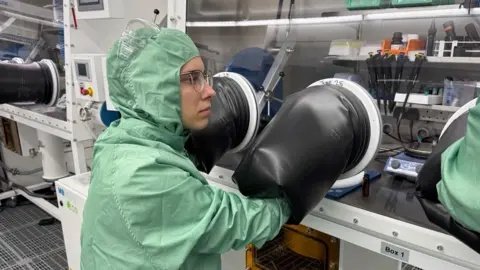
The teenager, now living in Swansea, has become the first school pupil ever to complete an internship at Swansea University’s prestigious Centre of Integrative Semiconductor Materials (CISM). The internship programme is normally reserved for third-year undergraduates who have already completed extensive training in physics. Yet Kateryna, still in her A-level studies, not only qualified but excelled, drawing praise from senior academics who described her as “exceptional,” “brilliant,” and years ahead of her peers in intellectual maturity.
Her work focused on the frontier of solar space technology—high-efficiency semiconductors designed for satellites that orbit the Earth and capture sunlight continuously. These ultra-thin photovoltaic panels could one day beam clean energy back to Earth, helping countries meet ambitious net-zero targets without depending on weather patterns or daylight cycles. For Kateryna, who once spent months without a desk of her own, the idea that she is now contributing to research with global implications is still difficult to comprehend.
“It’s strange in a way,” she said, reflecting on her rapid transformation from refugee to researcher. “When I first came here, I didn’t have any space to study. I didn’t know if I’d be able to continue with science the way I wanted. But now I’m working with scientists and studying materials that have to survive extreme temperatures in space. Sometimes I still can’t believe it.”

Kateryna arrived in Wales in 2022, alongside her mother, Olena, and her grandmother, also named Kateryna. Like thousands of Ukrainians who escaped the invasion, they came through humanitarian routes set up jointly by the UK and Welsh governments. Their first home in Britain was a hotel room in Swansea—a small, temporary space that became their world for 10 long months.
There was no private study corner, no quiet desk, no separation between rest and work. For a child who had spent her early years answering complex maths questions for fun, adapting to hotel living was painful.
“I didn’t have the space to think clearly,” she recalled. “Studying was very hard because you’re in one room with two other people all the time. You can’t concentrate; you can’t spread out your books. It was difficult, but somehow we kept going.”
Finding a permanent flat shortly before her GCSE exams changed everything. With a bedroom of her own and a desk where she could study late into the evening, Kateryna’s academic talents blossomed. She went on to achieve top grades and was soon recommended for the CISM internship.
At Swansea University, Kateryna stepped into a world where cutting-edge research meets industrial innovation. Her internship focused on semiconductors used in space-based solar panels—technology with the potential to reshape how the world produces energy.
Unlike traditional solar panels made from silicon, which are heavy and limited by Earth’s climate and rotation, the space-based model captures sunlight continuously. Positioned in orbit, such panels can remain in full sunlight almost 24 hours a day, generating large amounts of energy that can be transmitted to receiving stations on the ground.
Dr ****** Gregory Burwell, a senior lecturer in the physics department and one of Kateryna’s mentors, stressed the importance of her research. “The challenge,” he explained, “is that satellites must endure extreme heat when facing the sun and extreme cold when shielded behind the Earth. Semiconductors must continue to function efficiently despite this.”
Kateryna was tasked with examining how thin-film photovoltaic materials behave under these fluctuating conditions. While most school pupils her age are studying basic principles of physics, she was handling equipment and problems typically assigned to advanced undergraduates.
“Kateryna’s achievements demonstrate what is possible when talented students are given access to advanced facilities and the right mentoring,” Dr Burwell said. “Her work on photovoltaics in space is highly relevant to future energy systems. This internship was the first of its kind, and she set the bar extremely high.”
Kateryna’s ambitions stretch far beyond photovoltaic research. She dreams of becoming a theoretical physicist, following in the footsteps of Albert Einstein and Stephen Hawking. She often jokes that school feels “quite easy” compared to her university internship.
She has begun A-levels in further mathematics, mathematics, physics, chemistry, computer science, as well as the Welsh baccalaureate. It is an exceptionally demanding workload, yet one she approaches with enthusiasm.

“Physics explains everything,” she said. “I love the challenge of trying to understand the world through equations and theories. It’s like solving a huge puzzle.”
Despite her love for Wales, she admits she is uncertain about where she will study next. Although she would like to apply to Oxford or Cambridge, she is also considering universities in Germany or Austria due to the rising tensions around refugees and immigration in Britain.
“I’ve been very fortunate not to face direct hostility,” she said. “But when you hear discussions about deportations or ending support for Ukrainian refugees, it is worrying. I need stability for my future, especially in science.”
Kateryna’s journey unfolds at a time when Ukraine continues to suffer damage to its infrastructure, especially its power grid. Russian attacks on energy facilities have left thousands without electricity, heating, or running water. As winter approaches, the humanitarian strain is increasing.
“Many people don’t realise how hard it has become,” she said. “Towns are without water, without gas. Many families have had to evacuate again because the front lines are too dangerous. Help is still needed, and it is important to talk about it.”
Her comments come as volunteers in Wales prepare hundreds of Christmas parcels for Ukrainian hospitals, orphanages, and refugee centres. The resilience of Welsh communities continues to leave a deep impression on Kateryna and her family.
Her mother, Olena, said she remains profoundly grateful. “Wales gave us safety when we needed it the most,” she said. “The people here are kind. They helped us find food, a home, an education. Seeing my daughter succeed like this brings me happiness every single day.”
What lies ahead for Kateryna is uncertain but full of possibility. Her research at CISM will now be studied further by older undergraduates, and she hopes one day to contribute to real-world satellite projects. She wants to help design the next generation of space technology—advancing the world’s ability to produce clean energy and reduce dependence on fossil fuels.
From a cramped hotel room to the laboratory halls of Swansea University, her journey shows how resilience, opportunity, and education can transform a life. Her work may one day help power cities, support climate goals, and bring the world closer to a sustainable future.
Related News:
 Critically Endangered Spider Rediscovered in UK After 40 Years
 Experts Urge Legal Right to Timely Cancer Care
 North Sea oil workers must lose weight or face job loss
 No link found between paracetamol in pregnancy and autism
 NHS frontline staff forced to cover gaps as managers remain scarce
 Tech firms to test AI safeguards against child abuse images
 New Research Explains Severe Diabetes in Children
 Working-Class Men with Prostate Cancer Left Behind by NHS
 Healthy Habits in Your 30s That Boost Life in Your 70s
 Cardiff Shopper ‘Branded a Thief’ by Facewatch System
 Raccoons Could Become America’s Next Pet
 Australia to Ban Social Media for Kids Under-16 Starting December
 Coffins Now Too Large to Cremate Amid Rising Obesity Crisis
 Australians Angry as BOM Website Revamp Backfires
 Shocking Rise in Children’s Exposure to Violent Online Pornography Raises Alarm
 Spectacular ‘Blood Moon’ Illuminates Skies Across the Globe
 Weatherwatch: From Astrology to Modern Meteorology
 Persistent Offenders Owe Over £700m in Ulez Fines as TfL Cracks Down on Evasion
 Peterborough Mosques Tighten Security After Attack
 Hospice Cuts Raise Alarm Across England Amid Funding Crisis
 Virgin Trains Moves Closer to Challenging Eurostar Monopoly
 UK Woman Loses Child Benefit After Booking Flight She Never Took
 UK launches search for first-ever ‘town of culture’ to highlight overlooked areas
 Army Officers Orders to Cut Ties with Men-Only Clubs
 Children to Learn Local History in Major Curriculum Overhaul
 The Lowry Hotel: Manchester’s Iconic Five-Star Retreat
 UK Bans Fake Numbers: Scammers Lose Their Trick
 Prince William Plants Trees with Brazil’s Nature Heroes
 World Whisky Tour: 9 Global Gems
 Greta Thunberg Backs Student Facing UK Visa Revocation
 Kent village told to remove flags before Christmas lights go up
 Vibe coding’ named Collins dictionary’s word of the year
 Patients to Test Health at Home to Ease NHS Winter Pressure
 Earl of Yarmouth Faces £1.3m Legal Bill Over Family Estate
 Jailed UK climate protesters face extremist-style restrictions
 Britain deploys RAF specialists to assist Belgium with drone threats
 How to get help when a child goes missing – call 999 urgently
 ‘Reckless’ cuts to victims’ services will cost more than they save
 From Lego to Pokémon: How Adults Are Driving UK Toy Market Growth
 UK Faces Arctic Blast as Polar Vortex Disruption Brings Heavy Snow
 Shouting Works Best to Deter Gulls, UK Study Finds
 Reeves rejects £1bn plea for NHS redundancy payouts
 Stop using ChatGPT to write speeches, AI minister tells MPs
 UK toy market enjoys bumper year as ‘kidults’ fuel demand
 Northern Lights may illuminate UK skies this week
 New laws to bolster UK’s defences against cyber attacks on NHS, transport and energy
 Politics latest: Starmer ‘will fight any leadership coup’ as Streeting denies attempt to oust Labour PM
 PM Condemns Leaks, Vows Loyalty to Ministers and Stability
 Son Reveals UK Couple in Iran Resort to Hunger Strike for Help
 Hitler’s DNA Confirms He Truly Had Only One Testicle
 Senator John Fetterman Hospitalized After Fall from Heart Flare-Up, Keeps Sense of Humor
 New AI tool could cut wasted efforts in organ transplants
 Australia Mourns Paralympic Champion Paige Greco
 How Cultures Interpreted the Aurora Through History
 Mum Calls for New Licence Rules After Teen Road Death
 From Baby Teeth to Bioengineering: The Future of Self-Healing Teeth
 Mother Watches in Horror as Teen Daughter Dies on Tracks
 Agency Workers Vote to Join Picket Lines Amid Dispute
 Irish Hero Parrott Says Goal Brought First Tears in Years
 Google Chief Urges Caution: Don’t Trust AI Blindly
 Seven Countries, One Winner: Europe’s Best Christmas Market
 ‘Traumatic Wait’: Northern Ireland Women Face Breast Cancer Delays
 Commuters warned as yellow snow and ice alert hits Northern Ireland
 US Judge Says Meta Did Not Hold Illegal Social Media Monopoly
 Woman Meets Boy Whose Life She Saved with Kidney
 Kate Forbes: Motherhood Harder Than Politics
 UK Taskforce Unveils Plan to Streamline Nuclear Reactor Rules
 NHS paediatric leave parents waiting months for answers
 Labour MP claims devolution bill is ‘blatant discrimination’ against Cornwall
 Ofcom urges platforms to limit abuse and curb online ‘pile-ons’
 Vicki Fears Losing Motability Car
 Planned Palestinian Flag Raising at Belfast City Hall Faces Delay Amid Legal Concerns
 Delhi’s Toxic Air Crisis Leaves Children Sick and Vulnerable
 Fibromyalgia Patients Struggle as NHS Fails to Provide Care
 Scotland Gains 33 New Towns – Life in Growing Communities
 Machynlleth High Street Left Without Christmas Lights
 AI Actress Creator Says Tilly Norwood Won’t Replace Actors
 Search underway for British man overboard off Tenerife
 Virgin Media Fined £23.8m Over Telecare Safety Failures
 Pavarotti statue frozen in Italian ice rink sparks backlash