Published: March 11, 2026
The English Chronicle Desk. The English Chronicle Online
Voters in the U.S. state of Georgia will return to the polls next month after a crowded special election to replace former congresswoman Marjorie Taylor Greene ended without any candidate securing a majority, forcing a decisive runoff between a Republican and a Democrat in the traditionally conservative district.
The race for Georgia’s 14th congressional district seat has attracted national attention, reflecting both the political significance of the district and the unusual circumstances that led to Greene’s departure from the U.S. House of Representatives earlier this year. ()

The special election, held on March 10, featured more than a dozen candidates from different political parties competing on a single ballot, as required under Georgia law. Because no contender received more than 50 percent of the vote, the two candidates with the highest totals advanced to a runoff scheduled for April 7. ()
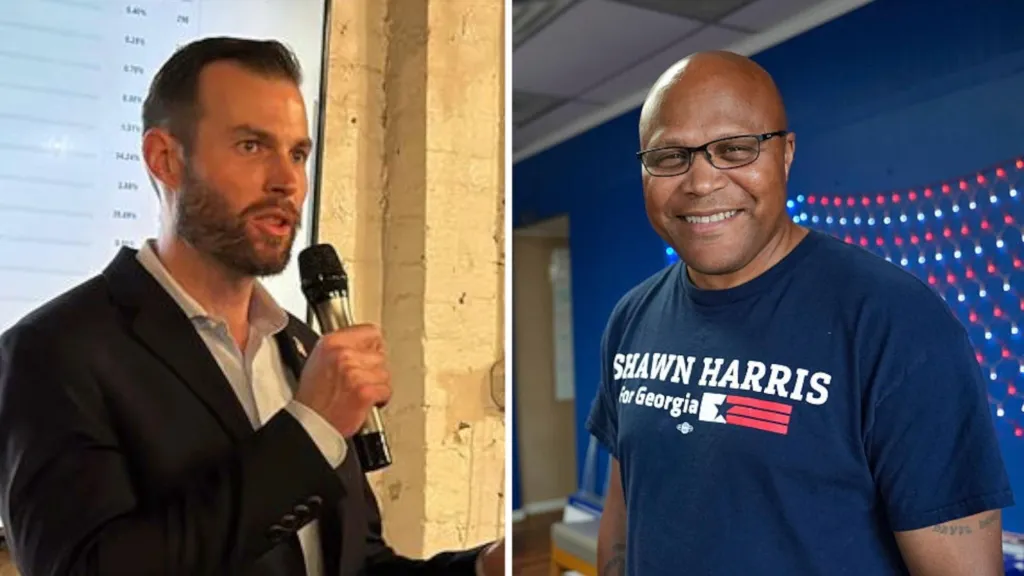
The runoff will pit Republican district attorney Clay Fuller against Democrat Shawn Harris, a retired U.S. Army brigadier general and cattle farmer who previously challenged Greene in the 2024 election. ()
Early results showed Harris finishing first in the initial round with roughly 37 percent of the vote, while Fuller secured about 35 percent in a crowded field dominated by Republican contenders. ()
Although Harris led the first round, political analysts note that Georgia’s 14th district is heavily Republican, meaning Fuller is widely considered the favorite in the upcoming runoff. The district, located in the northwest corner of the state, strongly supported Republican candidates in recent national elections and delivered a large majority of votes for Donald Trump in the 2024 presidential race. ()
The contest is being closely watched as a potential test of Trump’s continued influence in Republican politics. Fuller, who serves as a district attorney and lieutenant colonel in the Georgia Air National Guard, received Trump’s endorsement during the campaign, a factor that helped him stand out among a large group of Republican candidates. ()
Harris, meanwhile, built his campaign around a message of pragmatic leadership and cross-party cooperation. His campaign has emphasised economic concerns affecting voters in northwest Georgia and the need for a less confrontational style of politics than the one often associated with Greene’s tenure in Congress. ()
The special election was triggered after Greene resigned from Congress in early January 2026 following a highly publicised split with Trump and disagreements within the Republican Party. Her departure created an unexpected vacancy in one of the most reliably conservative congressional districts in the United States. ()
Greene had been one of the most prominent and controversial figures in the Republican Party during her time in office. First elected in 2020, she became known nationally for her outspoken support of Trump and her alignment with the “America First” wing of the party.
Her resignation set off a scramble among Republican candidates eager to inherit her political base, which contributed to the unusually large number of contenders entering the race. In total, more than a dozen Republicans joined the ballot alongside several Democrats and independent candidates. ()
Because Georgia uses a special election system in which all candidates appear on a single non-partisan ballot regardless of party affiliation, the vote effectively functioned as an open primary. The top two vote-getters moved on to the runoff regardless of their party identity. ()
The outcome of the April runoff will determine who serves the remainder of Greene’s congressional term, which runs until January 2027. ()
Although the district’s strong Republican lean makes a Democratic victory unlikely, Harris’s performance in the first round has encouraged Democratic strategists who see the contest as an opportunity to test their appeal in conservative-leaning areas. Some analysts say even a competitive result could signal shifting political dynamics in rural parts of the United States.
For Republicans, the race carries different implications. Party leaders are watching closely to see whether Trump-aligned candidates continue to dominate primary contests and maintain control of traditionally conservative districts.
The runoff campaign is expected to intensify over the coming weeks as both candidates attempt to mobilise voters who supported eliminated contenders in the first round.
Political observers say turnout will likely play a decisive role. Special election runoffs often attract significantly fewer voters than the initial contest, meaning that campaigns with the most motivated supporters can gain a crucial advantage.

As the campaign enters its final stage, the Georgia race is increasingly being viewed as a small but symbolically important test of the balance of political forces shaping American politics ahead of the broader 2026 midterm elections.
For now, voters in northwest Georgia are preparing for one more trip to the ballot box—one that will decide who inherits a seat that has become one of the most closely watched in the U.S. Congress.
Related News:
 Putin Intensifies Territorial Demands Before US Talks
 Trump to Recheck Green Cards from 19 Nations After DC Attack
 Russia losses Ukraine war peace talks intensify amid rising deaths
 Trump Escalates Minnesota Immigration Surge Amid Rising Tensions
 Trump: US Stands Ready to Help Iran Find Freedom Amid Widespread Unrest
 US Conducts Large-Scale Strikes Against ISIS Targets Across Syria
 Trump Says US Will Act on Greenland ‘Whether They Like It or Not’
 Trump Administration Probe of Fed’s Powell Draws Pushback
 Greenland Faces Pivotal Summit Over Arctic Power Struggle
 Trump Threatens Strong Action If Iran Executes Protesters
 Trump Receives Machado’s Nobel Medal in White House Meeting
 Greenland Crisis Forces Europe to Draw a Line With Trump
 Iran Cannot Be Bombed Into Democracy, Only Helped There
 Historic Abu Dhabi Talks Bring US, Ukraine and Russia Together
 Trump Pulls Canada from His Controversial ‘Board of Peace’ Plan
 EU Says US Ties Have Suffered ‘Big Blow’ After Greenland Crisis
 Thousands Protest ICE Operations in Nationwide US Day of Action
 Epstein Files Reveal Trump Officials’ Emails with Financier
 Thousands Protest ICE in New York Against Trump Deportation Campaign
 Trump Praises ‘Terrific’ Petro After White House Talks
 US Must Be Prudent When Supplying Arms to Taiwan, Xi Tells Trump
 Fears of New Arms Race as US-Russia Nuclear Weapons Treaty Expires
 New Nuclear Talks Between US and Iran Begin in Geneva
 ‘He Did It for Us’: US Soldier Recalls Jesse Jackson’s Efforts to Free Him and Two Other POWs
 Under Pressure From Trump, Venezuela’s New President Has Aces Up Her Sleeve
 Stephen Colbert Says CBS Spiked Interview With Democrat Over FCC Fears
 US to Withdraw Troops from Syria
 US Urges Iran to Make Deal as Military Presence Rises
 Trump’s Foreign Policy Dilemma Laid Bare by Iran Tensions
 Billionaire Les Wexner Tells US Lawmakers He Was ‘Naive’ and ‘Conned’ by Epstein
 Inside Kyiv’s resolve as conflict nears five‑year mark
 What to Watch for During Trump’s State of the Union Address
 US Partially Evacuates Beirut Embassy Amid Rising Iran Tensions
 Clinton Testimony Erupts in Fiery Exchange
 American Citizen Killed in Cuba Boat Shooting, U.S. Officials Say
 Hillary Clinton Tells House Panel She ‘Had No Idea’ of Epstein’s Crimes
 Hopes and Fears as US Iranians Take to Streets After Toppling of Supreme Leader
 Iran, the US, and a World Cup That Starts in Three Months
 Britain’s Position and Trump Vows to Press On in Iran Conflict
 Trump Faces Questions Over Iran Conflict Plan
 Trump’s Iran Endgame Unclear After Mixed Messaging on War Aims
 Rubio Responds to Reported Strike on Iranian School
 US Senate Backs Trump War Powers Amid Iran Missile Barrage
 Six US Soldiers Killed in Iran-Linked Kuwait Strike
 US Senate Vote Fails to Rein in Trump War Powers on Iran
 Trump Removes Kristi Noem From Homeland Security Role
 US and Venezuela Agree to Resume Diplomatic Ties After Maduro Capture
 UK Prepares Aircraft Carrier for Middle East Crisis
 Pete Hegseth Iran War Remarks Spark Alarm
 Iran War Puts Trump at Political Risk Amid Rising Prices
 Iran Rejects Ceasefire, Warns Trump With Chilling Message
 UK Must Act with Courage and Clarity on Israel-Palestine Conflict, Says Foreign Affairs Committee Report
 Channel Crossings Surge: Over 1,000 People Arrive in the UK in Small Boats in a Single Day
 Yvette Cooper Signals Global Momentum Towards Gaza Peace Deal Amid Humanitarian Crisis
 Russia’s Latest Push to Win US Favors Shows Deep Desperation
 BBC to Apologise Over Edited Trump Speech Amid Backlash
 Britain deploys RAF specialists to assist Belgium with drone threats
 Trump Urges Herzog to Grant Netanyahu Full Pardon
 Indian authorities demolish Kashmir home linked to Red Fort blast
 Greene Pushes Epstein Files Amid Trump Fallout
 December Run-Off in Chile as Election Produces No Winner
 Shadow Fleet at Sea: Europe’s Battle Against Illicit Oil Shipping
 India’s COP30 Delay Raises Global Climate Concerns
 Georgians Defy Government Crackdown After Year of Protests
 Trump Weighs Response to Iran Crackdown as Tehran Says Communication Open With US
 US Clears Nvidia AI Chip Sales to China in Policy Shift
 ‘Trump Will Be Gone in Three Years,’ Top Democrats Tell Europe
 Australian Families Leave Syrian Camp for Home
 Australian PM Says Former Prince Andrew Has Suffered ‘Extraordinary Fall’ but That Won’t Prompt Republic Referendum
 Farage Chagos Islands Row Sparks Fury
 Ukraine Negotiator Reveals What It Feels Like Facing Russia
 Chad Shuts Border With Sudan in Bid to Stop Conflict Spreading
 Iran’s Regime Still Intact — Coming Days Will Test Its Survival
 Herzog Asio meeting sparks security storm
 Finland Plans to Lift Decades‑Old Ban on Hosting Nuclear Weapons
 Minister Meets Crews Who Will ‘Take Out’ Iranian Drones
 Thousands Protest Iran Strikes Outside US Embassy London
 Nine Days of Strikes Reshape the Middle East
 Trump Pressures Congress Over Save America Act
 Real Estate Brothers Convicted in Sex Trafficking Trial