Published: March 5, 2026
The English Chronicle Desk
The English Chronicle Online
A deadly attack on a United States military facility in Kuwait has claimed the lives of six American soldiers, marking one of the most serious recent escalations linked to the ongoing tensions between the United States and Iran in the Gulf region. The US Department of Defense confirmed the identities of the fallen service members after an unmanned aircraft system struck a command centre at Port Shuaiba on Sunday, breaching air defences and hitting a tactical operations site where troops were stationed.

Initial reports from US Central Command indicated that three soldiers had been killed in the attack. However, the death toll rose to six by Monday after one injured soldier died from wounds and two additional bodies were recovered from the rubble of the damaged structure. Officials later disclosed the identities of the victims over several days as families were notified and information was verified.
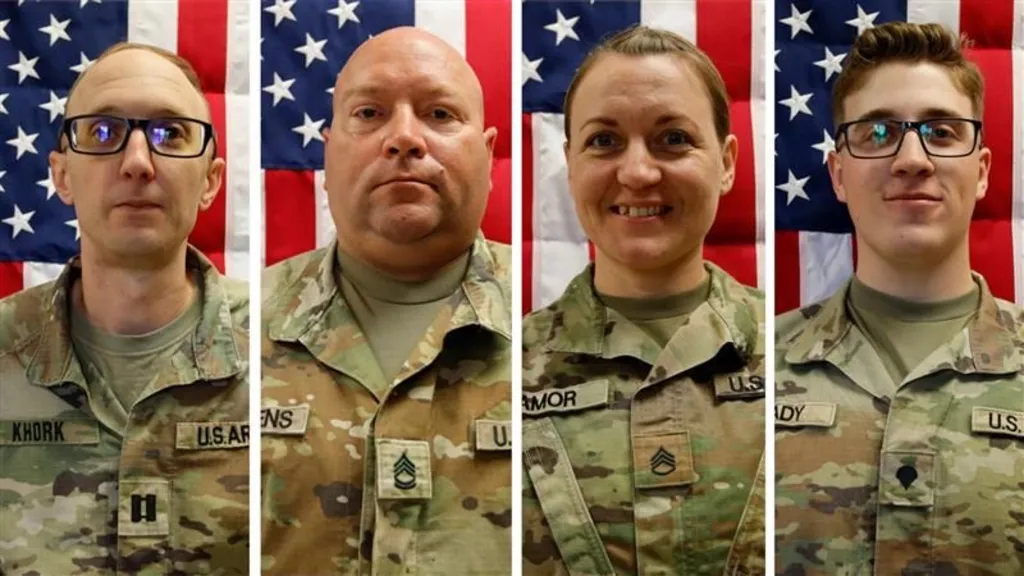
The six soldiers were identified as Chief Warrant Officer 3 Robert M. Marzan, 54, Major Jeffrey R. O’Brien, 45, Captain Cody Khork, 35, Sergeant Noah Tietjens, 42, Sergeant Nicole Amor, 39, and Sergeant Declan Coady, 20. All were members of the United States Army Reserve, a component of the US Army that provides essential logistical, operational and support roles for military deployments around the world.
Four of the soldiers were formally identified earlier in the week, while the final two names—Marzan and O’Brien—were publicly confirmed on Wednesday. US Army Secretary Daniel Driscoll paid tribute to the fallen troops, describing them as individuals who had volunteered to serve their country and whose sacrifice would never be forgotten.
The White House also acknowledged the tragedy, with Press Secretary Karoline Leavitt stating that President Donald Trump intends to attend the dignified transfer ceremony for the fallen soldiers once their remains are returned to the United States. Such ceremonies traditionally take place at military airbases and serve as a solemn moment when the remains of service members killed overseas are received by military personnel and grieving families.
The Pentagon said arrangements are currently being made by the Department of Defense to repatriate the soldiers’ remains. Military officials indicated that support services are being provided to the families of those who lost their lives.
Among the victims was Captain Cody Khork, a Florida resident who had long aspired to serve in the military. According to statements provided by his family to the Associated Press, Khork had pursued his goal of military service from a young age and enrolled in the Reserve Officers’ Training Corps programme while attending university. Over the course of his career, he had previously been deployed to Saudi Arabia, Guantanamo Bay and Poland.
Family members described Khork as someone whose personality and dedication left a strong impression on those around him. In a joint statement, his mother Donna Burhans, father James Khork and stepmother Stacey Khork remembered him as a person with an infectious spirit, a generous heart and a deep sense of commitment to those who served alongside him.
Sergeant Nicole Amor, who was from Minnesota, also had significant deployment experience. She had previously served in Kuwait and Iraq and was nearing the end of her latest assignment at the time of the attack. Her husband Joey Amor told reporters that the family had not expected danger during the Kuwait deployment, reflecting on the painful reality that she was among the first American casualties of the latest confrontation.
Amor leaves behind two children, a son in high school and a younger daughter in primary school. Friends and family remembered her as someone who loved spending time outdoors with her children, gardening and rollerblading together during family time at home.
Another soldier killed in the strike, Sergeant Noah Tietjens of Nebraska, had been deployed to Kuwait twice before. Described by relatives as a devoted husband and father, Tietjens was also widely respected for his commitment to martial arts training. According to the Philippine Martial Arts Alliance, he had earned a black belt in Taekwondo and trained extensively in Philippine Combatives, a system of martial arts that emphasizes discipline and close-quarters combat skills.
In a tribute posted online, the alliance said Tietjens represented the values of martial arts not only in training but also in the way he lived his life. The organization described him as a person who led with integrity, trained with purpose and taught with humility.
Sergeant Declan Coady, the youngest of the fallen soldiers at 20 years old, had joined the Army Reserve just three years earlier. Originally from Iowa, he served as an information technologies specialist supporting military communications and digital systems. Following his death, the US military announced that he had been posthumously promoted from the rank of specialist to sergeant in recognition of his service.
Coady had studied at Drake University, which released a statement expressing grief over the loss of a young man described as having an exceptionally bright future. His father Andrew Coady told reporters that his son had been highly skilled in his field and had demonstrated remarkable dedication during his short military career.
Members of his family are still struggling to come to terms with the loss. His sister Keira Coady said she continues to find it difficult to believe that he is gone, recalling conversations they had about his plans for the future once he returned home from deployment.
Major Jeffrey O’Brien, another victim of the attack, was from Indianola, Iowa. He joined the Army Reserve in 2012 and had previously been deployed to Kuwait in 2019. His experience and leadership were considered valuable within the unit.
Meanwhile, the identification of Chief Warrant Officer 3 Robert M. Marzan of Sacramento, California, is still undergoing final confirmation by a medical examiner. Military officials said that although his identity is known, formal procedures must be completed before all details are officially finalised.
Details about the strike itself remain under investigation. According to US Defense Secretary Pete Hegseth, the facility targeted by the drone was a fortified tactical operations centre. The attack involved what he described as a powerful weapon capable of penetrating defences that were designed to protect personnel.
However, questions have begun to emerge regarding whether the location where the soldiers were working provided sufficient protection against such attacks. Three US military officials familiar with the incident told CBS News that the troops had been operating from what was essentially a makeshift office space.
The officials indicated that the workspace consisted of a trailer surrounded by steel-reinforced concrete barriers. While those barriers are commonly used for protection against blasts or shrapnel, some military analysts have suggested that they may not have been adequate against a direct strike by a high-powered unmanned aerial weapon.
The attack took place in Port Shuaiba, a strategic port area in Kuwait where US military logistics and operational activities are frequently conducted. The United States maintains a longstanding defence partnership with Kuwait, and more than 13,000 American troops are currently stationed in the Gulf country.
The broader regional situation remains tense. Iran has previously responded to military actions against it by launching missile or drone strikes against Gulf nations that maintain close alliances with the United States. Countries including Bahrain, the United Arab Emirates, Saudi Arabia, Oman and Qatar have all experienced attacks during periods of heightened confrontation in the region.
Security analysts warn that incidents such as the strike in Kuwait could further intensify instability across the Gulf, where numerous US military bases and strategic facilities operate within range of Iranian missile and drone systems.

For now, the focus in the United States remains on honouring the six soldiers whose lives were lost. Their families, fellow service members and communities across the country are mourning the sudden loss of individuals who had volunteered to serve in one of the world’s most volatile regions.
As investigations continue into the circumstances surrounding the attack, military leaders have indicated that operational and defensive measures may be reviewed to prevent similar tragedies in the future.
Related News:
 Putin Intensifies Territorial Demands Before US Talks
 Trump to Recheck Green Cards from 19 Nations After DC Attack
 Russia losses Ukraine war peace talks intensify amid rising deaths
 Trump Escalates Minnesota Immigration Surge Amid Rising Tensions
 Trump: US Stands Ready to Help Iran Find Freedom Amid Widespread Unrest
 US Conducts Large-Scale Strikes Against ISIS Targets Across Syria
 Trump Says US Will Act on Greenland ‘Whether They Like It or Not’
 Trump Administration Probe of Fed’s Powell Draws Pushback
 Greenland Faces Pivotal Summit Over Arctic Power Struggle
 Trump Threatens Strong Action If Iran Executes Protesters
 Trump Receives Machado’s Nobel Medal in White House Meeting
 Greenland Crisis Forces Europe to Draw a Line With Trump
 Iran Cannot Be Bombed Into Democracy, Only Helped There
 Historic Abu Dhabi Talks Bring US, Ukraine and Russia Together
 Trump Pulls Canada from His Controversial ‘Board of Peace’ Plan
 EU Says US Ties Have Suffered ‘Big Blow’ After Greenland Crisis
 Thousands Protest ICE Operations in Nationwide US Day of Action
 Epstein Files Reveal Trump Officials’ Emails with Financier
 Thousands Protest ICE in New York Against Trump Deportation Campaign
 Trump Praises ‘Terrific’ Petro After White House Talks
 US Must Be Prudent When Supplying Arms to Taiwan, Xi Tells Trump
 Fears of New Arms Race as US-Russia Nuclear Weapons Treaty Expires
 New Nuclear Talks Between US and Iran Begin in Geneva
 ‘He Did It for Us’: US Soldier Recalls Jesse Jackson’s Efforts to Free Him and Two Other POWs
 Under Pressure From Trump, Venezuela’s New President Has Aces Up Her Sleeve
 Stephen Colbert Says CBS Spiked Interview With Democrat Over FCC Fears
 US to Withdraw Troops from Syria
 US Urges Iran to Make Deal as Military Presence Rises
 Trump’s Foreign Policy Dilemma Laid Bare by Iran Tensions
 Billionaire Les Wexner Tells US Lawmakers He Was ‘Naive’ and ‘Conned’ by Epstein
 Inside Kyiv’s resolve as conflict nears five‑year mark
 What to Watch for During Trump’s State of the Union Address
 US Partially Evacuates Beirut Embassy Amid Rising Iran Tensions
 Clinton Testimony Erupts in Fiery Exchange
 American Citizen Killed in Cuba Boat Shooting, U.S. Officials Say
 Hillary Clinton Tells House Panel She ‘Had No Idea’ of Epstein’s Crimes
 Hopes and Fears as US Iranians Take to Streets After Toppling of Supreme Leader
 Iran, the US, and a World Cup That Starts in Three Months
 Britain’s Position and Trump Vows to Press On in Iran Conflict
 Trump Faces Questions Over Iran Conflict Plan
 Trump’s Iran Endgame Unclear After Mixed Messaging on War Aims
 Rubio Responds to Reported Strike on Iranian School
 US Senate Backs Trump War Powers Amid Iran Missile Barrage
 UK Must Act with Courage and Clarity on Israel-Palestine Conflict, Says Foreign Affairs Committee Report
 Radioactive Leak at UK’s Nuclear Warhead Base Sparks Outcry Over Safety and Secrecy
 Mutual Inconvenience: Why Alaska Was Chosen for the Trump-Putin Summit on Ukraine
 Hong Kong Summons UK and Australian Envoys Following Asylum Grants to Democracy Activists
 Is the UK Ready to Put Boots on the Ground in Ukraine? Assessing Military Capacity and Challenges
 Channel Crossings Surge: Over 1,000 People Arrive in the UK in Small Boats in a Single Day
 Yvette Cooper Signals Global Momentum Towards Gaza Peace Deal Amid Humanitarian Crisis
 Russia’s Latest Push to Win US Favors Shows Deep Desperation
 BBC to Apologise Over Edited Trump Speech Amid Backlash
 Britain deploys RAF specialists to assist Belgium with drone threats
 Trump Urges Herzog to Grant Netanyahu Full Pardon
 Indian authorities demolish Kashmir home linked to Red Fort blast
 Greene Pushes Epstein Files Amid Trump Fallout
 December Run-Off in Chile as Election Produces No Winner
 Canada Passes Carney’s First Budget in Tight Parliamentary Vote
 Shadow Fleet at Sea: Europe’s Battle Against Illicit Oil Shipping
 India’s COP30 Delay Raises Global Climate Concerns
 Georgians Defy Government Crackdown After Year of Protests
 US National Guard Member Killed in DC Shooting
 American Mother Extradited From UK to U.S. on Murder Charges
 Albanese Opens Door to Bondi Royal Commission Amid Rising Pressure
 Trump Weighs Response to Iran Crackdown as Tehran Says Communication Open With US
 US Clears Nvidia AI Chip Sales to China in Policy Shift
 EU weighs response amid Greenland tariff crisis with Trump
 Videos reveal earlier clash before Alex Pretti shooting
 Israel Moves to Bar MSF From Gaza Operations
 Nurses’ families fear breakup under UK immigration crackdown
 ‘Trump Will Be Gone in Three Years,’ Top Democrats Tell Europe
 Australian Families Leave Syrian Camp for Home
 Starmer Weighs Fast-Tracking Defence Boost
 Nine Arrested in France Over Death of Far‑Right Student
 Australian PM Says Former Prince Andrew Has Suffered ‘Extraordinary Fall’ but That Won’t Prompt Republic Referendum
 Farage Chagos Islands Row Sparks Fury
 Ukraine Negotiator Reveals What It Feels Like Facing Russia
 Chad Shuts Border With Sudan in Bid to Stop Conflict Spreading
 Iran’s Regime Still Intact — Coming Days Will Test Its Survival
 Herzog Asio meeting sparks security storm