Published: 6 May 2026. The English Chronicle Desk. The English Chronicle Online
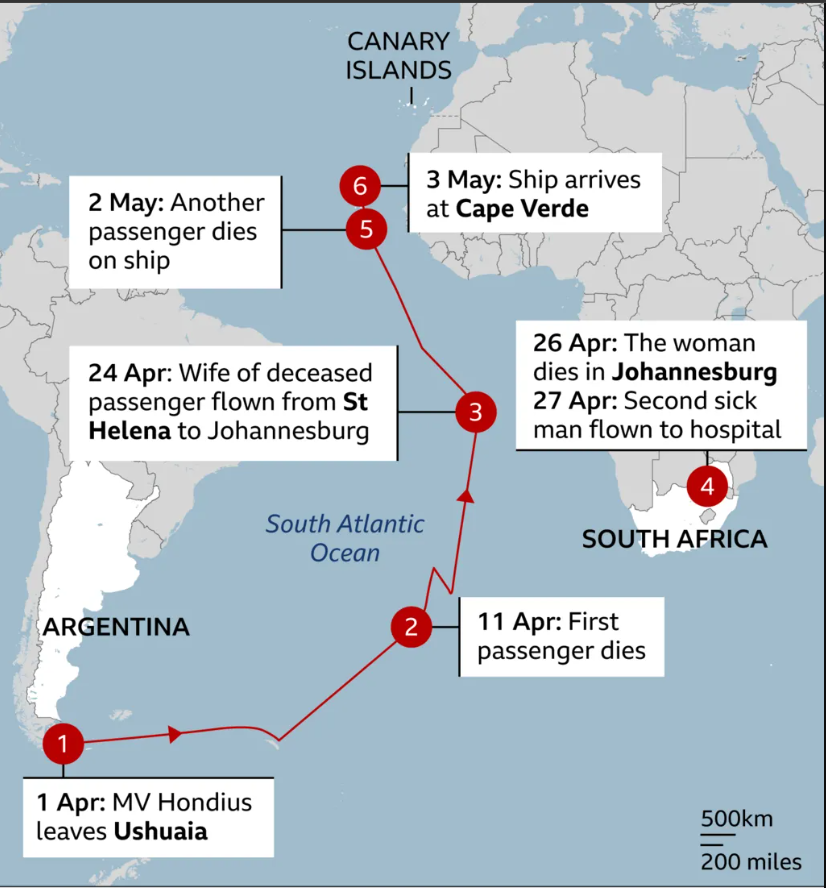
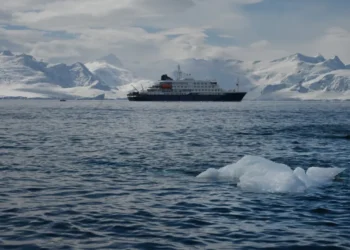
In a developing “national security emergency” for regional health, the luxury expedition ship MV Hondius is currently steaming north toward the Canary Islands under a cloud of international concern. The vessel, carrying 147 passengers and crew, has been at the center of a “clinical” and deadly hantavirus outbreak that has already claimed three lives and left several others in critical condition.

After being barred from docking in Cabo Verde, the ship was granted “humanitarian” entry to Spanish waters by the Ministry of Health, which determined that the archipelago was the “closest place with the necessary capabilities” to handle a rare and potentially “divergent” viral threat.
The crisis began in late April during the ship’s voyage from Ushuaia, Argentina, toward the South Atlantic.
The Death Toll: As of May 6, three fatalities have been recorded. The index case, an adult male who died on April 11, was followed by two more deaths as the virus moved through the “clinical silence” of the passenger decks.
Human-to-Human Suspicions: In a “milestone” statement for virology, the World Health Organization (WHO) suggested that “rare human-to-human transmission” may have occurred between close contacts on board, such as cabin-mates. If confirmed, this would mark a significant shift from the virus’s typical spread via rodent droppings.
The “Clinical” Profile: Patients have exhibited a “rapid progression” from fever and gastrointestinal distress to Hantavirus Pulmonary Syndrome (HPS)—a condition characterized by acute respiratory failure and shock.
The decision to dock in Tenerife or Gran Canaria has sparked a “postcode lottery” of anxiety among local residents and tourists.
The Medevac Operation: Before the ship reaches the islands, a high-stakes “human-machine coordination” is underway to medically evacuate two critically ill crew members—including the ship’s doctor—via Cabo Verde to specialized facilities in the Netherlands.
The “Three-Day” Sail: The MV Hondius is expected to arrive at a “yet-to-be-disclosed” port in the Canaries within 72 to 96 hours. Upon arrival, the ship will likely face a “clinical” quarantine, with passengers repatriated under strict medical supervision.
Bypassing the “Resilience Deficit”: Spanish authorities have emphasized that the “accountability rot” seen in early 2020 cruise ship handlings will not be repeated. “Justice has no expiry date for public health,” stated a Ministry spokesperson, promising a “fully isolated” disembarkation process.
While hantaviruses are traditionally linked to infected rodents, the “Hondius” case is being treated as an “asymmetric challenge” due to its maritime setting.
Environmental Vetting: Experts are investigating whether passengers were exposed during stops in remote ecological zones like South Georgia or Tristan da Cunha, or if a “resilience deficit” in onboard pest control allowed the virus to gain a foothold.
The “160 MPH Clip” of Fear: Travel stocks for major cruise lines have dipped slightly as news of the outbreak hit the “dopamine desert” of the morning markets, though health officials stress the risk to the general public in the Canary Islands remains “very low.”

As the RHS Wisley wisteria blooms and the Southbank Centre celebrates 75 years of progress, the MV Hondius represents a “recalibration” of how the world manages “frontier” health threats.
“The situation is being closely monitored,” noted Maria Van Kerkhove of the WHO. “We are working to ensure that the ‘golden tone’ of a safe return is possible for those on board.” With the King’s Speech on May 13 expected to reference “Global Health Resilience,” the arrival of the “Hantavirus Ship” in the Canaries will be the ultimate test of the “clinical” coordination between the WHO, Spain, and the European Centre for Disease Prevention and Control.
Related News:
 Facing a Demographic Catastrophe, Ukraine Is Paying for Troops to Freeze Their Sperm
 “The Floating Fever”: WHO Confirms Second Hantavirus Case as Cruise Outbreak Death Toll Reaches Three
 Costa Blanca Holiday Horror as Food Poisoning Outbreak Hits Four-Star Hotel
 CDC Plunged Into Turmoil as Ousted Chief Susan Monarez Refuses to Step Down
 First Group of Children from Gaza Arrive in UK for Life-Saving NHS Treatment
 Global Study Reveals Violence in GP Surgeries Linked to Long Waiting Times and Drug Refusals
 The diet that can significantly ease symptoms of IBS
 EU weighs response amid Greenland tariff crisis with Trump
 EU Says US Ties Have Suffered ‘Big Blow’ After Greenland Crisis
 Thousands Left Without Heating in Ukraine Amid Russia Strikes
 Canada Dispatches Senior Officials to Open Greenland Consulate
 Portugal Election Delivers Socialist Win as Far Right Surges
 Two Britons Among Three Dead in French Alps Avalanche
 Cuban Cigar Festival Cancelled Amid US-Linked Energy Crisis
 Macron Rebuked in Franco-German Defence Row
 Five Young People Die in Spain Apartment Block Fire
 Jet2 Hands Passengers Life Ban After Mid‑Air Brawl
 Dual Nationals Face Scramble for UK Passports as New Rules Come Into Force
 Inland Australia Town Turns Streets into a Beach for Volleyball Contest
 New Russia Sanctions on Hold as Hungary Blocks EU Package Ahead of Fourth Ukraine War Anniversary
 Major 7.1 Earthquake Strikes Off Malaysian Tourist Coast
 Brit Killed in Horror Bus Crash as 18 Others Die and 25 Injured
Storm Hernando: Edinburgh Airport Flights Cancelled in US Travel Chaos
Brit Killed in Horror Bus Crash as 18 Others Die and 25 Injured
Storm Hernando: Edinburgh Airport Flights Cancelled in US Travel Chaos
 More Than 5,000 Flights Cancelled as US East Coast Digs Out of Record Snow
 Drugs, Denial, Stigma: Fiji’s HIV Crisis Hits Children
 Rob Jetten becomes Netherlands’ youngest ever prime minister
 Ukraine remembers its dead as war enters a fifth year
 UK’s New Travel System: What It Is and How Dual Nationals Are Impacted
 Louvre Museum Director Resigns Months After High‑Profile Heist
‘I Wanted to Save Her Life’ — The Moment Twin Sisters Learned They Were Identical
Louvre Museum Director Resigns Months After High‑Profile Heist
‘I Wanted to Save Her Life’ — The Moment Twin Sisters Learned They Were Identical
 Orbán Accuses Ukraine of Disrupting Oil Supplies to Hungary
 Tick Bite Tragedy Claims Teen in Meat Allergy Case
 Spain Declassifies Files on 1981 Attempted Coup in Effort to Dispel Conspiracy Theories
 Hungary Faces Political Tension Over the Ukraine Crisis
 Flights Cancelled and New Travel Warnings Issued After Iran Strikes
 Islanders Advised on Travel to Middle East Amid Escalation
 Australian GP Confident Amid Travel Disruption
 Limited Flights Leave UAE But Disruption Continues Amid Iran Strikes
 Not in the Mood to Exercise? These Simple Daily Habits Work Every Time
 U.S. Tells Citizens to Leave Israel Now as Regional Conflict Escalates
 First Wave of Europeans Stranded by Iran Conflict Return Home, With Hundreds of Thousands Still Left in Region
 Russia Blames Ukrainian Naval Drones as Tanker Sinks
 UK Government’s First Repatriation Flight to Leave Middle East, More Planned
 Macron Finds ‘Freedom Fries’ Redemption in Iran Crisis
 Finland Plans to Lift Decades‑Old Ban on Hosting Nuclear Weapons
 My One-Hour Flight Transfer Left Me Facing 10 Days Stuck in a City Under Attack
 Cyprus Drone Strike Sparks Europe’s Strong Response
 Istanbul Mayor Faces Corruption Trial Amid Political Storm
 Air India Express Plane Damaged in Chaotic Landing at Phuket Airport
 Ukraine War Becomes Flashpoint in Hungarian Election
 Tehran Diary: Dark Days Under Relentless Bombardment
 Horror in the Outback as Crocodile Kills World-Renowned Doctor
 I’ve Lived in a French Village for 35 Years. This is Why They are So Special.
 ‘I’m So Ready’: Céline Dion Announces 10-Night Paris Comeback Residency
 ‘The Invisible Killer’: Chiang Mai Air Pollution Sparks Health Crisis as Children Suffer Nosebleeds
 ‘The Invisible Killer’: Chiang Mai Air Quality Crisis Sparks Pediatric Health Emergency
 “An Amazing Legacy”: Prince William Praises Incredible £20m Milestone for Bowelbabe Fund
 Who Is Viktor Orbán, Hungary’s Long-Serving PM?
 Paradise Aground: Cruise Ship Evacuated After Striking Reef Near ‘Cast Away’ Island
 “He Was One of the Kindest People I Knew”: The Tragic Death of Oliver Robinson
 Bangladesh Launches Emergency Vaccine Drive After 100 Child Deaths
 The Spiky Standoff: German Mayors Call for Night-Time ‘Robot Ban’ to Save Hedgehogs
 ‘The Soul of Spain’: Politicians Clash Over Renewed Push to Move Picasso’s Guernica
 The ‘Svuota Londra’ Effect: Why the Super-Rich are Swapping Dubai for Milan
 ‘Free at Last’: French Teachers Released as Iran Exchanges ‘State Hostages’ for Legal Concessions
 The Crown of Agony: Ranking the Most Painful Stings in the World
 Hungary election: Orbán faces biggest test amid scandal
 The Outback Squeeze: ‘Out of Control’ Diesel Prices Threaten Australia’s Freight Arteries
 “I was fighting two wars”: Ukraine soldiers’ addiction crisis
 Grounded: Lufthansa Slashes 20,000 Summer Flights as Fuel Crisis Bites
 Fragile Silence Broken: 14 Killed in Southern Lebanon During “Bloodiest Day” of Truce
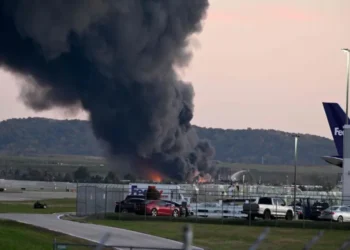 Two Dead in Adelaide Airport Plane Crash Fire
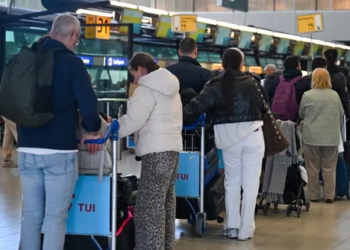 Border Chaos: UK Travellers Face Massive EU Delays
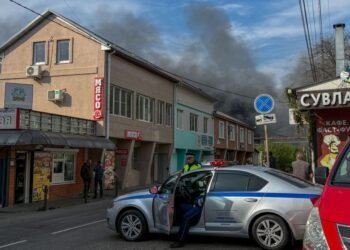 Ukraine strikes Tuapse as oil disaster worsens
 Global order shifts amid Trump-era turmoil
 Giuliani hospitalised in critical condition
 “A Summer of Consolidation”: Government Triggers Emergency Flight Rules as Jet Fuel Crisis Looms
 “Speechless and Determined”: Two Dead, 22 Injured in Leipzig “Vehicular Rampage”
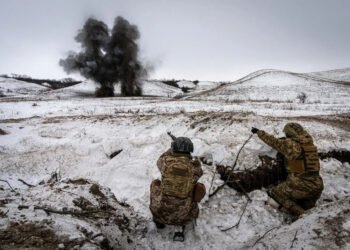 Ceasefire Standoff Deepens in Ukraine War
 US Court Restores Abortion Pill Access Temporarily