Published: 01 October 2026. The English Chronicle Desk. The English Chronicle Online
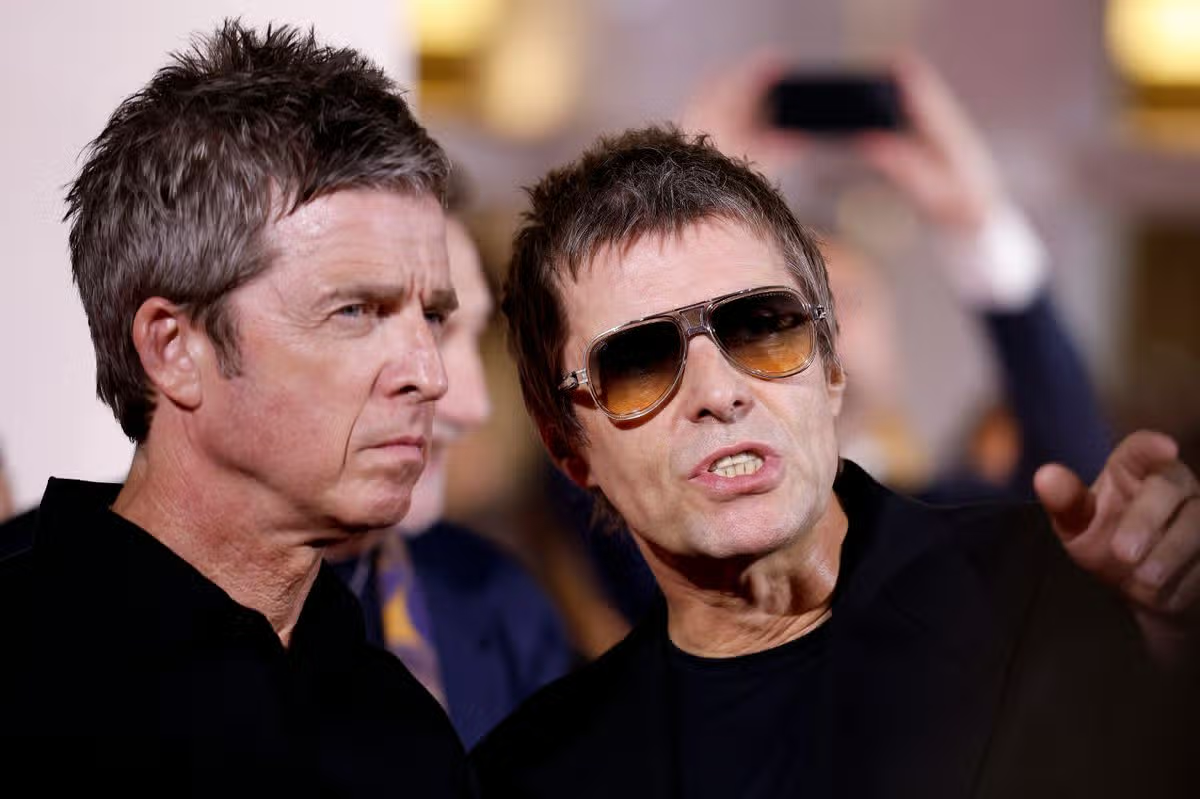
A collection of previously unheard Oasis recordings, including live performances, rehearsal sessions and private conversations involving brothers Noel and Liam Gallagher, has been withdrawn from auction following legal action by the band.
The recordings, which were expected to attract bids of between £1.2 million and £1.6 million, were due to be offered for sale in Worcestershire this week. The decision to halt the auction has placed the archive at the centre of a legal dispute over ownership, intellectual property and the rights surrounding recordings made during one of the most significant periods in Oasis’s history.
The collection was created by Huw Richards, a sound engineer who worked with Oasis from the release of their 1994 debut album, Definitely, Maybe, through to 2001. During those years, the band became one of Britain’s most commercially successful and internationally recognised rock groups.
Richards accumulated a substantial private archive during his time working with the band. The collection reportedly consists of 209 digital audio tapes, 73 analogue cassettes and three MiniDiscs. Together, they contain material recorded across years of concerts, rehearsals and other activities surrounding the group.

Among the most significant material are recordings from 63 live shows. The archive also contains hours of rehearsal audio and informal conversations between Noel and Liam Gallagher, offering a potentially unusual insight into the band’s life away from the stage.
The recordings were being offered for sale by Huw Richards’ son, Owain Richards, who is also a sound engineer. The collection was presented as an important historical archive because of the period it covers and the scarcity of previously unheard Oasis material.
Littleton Auctions had initially scheduled the recordings for its October sale, with a guide price between £1.2 million and £1.6 million. However, the auction house has now confirmed that the material will not be included in the sale because of legal proceedings involving Oasis.
Ben Homer, managing director of Littleton Auctions, said the recordings known as The Desk Tapes had been withdrawn following the legal action. He indicated that the auction house was disappointed that the archive could no longer be offered as planned but said the decision was connected directly to the ongoing legal process.
Owain Richards has acknowledged that Oasis has taken legal action against him and his father in an attempt to prevent the sale of the recordings.
The family has agreed to postpone the auction while the dispute is addressed, either through court proceedings or another legal resolution. The postponement means that the future of the tapes will depend on the outcome of the dispute and any agreement reached between the parties.
At the heart of the dispute is the distinction between ownership of physical recording media and intellectual property rights over the material contained on those recordings. Although the tapes were created and retained by the sound engineer, Oasis maintains intellectual property rights connected with its music and recordings.
That distinction could have significant implications for any potential buyer. Even if the physical tapes were sold, the buyer would not necessarily have unrestricted authority to reproduce, distribute or commercially release the recordings.
Owain Richards previously described the archive as a significant piece of music history. He also indicated that the recordings remained in sufficiently good condition to be of interest to collectors and historians.
The existence of recordings covering such an extensive period of Oasis’s career has generated particular interest because the band’s early and mid-career years included some of its most important musical and cultural moments.
Oasis emerged from Manchester in the early 1990s and quickly became one of the defining British bands of the decade. Their rise coincided with the wider Britpop movement, while the Gallagher brothers became central figures in the group’s public identity.
The relationship between Noel and Liam has also been an enduring part of the band’s story. Their creative partnership produced some of Oasis’s best-known songs, but disagreements between the brothers eventually contributed to the band’s breakup in 2009.
Private recordings from the period could therefore hold considerable historical value, particularly if they document conversations or rehearsals that have never previously been heard publicly.
The legal dispute has also emerged at a significant moment for Oasis. Noel and Liam Gallagher have recently returned to the public spotlight following the band’s reunion and subsequent touring activity.
The group reunited for a major tour in 2025, bringing the Gallagher brothers back together on stage after years apart. The reunion generated substantial interest among long-standing fans and introduced the band’s music to another generation of audiences.
Oasis has since announced further live performances as part of its Live ’27 world tour, including a planned return to Knebworth. The announcement has reinforced the band’s continuing commercial and cultural significance more than three decades after its formation.
The brothers have also appeared together at events connected with a new documentary about the band. Their participation in the film’s premiere at the Venice Film Festival and its subsequent UK premiere has kept attention focused on the history and legacy of Oasis.
Against that backdrop, the existence of an extensive collection of unreleased recordings has naturally attracted interest from collectors and fans. The estimated value of up to £1.6 million reflects not only the physical archive but also the rarity and potential historical significance of the material.
However, the legal dispute demonstrates the complexities involved in trading archival recordings made during a band’s professional career. Physical possession of a tape does not necessarily establish unrestricted rights to publish or commercially exploit its contents.
For collectors, that uncertainty is particularly important. A prospective buyer would need to understand what rights accompany the physical recordings and what permissions would be required before any material could legally be released.
Littleton Auctions has confirmed that the remainder of its scheduled sale will continue. Other music memorabilia is expected to be offered, including an original Oasis tour parka associated with Richards’ collection.
Items connected with other major musicians are also due to feature in the auction, including signed photographs of Nirvana, autographs associated with members of the Rolling Stones and a guitar signed by Queen guitarist Brian May.
The auction house has said that the legal dispute surrounding the Oasis recordings does not affect the remainder of the sale. It has also indicated that it will not comment further while the legal proceedings are ongoing.
The next stage of the dispute will determine whether the recordings eventually return to the market, remain with the Richards family or are dealt with through another arrangement involving Oasis.
For fans, the tapes represent the possibility of hearing previously unknown moments from one of Britain’s most influential rock bands. For the people involved in the legal dispute, however, the immediate issue is ownership and control over recordings that were created more than two decades ago.

The case also highlights a broader challenge facing the music industry as valuable historical archives increasingly attract attention from collectors. Recordings that were once considered working materials can become highly valuable cultural artefacts decades later, particularly when they document artists during important stages of their careers.
For now, The Desk Tapes remain unavailable to potential buyers. Their contents, although reportedly preserved in good condition, will remain outside the public domain while the legal dispute between Oasis and the Richards family is resolved.
Whether fans will eventually hear the recordings may depend not only on the outcome of the legal proceedings but also on any future agreement over the band’s intellectual property rights. Until then, one of the most intriguing private archives connected with Oasis remains behind closed doors.
Related News:
 Taylor Swift and Madonna Lead 2026 MTV VMAs
 Taylor Swift and Travis Kelce Marry at Madison Square Garden
 Is This the End of Harry and Meghan’s US Dream?
 Susan Sarandon Says Palestine Stand Costs Roles
 Prunella Scales: From Fawlty Towers Icon to Beloved Canal Explorer
 Charlie Kaufman: They told me Being John Malkovich would never get made
 The Line of Beauty, Almeida review: A wild, witty ride through Thatcher-era high society
 Kate Winslet to Narrate Film Highlighting King’s Environmental Mission
 Hollywood Is an Industry of Looney Tunes Pretending to Be Normal
 Prince of Wales showcases volleyball skills on Brazil visit
 Top Christmas Books Reads: Classics to Cozy Romcoms
 Meghan ‘to return to acting’ after eight-year hiatus
 Oprah enjoys Meghan’s jam on English muffins
 Pauline Collins, Beloved ‘Shirley Valentine’ Star, Dies at 85
 VAR Must Rein Its Neck In to Save Football’s Spirit
 From Lego to Pokémon: How Adults Are Driving UK Toy Market Growth
 David Szalay’s ‘Flesh’ Wins 2025 Booker Prize
 Boos, backlash and body horror: The story of Alpha
 Pop Stars Call on UK Government to Cap Resale Prices for Fans
 ‘I’ve Read 38 Books, but This Is My Standout Favourite’
 Pat Butcher Returns to EastEnders in Touching Dementia Storyline

 Yungblud Pauses Tour Over Health Concerns, Apologises to Fans
 SS Rajamouli Announces ‘Varanasi,’ a Mythic Time-Travel Epic
 Tom Cruise Receives Honorary Oscar, Celebrates Cinema
 Eminem Takes Legal Aim at Australian ‘Swim Shady’ Brand
 The Lasting Legacy of Seven: Crime, Morality, and Urban Decay
 Australia to Ban Social Media for Kids Under-16 Starting December
 Director Michael Caton-Jones Reflects on Career and Beginnings
 TikTok Star Jessie Yendle Mocked by KFC
 Sony, Warner, Universal Sign AI Music Deals With Klay
 Reggae Legend Jimmy Cliff Dies at 81
 Rosalía Inspires Young Listeners to Discover Classical Music
 Belfast’s Elle Vosque finishes runner-up on Drag Race UK
 Rusty Bond-Era Aston Martin Restored to £1m Glory
 Pavarotti statue frozen in Italian ice rink sparks backlash
 Amanda Seyfried, Faith and Fear in a Radical Musical Leap
 ‘A long time coming’: US table tennis finds its moment
 Victoria Beckham Breaks Silence as Spice Girls Close Ranks
 John Lithgow criticises Rowling stance in trans debate
 Draco Malfoy Emerges as Lunar New Year Icon in China
 Top 10 Must-See Films Arriving This February
 Robert Duvall dies aged 95, Hollywood mourns
 Toxic e-waste found in dolphins raises urgent health concerns
 ‘People feel like they’re in on the joke’: the new wave of pseudo-biopics
 The Hidden Dark Side of Early Reality TV Fame
 Jack Nicholson and the Legacy of the Cuckoo’s Nest
 Mediterranean Storms: A New Era of Climate Tragedies
 Last Weekend of Summer Brings Sparkle and Stars to Sydney
 Ticketmaster Fees Rise Despite Recent US Junk Fee Crackdown
 Scott Mills Sacked by BBC Over Personal Conduct Claims
 Army Probes Apache Flyover at Kid Rock’s Nashville Estate
 US Senators Slam Ticketmaster Over Sneaky New Fee Hikes
 Keir Starmer Expresses Concern Over Kanye West Wireless Festival Dates
 X Factor Star Chico Slimani Convicted of Drink-Driving
 Beckham Joins King’s Chelsea Flower Show Team
 Harry and Meghan’s Australia Visit Sparks Debate
 Rebel Wilson Accused of Orchestrating Smear Campaign
 Michael Moonwalks to Record-Shattering $217m Opening
 Rebel Wilson Denies Role in Smear Campaign Trial
 Disneyland Adds Facial Recognition at Entrances
 Rebel Wilson Rejects Phone Dump Claim
 Stephen Fry Sues Tech Organisers For £100k Following Stage Fall
 Martin Short’s Brave Reflection on Family Tragedy
 Dua Lipa Sues Samsung for $15m Over TV Box Image Use
 Canada Set to Spark New Era for Eurovision Contest
 Spotify and UMG Ink Groundbreaking AI Remix Deal
 Whistler’s Mother and why its fame frustrated artist
 Cannes filmmakers split over AI’s role in cinema
 Mandalorian Movie Hits Record Disney Era Low at Box Office
 The Obamalisk: Inside the Controversial $850m Presidential Center
 Saving the Scalloped Hammerhead: The Pacific Battle
 BBC Faces Backlash Over Ashley Cain Vetting Failures
 BBC Faces Backlash Over Ashley Cain Vetting Failures
 The ‘Special Relationship’ at 250: Irrelevance or Influence?
 Dua Lipa Backs Albania’s Fight Against Kushner Resort
 Can Anyone Replace Graham Norton? Chat Show Challenge
 Indian Jewellery Ad Pulled After Backlash Over Outfit
 Selena Gomez rejects ‘frivolous’ fraud allegations
 Pelicot Trial Play Comes to London for One Night