Published: 25 September 2025. The English Chronicle Desk
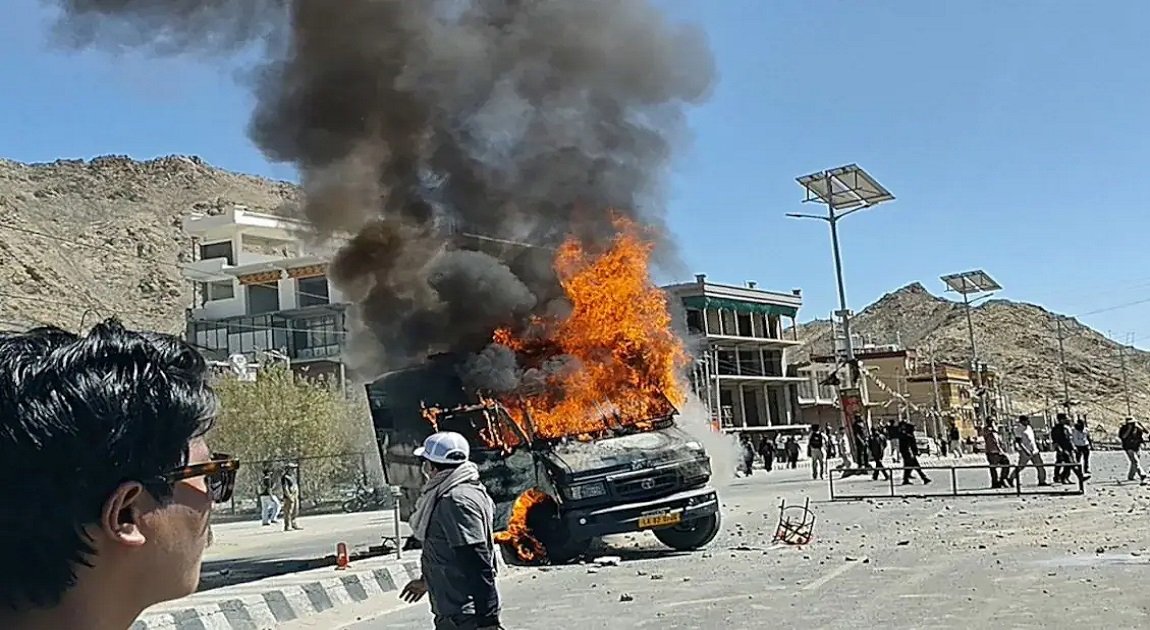
Authorities in India have imposed a curfew in Leh, the capital of the Himalayan region of Ladakh, following violent clashes between security forces and protesters demanding statehood for the federal territory. The unrest, which erupted on Wednesday, resulted in at least four deaths and left dozens injured. In addition to casualties, the local office of India’s ruling Bharatiya Janata Party (BJP) was set ablaze, escalating tensions in a region already sensitive to political and cultural disputes.
The government has attributed the violence to activist Sonam Wangchuk, who has been at the forefront of the statehood movement, accusing him of inciting unrest. Wangchuk, however, denied these allegations and called for calm, emphasizing that the ongoing protests are meant to be peaceful. He had recently undertaken a hunger strike, which he called off following the outbreak of violence, appealing to young people in the region to avoid actions that could harm the movement’s objectives.
Ladakh, a mountainous desert region with a population of around 300,000, is home to a diverse population of Muslim and Buddhist communities. The territory lost its semi-autonomous status in 2019 when the federal government, led by the BJP, reorganized it as a separate Union Territory, removing it from the erstwhile Indian-administered state of Jammu and Kashmir. While the Buddhist-majority Leh region has long advocated for greater autonomy, the Muslim-majority Kargil district had historically sought integration with Jammu and Kashmir. Since 2019, both communities have united in their demand for full statehood and enhanced local control over jobs, land, and governance.

The precise trigger for Wednesday’s violence remains unclear. Protests have been ongoing intermittently across the region for several months, with the movement for statehood gaining momentum. Security forces reported that demonstrators attacked the BJP’s local office, setting fire to the building and torching a police vehicle. Police responded with bullets and tear gas, resulting in injuries to dozens of protesters, four of whom later died. Authorities confirmed that at least thirty police personnel were also injured in the clashes.
The federal home ministry described the unrest as being instigated by provocative statements from Wangchuk, drawing comparisons to the Arab Spring and youth-led movements in neighboring Nepal. Officials framed the violence as part of a broader attempt to disrupt peace in the territory, stating that protesters had acted in ways that necessitated defensive police action.
Activists and local leaders, however, argue that frustration among Ladakh’s youth, many of whom face unemployment and limited economic opportunities, fueled the unrest. Padma Stanzin, one of the organisers of the hunger strike, told international media that protesters did not anticipate the situation escalating to fatal violence, asserting that the movement has historically remained peaceful. Chhering Dorje Lakrook, head of the influential Ladakh Buddhist Association, echoed these sentiments, emphasizing that the youth are deeply frustrated by repeated delays in dialogue with the federal government.
India maintains a significant military presence in Ladakh, which borders both China and Pakistan. The region has been a flashpoint in recent years, notably in 2020 when clashes in the Galwan Valley led to the deaths of at least 20 Indian and four Chinese soldiers. The strategic and contested nature of Ladakh has amplified concerns about internal unrest and the impact of any escalation on national security.
Sonam Wangchuk, a well-known engineer and activist recognized for his contributions to education and climate change, has led the campaign for restoring statehood, arguing that promises of greater local political power made in 2019 have not been fulfilled. Many residents fear that losing Ladakh’s previous special status has exposed the region to external economic influence and diminished local control over cultural and natural resources.
The federal government, however, maintains that it has engaged in extensive dialogue with local leaders since 2023 and that these talks have produced “phenomenal results.” Officials contended that while some progress has been made, certain politically motivated individuals were dissatisfied with the pace of reforms. Ladakh’s federally appointed Lieutenant Governor, Kavinder Gupta, announced that a formal investigation into Wednesday’s violence has been initiated, characterizing the events as attempts to incite unrest and likening them to protests in neighboring countries, which he suggested could indicate a broader conspiracy.
Authorities have scheduled further rounds of discussions between regional leaders and federal officials for Thursday and Friday, with a committee set to convene on 6 October to continue dialogue aimed at resolving the statehood issue. Meanwhile, security measures remain in place to prevent further escalation, including the curfew in Leh, which authorities hope will restore order while negotiations continue.

As Ladakh navigates these tensions, the unfolding events underscore the complex intersection of regional identity, political autonomy, and national security in a region long marked by strategic importance and cultural diversity. The outcome of these talks and the government’s response to the protests will likely shape the future of governance, youth engagement, and community relations in the Himalayan territory.
Related News:
 Two Decades Since 7/7: King Charles III Leads Nation in Honouring Victims of London’s Deadliest Terror Attack
 Fog Aids Russian Forces in Deep Push into Pokrovsk
 Meny Godard Identified as Israeli Hostage Body Returned by Hamas
 Bataclan Anniversary: France Remembers but Jihadist Danger Lingers
 Israel Confirms Returned Hostage as Meny Godard
 Video shows Israeli troops kill Palestinians after surrender
 Man Arrested Over Manchester Synagogue Terror Attack
 Kidnap Gangs, Jihadists and Separatists Plague Nigeria
 Kinnock’s Rebuke Echoes Loudly as Corbyn Allies Launch Left-Wing Breakaway: “A Gift to Farage”
 Post Office Scandal Compensation Tops £1 Billion as Victims Finally See Justice
 UK and Norway Forge Stronger Ties Through Joint Sanctions and Enhanced Defence Cooperation
 Exclusive: Leaked Documents Reveal Khan’s Controversial Road Policy Overhaul – Drivers Warn of ‘Final Nail in Coffin’
 UK Banks Granted Reprieve as BoE Delays Basel III Capital Rules Until 2028
 Trump Administration Dismisses 17 Immigration Judges, Sparking Debate Over Judicial Independence
 England Grapples with Unprecedented Bluetongue Virus Outbreak: Entire Nation Declared Infected Zone
 Justice Deferred, Not Denied: Government Orders Full Statutory Inquiry into Orgreave Clash Four Decades On
 Northern Ireland Family of Three Shot Dead in Maguiresbridge Home Incident
 West End Exposed as London’s Knife Crime Epicentre Amid Alarming Surge in Violence
 Singapore Corruption Scandal: Details Emerge on Iswaran’s Luxury Flight and Ties to Tycoon Ong Beng Seng
 Mystery Wallaby Spotted on Norfolk-Suffolk Border Sparks Police Appeal
 Manchester Airport Faces Delays After EasyJet Planes’ Wings ‘Clip’ on Runway
 Peter Andre Breaks 16-Year Silence with Scathing Statement Against Katie Price
 UK Weather: Heat Alerts Extended as Temperatures Set to Reach 30°C This Weekend
 Access to Iconic Cornish Beach Cut Off by National Trust Amid Safety Concerns
 Where Is Prince William and Kate Middleton’s New House? Inside the Historic Lodge Set to Become Their ‘Forever Home’
 Costa Blanca Holiday Horror as Food Poisoning Outbreak Hits Four-Star Hotel
 Hundreds of Swimming Pool Closures Leave Children ‘At Risk of Drowning’, Union Warns
 Xi, Putin and Kim Display Unified Front at Massive Beijing Military Parade
 British Holidaymaker’s Tragic Death in Greece Confirmed as Drowning
 India Triumph in Dubai Amid Unexpected Twists
 Public Executions in Gaza City Captured on Video Amid Ongoing Conflict
 Macron Phones Trump Over Traffic Jam in New York
 Aston Villa Fight Back to End Winless Run with Convincing Victory over Fulham
 Bournemouth Stun Fulham with Dramatic Comeback in Premier League Thriller
 Arsenal Showcase Depth and Flexibility as Arteta Eyes Title Challenge
 UK Affirms No Relaxation of Visa Rules for India Amid Trade Push
 Women Challenge Meta Over Targeted Ads After Miscarriage
 Vice President Vance Warns of ‘Painful’ Job Cuts as U.S. Government Shutdown Deepens
 Japanese Court Sentences Man to Death for 2023 Quadruple Murder in Rare Gun and Knife Attack
 Zelensky to Urge Missile Aid as Trump and Putin Plan Summit
 Gibbs-White Inspires Forest to Thrilling Win Over Porto
 Manchester United triumph as Mbeumo brace seals thrilling win
 Hospice Cuts Raise Alarm Across England Amid Funding Crisis
 Tragedy on Lizard Island: Cruise Passenger Dies
 Fed Cuts US Interest Rates Again Amid Labour Market Uncertainty
 Zarah Sultana Launches Party to Change Politics
 Ex-Army Sergeant Jailed for Assault on Soldier Who Later Died
 Mass Stabbing on Doncaster to London Train Leaves Ten Injured
 US Senate Passes Funding Bill to End Historic Shutdown
 Mary Earps’s Manchester United Return Faces Mixed Reception
 Son Reveals UK Couple in Iran Resort to Hunger Strike for Help
 Pressure Mounts on Starmer to Sack Chief of Staff Over Briefing Row
 US Justice Department Files Lawsuit Against California Over Partisan Voting Maps
 Former Lion Heskey Warns of Shortage of England Strikers
 How Cultures Interpreted the Aurora Through History
 Orban Says Ukraine Has ‘No Chance’ as EU Support Continues
 Mother Watches in Horror as Teen Daughter Dies on Tracks
 Seven Countries, One Winner: Europe’s Best Christmas Market
 Israeli Strike Kills 13 Near Palestinian Camp in Lebanon
 Commuters warned as yellow snow and ice alert hits Northern Ireland
 Haiti Qualifies for World Cup Despite Coach Never Visiting Country
 US Judge Says Meta Did Not Hold Illegal Social Media Monopoly
 Serial Rapist and Former Cop Found Guilty Again
 Man Charged Over Attempted Murder of Senior Officer
 Pentagon Officials in Ukraine to Discuss War End
 Ex-Harvard President Pauses Teaching Over Epstein Emails
 Vietnam Battles Deadly Floods as Rains Continue
 Scottish Families Take Legal Action Over School CO Leak
 Venezuela Threatens Nobel Winner Machado with Fugitive Status
 Vicki Fears Losing Motability Car
 Millions Face Higher Taxes Under Reeves New Budget
 Two National Guard Soldiers Critically Injured Near White House
 Sri Lanka Floods Leave 56 Dead, Dozens Missing
 Scotland Gains 33 New Towns – Life in Growing Communities
 Jordan Bardella: France’s Young Presidential Contender
 Search underway for British man overboard off Tenerife
 Pavarotti statue frozen in Italian ice rink sparks backlash
 EU plans $105bn Ukraine aid using frozen Russian assets
 Global campaign launched to free Palestinian leader Barghouti
 Kenya Signs $2.5bn Health Deal with US Amid Data Concerns